
jarallax
v3.1.0
Published
Smooth parallax scrolling effect for background images, videos and inline elements. Code in pure JavaScript with NO dependencies + jQuery supported. Youtube, Vimeo and Local Videos parallax supported.

Maintainers
 nk-o
nk-oReadme
Jarallax


Parallax scrolling for modern browsers. Supported <img> tags, background images, YouTube, Vimeo and Self-Hosted Videos.
Online Demo
Table of Contents
- WordPress Plugin
- Quick Start
- Import Jarallax
- Prepare HTML
- Run Jarallax
- Background Video Usage Examples
- Options
- Events
- Methods
- For Developers
- Real Usage Examples
- Credits
WordPress Plugin

We made WordPress plugin to easily add backgrounds for content in your blog with all Jarallax features.
Demo: https://wpbackgrounds.com/
Download: https://wordpress.org/plugins/advanced-backgrounds/
Quick Start
There are a set of examples, which you can use as a starting point with Jarallax.
Import Jarallax
Use one of the following examples to import jarallax.
ESM
We ship self-hosted ESM bundles (dist/jarallax.esm.js and dist/jarallax.esm.min.js) for browsers that support ES modules.
<!-- Jarallax CSS -->
<link href="./node_modules/jarallax/dist/jarallax.min.css" rel="stylesheet">

<!-- Jarallax JS -->
<script type="module">
  import { jarallax, jarallaxVideo } from "./node_modules/jarallax/dist/jarallax.esm.js";

  // Optional video extension
  jarallaxVideo();

  jarallax(document.querySelectorAll('.jarallax'));
</script>
ESM CDN
<!-- Jarallax CSS -->
<link href="https://cdn.jsdelivr.net/npm/jarallax@3/dist/jarallax.min.css" rel="stylesheet">

<!-- Jarallax JS -->
<script type="module">
  import { jarallax, jarallaxVideo } from "https://cdn.jsdelivr.net/npm/jarallax@3/+esm";

  // Optional video extension
  jarallaxVideo();
</script>
UMD
Jarallax may be also used in a traditional way by including script in HTML and using library by accessing window.jarallax.
<!-- Jarallax CSS -->
<link href="jarallax.min.css" rel="stylesheet">

<!-- Jarallax JS -->
<script src="jarallax.min.js"></script>

<!-- Jarallax JS: Optional video extension -->
<script src="jarallax-video.min.js"></script>
UMD CDN
<!-- Jarallax CSS -->
<link href="https://cdn.jsdelivr.net/npm/jarallax@3/dist/jarallax.min.css" rel="stylesheet">

<!-- Jarallax JS -->
<script src="https://cdn.jsdelivr.net/npm/jarallax@3/dist/jarallax.min.js"></script>

<!-- Jarallax JS: Optional video extension -->
<script src="https://cdn.jsdelivr.net/npm/jarallax@3/dist/jarallax-video.min.js"></script>
Package Imports (Bundlers / Node)
Install Jarallax as a Node.js module using npm.
npm install jarallaxUse the package root in modern bundlers:
import { jarallax, jarallaxVideo } from "jarallax";
import 'jarallax/dist/jarallax.min.css';

// Optional video extension
jarallaxVideo();

jarallax(document.querySelectorAll('.jarallax'));
The package root is safe to import in SSR and Node toolchains, but Jarallax is still a frontend-only runtime and must only be initialized once a real browser DOM exists.
The CommonJS entry point remains available for older bundlers and browser-targeted build setups:
const { jarallax, jarallaxVideo } = require('jarallax');
require('jarallax/dist/jarallax.min.css');

jarallaxVideo();
jarallax(document.querySelectorAll('.jarallax'));
In SSR frameworks such as React or Next.js, keep the import at module scope if you want, but call jarallax() only in a client-only lifecycle or behind a typeof window !== 'undefined' guard.
TypeScript
Generated declarations are published from dist/types, while typings/index.d.ts remains as a compatibility re-export.
import { jarallax, jarallaxVideo, type JarallaxOptions } from 'jarallax';
import 'jarallax/dist/jarallax.min.css';

const options: JarallaxOptions = {
  speed: 0.2,
  videoSrc: 'https://www.youtube.com/watch?v=ab0TSkLe-E0',
};

jarallaxVideo();
jarallax(document.querySelectorAll<HTMLElement>('.jarallax'), options);
React / Next.js
The jarallax/react subpath keeps imports SSR-safe while delaying all DOM work until useEffect runs on the client.
The built-in React components apply the required base Jarallax styles automatically, so you do not need to import jarallax.css manually when using Jarallax, JarallaxImage, or JarallaxVideo.
Component API:
'use client';

import {
  Jarallax,
  JarallaxImage,
  JarallaxVideo,
} from 'jarallax/react';

export function Hero() {
  return (
    <Jarallax className="hero" options={{ speed: 0.4 }}>
      <JarallaxImage
        src="https://jarallax.nkdev.info/images/image-1.jpg"
        alt=""
      />
      <h1>Jarallax React</h1>
    </Jarallax>
  );
}

export function VideoHero() {
  return (
    <JarallaxVideo
      className="hero"
      options={{ speed: 0.2 }}
      videoSrc="https://youtu.be/mru3Q5m4lkY"
    />
  );
}
Hook API for custom markup:
'use client';

import { useJarallax } from 'jarallax/react';

export function CustomMarkupHero() {
  const ref = useJarallax({
    options: {
      speed: 0.4,
    },
  });

  return (
    <section ref={ref} className="jarallax hero">
      <img
        className="jarallax-img"
        src="https://jarallax.nkdev.info/images/image-2.jpg"
        alt=""
      />
      <h2>Hook-based markup control</h2>
    </section>
  );
}
Video hook API:
'use client';

import { useJarallaxVideo } from 'jarallax/react';

export function CustomVideoHero() {
  const ref = useJarallaxVideo({
    options: {
      speed: 0.2,
    },
    videoSrc: 'https://youtu.be/mru3Q5m4lkY',
  });

  return <section ref={ref} className="jarallax hero" />;
}
useJarallax and useJarallaxVideo are part of the React API when you want full control over the rendered markup.
For Next.js App Router, keep these components in files marked with 'use client';. Server rendering only outputs regular HTML, and the parallax instance is created after hydration on the client.
Prepare HTML
<!-- Background Image Parallax -->
<div class="jarallax">
  <img class="jarallax-img" src="<background_image_url_here>" alt="">
  Your content here...
</div>

<!-- Background Image Parallax with <picture> tag -->
<div class="jarallax">
  <picture class="jarallax-img">
    <source media="..." srcset="<alternative_background_image_url_here>">
    <img src="<background_image_url_here>" alt="">
  </picture>
  Your content here...
</div>

<!-- Alternate: Background Image Parallax -->
<div class="jarallax" style="background-image: url('<background_image_url_here>');">
  Your content here...
</div>
Run Jarallax
Note: automatic data-attribute initialization and jQuery integration are available in UMD mode only.
A. JavaScript way
jarallax(document.querySelectorAll('.jarallax'), {
  speed: 0.2,
});
B. Data attribute way
<div data-jarallax data-speed="0.2" class="jarallax">
  <img class="jarallax-img" src="<background_image_url_here>" alt="">
  Your content here...
</div>
Note: You can use all available options as data attributes. For example: data-speed, data-img-src, data-img-size, etc...
C. jQuery way
$('.jarallax').jarallax({
  speed: 0.2,
});
No conflict (only if you use jQuery)
Sometimes to prevent existing namespace collisions you may call .noConflict on the script to revert the value of.
const jarallaxPlugin = $.fn.jarallax.noConflict() // return $.fn.jarallax to previously assigned value
$.fn.newJarallax = jarallaxPlugin // give $().newJarallax the Jarallax functionality
Background Video Usage Examples
A. JavaScript way
import { jarallax, jarallaxVideo } from 'jarallax';
jarallaxVideo();

jarallax(document.querySelectorAll('.jarallax'), {
  speed: 0.2,
  videoSrc: 'https://www.youtube.com/watch?v=ab0TSkLe-E0'
});
<div class="jarallax"></div>B. Data attribute way
<!-- Background YouTube Parallax -->
<div class="jarallax" data-jarallax data-video-src="https://www.youtube.com/watch?v=ab0TSkLe-E0">
  Your content here...
</div>

<!-- Background Vimeo Parallax -->
<div class="jarallax" data-jarallax data-video-src="https://vimeo.com/110138539">
  Your content here...
</div>

<!-- Background Self-Hosted Video Parallax -->
<div class="jarallax" data-jarallax data-video-src="mp4:./video/local-video.mp4,webm:./video/local-video.webm,ogv:./video/local-video.ogv">
  Your content here...
</div>
Note: self-hosted videos require 1 video type only, not necessarily using all mp4, webm, and ogv. This is only needed for maximum compatibility with all browsers.
Options
Options can be passed in data attributes or in object when you initialize jarallax from script.
Name | Type | Default | Description
:--- | :--- | :------ | :----------
type | string | scroll | scroll, scale, opacity, scroll-opacity, scale-opacity.
speed | float | 0.5 | Parallax effect speed. Provide numbers from -1.0 to 2.0.
containerClass | string | jarallax-container | Container block class attribute.
imgSrc | path | null | Image url. By default used image from background.
imgElement | dom / selector | .jarallax-img | Image tag that will be used as background.
imgSize | string | cover | Image size. If you use <img> tag for background, you should add object-fit values, else use background-size values.
imgPosition | string | 50% 50% | Image position. If you use <img> tag for background, you should add object-position values, else use background-position values.
imgRepeat | string | no-repeat | Image repeat. Supported only background-position values.
keepImg | boolean | false | Keep <img> tag in it's default place after Jarallax inited.
elementInViewport | dom | null | Use custom DOM / jQuery element to check if parallax block in viewport. More info here - Issue 13.
zIndex | number | -100 | z-index of parallax container.
disableParallax | boolean / RegExp / function | - | Disable parallax on specific user agents (using regular expression) or with function return value. The image will be set on the background.
Disable on mobile devices
You can disable parallax effect and/or video background on mobile devices using option disableParallax and/or disableVideo.
Example:
jarallax(document.querySelectorAll('.jarallax'), {
  disableParallax: /iPad|iPhone|iPod|Android/,
  disableVideo: /iPad|iPhone|iPod|Android/
});
Or using function. Example:
jarallax(document.querySelectorAll('.jarallax'), {
  disableParallax: function () {
    return /iPad|iPhone|iPod|Android/.test(navigator.userAgent);
  },
  disableVideo: function () {
    return /iPad|iPhone|iPod|Android/.test(navigator.userAgent);
  }
});
Reduced motion
Nothing to configure. When the reader's system asks for reduced motion, Jarallax stops on its own: the image is still covered and positioned, it just does not move with the scroll, and background video never plays. The block always keeps something to look at:
| Background | Reduced motion shows | | :--- | :--- | | Image | The image, positioned as usual, not moving | | YouTube / Vimeo | The provider thumbnail; the player iframe is never requested | | Self-hosted, with a fallback image | That image; the video is never requested | | Self-hosted, no fallback image | The video's own first frame, inserted paused |
The parallax side matches what disableParallax: true already does, so the layout is the one that path has always produced. disableVideo keeps meaning only what you asked for — reduced motion is decided separately, because what replaces the video depends on the provider.
A fallback image (imgSrc, a .jarallax-img element, or a CSS background-image) is still worth adding for a self-hosted video: it gives you control over the frame and it loads faster than the video does.
Read from (prefers-reduced-motion: reduce) when the instance is created; changing the system setting applies on the next page load.
Additional options for video extension
Requires the video extension bundle. In package-based apps call jarallaxVideo() after importing from jarallax. In script-tag usage load dist/jarallax-video(.min).js after the core bundle.
Name | Type | Default | Description
:--- | :--- | :------ | :----------
videoClass | string | jarallax-video | Video frame class attribute. Will also contain the type of the video, for example jarallax-video jarallax-video-youtube
videoSrc | string | null | You can use Youtube, Vimeo or Self-Hosted videos. Also you can use data attribute data-jarallax-video.
videoStartTime | float | 0 | Start time in seconds when video will be started (this value will be applied also after loop).
videoEndTime | float | 0 | End time in seconds when video will be ended.
videoLoop | boolean | true | Loop video to play infinitely.
videoPlayOnlyVisible | boolean | true | Play video only when it is visible on the screen.
videoLazyLoading | boolean | true | Preload videos only when it is visible on the screen.
videoYoutubeHost | string | - | Origin the YouTube embed is loaded from, for example https://www.youtube-nocookie.com. Left empty, video-worker picks its own default.
videoVimeoHost | string | - | Origin the Vimeo embed is loaded from. Left empty, video-worker picks its own default.
disableVideo | boolean / RegExp / function | - | Disable video load on specific user agents (using regular expression) or with function return value. The image will be set on the background.
Events
Events used the same way as Options.
Name | Description :--- | :---------- onScroll | Called when parallax working. Use first argument with calculations. More info see below. onInit | Called after init end. onDestroy | Called after destroy. onCoverImage | Called after cover image.
Additional events for video extension
Requires the video extension bundle. In package-based apps call jarallaxVideo() after importing from jarallax. In script-tag usage load dist/jarallax-video(.min).js after the core bundle.
Name | Description
:--- | :----------
onVideoInsert | Called right after video is inserted in the parallax block. Video can be accessed by this.$video
onVideoWorkerInit | Called after VideoWorker script initialized. Available parameter with videoWorkerObject.
onScroll event
jarallax(document.querySelectorAll('.jarallax'), {
  onScroll: function(calculations) {
    console.log(calculations);
  }
});
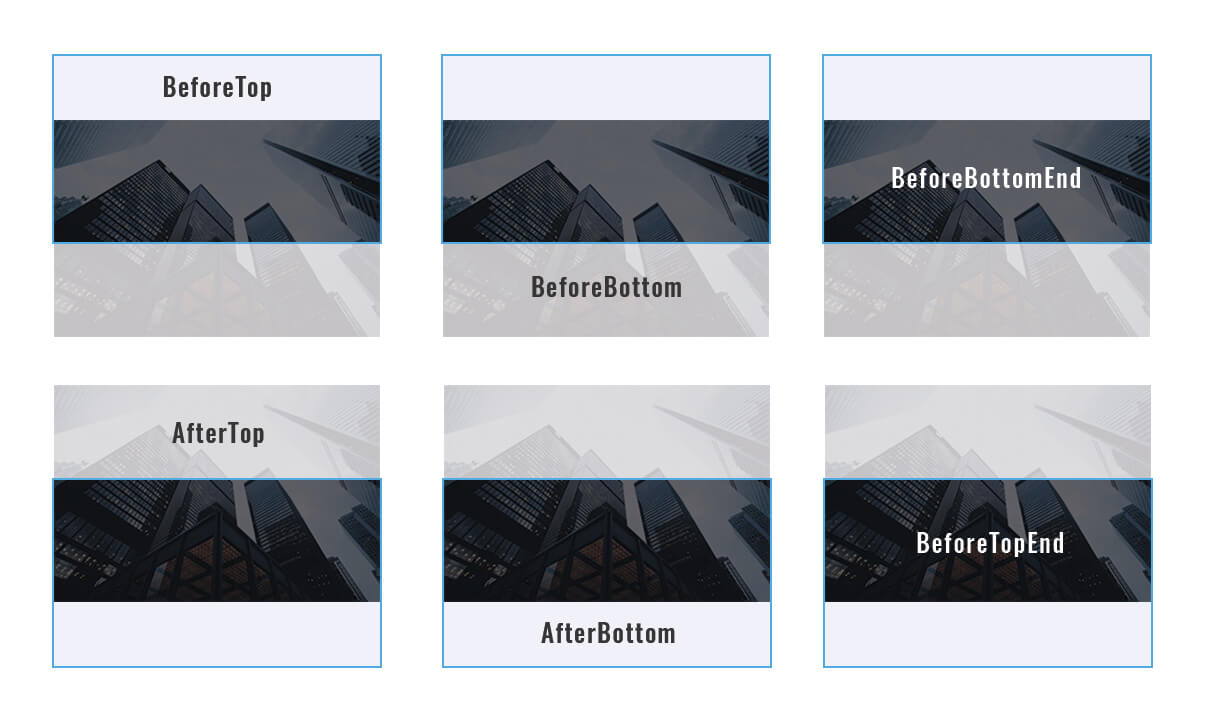
Console Result:
{
  // parallax section client rect (top, left, width, height)
  rect            : object,

  // see image below for more info
  beforeTop       : float,
  beforeTopEnd    : float,
  afterTop        : float,
  beforeBottom    : float,
  beforeBottomEnd : float,
  afterBottom     : float,

  // percent of visible part of section (from 0 to 1)
  visiblePercent  : float,

  // percent of block position relative to center of viewport from -1 to 1
  fromViewportCenter: float
}
Calculations example:
Methods
Name | Result | Description :--- | :----- | :---------- destroy | - | Destroy Jarallax and set block as it was before plugin init. isVisible | boolean | Check if parallax block is in viewport. onResize | - | Fit image and clip parallax container. Called on window resize and load. onScroll | - | Calculate parallax image position. Called on window scroll.
Call methods example
A. JavaScript way
jarallax(document.querySelectorAll('.jarallax'), 'destroy');B. jQuery way
$('.jarallax').jarallax('destroy');For Developers
Installation
- Run
npm installin the repository root
Core workflows
npm run devto run build and start local server with files watchernpm run buildto build all distributable bundles and declarationsnpm run typecheckto type-check source and Vitest coverage
Quality checks
npm run lintto run Biome lint checksnpm run lint:fixto apply Biome lint fixesnpm run format:checkto verify formattingnpm run formatto apply formatting
Test
npm run testfor interactive Vitestnpm run test:runfor a single CI-style test runnpm run test:coveragefor coverage outputnpm run test:artifactsto validate the published package contract
Examples in this repository
- The HTML, JavaScript, jQuery, and ES modules examples under
examples/use CDN assets so they can be opened without a local package build - In
examples/es-modules, runnpm installandnpm run devto serve the example through BrowserSync while keeping CDN imports - In
examples/next, runnpm installandnpm run devto test the published package shape through Next.js - In
examples/next-advanced, runnpm installandnpm run devto test dynamic block updates against the published package shape
Real Usage Examples
Credits
- Images https://unsplash.com/
- Videos https://videos.pexels.com/