
judgeme-react
v1.0.8
Published
React adapters for Judge.me widgets across Shopify headless storefronts.

Maintainers
 pandazaar
Readme
judgeme-react
Bring Judge.me's Shopify widgets to a React or headless storefront, including the styles and settings merchants already manage in Judge.me.
bun add judgeme-react[!WARNING] This is an unofficial, reverse-engineered compatibility library. It is not affiliated with or endorsed by Judge.me. It talks to public Judge.me APIs and CDN endpoints, reads public Shopify storefront data, and loads parts of Judge.me's current Shopify extension runtime. Judge.me can change those internals without warning, so pin the package version and test upgrades against a real store.
[!TIP] These docs are written for coding agents. The recommended setup is to open your storefront repository in Codex, Claude Code, Cursor, or another agent that can inspect and edit the project, then give it the full
SETUP_PROMPT.md. It will ask for the missing store choices first, then handle the provider, loaders, CSP, widget selection, fallbacks, and verification. Manual instructions remain below for reference and review.
Why this exists
Judge.me works well in a Liquid theme because its app embed, app blocks, generated markup, settings payload, CSS, and browser runtime all arrive together. A headless React storefront does not get any of that automatically.
Judge.me's official Hydrogen package is a much smaller, client-side integration. Its current release exposes eight older widgets, documents rendering flicker, and does not reproduce the current Shopify app-block runtime. judgeme-react takes the less tidy route: it reconstructs the pieces a Liquid storefront receives and adapts them to a React lifecycle.
That means this package can:
- reuse dashboard-level Judge.me colors, labels, branding, locale strings, and legacy widget CSS;
- mount current Shopify widget modules for newer surfaces such as Review Widget v3, Reviews Grid, and the new carousels;
- server-load initial review data instead of waiting for a client-only document scan;
- keep widgets isolated, so one broken or disabled Judge.me response does not take down the product page;
- expose typed React configuration for settings that normally live only on a Shopify theme block.
There is a trade-off. This gets much closer to the Shopify theme experience than a small API wrapper, but it is coupled to undocumented behavior. If you want a boring, permanent data contract, use Judge.me's supported APIs and build your own review UI instead.
What carries over from Judge.me
| Configuration source | What happens in headless React |
| --- | --- |
| Judge.me dashboard settings returned by its public storefront payload | Reused automatically where the widget exposes them: colors, labels, branding, locale, rating display, legacy CSS, and feature flags |
| Judge.me review data and generated shop metafields | Loaded by the server adapters and passed to the matching widget |
| Shopify app embed | Must be enabled on a public Online Store theme so the library can discover the store's current Judge.me extension deployment |
| Shopify theme-editor app-block settings | They do not exist in the public Judge.me settings payload. Pass their typed equivalents through each component's config |
| Awesome-plan or content-gated features | The component renders only when Judge.me returns real eligible data, unless the package documents a public compatibility fallback |
Get started with a coding agent
The fastest route is to give an agent the package's full integration brief. It asks you for the store, widgets, loading preference, feature state, and credentials before touching the app, then uses the working Hydrogen implementation as its reference.
- Open
SETUP_PROMPT.md. - Copy the whole prompt into Codex or your coding agent from inside the storefront repository.
- Answer its setup questions in one message.
- Let it implement and verify the integration.
The prompt recommends a server-first product integration, but it can defer below-the-fold widgets when that fits the existing app better.
See it running
The Hydrogen example is the compatibility harness and the best source to copy from. It includes the provider, server loaders, automatic asset discovery, CSP, nullable widget composition, and all implemented storefront components.
The standalone gallery provides the same captures on one page. Every component is also shown below so npm users do not have to leave this README to understand the catalog.
Widgets with no eligible production data stay unmounted. The current live fixture has no published UGC, Q&A, or video-review playback case; those gaps are documented instead of being disguised as live customer content.
Component gallery
Every image is a Brave capture of one component with the surrounding product page removed. Dashboard colors, labels, branding, locale strings, and star treatment are live Judge.me settings. Shopify theme-block choices come from the example's typed React config.
Product review surfaces
Star Rating Badge
Compact product rating for a title, buy box, or product card.

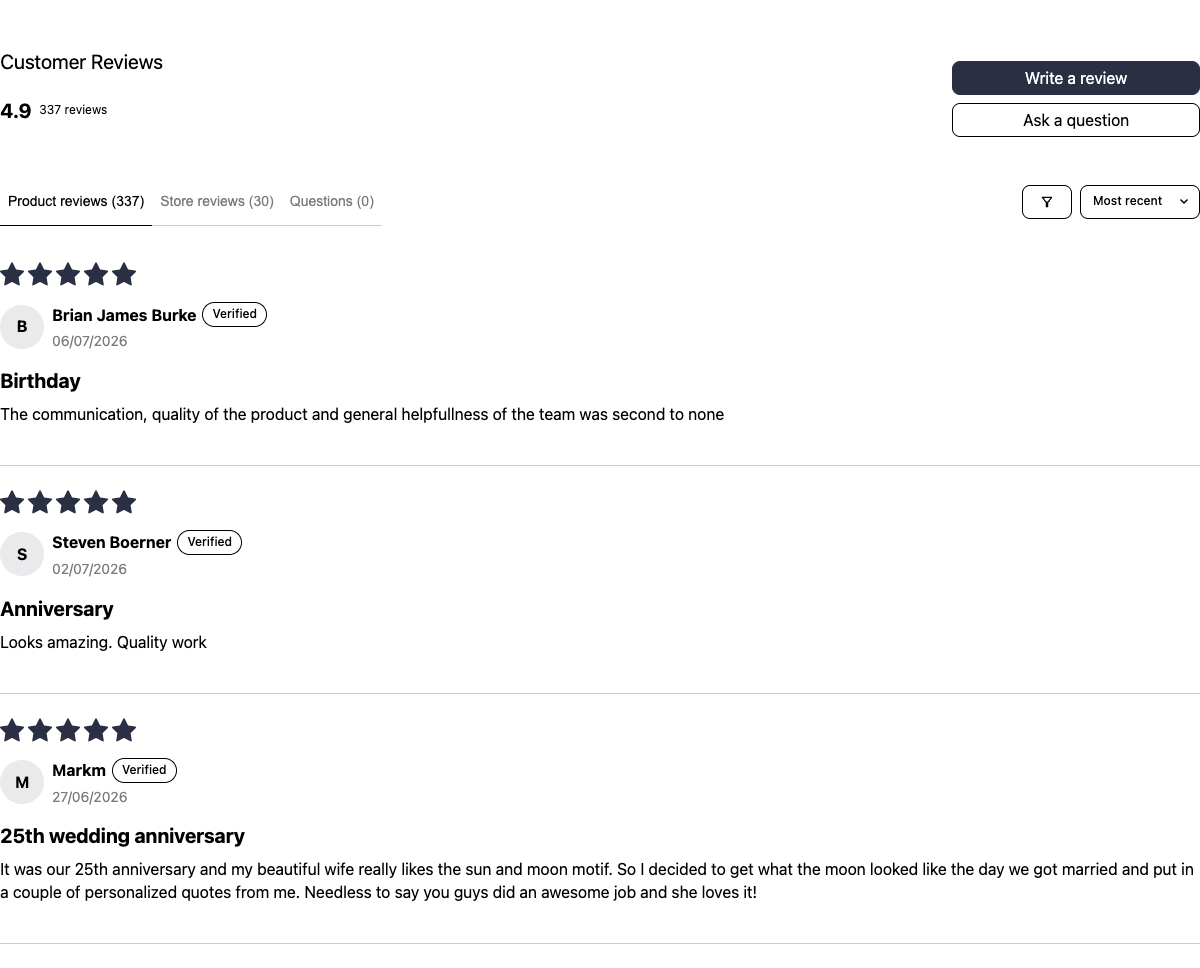
Review Widget v3
Judge.me's current Shopify Review Widget with product/store tabs, filters, review cards, and the Write a review flow.
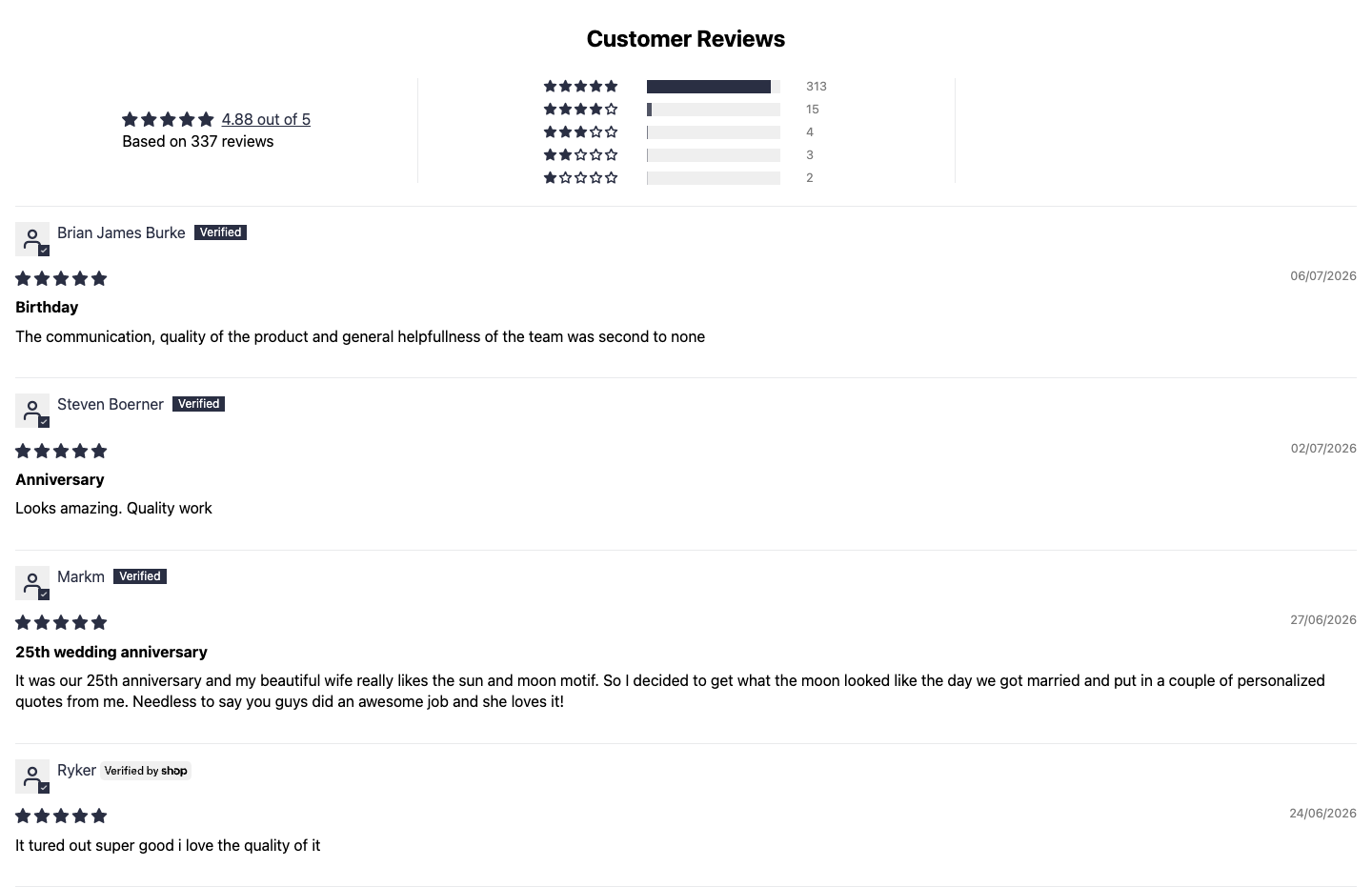
Legacy Review Widget
The public platform-independent Review Widget and fallback for stores that do not return the v3 feed.
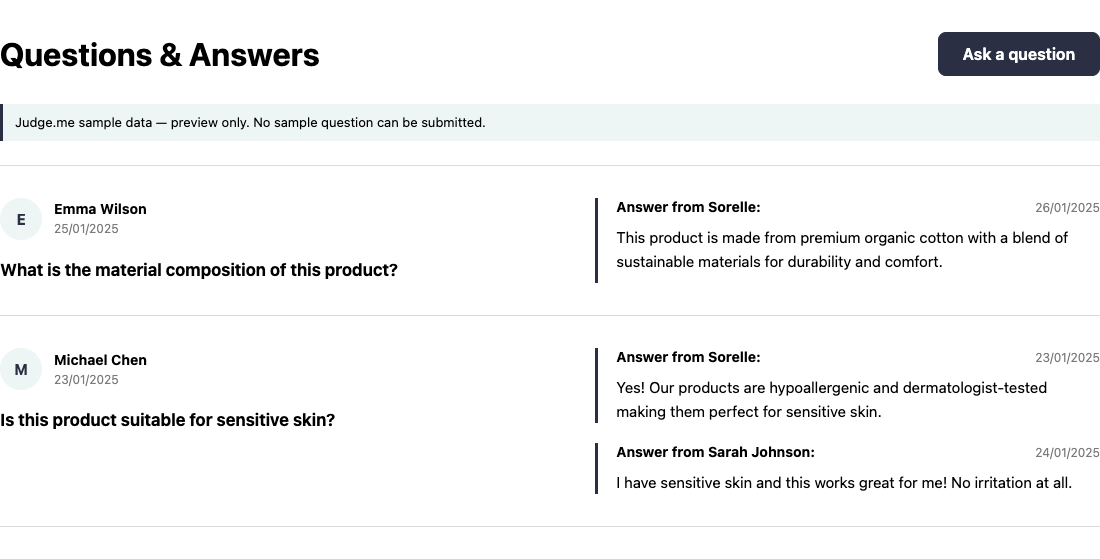
Questions & Answers
An independently placeable React Q&A feed and form. This screenshot uses Judge.me's visibly labeled, read-only sample_data preview because the fixture store has no published questions.
Store-wide reviews and trust
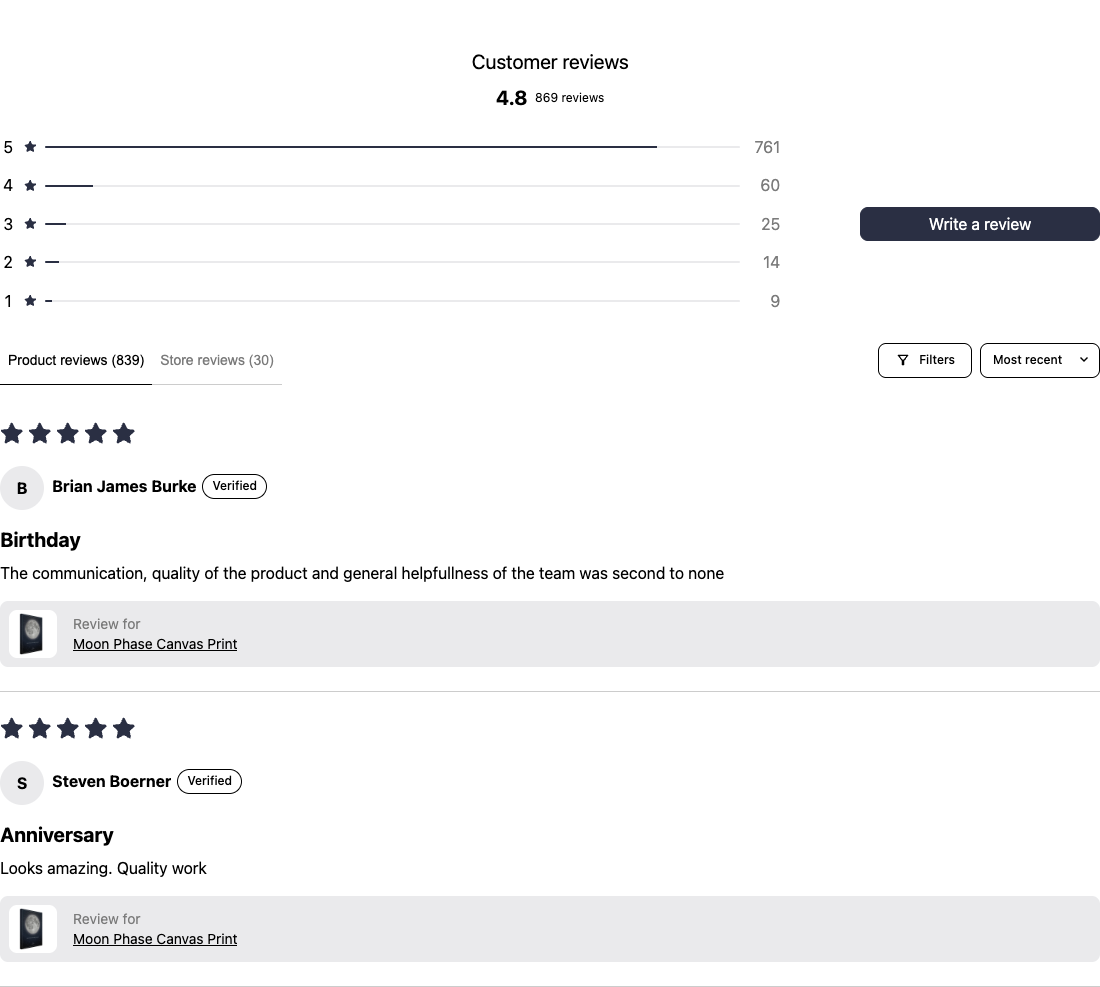
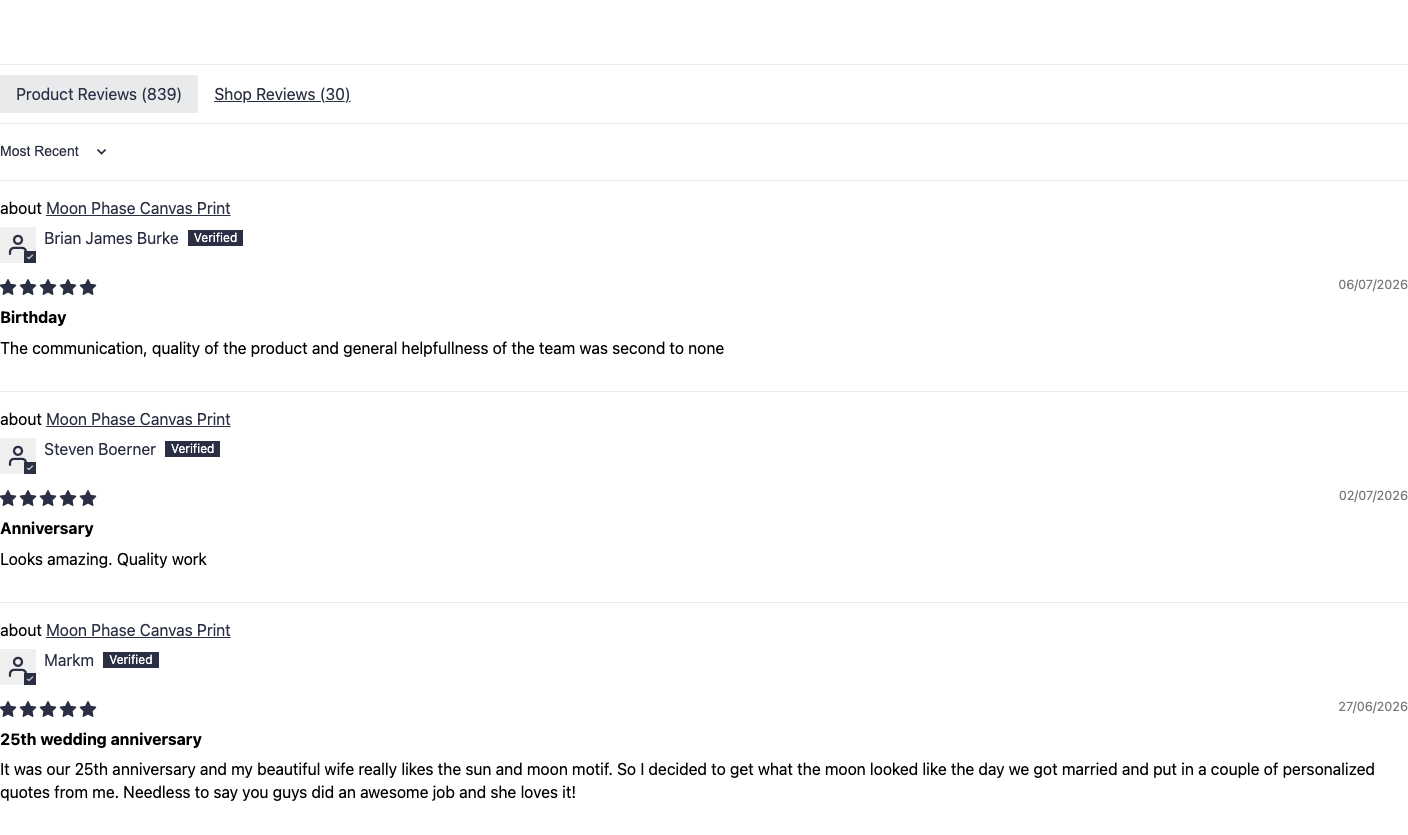
Happy Customers
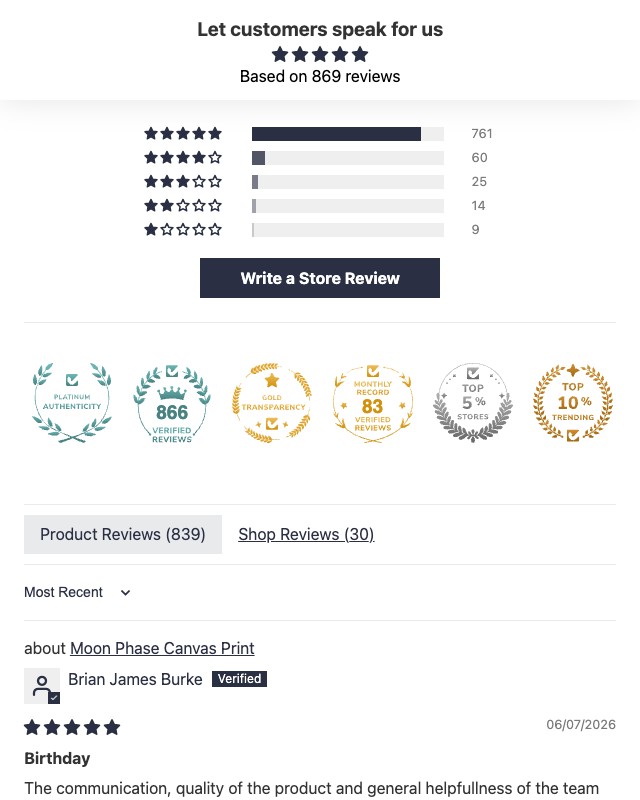
Judge.me's current All Reviews v2025 experience with its histogram, review streams, filters, sorting, and pagination.
All Reviews Widget
The platform-independent All Reviews surface with product/shop streams and React-owned navigation.
All Reviews Counter
Combined store rating and review count using the merchant's branded dashboard treatment.

Verified Reviews Counter
Judge.me's exact branded verified-review badge. Judge.me returns it only after the store reaches its verified-review threshold.

Judge.me Medals
The medals currently earned by the store, together with Judge.me's verified-review summary.

Trust Badge
The compact Trust Badge. Selecting it opens Judge.me's verified-review modal.

AI Reviews Summary
Judge.me's generated shop summary, sourced from its Shopify metafield and rendered by the current extension module.

Carousels and visual proof
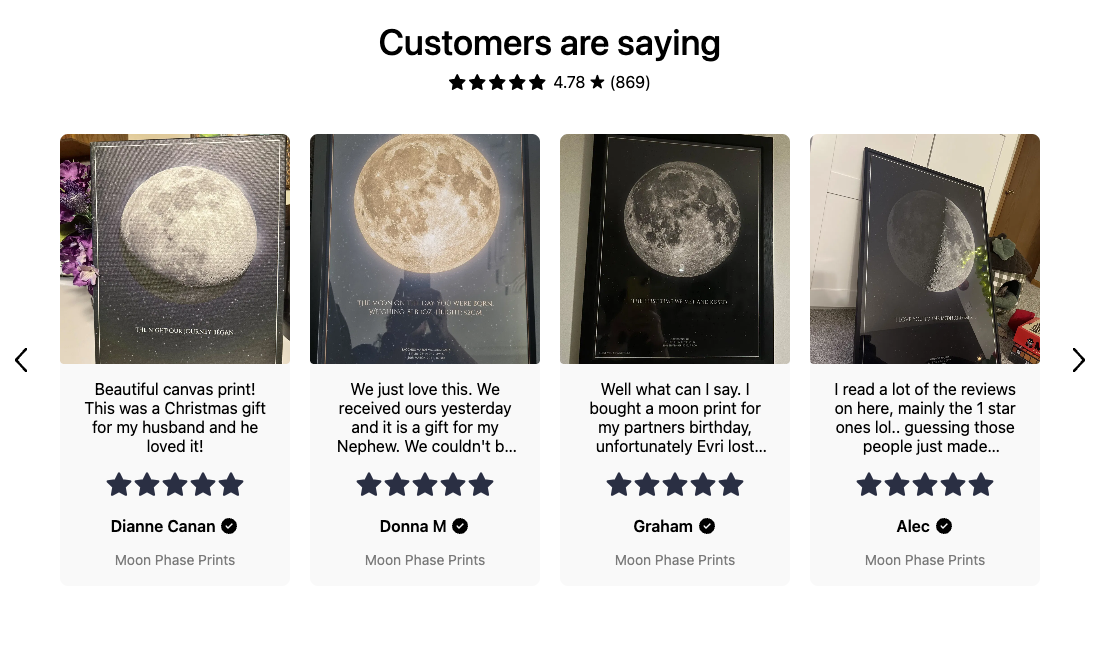
Cards Carousel
The current visual review-card carousel and media lightbox surface.
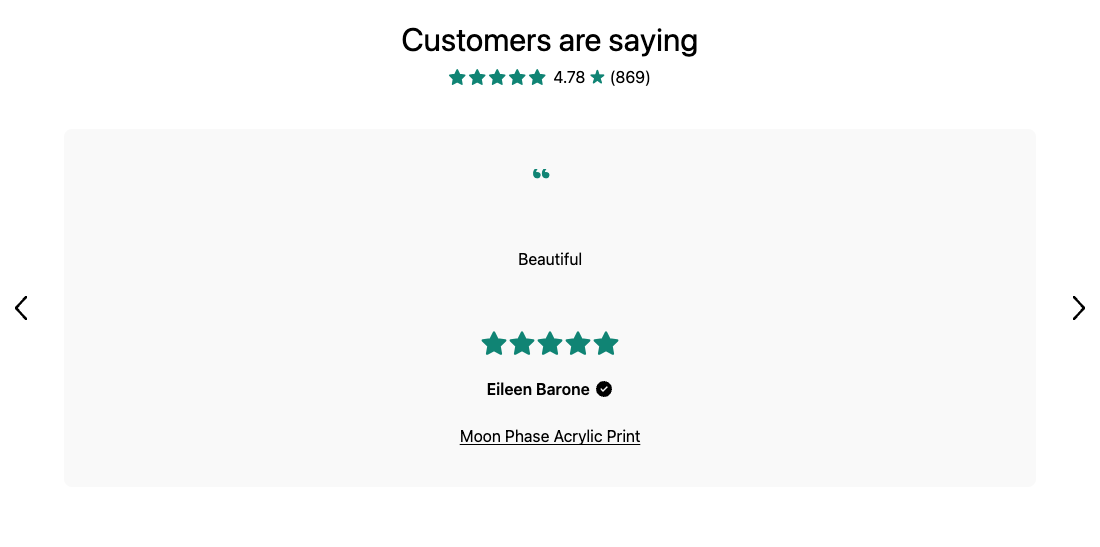
Testimonials Carousel
One-at-a-time quote cards with React-owned arrows and autoplay lifecycle.
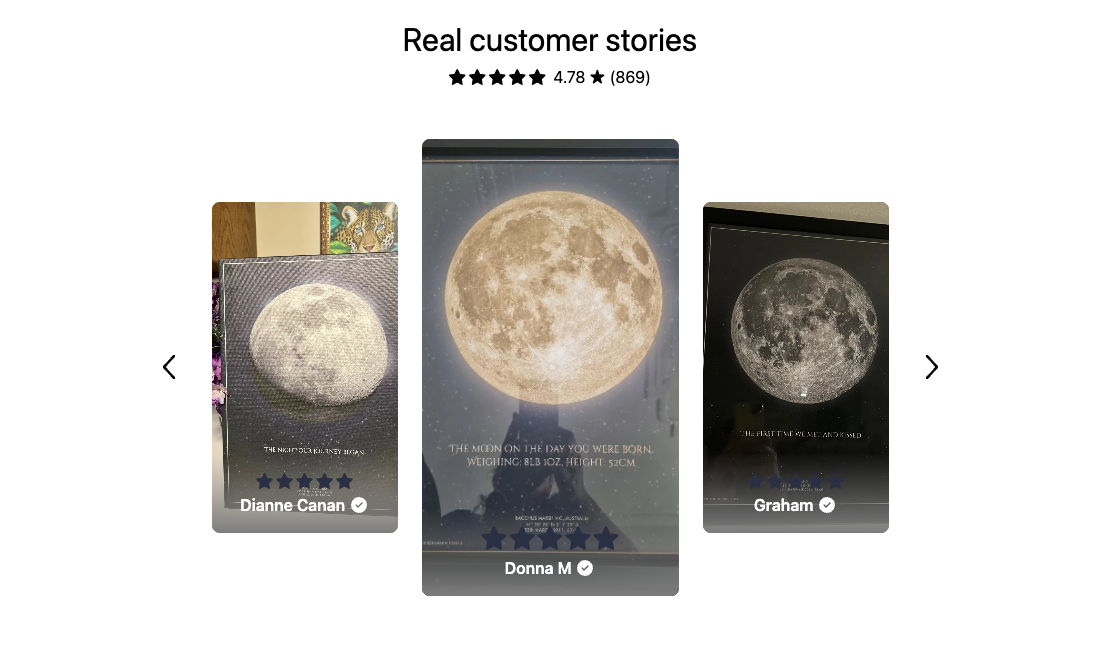
Videos Carousel
The current media carousel in photo/video selection mode. The fixture has photo cards but no published video playback case, so this image demonstrates the media layout rather than iframe playback.
Classic Reviews Carousel
Judge.me's older fixed-height Reviews Carousel for storefronts that use its classic design.

Review Snippets
The compact rotating product or cart review strip. Its loader first tries Judge.me's dedicated tokenless feed and automatically normalizes the public Cards Carousel feed when that route is unavailable. page.requestUrl remains the URL expected by Judge.me's browser module, while page.sourceUrl identifies the public feed that supplied the reviews. Neither path needs a private token.

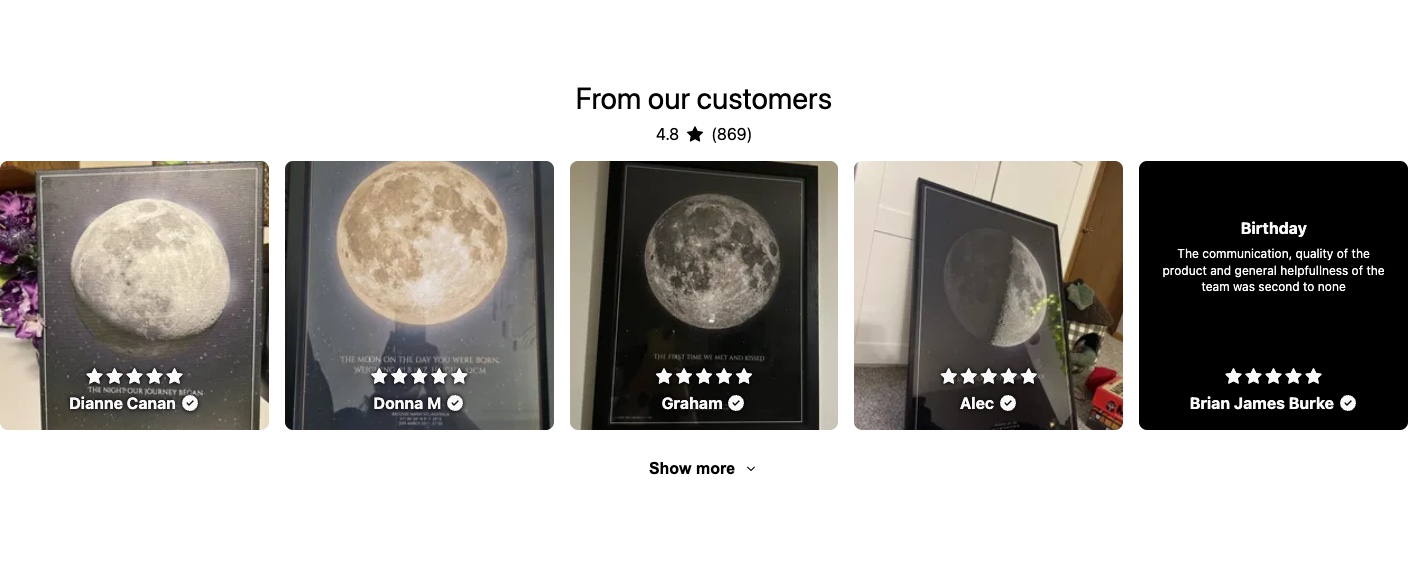
Reviews Grid
Judge.me's current extension-driven review and media grid.
UGC Media Grid
The Instagram shopping grid rendered through Judge.me's current browser runtime. This screenshot uses a clearly documented local post fixture because the live store has no published UGC posts.

Global overlays
Floating Reviews Tab
The open global drawer returned by Judge.me's exact reviews_tab path. Stores without the paid endpoint can use the package's public All Reviews fallback.
Pop-up Reviews
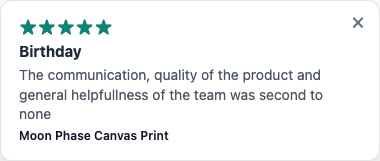
The native React compatibility version of Judge.me's timed review notification.
Manual quick start
1. Get the Judge.me values
In Judge.me Admin, open Settings > Integrations > View API tokens.
| Environment variable | Value | Browser-safe? |
| --- | --- | --- |
| JUDGEME_SHOP_DOMAIN | Permanent store.myshopify.com domain | Yes |
| JUDGEME_PUBLIC_TOKEN | Judge.me Public API Token | Yes, although keeping configuration server-owned is cleaner |
| JUDGEME_STOREFRONT_URL | Public Online Store page with the Judge.me app embed enabled | Yes; used for server-side v3 asset discovery |
| JUDGEME_V3_ASSET_BASE_URL | Optional last-known-good extension asset URL | Yes; normally leave this empty |
Do not use the Judge.me private token. None of the current adapters need it.
Shopify Headless, Storefront API, Customer Account API, and optional Shopify Admin credentials belong to the host app. The Hydrogen example guide shows where to get those values and which ones must remain server-only.
Where v3AssetBaseUrl comes from
v3AssetBaseUrl is not a token or a value exposed in Judge.me Admin. It is the public directory for the store's current Judge.me Shopify theme-extension assets. Its validated shape is:
https://cdn.shopify.com/extensions/<deployment-id>/<extension-handle>/assets/The deployment identifiers can change whenever Judge.me publishes its Shopify extension, so the library must not hardcode one. Resolve it in a server loader from the public Online Store URL where the Judge.me app embed is enabled:
import {resolveJudgeMeV3AssetDeployment} from "judgeme-react/server";

const judgeMeAssets = await resolveJudgeMeV3AssetDeployment({
  shopDomain: context.env.JUDGEME_SHOP_DOMAIN,
  storefrontUrl: context.env.JUDGEME_STOREFRONT_URL,
  fallbackAssetBaseUrl:
    context.env.JUDGEME_V3_ASSET_BASE_URL || undefined,
  signal: request.signal,
});

const v3AssetBaseUrl = judgeMeAssets.assetBaseUrl;
The resolver fetches that public storefront page on the server, extracts its Shopify-extension asset candidates, and accepts only a deployment whose manifest.json contains the Judge.me modules expected by this package. It caches successful discovery and can temporarily reuse a previous success after a refresh error.
Pass judgeMeAssets.assetBaseUrl through loader data to JudgeMeProvider. JUDGEME_V3_ASSET_BASE_URL is only an optional input to the resolver when automatic discovery is unavailable; it is not the normal source of the provider value. If you want a production fallback, copy a previously returned judgeMeAssets.assetBaseUrl into that env variable and refresh it after Judge.me deployment changes. The value is public, but it is version-specific.
2. Fetch widget data on the server
This starter fetches the product badge and legacy Review Widget in one batch:
import {
  fetchLegacyProductWidgets,
  getShopifyNumericId,
} from "judgeme-react/server";

const judgeMe = await fetchLegacyProductWidgets({
  productId: getShopifyNumericId(product.id),
  publicToken: context.env.JUDGEME_PUBLIC_TOKEN,
  shopDomain: context.env.JUDGEME_SHOP_DOMAIN,
  signal: request.signal,
});

return {product, judgeMe};
Every widget result is nullable. Keep that property when composing larger loaders.
3. Mount the provider and components
Mount JudgeMeProvider once near the app root. Components own their required styles; callers do not select or match a stylesheet to a widget.
| Widget implementation | How its styles load | | --- | --- | | Legacy Judge.me markup | The component emits the dashboard CSS carried by its data | | Native React adapter | The component emits its package-owned CSS | | Exact extension widget | The runtime resolves that widget's recursive CSS graph from the current deployment manifest, then ensures the shared dashboard/font CSS exists before mounting |
For exact widgets, loader-supplied shared CSS is installed immediately when available. If it was omitted, the browser makes one public Judge.me storefront-cache request per shop and installs the returned CSS with the current document CSP nonce. No private token is used. You do not need to mount JudgeMeWidgetStyles or set includeStyles.
import {
  JudgeMeProvider,
  LegacyReviewWidget,
  StarRatingBadge,
} from "judgeme-react/react";

<JudgeMeProvider
  config={{
    shopDomain: judgeMeShopDomain,
    publicToken: judgeMePublicToken,
    v3AssetBaseUrl, // judgeMeAssets.assetBaseUrl from the server loader
  }}
>
  {judgeMe.starRatingBadge ? (
    <StarRatingBadge
      data={{...judgeMe.starRatingBadge, ...judgeMe.resources}}
    />
  ) : null}

  {judgeMe.reviewWidget ? (
    <LegacyReviewWidget
      data={{...judgeMe.reviewWidget, ...judgeMe.resources}}
    />
  ) : null}
</JudgeMeProvider>
When composing exact widget data from a shared batch, passing resources.styles to its create*Data helper avoids that fallback browser request. It is an optional request optimization, not correctness wiring: forgetting it is safe because the exact runtime retrieves the public CSS before mounting. JudgeMeWidgetStyles and includeStyles remain accepted only for compatibility with earlier releases; includeStyles no longer disables required CSS.
Use the split entry points to keep the security boundary obvious:
| Import | Use it for |
| --- | --- |
| judgeme-react/server | Fetchers, normalizers, data combiners, Shopify ID helpers, and v3 asset discovery |
| judgeme-react/react | Provider, components, props, and client runtime events |
| judgeme-react | Compatibility entry that exports both sides; avoid it in strict server/client module systems |
4. Copy the CSP allowlist
The host application owns Content Security Policy. Exact widgets need Judge.me APIs and media plus the store's current cdn.shopify.com extension assets. Video, Instagram, reviewer avatars, and branded verification marks add their own origins.
Review photos can use https://review-images.judgeme.com. That origin is not covered by https://*.judge.me and must be allowed explicitly in the host's img-src.
Do not guess the list from an error at a time. Copy the tested policy from the example's entry.server.tsx, then merge it with the storefront's existing checkout, analytics, and platform sources. Hydrogen/Vite must keep 'self' in scriptSrc and use workerSrc: ["'self'", "blob:"]; do not add blob: to scriptSrc.
Pick your widgets
A good product-page starting set is StarRatingBadge near the title, ReviewWidgetV3 below the product content with LegacyReviewWidget as a fallback, and CardsCarousel or ReviewSnippets for social proof. Add overlays only after the main page is stable.
| Component | Best used for | Implementation |
| --- | --- | --- |
| StarRatingBadge | Compact product rating near the title | Public legacy cache + dashboard runtime |
| ReviewWidgetV3 | Current product/store review list and Write a review form | Current Shopify extension module |
| LegacyReviewWidget | Platform-independent Review Widget and v3 fallback | Public legacy cache + dashboard runtime |
| CardsCarousel | Visual review cards | Current carousel endpoint and extension assets |
| TestimonialsCarousel | One-at-a-time quote carousel | Current carousel endpoint and extension assets |
| VideosCarousel | Photo/video review cards | Current media scripts; real playback needs video reviews |
| ReviewsCarousel | Judge.me's classic carousel | Public legacy cache + dashboard runtime |
| ReviewSnippets | Compact rotating product/cart reviews | Dedicated tokenless feed, public Cards fallback + current extension module |
| ReviewsGrid | Dense visual review/media grid | Public tokenless feed + current extension module |
| HappyCustomers | Current All Reviews v2025 experience | Public feed + current extension manager |
| AllReviewsWidget | Standalone product/store review streams | Public Widget API + React-owned controls |
| AllReviewsCounter | Store-wide average and review count | Public aggregate data + dashboard treatment |
| VerifiedReviewsCounter | Judge.me verified-review badge | Exact public badge; hidden below 20 verified reviews |
| JudgeMeMedals | Earned Judge.me medals | Exact public cache markup and settings |
| TrustBadge | Verified-review trust badge and modal | Shopify metafields + current extension module |
| AiReviewsSummary | Judge.me-generated store summary | Shopify metafield + current extension module |
| UgcMediaGrid | Instagram shopping/review media | Public cache or tokenless social feed + Judge.me runtime |
| QuestionsAndAnswers | Product Q&A feed and submission form | Native React surface over public tokenless routes |
| FloatingReviewsTab | Global side-tab review drawer | Exact public tab or All Reviews fallback |
| PopupReviews | Timed global review notification | Native React app-embed-style surface |
All component props and block-level configuration are typed. The full route in the example shows how the shared batch and the exact/native adapters fit together without repeating the large settings payload.
Merchant activation
Installing a component does not enable the corresponding Judge.me feature. Start by enabling Judge.me under Shopify Admin > Online Store > Themes > Customize > App embeds on the published theme.
| Feature | Plan/eligibility | Merchant action before production data appears |
| --- | --- | --- |
| New Review Widget | Free | In Judge.me, open Settings > Widgets > Review Widget and upgrade the widget version if the store still uses legacy |
| Happy Customers, new version | Awesome | Upgrade it under Settings > Widgets > Happy Customers Widget |
| Trust Badge | Free + verified reviews | Enable it under Settings > Widgets > Customize; the headless server may need Shopify Admin metafield access |
| Questions & Answers | Awesome UI | Enable customer questions; submitted questions remain hidden until explicitly published |
| AI Reviews Summary | Awesome + more than five text reviews | Add its app block once on a real Online Store template and wait for Judge.me to generate the shop metafield |
| UGC Media Grid | Instagram content | Connect a professional Instagram account and publish fetched posts in Judge.me |
| Videos Carousel | Published media reviews | Publish matching video reviews; videos-only mode stays hidden below three cards |
| Verified Reviews Counter | At least 20 verified reviews | No toggle; the component returns null below Judge.me's threshold |
| Judge.me Medals | Earned medals | No toggle; only medals returned by Judge.me are rendered |
Judge.me officially gates Floating Reviews Tab, Pop-up Reviews, Review Snippets, Q&A, AI Reviews Summary, and Happy Customers to Awesome. Some currently have public-data compatibility paths in this package. Those paths are interoperability workarounds, not a promise that Judge.me will keep the routes available or grant the same entitlement forever.
Loading strategy
The default architecture is server-first data with client enhancement:
- Fetch and validate the initial public payload in the route loader.
- Server-render safe legacy markup or the exact widget marker.
- Hydrate the React component.
- Load Judge.me's browser module for forms, filters, lightboxes, media, and other interactions.
For below-the-fold widgets, the host can defer the fetch or mount behind an intersection observer. Do not stream Judge.me-owned SSR markup through Suspense until the host has tested that widget's hydration race. Global overlays such as FloatingReviewsTab and PopupReviews should mount once outside the normal vertical widget stack.
Failure behavior
- A disabled endpoint or ineligible feature becomes
null. - Malformed rows are removed without discarding valid siblings.
- A failed optional widget must not reject the product loader.
- Unsafe executable markup, mismatched product data, and mismatched shop data remain hard failures for that widget.
- Sample Q&A, summaries, reviews, counts, UGC, and media are never presented as live customer content.
Known limits
- Judge.me's undocumented endpoints and extension modules can change between deployments.
- Exact widgets need browser JavaScript; they are not pure React Server Components.
- One document can host one Shopify store and one Judge.me extension deployment.
- Automatic v3 asset discovery needs a public Online Store page. A password-protected or rate-limited theme may need a cached last-known-good
JUDGEME_V3_ASSET_BASE_URL. - Theme-editor block settings must be passed as typed config because Shopify does not expose the Liquid block instance to the headless app.
- The current fixture still lacks real video playback, published Q&A moderation, and published UGC. Those are live-verification gaps, not missing components.
- Customer Account, checkout, Thank you, and Order status extensions run in Shopify-owned surfaces and are outside this storefront package.
Package contract
- ESM only
- React 18.3 or React 19
- TypeScript declarations for every public entry point
- No runtime dependency on Hydrogen
- Judge.me private token is never required
- Optional Shopify Admin credentials stay server-only
License and trademark
MIT © 2026 Filip Ljubic. See LICENSE.
Judge.me and its related marks belong to their respective owner. This package is an independent compatibility project.