
kaspa-mcp
v0.1.3
Published
MCP server for Kaspa transactions


Readme
Kaspa MCP
MCP server for sending KAS on the Kaspa blockDAG.
About Kaspa
Kaspa is a fast, scalable Layer-1 cryptocurrency built on proof-of-work (PoW) and powered by the GHOSTDAG protocol — a novel consensus mechanism that extends Nakamoto's original design. Unlike traditional blockchains that discard competing blocks, GHOSTDAG allows parallel blocks to coexist and orders them within a Directed Acyclic Graph (blockDAG), enabling high throughput while preserving decentralization and security.
Key Features:
- 10 blocks per second with sub-second finality (Crescendo upgrade, May 2025)
- Proof of Work using kHeavyHash algorithm
- Fair launch - no premine, no ICO, no token allocations
- Decentralized - runs on standard hardware
Installation
npm install
npm run build
Configuration
Set these environment variables:
| Variable | Required | Description |
|----------|----------|-------------|
| KASPA_MNEMONIC | Yes* | BIP39 mnemonic phrase (24 words) |
| KASPA_PRIVATE_KEY | Yes* | Hex-encoded private key (alternative to mnemonic) |
| KASPA_NETWORK | No | Network: mainnet, testnet-10, testnet-11. Defaults to mainnet |
| KASPA_ACCOUNT_INDEX | No | BIP44 account index when using mnemonic. Defaults to 0 |
*Either KASPA_MNEMONIC or KASPA_PRIVATE_KEY must be set.
Usage with Claude Desktop
Add to your Claude Desktop config (~/Library/Application Support/Claude/claude_desktop_config.json):
{
  "mcpServers": {
    "kaspa": {
      "command": "npx",
      "args": ["kaspa-mcp"],
      "env": {
        "KASPA_MNEMONIC": "your twenty four word mnemonic phrase here ...",
        "KASPA_NETWORK": "mainnet"
      }
    }
  }
}
Tools
get_my_address
Get the Kaspa address derived from your configured private key or mnemonic.
Returns: { address: string }
get_balance
Get balance for a Kaspa address.
Parameters:
address(optional): Address to check. Defaults to your wallet address.
Returns: { address: string, balance: string, utxoCount: number }
get_fee_estimate
Get current fee estimates from the network.
Returns: { priorityFee: string, normalFee: string, lowFee: string }
send_kaspa
Send KAS tokens to a recipient.
Parameters:
to: Recipient Kaspa address (must match wallet network)amount: Amount in KAS as string (e.g., "10.5", max 8 decimal places)priorityFee(optional): Priority fee in sompi
Returns: { txId: string, fee: string }
Validations:
- Address format and network prefix validation
- Amount must be a valid positive decimal number
- Maximum 8 decimal places (1 sompi = 0.00000001 KAS)
- Insufficient balance check before broadcast
get_transaction
Get transaction details including inputs and outputs.
Parameters:
txId: Transaction ID
Returns:
{
  txId: string,
  accepted: boolean,
  blockHash?: string,
  blockTime?: number,
  inputs: Array<{ transactionId: string, index: number }>,
  outputs: Array<{ index: number, amount: string, address: string }>
}
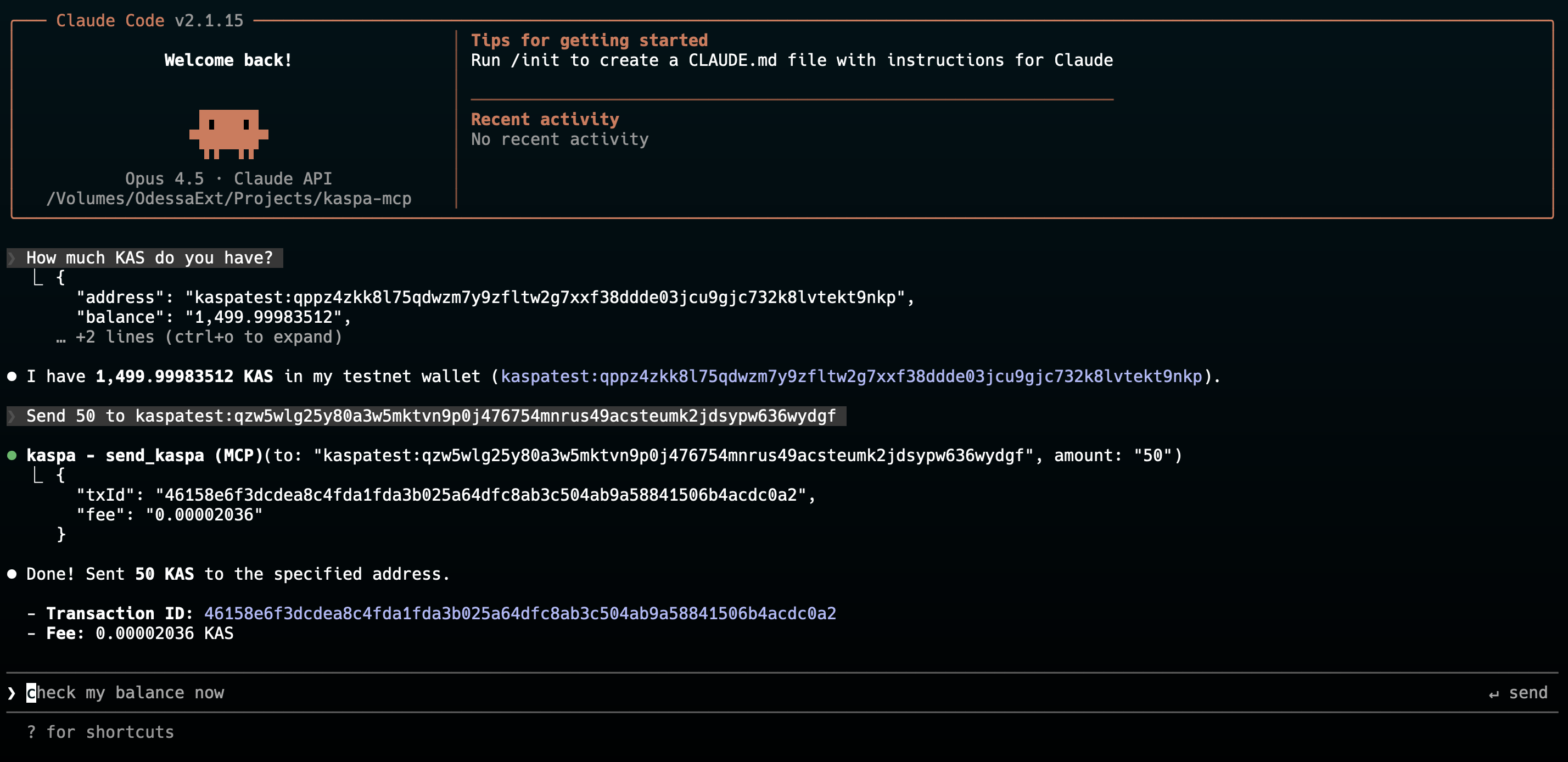
Example
Test Prompts
Try these prompts to verify your MCP is working:
"What is my Kaspa address?""How much KAS do I have?""What are the current network fees?""Send 5 KAS to kaspa:qz..."The MCP will:
- Validate the recipient address matches your network
- Check your balance is sufficient
- Build the transaction with KIP-9 compliant fees
- Sign with your private key
- Broadcast to the network via public nodes
- Return the transaction ID
Technical Details
- Uses kaspa-wasm for cryptographic operations
- Connects to public nodes via Resolver for automatic node discovery
- Implements BIP44 derivation path
m/44'/111111'/account'for mnemonic wallets - Transaction building uses Generator for KIP-9 compliant UTXO management
Security
- Private keys and mnemonics are only used locally for signing
- Keys are never sent to any external service
- Error messages are sanitized to prevent secret leakage
- All transactions require explicit user action via MCP tools
Networks
| Network | Address Prefix | API Endpoint |
|---------|---------------|--------------|
| mainnet | kaspa: | api.kaspa.org |
| testnet-10 | kaspatest: | api-tn10.kaspa.org |
| testnet-11 | kaspatest: | api-tn11.kaspa.org |
License
ISC