
libx.js
v6.1.0
Published
[](https://cdn.jsdelivr.net/gh/Livshitz/libx.js@latest/dist/libx.min.js) [](https://codec


Readme
Libx.js





🛠 libx.js is a carefully crafted toolbelt full of useful modules and helpers for node & web apps
Description:
Different projects usually have a shared portion of infrastructural or helpers code. Libx.js is intended to bring a broad of useful tools, shaped and sharpened to be easily used, hiding the complex or troublesome routines usually needed.
Features:
- Heavily modular and flexible
- Support javascript and Typescript
- Browserify & bundler friendly
- Shared support:
- Modules:
- Dependency Injection
- Log
- Network
- Callbacks (pub/sub)
- Firebase wrapper
- Linked nodes and lists
- BinrayHeap (min and max)
- Queue
- General QueueWorker
- Datastore for clientside caching
- Promise and deferred wrappers
- General helpers & extensions
- Datastore and cache mechanism
- Crypto related helpers
- Many general helpers
- Modules:
- Browser-only support:
- General helpers & extensions
- Require (for browser)
- User management (firebase)
- Node-only support:
- CLI helpers
- QuickServer (ExpressJS wrapper)
- ~~Bundler - Watcher, bundler, transformer, and more~~ (moved to pax.libx.js)
Use Cases:
- General:
- Essential string, array, date, extensions:
- format date into strings
- string ellipsis, capitalize, padding, hashcode
- array manipulation
- Simplified promise wrapper for easily wrapping callbacks into promises
- Use same API for networking (HTTP get/post/etc) in both browser and node
- Create dynamic linked-lists and trees to track, traverse nodes and also be able to serialise/deserialize easily
- Use QueueWorker for handle one or multiple workers and split work into async concurrent handlers
- Log code flow and events and filter by log level (debug/verbose/info/warning/error), including formatted date and time, stacktrace, etc
- Use simplified callbacks for easy pub/sub
- Firebase wrapper for handling read/write access and polyfill some missing functionality (reverse key ordering, entity version, etc.)
- Helpers for object manipulation, handy types and checks, chain functions, deep clone and extend objects, guid generation, regexp wrappers, and many more
- Essential string, array, date, extensions:
- Node:
- Allow modules to be able to detect and work in both CLI or import modes
- Quickly access command line arguments
- Bump package.json version
- Execute complex shell commands and capture outputs
- Parse and encrypt/decrypt project.json files
- Encrypt/decrypt files
- Globally catch errors and unhandled promises
- Browser:
- Browserify and make all the helpers and modules available to be used (share same codebase for both Node and browser).
- Support progressive script loading, just like
requirebut in the browser and on demand - Events and Messages managers
- Helpers for download, upload, inject and many more helpers
** See unit-tests and example folder for practical uses and examples. ** Live playground
Related packages:
- concurrency.libx.js -
Module that provides handy helpers for Async and concurrent work, for example Deferred utility, Debounce/Throttle, Chain, measurements and more.
Was initially part of libx and departed to be independent package. - di.libx.js -
Light weight Dependency-Injection module.
Was initially part of libx and departed to be independent package. - pax.libx.js -
Custom made bundler, based on gulp that supports Browserifying, TS, LESS, SCSS, Vue and more. Used here to bundle libx.js for browser use.
Usage
$ yarn add libx.js
or
$ npm install --save libx.js
Play with it in browser playground: https://npm.runkit.com/libx.js
For browser:
Create a dedicated file, include (e.g: require) the needed modules into global (window) scope and browserify it. See pax.libx.js for more details how to efficiently browserify and bundle files for browser use.
Grab from CDN:
https://cdn.jsdelivr.net/npm/libx.js@latest/dist/libx.min.jsNode: Environment Variable Loading (.env)
Libx.js provides a robust dotenv-equivalent loader for Node.js/TS projects:
Features
- Loads
.envby default, or.env.<env>if an env arg is supplied - Allows overriding the .env path as a string or array, merging in order
- Merges multiple env files in order
- Applies loaded variables to
process.env(without overwriting existing ones) - Returns the loaded variables as an object
- Supports multiline quoted values, escaped characters, inline comments,
exportkeyword, and variable expansion ($VAR,${VAR})
Usage
import { loadEnv } from 'libx.js/src/node/env';

// Load .env from current directory
loadEnv();

// Load .env.production (merges with .env if both exist)
loadEnv({ env: 'production' });

// Load custom env files in order (merging)
loadEnv({ path: ['.env', '.env.local'] });

// All loaded variables are applied to process.env and also returned as an object
const env = loadEnv();
console.log(env.MY_KEY);
Supported .env Features
- Unquoted, single-quoted, and double-quoted values
- Multiline quoted values
- Escaped characters:
\n,\t,\r,\\,\",\' - Inline comments (after values)
exportkeyword (optional)- Variable expansion:
$VARand${VAR}(from previous keys or process.env)
See src/node/env.ts and tests in tests/node/env.test.ts for more details and examples.
Contributing
Fork into your own repo, run locally, make changes and submit PullRequests to the main repository.
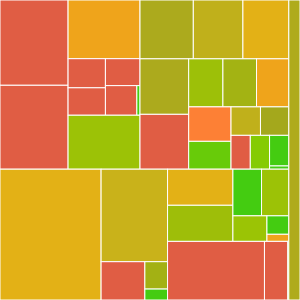
Tests Coverage:
License
All projects and packages in this repository are MIT licensed.