
lifecycle-kit
v0.3.2
Published
The stage stack: chemistry, biological scaling laws, compositional form, pigment, and 2.5D assembly.

Maintainers
 jbdevprimary
Readme
lifecycle-kit
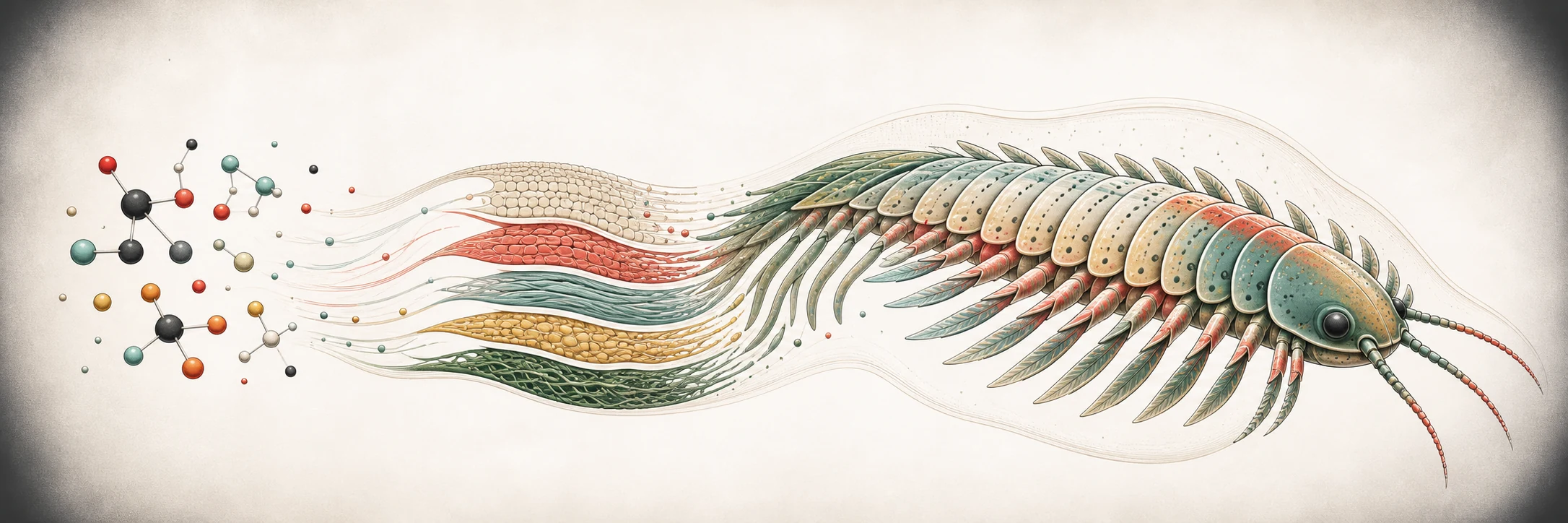


Lifecycle Kit is a deterministic TypeScript stage stack for growing procedural creatures from causes rather than catalogs. A world's chemistry determines its tissue, lived diet and activity reshape that tissue, biological laws scale the organism, compositional rules emit its form, and pigment plus self-shadowing turn the result into renderer-neutral visual data.
Use one stage independently or carry the same creature through the full pipeline. The package has no runtime dependencies, browser globals, hidden randomness, or rendering-engine lock-in.
Why Lifecycle Kit
Many procedural-creature systems select from authored body parts and recolor the result. Lifecycle Kit keeps the causal chain intact:
- real elemental properties and biomolecule formulas decide what can grow;
- cited allometric laws replace hand-tuned size and life-history guesses;
- a small vocabulary of continuous vector rules creates body plans;
- diet, exposure, tissue, depth, and light remain visible in the final palette;
- pure POJO inputs and outputs are serializable, replayable, and easy to test.
Install
pnpm add lifecycle-kitNo runtime dependencies.
Lifecycle Kit is ESM-only and supports Node.js 22 or newer, plus modern
bundlers. CommonJS applications can load it with dynamic import().
There is no global configuration or environment-variable contract. Each pure function receives the world, creature state, or rendering parameters it needs, which keeps parallel simulations isolated and deterministic.
Use a stage
Import the stage you need. Subpaths are the primary interface — they keep the bundle small and make a symbol's provenance obvious.
chem — elements, bonding, tissue composition
import {
  NEWBORN,
  compositionColor,
  deriveBiochemistry,
  metabolise,
  normalise,
  readMetabolicState,
  writeMetabolicState,
} from "lifecycle-kit/chem";

// Which backbone element wins on this world, from its temperature and
// element abundances.
const { backbone, rationale } = deriveBiochemistry({ Si: 30 }, 500);
// backbone: "Si", rationale: "Silicon, narrowly — no liquid water to break
// its chains, and plenty of it"

// A raw tissue tally, normalised to fractions that sum to 1. Invalid or
// negative quantities fail at this boundary instead of becoming NaN later.
const body = normalise({ sugar: 0, protein: 3, lipid: 1, mineral: 0, chitin: 0, keratin: 0 });
// { sugar: 0, protein: 0.75, lipid: 0.25, mineral: 0, chitin: 0, keratin: 0 }

compositionColor(body); // "#beb5af" — a real hex colour, never NaN

// Safely persist an evolving body. Writes reject invalid state; reads migrate
// partial legacy tissue records and fall back to a fresh newborn if corrupt.
const next = metabolise(NEWBORN, { protein: 1 }, { exertion: 1, growth: 0.3, rest: 0 });
const saved = writeMetabolicState(next);
readMetabolicState(saved); // a canonical MetabolicState
bio-laws — cited biological scaling laws
import { expectedBrainMass, encephalizationQuotient, maxGroupSize } from "lifecycle-kit/bio-laws";

expectedBrainMass(70); // ~0.24 kg, from Jerison's mammalian brain/body scaling
encephalizationQuotient(1.4, 62); // ~6.3, a human-scale EQ (Jerison 1973)
maxGroupSize(4.1); // ~148 — Dunbar's number, from his own neocortex-ratio regression
forms — compositional rules emitting vector geometry
import { taper, repeat, bounds } from "lifecycle-kit/forms";

// A single tapered body segment.
const segment = taper({ from: 0.2, to: 0.1, bulgeAt: 0.5, length: 0.4, part: "seg" });

// Three of them in a row — a centipede-style body, not a bespoke shape.
const body = repeat(segment, { axis: { x: 1, y: 0 }, count: 3, spacing: 0.5, part: "seg" });

bounds(body); // { min: { x, y }, max: { x, y } } — the emitted geometry's exact extent
pigment — colour from diet, exposure, chemistry
import { derivePigments, paletteRamp, NO_DIET_HISTORY, recordMeal } from "lifecycle-kit/pigment";
import { EMPTY_COMPOSITION } from "lifecycle-kit/chem";

const diet = recordMeal(NO_DIET_HISTORY, 0.8); // a mostly plant-matter meal
const composition = { ...EMPTY_COMPOSITION, keratin: 1 };

const pigments = derivePigments(composition, diet, { uvExposure: 0.6, genetics: 0.5 });
// { melanin, carotenoid, pterin, purine, porphyrin } — real concentrations, never NaN

paletteRamp(composition, pigments, { metallic: 0.1, roughness: 0.7, opacity: 1 });
// { shadow, base, pigment, highlight } — four hex stops a renderer shades with
assemblage — 2.5D assembly, lighting, depth
import { assemble, shade, DEFAULT_LIGHT } from "lifecycle-kit/assemblage";
import { taper } from "lifecycle-kit/forms";

const segment = taper({ from: 0.2, to: 0.1, bulgeAt: 0.5, length: 0.4, part: "seg" });

// Place tagged shapes in depth bands and light them.
const [part] = assemble(segment.shapes, DEFAULT_LIGHT);
// { shape, depth, light, direct, occlusion } — depth-sorted, ready to draw

shade("#beb5af", part.light); // the tissue colour, shaded by that part's light level
The root export exposes each stage as a namespace:
import { chem, forms } from "lifecycle-kit";

chem.normalise(/* ... */);
forms.taper(/* ... */);
It is namespaced rather than flat on purpose. chem and assemblage both
export normalise, so a flat re-export would silently shadow one depending on
declaration order.
How the stages relate
chem, forms, and bio-laws stand alone. pigment builds on chem.
assemblage builds on forms and pigment.
Those were version constraints across six packages that had to be kept in step. Inside one package they are just imports.
world abundance + temperature
            │
            ▼
          chem ───────► bio-laws
            │              │
            ▼              │
         pigment           │
            │              │
            └──────┐       │
                   ▼       ▼
forms ─────────► assemblage ──► renderer-ready geometry, colour, depth, light
The stage boundaries are plain data: Composition, Path, PaletteRamp, and
AssembledPart. No stage owns a clock, random-number source, DOM, canvas, or
game-engine object. Consumers decide persistence, seeding, scheduling, and the
final renderer.
The complete API reference lists every public function and type, including units, validation behavior, persistence fallbacks, and renderer contracts.
For code you can run unchanged, start with the two-stage quick start, then follow the complete world-to-creature pipeline. The examples execute in CI against the package's built export map, so they cannot quietly drift away from the released API.
The documentation site adds an explicit rendering guide for SVG, Pixi, and custom renderers, plus an agentic-consumer contract for reliable automated integrations. The generated API pages remain the source of truth for every exported symbol's signature, unit, and validation behaviour.
Development
The repository pins Node 22 and pnpm 11.23.0. The same command used by CI checks formatting and lint rules, TypeScript, the full coverage floor, the production build, runnable examples, and the packed package's ESM declarations:
corepack enable
pnpm install --frozen-lockfile
pnpm verify
See CONTRIBUTING.md for the change and release workflow.
Individual commands are available when iterating:
pnpm lint            # Biome formatting and static rules
pnpm typecheck       # strict TypeScript without emitting
pnpm test            # 500+ unit, regression, and integration assertions
pnpm coverage        # tests plus enforced coverage floors
pnpm build           # ESM JavaScript, declarations, maps, and source maps
pnpm check:examples  # execute both examples through the built export map
pnpm check:package   # publint plus arethetypeswrong
The full documentation site, including a TypeDoc-generated API reference for
every subpath export, is published at
jonbogaty.com/lifecycle-kit and built
from docs/ with pnpm docs:build.
Compatibility
The public package targets ES2022 and is tested on Node.js 22, 24, and 26, with
an additional Windows CI run. Its runtime modules use no Node-only APIs, so
modern ESM bundlers can tree-shake the subpath exports for browser games.
CommonJS callers must use dynamic import(); a synchronous require() build
is intentionally not shipped.
Troubleshooting
ERR_REQUIRE_ESM: useimportsyntax, set"type": "module", or load from CommonJS withawait import("lifecycle-kit/chem").- An input throws instead of being clamped: validation is deliberate. Temperatures are kelvin, composition and exposure fractions are 0..1, masses are kilograms where documented, and negative physical quantities are caller errors. Error messages name the function and field.
- A save will not load:
readMetabolicStatenever throws for corrupt or older JSON; it migrates partial known tissue or returns a fresh newborn. UsewriteMetabolicStateto reject invalid state before persisting it. - A bundle includes more than expected: import a stage subpath such as
lifecycle-kit/formsinstead of the root namespace module.
If behavior still looks wrong, open a bug report with a minimal input and exact runtime version. Report vulnerabilities privately as described in SECURITY.md.
Contributing, releases, and license
Contributions are welcome under the process in CONTRIBUTING.md and the Code of Conduct. Release Please builds changelog entries and versions from Conventional Commits; a release tag triggers a verified package build and npm publication with provenance.
Lifecycle Kit is available under the MIT License.