
llm-contract
v0.10.1
Published
TypeScript library and CLI for LLM evaluation, AI agent testing, prompt regression, RAG grounding, structured output, flakiness tracking, and CI gates.

Maintainers
 alivirgo
Readme
llm-contract





Daily downloads
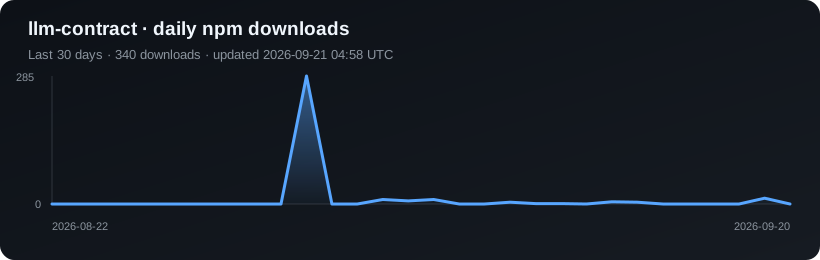
Updated automatically from npm's public download API every 12 hours.
Read the launch article: Stop Shipping Broken AI: Contract Testing for LLMs in TypeScript
Explore the interactive documentation for the quickstart, validation pipeline, regression workflow, CI policies, reports, and honest limits.
Define what an AI system must do. Test it across real cases. Detect when a model, prompt, tool, or RAG change breaks the contract.
llm-contract is an open-source TypeScript library and CLI for deterministic-first LLM evaluation, AI agent testing, prompt regression, RAG grounding checks, structured-output validation, flakiness tracking, and CI gates.
Use it to express reusable behavioral requirements, evaluate generated output, run datasets repeatedly, compare results with a baseline, detect flaky cases, and enforce release thresholds in CI. It accepts outputs from any model or agent framework and makes no hidden network calls.
When to use it
- Test a prompt or model migration before release.
- Catch regressions in AI assistants and tool-using agents.
- Validate JSON with Zod, Valibot, or a JSON Schema subset.
- Check required facts, forbidden claims, clarification, refusal, citations, ranges, enums, and business rules.
- Evaluate RAG answers against supplied context with transparent evidence.
- Track pass rate, score changes, new failures, fixes, and nondeterminism across a test dataset.
- Fail CI when critical AI behavior regresses.
Why behavioral contracts?
- Exact text snapshots reject valid paraphrases.
- Schema validation cannot tell whether a structurally valid answer preserves facts or follows behavioral requirements.
- LLM judges are useful but probabilistic, so they should not overwrite deterministic failures.
llm-contract keeps those signals separate and returns an inspectable result containing checks, failures, warnings, scores, evidence, raw output, and normalized output.
graph TD
    Raw[LLM Raw Output] --> Norm[1. Conservative Normalizer]
    Norm --> Syn[2. Syntactic Validation: Parse JSON / Markdown]
    Syn --> Struct[3. Structural Validation: Zod / Valibot / JSON-Schema]
    Struct --> Sem[4. Semantic Validation: Range / Enums / Business Rules]
    Sem --> Ground[5. Grounding: Fact Preservation / Anti-Hallucination]
    Ground --> Behav[6. Behavioral: Clarifications / Refusals / Constraints]
    Behav --> Rep[Structured Report & CI Enforcement]
⚡ Quickstart
1. Installation
npm install llm-contract
npx llm-contract init
npm run test:ai
That is the complete first-run path. init creates a small executable suite in
evals/, adds the test:ai script, and writes concise project guidance for
Cursor, Codex, Claude, Gemini, Antigravity, and other agents that read
AGENTS.md. It does not install a model SDK, make a network call, or require an
API key. Replace the sample outputs with output captured from the AI stack you
already use.
npx llm-contract init --dir ./my-app  # choose a project directory
npx llm-contract init --no-agents     # skip agent instruction files
npx llm-contract init --force         # replace initializer-owned targets
Optional schema validators can be added later with npm install zod or
npm install valibot.
The canonical package is llm-contract on npmjs. A public scoped mirror, @alivirgo/llm-contract, is also published through GitHub Packages for authenticated GitHub registry workflows. Versioned tarballs are attached to GitHub Releases.
2. Customize the generated contract
import { z } from 'zod';
import {
  defineContract,
  zodAdapter,
  mustPreserveFacts,
  mustNotInvent,
  mustAskWhenUncertain,
  assertNoContradiction,
  assertRequiredTopicsCovered,
  evaluate,
} from 'llm-contract';

// Define the expected output structure
const CustomerSupportSchema = z.object({
  reply: z.string(),
  category: z.enum(['refund', 'billing', 'technical', 'general']),
  requiresFollowUp: z.boolean(),
});

// Define the behavioral contract
export const supportContract = defineContract({
  name: 'customer-support-response',
  schema: zodAdapter(CustomerSupportSchema),
  normalization: {
    stripCodeFences: true, // strips ```json ... ``` without altering content
    trimWhitespace: true,
  },
  invariants: [
    // 1. Must faithfully preserve key facts (IDs, dates, numbers) from context
    mustPreserveFacts({ threshold: 1.0 }),

    // 2. Must not invent ungrounded claims absent from context
    mustNotInvent({ mode: 'strict' }),

    // 3. Must ask clarifying questions when input lacks essential parameters
    mustAskWhenUncertain({
      isAmbiguousInput: (input) => !input.orderId,
    }),

    // 4. Must never contradict facts in the context
    assertNoContradiction(),
  ],
  assertions: [
    // Soft evaluator: contributes to score without automatically hard-failing
    assertRequiredTopicsCovered(['refund', 'policy'], { weight: 0.5 }),
  ],
});
3. Evaluate Output
const result = await evaluate(supportContract, {
  input: { query: 'Where is my package?' },
  context: 'Order ORD-9921 was shipped on 2026-09-01 via FedEx.',
  output: JSON.stringify({
    reply: 'Your order ORD-9921 was shipped on 2026-09-01 via FedEx.',
    category: 'general',
    requiresFollowUp: false,
  }),
});

console.log(result.passed); // true
console.log(result.score);  // 1.0
console.log(result.failures); // []
🔍 Structured Failure Taxonomy
Every failure produces a machine-readable code, exact path, human-readable explanation, and evidence:
| Failure Code | Meaning |
| :--- | :--- |
| PARSE_ERROR | Malformed JSON or invalid syntax |
| SCHEMA_VIOLATION | Zod, Valibot, or JSON Schema validation error |
| MISSING_REQUIRED_INFORMATION | Required parameters or topics missing |
| UNSUPPORTED_CLAIM | Output claims facts/entities absent from context |
| FACT_CONTRADICTION | Output directly contradicts context statements |
| UNCERTAINTY_VIOLATION | AI failed to ask for clarification on ambiguous input |
| FORBIDDEN_PHRASE_DETECTED | Banned term or hallucinated phrase found |
| REQUIRED_TOPIC_MISSING | Mandatory topic or concept omitted |
| NUMERIC_OUT_OF_BOUNDS | Structured numerical value outside bounds |
| ENUM_VIOLATION | Value not in allowed enum set |
| REFUSAL_EXPECTED_BUT_MISSING | Adversarial / unsafe input answered instead of refused |
| UNEXPECTED_REFUSAL | Benign prompt incorrectly refused |
| CUSTOM_INVARIANT_FAILURE | User-defined invariant check failed |
🧪 Dataset Regression Testing & CI Integration
The core superpower of llm-contract is running behavioral contracts across datasets before and after model or prompt changes.
import { runSuite, evaluatePolicy, standardCIPolicy, formatSuiteTerminal } from 'llm-contract';

const cases = [
  {
    id: 'case-01',
    input: 'How do I return my item?',
    context: 'Returns are accepted at returns.store.com within 30 days.',
    contract: supportContract,
    baselineOutcome: { passed: true, score: 1.0 }, // Historical baseline
  },
  // ... more test cases
];

// Run suite against your model / generation function
const suiteResult = await runSuite('support-eval', cases, async (testCase) => {
  return await callMyModel(testCase.input, testCase.context);
}, {
  concurrency: 4,
  runsPerCase: 3, // Multi-run stability testing (detects flakiness)
});

// Enforce CI Policy
const policyResult = evaluatePolicy(suiteResult, standardCIPolicy);
console.log(formatSuiteTerminal(suiteResult, policyResult));

// Exit with non-zero code on CI policy violation
process.exit(policyResult.exitCode);
🚨 Prominent Regression Detection
llm-contract distinguishes an absolute failure from a new regression:
══════════════════════════════════════════════════════════════════════
  llm-contract suite: support-model-v2
══════════════════════════════════════════════════════════════════════

  Total Cases: 50   |   Passed: 48   |   Failed: 2
  Pass Rate:   96.0%   |   Avg Score: 97.5%   |   Duration: 420ms

  REGRESSIONS DETECTED (1)
  The following test cases passed in baseline but FAILED in current run:
    ✖ Case ID: case-12-refund-terms (Score: 0%, was 100%)
      ↳ [FACT_CONTRADICTION] Context states non-refundable, but output claims refundable

  FIXES DETECTED (2)
  The following test cases previously failed but now PASS:
    ✓ Case ID: case-04-clarification (Score: 100%)
📊 Stability & Flakiness Measurement
LLMs are probabilistic. Running a test once can hide nondeterminism:
runsPerCase: 3runs each test case 3 times.llm-contractnever hides flakiness by retrying until it passes.- All attempts are recorded, and a
stabilityScore(0.0 to 1.0) is reported.
⚖️ CI Policy Thresholds
Declare explicit acceptance policies:
import { evaluatePolicy } from 'llm-contract';

const policyResult = evaluatePolicy(suiteResult, {
  name: 'Release Gate Policy',
  minimumPassRate: 0.95,          // >= 95% pass rate
  maximumRegressionRate: 0.00,    // 0 regressions allowed compared to baseline
  maximumFlakyRate: 0.05,         // max 5% flaky cases
  zeroToleranceFailures: [
    'SCHEMA_VIOLATION',
    'UNSUPPORTED_CLAIM',
    'FACT_CONTRADICTION',
  ],
});
🧰 Schema Adapters
llm-contract is framework-agnostic with first-class adapters:
Zod
import { z } from 'zod';
import { zodAdapter } from 'llm-contract/adapters/zod';

const schema = zodAdapter(z.object({ name: z.string(), score: z.number() }));
Valibot
import * as v from 'valibot';
import { valibotAdapter } from 'llm-contract/adapters/valibot';

const schema = valibotAdapter(v.object({ name: v.string(), score: v.number() }));
Zero-Dependency JSON Schema Subset
import { jsonSchemaAdapter } from 'llm-contract/adapters/json-schema';

const schema = jsonSchemaAdapter({
  type: 'object',
  required: ['name', 'score'],
  properties: {
    name: { type: 'string' },
    score: { type: 'number', minimum: 0, maximum: 100 },
  },
});
The built-in adapter intentionally supports the common deterministic subset
(type, properties, required, additionalProperties, arrays, enums, and
basic string/number bounds). It is not a complete JSON Schema implementation;
use Zod, Valibot, or a custom adapter when you need $ref, composition, or
draft-specific behavior.
🖥️ Command Line Interface (CLI)
# Run a dataset with a real executable behavioral contract
npx llm-contract run --suite ./cases.json --contract ./support.contract.mjs --baseline ./baseline.json --preset standard

# Generate an interactive HTML dashboard
npx llm-contract run --suite ./cases.json --contract ./support.contract.mjs --html ./dashboard.html

# Generate GitHub PR comment markdown
npx llm-contract run --suite ./cases.json --contract ./support.contract.mjs --markdown ./pr-summary.md

# Compare two evaluation runs to detect regressions
npx llm-contract compare --baseline ./run-v1.json --current ./run-v2.json

# Quick validation of a single output
npx llm-contract validate --input "Hello" --output "Hello world!"
The contract module must export a contract as its default export or as a named
contract export. Running without --contract performs only a non-empty-output
smoke check; it is useful for wiring CI, not for behavioral validation.
📁 Interactive HTML Dashboard
Generate self-contained HTML reports with zero CDN dependencies:
npx llm-contract run --suite ./cases.json --html ./report.htmlFeatures:
- Dark/Light mode UI.
- Filter by All, Failed, Passed, Regressions, Fixes, or Flaky.
- Inspect raw vs normalized output and failure diffs.
🏗️ Architecture & Philosophy
- Deterministic Foundation: Core checks (schema, entity preservation, range bounds, forbidden phrases) run in milliseconds without network calls or API keys.
- Conservative Normalization:
rawOutputis always preserved alongsidenormalizedOutput. Never silently rewrite semantic content. - No Vendor Lock-In: Works with OpenAI, Anthropic, Gemini, Mistral, Ollama, LangChain, LlamaIndex, or custom pipelines.
- Zero Telemetry: No tracking, no hidden network requests, 100% private.
📄 License
MIT © 2026 llm-contract contributors