
llmpm
v3.1.4
Published
LLM Package Manager — download, run, and share AI models from the command line

Maintainers
 sarthaksaxena
Readme
llmpm — LLM Package Manager
Command-line package manager for open-sourced large language models. Download and run 10,000+ models, and share LLMs with a single command.
llmpm is a CLI package manager for large language models, inspired by pip and npm. Your command line hub for open-source LLMs. We’ve done the heavy lifting so you can discover, install, and run models instantly.
Models are sourced from HuggingFace Hub, Ollama & Mistral AI.
Explore a Suite of Models at llmpm.co →
Supports:
- Text generation (GGUF via llama.cpp and Transformer checkpoints)
- Image generation (Diffusion models)
- Vision models
- Speech-to-text (ASR)
- Text-to-speech (TTS)
Installation
via pip (recommended)
pip install llmpmThe pip install is intentionally lightweight — it only installs the CLI tools needed to bootstrap. On first run, llmpm automatically creates an isolated environment at ~/.llmpm/venv and installs all ML backends into it, keeping your system Python untouched.
via npm
npm install -g llmpmThe npm package finds Python on your PATH, creates ~/.llmpm/venv, and installs all backends into it during postinstall.
via Homebrew
brew tap llmpm/llmpm
brew install llmpm
Environment isolation
All llmpm commands always run inside ~/.llmpm/venv.
Set LLPM_NO_VENV=1 to bypass this (useful in CI or Docker where isolation is already provided).
Quick start
# Install a model
llmpm install meta-llama/Llama-3.2-3B-Instruct

# Run it
llmpm run meta-llama/Llama-3.2-3B-Instruct
llmpm serve meta-llama/Llama-3.2-3B-Instruct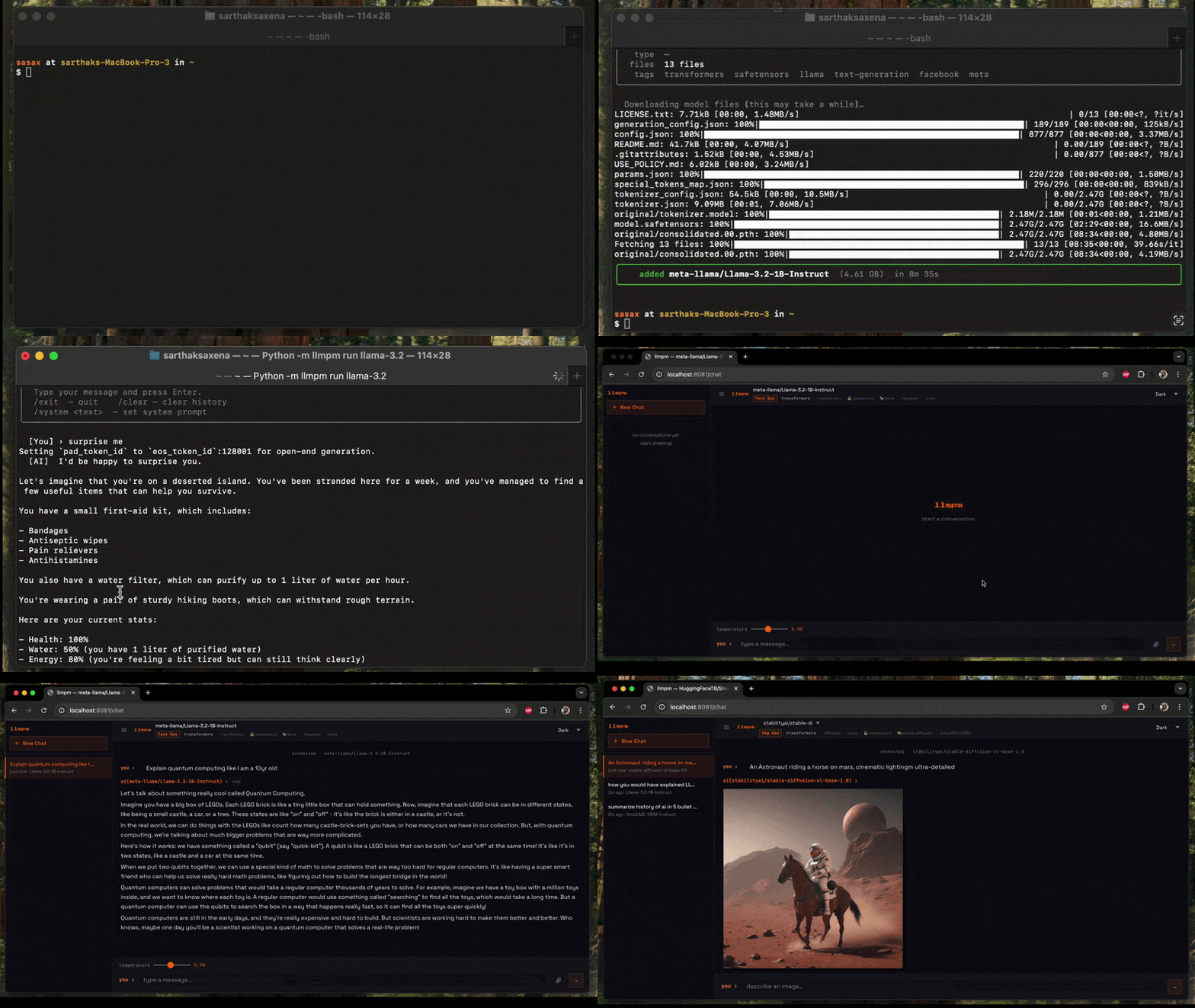
Commands
| Command | Description |
| ------------------------------- | --------------------------------------------------------------- |
| llmpm init | Initialise a llmpm.json in the current directory |
| llmpm install | Install all models listed in llmpm.json |
| llmpm install <repo> | Download and install a model from HuggingFace, Ollama & Mistral |
| llmpm run <repo> | Run an installed model (interactive chat) |
| llmpm serve [repo] [repo] ... | Serve one or more models as an OpenAI-compatible API |
| llmpm serve | Serve every installed model on a single HTTP server |
| llmpm benchmark <repo> | Run evaluation benchmarks against an installed model |
| llmpm push <repo> | Upload a model to HuggingFace Hub |
| llmpm search <query> | Search HuggingFace Hub for models |
| llmpm trending | Show top trending models by likes (text-gen & text-to-image) |
| llmpm list | Show all installed models |
| llmpm info <repo> | Show details about a model |
| llmpm uninstall <repo> | Uninstall a model |
| llmpm clean | Remove the managed environment (~/.llmpm/venv) |
| llmpm clean --all | Remove environment + all downloaded models and registry |
Local vs global mode
llmpm works in two modes depending on whether a llmpm.json file is present.
Global mode (default)
All models are stored in ~/.llmpm/models/ and the registry lives at
~/.llmpm/registry.json. This is the default when no llmpm.json is found.
Local mode
When a llmpm.json exists in the current directory (or any parent), llmpm
switches to local mode: models are stored in .llmpm/models/ next to the
manifest file. This keeps project models isolated from your global environment.
my-project/
├── llmpm.json        ← manifest
└── .llmpm/           ← local model store (auto-created)
    ├── registry.json
    └── models/
All commands (install, run, serve, list, info, uninstall) automatically
detect the mode and operate on the correct store — no flags required.
llmpm init
Initialise a new project manifest in the current directory.
llmpm init              # interactive prompts for name & description
llmpm init --yes        # skip prompts, use directory name as package name
This creates a llmpm.json:
{
  "name": "my-project",
  "description": "",
  "dependencies": {}
}
Models are listed under dependencies without version pins — llmpm models
don't use semver. The value is always "*".
llmpm install
# Install a Transformer model
llmpm install meta-llama/Llama-3.2-3B-Instruct

# Install a GGUF model (interactive quantisation picker)
llmpm install unsloth/Llama-3.2-3B-Instruct-GGUF

# Install a specific GGUF quantisation
llmpm install unsloth/Llama-3.2-3B-Instruct-GGUF --quant Q4_K_M

# Install a single specific file
llmpm install unsloth/Llama-3.2-3B-Instruct-GGUF --file Llama-3.2-3B-Instruct-Q4_K_M.gguf

# Skip prompts (pick best default)
llmpm install meta-llama/Llama-3.2-3B-Instruct --no-interactive

# Install and record in llmpm.json (local projects)
llmpm install meta-llama/Llama-3.2-3B-Instruct --save

# Install all models listed in llmpm.json (like npm install)
llmpm install
In global mode models are stored in ~/.llmpm/models/.
In local mode (when llmpm.json is present) they go into .llmpm/models/.
Gated models
Some models (e.g. google/gemma-2-2b-it, meta-llama/Llama-3.2-3B-Instruct) require you to accept a licence on HuggingFace before downloading. If you try to install one without a token you will see:
  error  Download failed: access to google/gemma-2-2b-it is restricted.

  This is a gated model — you need to:
    1. Accept the licence at https://huggingface.co/google/gemma-2-2b-it
    2. Re-run with your HF token:

         HF_TOKEN=<your_token> llmpm install google/gemma-2-2b-it
Get a token at https://huggingface.co/settings/tokens, accept the model licence on its HuggingFace page, then:
# Inline
HF_TOKEN=hf_your_token llmpm install google/gemma-2-2b-it

# Or export for the session
export HF_TOKEN=hf_your_token
llmpm install google/gemma-2-2b-it
llmpm install options
| Option | Description |
| ------------------ | -------------------------------------------------------------- |
| --quant / -q | GGUF quantisation to download (e.g. Q4_K_M) |
| --file / -f | Download a specific file from the repo |
| --no-interactive | Never prompt; pick the best default quantisation automatically |
| --save | Add the model to llmpm.json dependencies after installing |
llmpm run
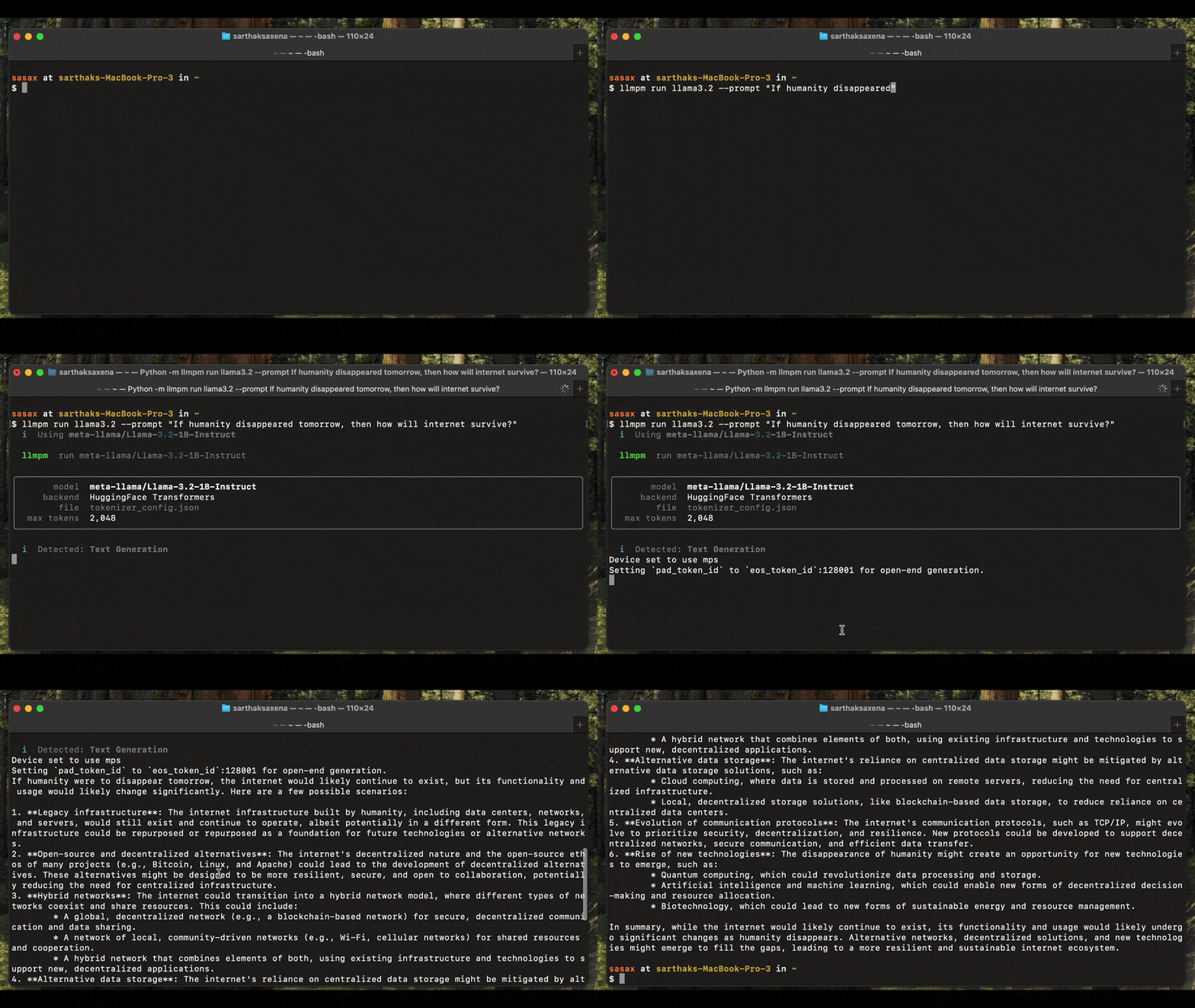
llmpm run auto-detects the model type and launches the appropriate interactive session. It supports text generation, image generation, vision, speech-to-text (ASR), and text-to-speech (TTS) models.
Text generation (GGUF & Transformers)
# Interactive chat
llmpm run meta-llama/Llama-3.2-3B-Instruct

# Single-turn inference
llmpm run meta-llama/Llama-3.2-3B-Instruct --prompt "Explain quantum computing"

# With a system prompt
llmpm run meta-llama/Llama-3.2-3B-Instruct --system "You are a helpful pirate."

# Limit response length
llmpm run meta-llama/Llama-3.2-3B-Instruct --max-tokens 512

# GGUF model — tune context window and GPU layers
llmpm run unsloth/Llama-3.2-3B-Instruct-GGUF --ctx 8192 --gpu-layers 32
Image generation (Diffusion)
Generates an image from a text prompt and saves it as a PNG on your Desktop.
# Single prompt → saves llmpm_<timestamp>.png to ~/Desktop
llmpm run amused/amused-256 --prompt "a cyberpunk city at sunset"

# Interactive session (type a prompt, get an image each time)
llmpm run amused/amused-256
In interactive mode type your prompt and press Enter. The output path is printed after each generation. Type /exit to quit.
Requires:
pip install diffusers torch accelerate
Vision (image-to-text)
Describe or answer questions about an image. Pass the image file path via --prompt.
# Single image description
llmpm run Salesforce/blip-image-captioning-base --prompt /path/to/photo.jpg

# Interactive session: type an image path at each prompt
llmpm run Salesforce/blip-image-captioning-base
Requires:
pip install transformers torch Pillow
Speech-to-text / ASR
Transcribe an audio file. Pass the audio file path via --prompt.
# Transcribe a single file
llmpm run openai/whisper-base --prompt recording.wav

# Interactive: enter an audio file path at each prompt
llmpm run openai/whisper-base
Supported formats depend on your installed audio libraries (wav, flac, mp3, …).
Requires:
pip install transformers torch
Text-to-speech / TTS
Convert text to speech. The output WAV file is saved to your Desktop.
# Single utterance → saves llmpm_<timestamp>.wav to ~/Desktop
llmpm run suno/bark-small --prompt "Hello, how are you today?"

# Interactive session
llmpm run suno/bark-small
Requires:
pip install transformers torch
Running a model from a local path
Use --path to run a model that was not installed via llmpm install — for
example, a model you downloaded manually or trained yourself.
# Run a GGUF file directly
llmpm run --path ~/Downloads/mistral-7b-q4.gguf

# Run a HuggingFace-style model directory
llmpm run --path ~/models/whisper-base --prompt recording.wav

# Optional: give the model a display label
llmpm run my-llama --path /data/models/llama-3
--path accepts either a .gguf file or a directory. The model type is
auto-detected (GGUF if the path contains .gguf files, otherwise the
transformers/diffusion/audio backend is chosen from config.json).
llmpm run options
| Option | Default | Description |
| ----------------- | -------- | ------------------------------------------------------- |
| --prompt / -p | — | Single-turn prompt or input file path (non-interactive) |
| --system / -s | — | System prompt (text generation only) |
| --max-tokens | 128000 | Maximum tokens to generate per response |
| --ctx | 128000 | Context window size (GGUF only) |
| --gpu-layers | -1 | GPU layers to offload, -1 = all (GGUF only) |
| --verbose | off | Show model loading output |
| --path | — | Path to a local model dir or .gguf file (bypasses registry) |
Interactive session commands
These commands work in any interactive session:
| Command | Action |
| ---------------- | ------------------------------------------ |
| /exit | End the session |
| /clear | Clear conversation history (text gen only) |
| /system <text> | Update the system prompt (text gen only) |
Model type detection
llmpm run reads config.json / model_index.json from the installed model to determine the pipeline type before loading any weights. The detected type is printed at startup:
  Detected: Image Generation (Diffusion)
  Loading model…  ✓
If detection is ambiguous the model falls back to the text-generation backend.
llmpm serve
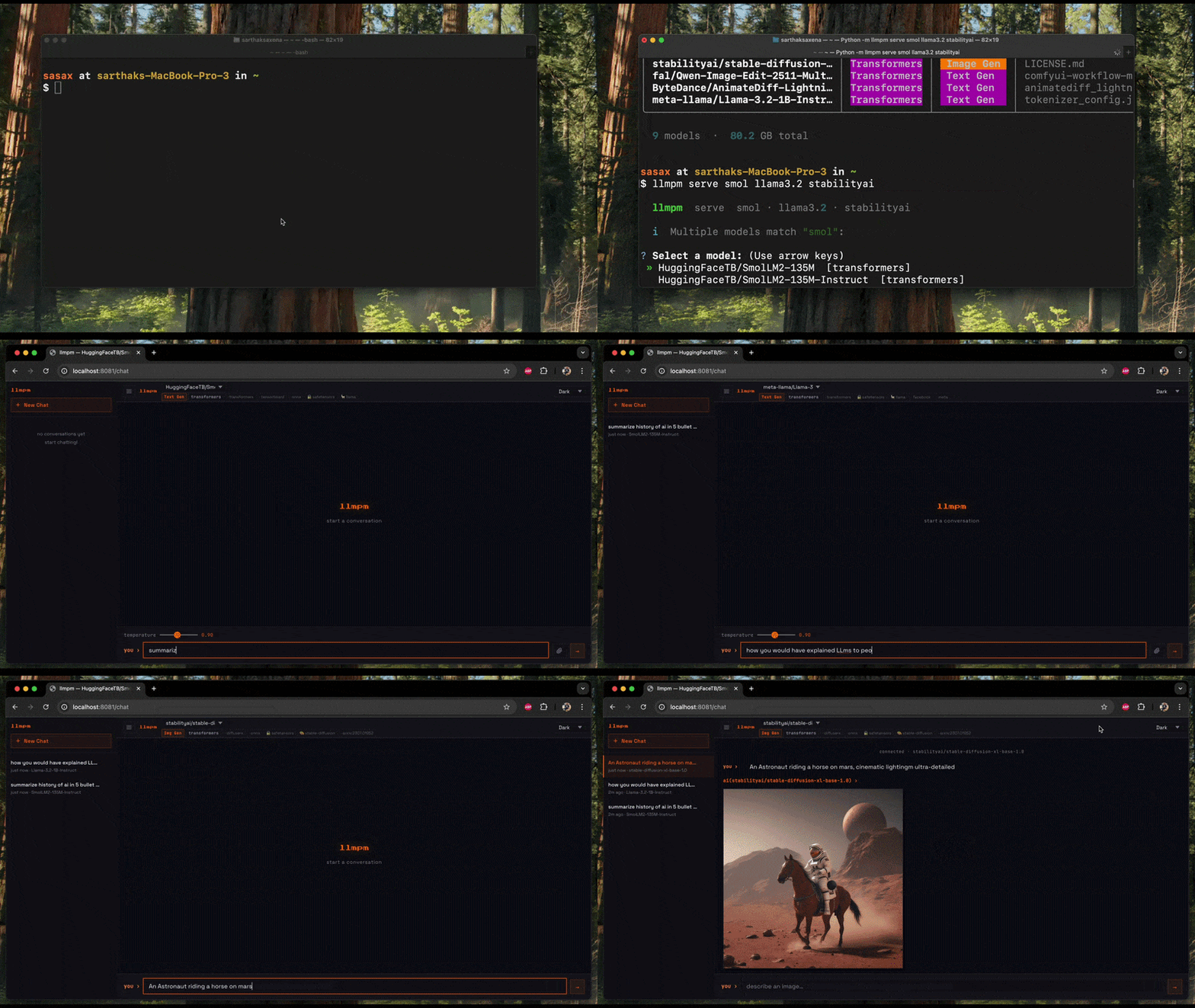
Start a single local HTTP server exposing one or more models as an OpenAI-compatible REST API.
A browser-based chat UI is available at /chat.
# Serve a single model on the default port (8080)
llmpm serve meta-llama/Llama-3.2-3B-Instruct

# Serve multiple models on one server
llmpm serve meta-llama/Llama-3.2-3B-Instruct amused/amused-256

# Serve ALL installed models automatically
llmpm serve

# Custom port and host
llmpm serve meta-llama/Llama-3.2-3B-Instruct --port 9000 --host 0.0.0.0

# Set the default max tokens (clients may override per-request)
llmpm serve meta-llama/Llama-3.2-3B-Instruct --max-tokens 2048

# GGUF model — tune context window and GPU layers
llmpm serve unsloth/Llama-3.2-3B-Instruct-GGUF --ctx 8192 --gpu-layers 32

# Serve a model from a local path (bypasses registry)
llmpm serve --path ~/models/mistral-7b-q4.gguf
llmpm serve --path ~/models/llama-3

# Mix registry models and local paths
llmpm serve meta-llama/Llama-3.2-3B-Instruct --path ~/models/custom-model

# Serve multiple local-path models
llmpm serve --path ~/models/llama --path ~/models/whisper
Fuzzy model-name matching is applied to each argument — if multiple installed models match you will be prompted to pick one.
llmpm serve options
| Option | Default | Description |
| --------------- | ----------- | --------------------------------------------------------- |
| --port / -p | 8080 | Port to listen on (auto-increments if busy) |
| --host / -H | localhost | Host/address to bind to |
| --max-tokens | 128000 | Default max tokens per response (overridable per-request) |
| --ctx | 128000 | Context window size (GGUF only) |
| --gpu-layers | -1 | GPU layers to offload, -1 = all (GGUF only) |
| --path | — | Path to a local model dir or .gguf file (repeatable, bypasses registry) |
Multi-model routing
When multiple models are loaded, POST endpoints accept an optional "model" field in the JSON body.
If omitted, the first loaded model is used.
# Target a specific model when multiple are loaded
curl -X POST http://localhost:8080/v1/chat/completions \
  -H "Content-Type: application/json" \
  -d '{"model": "meta-llama/Llama-3.2-3B-Instruct",
       "messages": [{"role": "user", "content": "Hello!"}]}'
The chat UI at /chat shows a model dropdown when more than one model is loaded.
Switching models resets the conversation and adapts the UI to the new model's category.
Endpoints
| Method | Path | Description |
| ------ | -------------------------- | -------------------------------------------------------------------- |
| GET | /chat | Browser chat / image-gen UI (model dropdown for multi-model serving) |
| GET | /health | {"status":"ok","models":["id1","id2",…]} |
| GET | /v1/models | List all loaded models with id, category, created |
| GET | /v1/models/<id> | Info for a specific loaded model |
| POST | /v1/chat/completions | OpenAI-compatible chat inference (SSE streaming supported) |
| POST | /v1/completions | Legacy text completion |
| POST | /v1/embeddings | Text embeddings |
| POST | /v1/images/generations | Text-to-image; pass "image" (base64) for image-to-image |
| POST | /v1/audio/transcriptions | Speech-to-text |
| POST | /v1/audio/speech | Text-to-speech |
All POST endpoints accept "model": "<id>" to target a specific loaded model.
Example API calls
# Text generation (streaming)
curl -X POST http://localhost:8080/v1/chat/completions \
  -H "Content-Type: application/json" \
  -d '{"messages": [{"role": "user", "content": "Hello!"}],
       "max_tokens": 256, "stream": true}'

# Target a specific model when multiple are loaded
curl -X POST http://localhost:8080/v1/chat/completions \
  -H "Content-Type: application/json" \
  -d '{"model": "meta-llama/Llama-3.2-1B-Instruct",
       "messages": [{"role": "user", "content": "Hello!"}]}'

# List all loaded models
curl http://localhost:8080/v1/models

# Text-to-image
curl -X POST http://localhost:8080/v1/images/generations \
  -H "Content-Type: application/json" \
  -d '{"prompt": "a cat in a forest", "n": 1}'

# Image-to-image (include the source image as base64 in the same endpoint)
IMAGE_B64=$(base64 -i input.png)
curl -X POST http://localhost:8080/v1/images/generations \
  -H "Content-Type: application/json" \
  -d "{\"prompt\": \"turn it into a painting\", \"image\": \"$IMAGE_B64\"}"

# Speech-to-text
curl -X POST http://localhost:8080/v1/audio/transcriptions \
  -H "Content-Type: application/octet-stream" \
  --data-binary @recording.wav

# Text-to-speech
curl -X POST http://localhost:8080/v1/audio/speech \
  -H "Content-Type: application/json" \
  -d '{"input": "Hello world"}' \
  --output speech.wav
Response shape for chat completions (non-streaming):
{
  "object": "chat.completion",
  "model": "<model-id>",
  "choices": [
    {
      "index": 0,
      "message": { "role": "assistant", "content": "<text>" },
      "finish_reason": "stop"
    }
  ],
  "usage": { "prompt_tokens": 0, "completion_tokens": 0, "total_tokens": 0 }
}
Response shape for chat completions (streaming SSE):
Each chunk:
{
  "object": "chat.completion.chunk",
  "model": "<model-id>",
  "choices": [
    {
      "index": 0,
      "delta": { "content": "<token>" },
      "finish_reason": null
    }
  ]
}
Followed by a final data: [DONE] sentinel.
Response shape for image generation:
{
  "created": 1234567890,
  "data": [{ "b64_json": "<base64-png>" }]
}
llmpm search
Search HuggingFace Hub for models matching a keyword or phrase.
llmpm search <query>Results are displayed in a table with model ID, task, download count, like count, and tags.
# Basic search
llmpm search llama

# Filter by pipeline task
llmpm search mistral --task text-generation

# Filter by library
llmpm search whisper --library transformers

# Sort results (downloads, likes, lastModified, trending)
llmpm search stable-diffusion --sort likes

# Limit number of results (default: 20)
llmpm search gemma --limit 10

# View detailed info for a result interactively
llmpm search llama --info
llmpm search options
| Option | Default | Description |
| ------------------ | ----------- | ------------------------------------------------------------------------------------------------- |
| --task / -t | — | Filter by pipeline task (e.g. text-generation, text-to-image, automatic-speech-recognition) |
| --library / -l | — | Filter by library (e.g. transformers, gguf, diffusers) |
| --sort / -s | downloads | Sort by downloads, likes, lastModified, or trending |
| --limit / -n | 20 | Maximum number of results to display |
| --info | off | Immediately prompt to view detailed info for a result |
After results are shown you will be asked if you want to view details for a specific model. Selecting one fetches the full model card from HuggingFace and shows author, task, license, languages, file list, tags, and a link to llmpm.co.
llmpm trending
Show the top trending models by likes & downloads, grouped by category.
llmpm trendingDisplays two sections — Text Generation and Text to Image — each listing the top 5 models with download counts, like counts, and a link to the model page on llmpm.co.

llmpm benchmark
Run standard evaluation benchmarks against an installed mode.
Installation
The benchmark backend is an optional dependency — install it separately to keep the base llmpm footprint small:
pip install llmpm[benchmark]Usage
# Run a single benchmark
llmpm benchmark meta-llama/Llama-3.2-3B-Instruct --tasks ifeval

# Run multiple benchmarks in one pass
llmpm benchmark meta-llama/Llama-3.2-3B-Instruct --tasks ifeval,hellaswag,mmlu

# Run the full Open LLM Leaderboard v1 suite
llmpm benchmark meta-llama/Llama-3.2-3B-Instruct --tasks openllm

# Run the full Open LLM Leaderboard v2 (open datasets, no gated data)
llmpm benchmark meta-llama/Llama-3.2-3B-Instruct --tasks leaderboard

# Benchmark GPT-2 on HellaSwag (no install needed — pulled directly from HuggingFace)
llmpm benchmark pretrained=gpt2 --tasks hellaswag

# With 10-shot prompting
llmpm benchmark pretrained=gpt2 --tasks hellaswag --num-fewshot 10

# Limit to 200 examples for a quick test
llmpm benchmark pretrained=gpt2 --tasks hellaswag --limit 200

# Save a full HTML report to ./results/
llmpm benchmark pretrained=gpt2 --tasks hellaswag --output ./results/

# Limit examples for a quick smoke test
llmpm benchmark meta-llama/Llama-3.2-3B-Instruct --tasks mmlu --limit 100

# Save results + HTML report to a directory
llmpm benchmark meta-llama/Llama-3.2-3B-Instruct --tasks ifeval --output ./results/
# → writes ./results/report.html with a full breakdown of metrics and run config

# Run Humanity's Last Exam (bundled open dataset)
llmpm benchmark meta-llama/Llama-3.2-3B-Instruct --tasks hle

# List all supported benchmarks
llmpm benchmark --list-tasks
llmpm benchmark options
| Option | Default | Description |
| ---------------------- | ------------ | ------------------------------------------------------------- |
| --tasks / -t | required | Comma-separated task or group names (e.g. ifeval,hellaswag) |
| --num-fewshot / -n | task default | Override few-shot count for all tasks |
| --limit / -l | — | Limit examples per task (integer = count, <1.0 = fraction) |
| --batch-size / -b | auto | Inference batch size |
| --device | auto | PyTorch device override (e.g. cpu, cuda:0) |
| --output / -o | — | Directory to write results; generates report.html inside it |
| --list-tasks | — | Print all supported benchmark tasks and exit |
Supported benchmarks
| Category | Tasks |
| ------------------------- | ------------------------------------------------------------------------------------------------------------------------------------------------------------------------------------------ |
| Leaderboard suites | openllm (ARC · HellaSwag · TruthfulQA · MMLU · Winogrande · GSM8K), leaderboard (IFEval · BBH · MATH Hard · GPQA · MuSR · MMLU-Pro — all open datasets), tinyBenchmarks, metabench |
| Commonsense | hellaswag, winogrande, wsc273, piqa, siqa, openbookqa, commonsense_qa, logiqa, logiqa2, babi, swag |
| Knowledge | mmlu, mmlu_pro, truthfulqa, triviaqa, nq_open, webqs, sciq, agieval, ceval, cmmlu, kmmlu |
| Reading comprehension | race, squadv2, drop, coqa, super_glue, glue |
| Math & reasoning | arc_easy, arc_challenge, gsm8k, gsm_plus, hendrycks_math, minerva_math, mathqa, arithmetic, asdiv, bbh, bigbench, anli |
| Code | humaneval, mbpp |
| Instruction following | ifeval |
| Long context | longbench |
| Language modeling | wikitext, lambada |
| Medical & science | medqa, medmcqa, pubmedqa |
| Safety & bias | wmdp, bbq, crows_pairs, hendrycks_ethics, realtoxicityprompts |
| Multilingual | xnli, xcopa, xwinograd, belebele, mgsm, global_mmlu, okapi |
| Summarization | cnn_dailymail |
| Bundled (custom) | gpqa, hle |
Report: After every successful run,
llmpm benchmarkwrites areport.htmlto the--outputdirectory (or the current directory if omitted). The report includes a results table with per-metric scores and ± stderr, plus the full run configuration.
Run llmpm benchmark --list-tasks for the full list with descriptions.
llmpm push
# Push an already-installed model
llmpm push my-org/my-fine-tune

# Push a local directory
llmpm push my-org/my-fine-tune --path ./my-model-dir

# Push as private repository
llmpm push my-org/my-fine-tune --private

# Custom commit message
llmpm push my-org/my-fine-tune -m "Add Q4_K_M quantisation"
Requires a HuggingFace token (run huggingface-cli login or set HF_TOKEN).
Backends
All backends (torch, transformers, diffusers, llama-cpp-python, …) are included in pip install llmpm by default and are installed into the managed ~/.llmpm/venv.
| Model type | Pipeline | Backend |
| ----------------------- | ---------------- | ------------------------------ |
| .gguf files | Text generation | llama.cpp via llama-cpp-python |
| .safetensors / .bin | Text generation | HuggingFace Transformers |
| Diffusion models | Image generation | HuggingFace Diffusers |
| Vision models | Image-to-text | HuggingFace Transformers |
| Whisper / ASR models | Speech-to-text | HuggingFace Transformers |
| TTS models | Text-to-speech | HuggingFace Transformers |
Selective backend install
If you only need one backend (e.g. on a headless server), install without defaults and add just what you need:
pip install llmpm --no-deps              # CLI only (no ML backends)
pip install llmpm[gguf]                  # + GGUF / llama.cpp
pip install llmpm[transformers]          # + text generation
pip install llmpm[diffusion]             # + image generation
pip install llmpm[vision]                # + vision / image-to-text
pip install llmpm[audio]                 # + ASR + TTS
Configuration
| Variable | Default | Description |
| -------------- | ---------- | ------------------------------------------------------------ |
| LLMPM_HOME | ~/.llmpm | Root directory for models and registry |
| HF_TOKEN | — | HuggingFace API token for gated models |
| LLPM_PYTHON | python3 | Python binary used by the npm shim (fallback only) |
| LLPM_NO_VENV | — | Set to 1 to skip venv isolation (CI / Docker / containers) |
Configuration examples
Use a HuggingFace token for gated models:
HF_TOKEN=hf_your_token llmpm install meta-llama/Llama-3.2-3B-Instruct
# or export for the session
export HF_TOKEN=hf_your_token
llmpm install meta-llama/Llama-3.2-3B-Instruct
Skip venv isolation (CI / Docker):
# Inline — single command
LLPM_NO_VENV=1 llmpm serve meta-llama/Llama-3.2-3B-Instruct

# Exported — all subsequent commands skip the venv
export LLPM_NO_VENV=1
llmpm install meta-llama/Llama-3.2-3B-Instruct
llmpm serve meta-llama/Llama-3.2-3B-Instruct
When using
LLPM_NO_VENV=1, install all backends first:pip install llmpm[all]
Custom model storage location:
LLMPM_HOME=/mnt/models llmpm install meta-llama/Llama-3.2-3B-Instruct
LLMPM_HOME=/mnt/models llmpm serve meta-llama/Llama-3.2-3B-Instruct
Use a specific Python binary (npm installs):
LLPM_PYTHON=/usr/bin/python3.11 llmpm run meta-llama/Llama-3.2-3B-InstructCombining variables:
HF_TOKEN=hf_your_token LLMPM_HOME=/data/models LLPM_NO_VENV=1 \
  llmpm install meta-llama/Llama-3.2-3B-Instruct
Docker / CI example:
ENV LLPM_NO_VENV=1
ENV HF_TOKEN=hf_your_token
RUN pip install llmpm[all]
RUN llmpm install meta-llama/Llama-3.2-3B-Instruct
CMD ["llmpm", "serve", "meta-llama/Llama-3.2-3B-Instruct", "--host", "0.0.0.0"]
License
MIT