
locklift-deploy-artifacts
v1.1.1
Published
Locklift plugin that enables you to store build artifacts across contract migration scripts.

Maintainers
 s0r0k
s0r0kReadme
Deploy artifacts plugin
Locklift plugin that enables you to store build artifacts across contract migration scripts.
Installation
- Install plugin.
npm i --save-dev locklift-deploy-artifacts- Initialize the plugin via the
locklift.config.tsfile.
// locklift.config.ts
// ...
import { FactorySource } from "./build/factorySource";
import { DeployArtifactsExtension } from "locklift-deploy-artifacts";
import "locklift-deploy-artifacts";

declare module "locklift" {
  export interface Locklift<FactorySource> extends DeployArtifactsExtension<FactorySource> {}
}
// ...
Usage
The deploy artifacts plugin provides methods to interact with the build artifacts.
deployContract()
This method deploys a contract and saves its artifacts to the ./artifacts directory.
It takes arguments:
alias- the alias of the contractversion- the version of the contract, use "latest" to increment versionargs- the deployment parameters, the same as you use atlocklift.factory.deployContract()deployFn- the function to deploy contract, default valuelocklift.factory.deployContract
const { contract, tx } = await locklift.deployArtifacts.deployContract(alias, version, args);getArtifacts()
This method returns an object with the current state of the build artifacts:
// scripts/get_deploy_artifacts.ts
import { IDeployArtifacts } from "../artifacts/artifacts";
const artifacts = locklift.deployArtifacts.getArtifacts<IDeployArtifacts>();
console.log("SampleA contract address", artifacts.local.SampleA.v0.address)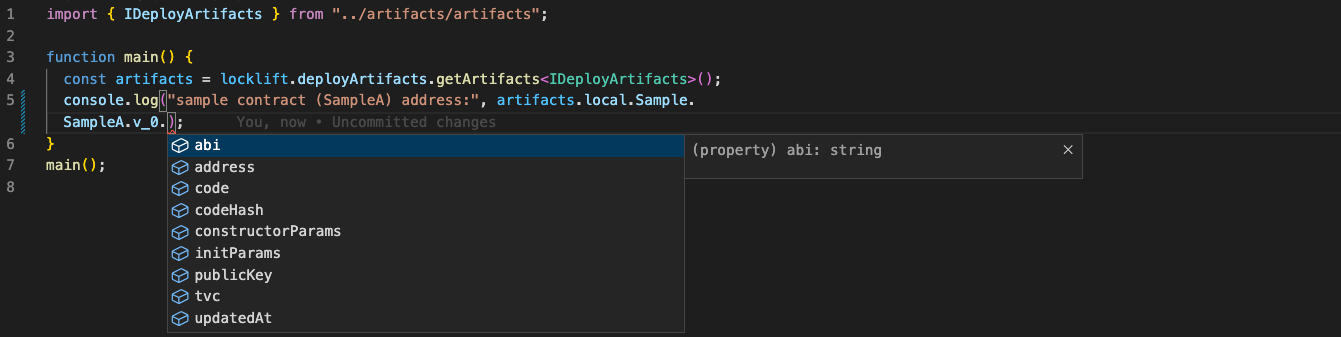
reset()
This method deletes all artifacts and resets storage:
locklift.deployArtifacts.reset();getContract()
This method returns the instance of the deployed contract.
// scripts/get_deployed_contract.ts
import { IDeployArtifacts } from "../artifacts/artifacts";

async function main() {
  const artifacts = locklift.deployArtifacts.getArtifacts<IDeployArtifacts>();

  const sampleAv0 = locklift.deployArtifacts.getContract(artifacts.test.Sample.SampleA.v0);

  const details = await sampleAv0.methods.getDetails().call();
  console.log("details", details);
}
main()
  .then(() => process.exit(0))
  .catch(e => {
    console.log(e);
    process.exit(1);
  });
deploy contract with locklift-deploy-private plugin
// locklift.config.ts
import { LockliftConfig } from "locklift";
import { FactorySource } from "./build/factorySource";

import { DeployArtifactsExtension } from "locklift-deploy-artifacts";
import { LockliftConfigExtension, PrivateDeployerExtension } from "locklift-private-deploy";
import "locklift-deploy-artifacts";
import "locklift-private-deploy";

declare module "locklift" {
  export interface Locklift<FactorySource>
    extends DeployArtifactsExtension<FactorySource>,
      PrivateDeployerExtension<FactorySource> {}
  export interface LockliftConfig extends LockliftConfigExtension {}
}
declare global {
  const locklift: import("locklift").Locklift<FactorySource>;
}

const LOCAL_NETWORK_ENDPOINT = "http://localhost/graphql";

const VENOM_TESTNET_ENDPOINT = process.env.VENOM_TESTNET_ENDPOINT || "https://jrpc-testnet.venom.foundation/rpc";
const VENOM_TESTNET_TRACE_ENDPOINT =
  process.env.VENOM_TESTNET_TRACE_ENDPOINT || "https://gql-testnet.venom.foundation/graphql";

const config: LockliftConfig = {
  privateRPC: "https://private-rpc.com/rpc",
  // ...
}
// scripts/deploy.ts
async function main() {
console.log("Starting Sample contract deployment...");
const signer = (await locklift.keystore.getSigner("0"))!;
const { contract: sample } = await locklift.deployArtifacts.deployContract(
"SampleA",
"latest",
{
contract: "Sample",
publicKey: signer.publicKey,
initParams: { _nonce: locklift.utils.getRandomNonce() },
constructorParams: { _state: 0 },
value: locklift.utils.toNano(1),
},
locklift.privateRPC.deployContract, // specify deploy function here
);
console.log("sample contract address:", sample.address.toString());
}
main()
.then(() => process.exit(0))
.catch(e => {
console.log(e);
process.exit(1);
});