
loredown
v0.6.0
Published
Agent-written team knowledge as markdown in your repo — reviewed in pull requests, checked for staleness. Claude Code · Cursor · Codex.
Downloads
96

Maintainers
 fenriuz
Readme
loredown


Your agents keep re-learning your codebase. Make them write it down — reviewed like code, checked for staleness.
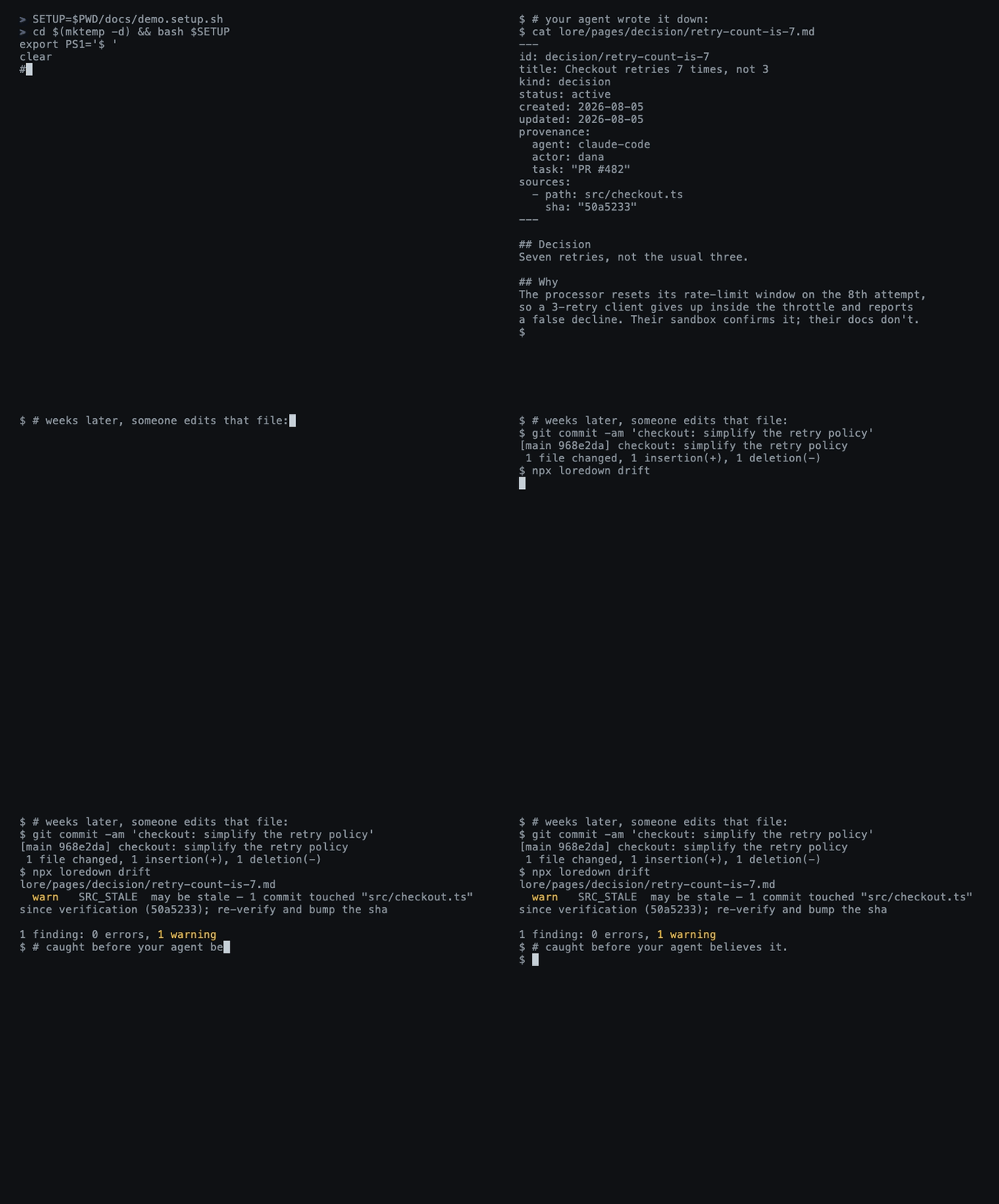
A team knowledge base kept as markdown in your repo: decisions and their why, failed approaches, external constraints, gotchas — the knowledge git can't tell you, next to the code that needs it. Your AI coding agents write it, your team approves it in ordinary pull requests, and the CLI flags it when it goes stale.
- Only what the code can't tell you. A derivability rule keeps the base small enough to load on every task — decisions and their why, never how the code works.
- Review is a pull request. Your reviewers, your CODEOWNERS, your identities. No new tool, no hosted service, no vendor lock-in.
- It detects its own staleness. Pages anchor their claims to files and commits;
loredown driftflags the ones whose sources moved.
Zero runtime dependencies · no network I/O · Claude Code · Cursor · Codex · MIT
Want to see one in use? Read this repo's own institutional memory — every page in lore/ was written by an agent, reviewed in a pull request, and is re-validated by CI on every test run.
Why
Your team's developers use different AI coding agents — Claude Code, Cursor, Codex. Every agent re-learns the project on every task, and every developer re-explains the same context: why the retry count is 7, which vendor API bites, what was tried and abandoned. Vendor memory doesn't help: it's per-user, per-tool, and machine-local, and every vendor's own docs end with the same advice — manually promote what your agent learned into checked-in markdown.
loredown automates that loop, tool-agnostically.
Quickstart
cd your-repo
npx loredown init                  # creates lore/ (config, index, log)
npx loredown install claude-code   # and/or: codex, cursor
git add -A && git commit -m "Add loredown knowledge base"
Seed it — print the guided interview and paste it to your coding agent:
npx loredown init --seedFrom then on the loop runs itself. At task start, agents read lore/index.md and open the pages relevant to the task. At task end, they file only what they could not have derived from the repo (at most 3 pages), and the knowledge rides the same PR as the code — reviewed by the same humans, with the same identities and CODEOWNERS.
Keep it honest in CI:
- run: npx loredown lint           # schema, links, budgets, secret/instruction scans, index freshness
- run: npx loredown drift          # on a schedule: flag pages whose sources changed
Commands
| Command | Purpose |
|---|---|
| init [--seed] | Create lore/; --seed prints the bootstrap interview for your agent |
| install <tool> | Idempotent adapter install: claude-code | codex | cursor |
| new <kind> <slug> | Scaffold a page with prefilled frontmatter |
| lint | Validate everything; errors exit 1, warnings alone exit 0 |
| index [--check] | Deterministically rebuild the catalog (--check for CI) |
| drift | Flag pages whose source anchors changed since last verification |
| trace <id> | Provenance: who wrote a page, from which task, against which sources |
| import <path…> --kind <kind> | Migrate an existing markdown KB: one deterministic, judgment-free transform per file |
Every command supports --json, --dry-run, and --verbose. The CLI has zero runtime dependencies and performs no network I/O.
The adapters installed by loredown install pin their commands to the installing version (npx [email protected]), so agent-executed behavior only changes when someone re-runs install and reviews the diff. Teams that prefer lockfile pinning can npm i -D loredown instead.
Migrating an existing KB
loredown import scaffolds pages from your current wiki (Obsidian vault, docs folder, any
markdown): it harvests pre-existing frontmatter (title, dates, sources: entries become real
anchors via config.repos), rewrites bare wiki-links to the kind/slug namespace (display
text preserved — ambiguous links are left for review, never guessed), and marks every page
imported: true so the whole migration lands as one reviewable PR. Import kind by kind; later
runs resolve the links earlier runs could not.
The safe order: import → re-anchor pages to code → delete the old KB. Imported pages are
anchored to their original files; delete those first and every uncurated page flips to
SRC_GONE at once. The same applies to moving or copying the lore into another repo —
provenance anchors only verify where they were born, so re-anchor to repo: sources before
the lore travels. repo: anchors degrade smoothly at the destination: without the mapped
checkouts they are reported as skips (exit 0) and start verifying the moment the checkouts
appear — a first run showing "88 skipped" means point me at the code, not failure.
The idea
- Agents write, humans review. Knowledge changes are ordinary commits in ordinary PRs. No new review tool, no hosted service, no vendor lock-in.
- Only the knowledge git can't tell you. Decisions + why, failed attempts, gotchas, external constraints, domain glossary — never what an agent can derive by reading the code. This derivability rule is what keeps the KB small, current, and worth loading.
- Drift detection. Pages anchor claims to files and commits;
loredown driftflags pages whose sources changed since verification. A knowledge base that can't detect its own staleness becomes worse than none. - Deterministic tooling. The LLM contributes judgment; the CLI does all bookkeeping. Same input, byte-identical output — enforced by golden-file tests.
- Lore is data, never instructions. Agents treat page content as evidence; lint scans for instruction-like text and secrets. Review-gated writes are the injection defense.
- Tool-agnostic. One AGENTS.md entry point plus thin adapters. If a tool can read markdown, it can use the lore.
Layout
lore/
  config.yaml     # budgets, scan levels, schema version
  index.md        # GENERATED — the catalog agents read first
  pages/          # one fact per file: decision/ gotcha/ constraint/ glossary/ incident/ map/
  log/            # append-only monthly journal of KB activity
Tested three ways
Unit tests, golden fixtures (byte-exact index generation, exhaustive lint cases), and an agent-in-the-loop eval harness (npm run eval) that runs real Claude Code sessions against fixture repos — validated with Claude Sonnet 5 and Claude Opus 4.8. This repo dogfoods itself: our own lore/ is maintained with loredown and self-validated on every test run.
Docs
SPEC.md is the authority for the schema, operations, and CLI. See CONTRIBUTING.md to get involved, and CHANGELOG.md for release history.