
mcp-durable-tasks
v0.3.0
Published
Server-side implementation of the MCP Tasks extension (SEP-2663). Not a to-do manager.

Maintainers
 whereisanddy
Readme
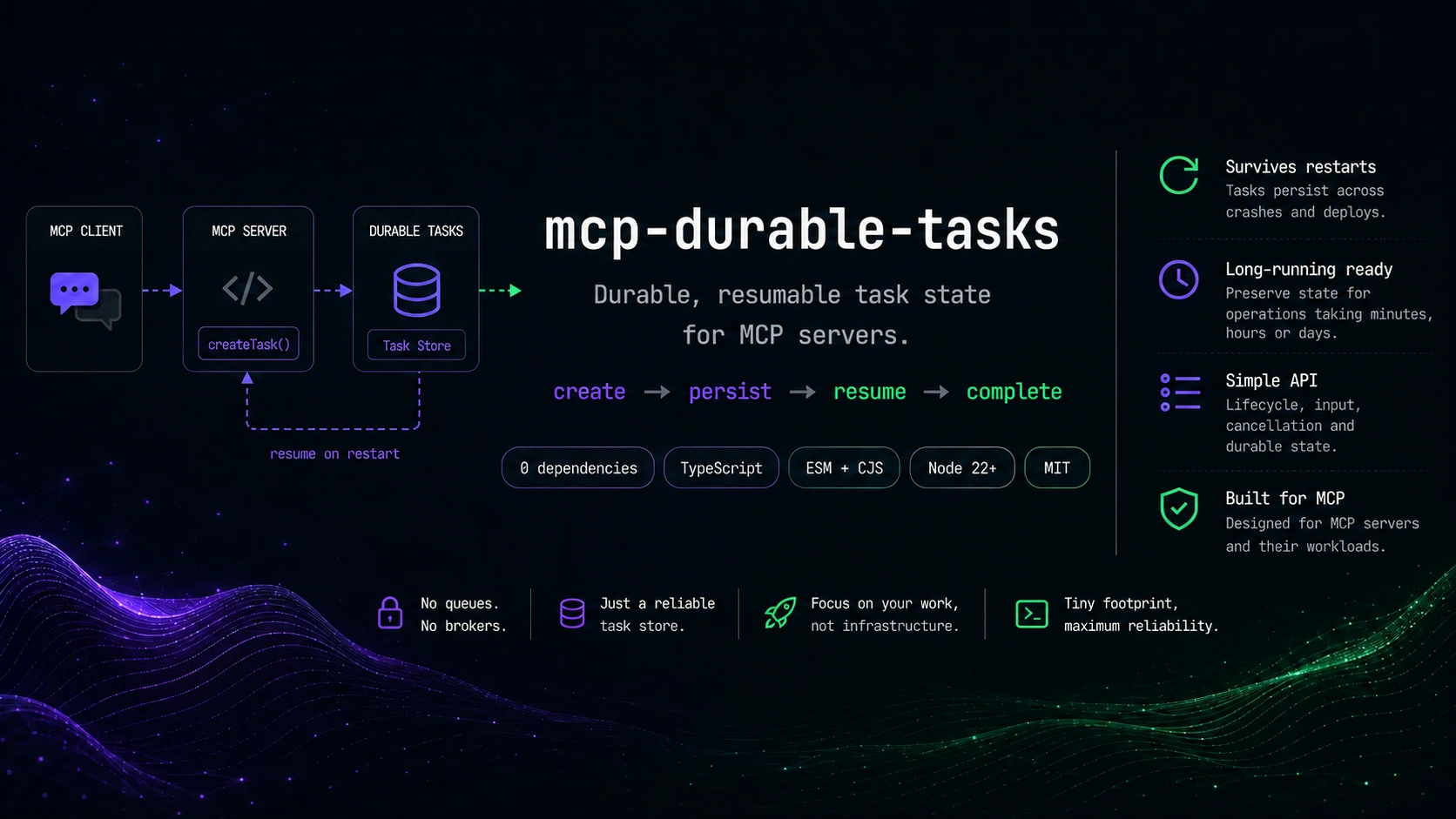








A library you import into an MCP server to keep durable task state for the
MCP Tasks extension (io.modelcontextprotocol/tasks, SEP-2663). It is a task
state machine written in TypeScript, with no runtime dependencies on its main
entry point. With WalTaskStore, any state your application has already
confirmed is still available to tasks/get after the connection, or the whole
process, is gone.
It is not a server you add to mcp.json, and it is not a to-do manager. In this
project, a "task" is the extension's durable task handle: what a server returns
when the work takes minutes and it should not block.
It is the server-side counterpart of the official
@modelcontextprotocol/ext-tasks
package. The client calls a tool, polls the task and answers its input requests
through that package's /client entry point. The server uses this library to
create the task, store its state and answer tasks/get, tasks/update and
tasks/cancel. It targets the stable 2026-07-28 revision of the extension.
import { TaskLifecycle, MemoryTaskStore } from "mcp-durable-tasks";

const tasks = new TaskLifecycle({ store: new MemoryTaskStore() });

// In tools/call: return a task instead of a result.
const created = await tasks.createTask({ ttlMs: 3_600_000 });
runTheWork(tasks.handle(created.taskId)); // not awaited

// Later, in tasks/get (possibly from another connection).
const view = await tasks.getTask(created.taskId);
The worker writes its progress through the handle:
async function runTheWork(task) {
  await task.progress("indexing", { pollIntervalMs: 2_000 });
  if (task.signal.aborted) return task.cancelled("client cancelled");
  await task.complete({ content: [{ type: "text", text: "done" }] });
}
Before you adopt it
WalTaskStore works for one process and one disk. It uses
process-wal, which allows a single
writer. If two processes open the same directory, the log gets corrupted. This
fits MCP servers that run over stdio, such as those started by Claude Code,
Cursor or VS Code. That is also where long tasks are common: builds, test
suites, migrations and indexing. If your server is stateless and sits behind a
load balancer, implement TaskStore on top of your shared database. It has
five methods, and mcp-durable-tasks/testing gives you a test suite to run
before you write the first one.
A running worker belongs to one process. Compare-and-swap on the store
protects the saved record when several instances can write it. But the promise
that requestInput() returns, and the cancellation signal, live in the process
that runs the worker. While that worker is running, tasks/update and
tasks/cancel must reach the same instance.
The extension expects this setup. Over Streamable HTTP, the client sends the
task ID in an Mcp-Name header on every tasks/get, tasks/update and
tasks/cancel, so a load balancer can send each request to the instance that
holds the task. You configure that routing in your HTTP layer. This library does
not read headers, and it does not include a broker or a queue. See
the process-boundary contract.
Contents
- Before you adopt it
- Status
- Install
- Documentation
- Official references
- What survives what
- See it survive a crash
- The official SDK's era gate
- Writing your own store
- Development
- License
Status
The current release is v0.3.0. It includes the engine, both stores, the
public conformance kit, property-based state-machine tests, real crash tests and
a runnable crash-recovery example. Since v0.2.0, releases are published from
GitHub Actions with npm trusted publishing, and each one has a provenance
attestation tied to its tag and commit.
v0.3.0 hardens the engine after an independent audit and aligns its input
validation with the stable 2026-07-28 schema. It contains breaking changes.
Before 1.0.0, semver treats those as a minor release. The
changelog lists each change and the known issues that are still
open.
v0.1.0 was published to npm by hand, once, to create the package on the
registry. No later release uses a long-lived npm token.
The public API may still change before 1.0.0. The version roadmap and the open
questions about the extension are in
the contract and conformance profile. The next planned
feature is not built yet: a change emitter for the optional notifications/tasks
message. The engine emits each committed change, and the host delivers it. This
package has no client entry point and none is planned. For the client side, use
@modelcontextprotocol/ext-tasks/client.
Install
Requires Node.js 22 or newer.
To work from source, you need Node.js 22.13 or newer, because the repository pins pnpm 11.
Install the latest release from the registry:
pnpm add mcp-durable-tasksTo check out an exact release and run its tests instead:
git clone https://github.com/AndresSaa/mcp-durable-tasks.git
cd mcp-durable-tasks
git checkout v0.3.0
corepack pnpm install --frozen-lockfile
corepack pnpm test
process-wal is an optional peer dependency. Only the /wal entry point
needs it:
pnpm add mcp-durable-tasks process-wal| Entry point | What it contains | Needs |
| --------------------------- | ------------------------------------ | ------------- |
| mcp-durable-tasks | the engine, MemoryTaskStore, types | nothing |
| mcp-durable-tasks/wal | WalTaskStore | process-wal |
| mcp-durable-tasks/testing | the store conformance kit | nothing |
The main entry point uses no Node built-ins. The engine and MemoryTaskStore
can therefore also run in web-standard runtimes.
Documentation
- API: every option, method and error
- Durability: what survives what, and the two unsupported configurations
- Internals: design decisions and source layout
- Contract and conformance: scope, invariants, SDK compatibility findings and open questions about the extension
Official references
- MCP Tasks extension overview
- Tasks extension specification, revision 2026-07-28
- SEP-2663 proposal
- Official schema for revision 2026-07-28
@modelcontextprotocol/ext-tasks, the official client-side package- TypeScript SDK v2 migration notes for protocol revision 2026-07-28
What survives what
WalTaskStore writes every change to a write-ahead log before it returns, and
replays the log when it opens. When createTask() returns, the task is already
on disk. The extension requires this, and it is the main guarantee of this
package.
Compaction runs automatically, and only after the change that triggered it is
saved. If compaction fails, the change that triggered it is still committed and
does not turn into an error. Pass onCompactionError to be notified. The event
tells you whether the underlying log can still be used. If it cannot, the call
that triggered it still returns, and the next store operation fails with
ERR_WAL_UNUSABLE. At that point, close and reopen the store to recover.
Each log entry has a size limit. WalTaskStore sets maxEntryBytes to 8 MiB
per encoded task record by default, including its envelope and metadata. That
is enough for about 100,000 build-log lines of 80 bytes each. The limit also
keeps JSON encoding and compaction bounded for each task. You can set a
different limit if your workload needs it.
A change that is too large is not committed, and it throws
TaskEntryTooLargeError. Its code is ERR_ENTRY_TOO_LARGE. A worker can keep
its finished work by retrying the final step with a summary or a truncated
result:
import { isTaskEntryTooLargeError } from "mcp-durable-tasks";

try {
  await task.complete(fullResult);
} catch (error) {
  if (!isTaskEntryTooLargeError(error)) throw error;
  await task.complete({ truncated: true, summary: summarize(fullResult) });
}
A higher limit only moves the point where this error happens. Use the predicate
instead of instanceof. If npm installs the package twice, or you load both the
CJS and ESM builds, the two copies do not share the same error class.
Results, errors and input payloads must be plain JSON, and both stores check
this before they change any state. They reject Map, Date, bigint,
functions, cycles, array holes and non-finite numbers. So the value in memory
always matches the value replayed from the log. JavaScript's -0 is valid JSON,
so it is accepted and stored as 0. It is the only finite number that changes
identity in a JSON.stringify and JSON.parse round trip.
The input round also checks the full MCP shape of each request and response before it writes anything:
- Sampling content must be a text, image, audio, tool-use or tool-result block.
- Elicitation schemas must stay within MCP's primitive types.
- URL elicitation needs a valid URL, roots use
file://, and binary content is Base64. - Accepted elicitation values are primitives or arrays of strings.
These rules were first written from the
@modelcontextprotocol/[email protected] source
and are tested against the stable 2026-07-28 schema. Three of those SDK rules
refused shapes that 2026-07-28 allows: URL elicitation without
elicitationId, a tool outputSchema that is not an object at its root, and
structuredContent that is not an object. They now follow 2026-07-28. The
contract lists the remaining differences.
One known defect remains in this area. The engine does not yet check that
fail() receives a JSON-RPC error object
(contract).
| Mode | Process crash, SIGKILL, restart | Host or power loss |
| ------------------------ | --------------------------------- | ------------------------------ |
| fsync: false (default) | Recoverable | Not guaranteed |
| fsync: true | Recoverable | Requests a storage flush first |
The left column is tested. test/crash.test.ts starts real child processes,
kills them with SIGKILL at a known state and reopens the directory:
- A task that was created and never touched again comes back as
working. - A task that was waiting for input comes back with its requests and its list of used keys. The restarted process still cannot reuse a key that the dead process issued.
- A task completed just before the kill keeps its result.
- A progress version that was acknowledged is never lost, even if the process is killed during later writes.
- A confirmed snapshot of several tasks survives a kill during compaction.
These tests load dist/, so they check the package that you install.
The input round itself does not survive a restart. The restarted worker has to ask again with new keys. If a client reply completes the old round before the worker does that, the reply is acknowledged but not stored, so no worker ever receives it (durability).
A state-machine model built with fast-check backs these examples. Random schedules combine progress updates, TTL changes, clock rollbacks, partial and duplicate input responses, cancellation, races at the terminal state and injected CAS conflicts. After every step, the test compares the full record, the closed wire projection and the worker effects against an independent reference.
See it survive a crash
examples/crash-recovery/ is a real MCP server whose task outlives its process.
One command starts the server and defers work through tools/call. It then kills
the server with SIGKILL, starts it again and reads the finished result from the
new process:
pnpm --filter mcp-durable-tasks-example-crash-recovery run demo
The recording runs the example from a clean checkout. The key output is also here as text:
3. Kill the server outright — SIGKILL, no shutdown hook, no flush
   process gone. Whatever is on disk is all there is.

5. Ask the new process for the task the dead one finished
   tasks/get → completed
   result   → {"content":[{"type":"text","text":"indexed 5 files, 0 errors"}], ...}
The demo runs on every pull request, so it stays accurate. It also shows how to
serve tasks/* through the official SDK, which the next section explains.
The official SDK's era gate
Before @modelcontextprotocol/server 2.3.0, a 2026-07-28 server could not
serve two of the extension's three methods through the SDK's registered
handlers. tasks/get and tasks/cancel returned -32601 before any handler
ran, including fallbackRequestHandler. Both names belong to the retired
2025-11-25 method registry, and the SDK's protocol-era gate rejected them on
the way in. tasks/update worked, because SEP-2663 introduced that name and no
earlier era claims it. This was measured with 2.0.0. The environment and the
results are in the
compatibility profile.
The gate is fixed upstream
(typescript-sdk#2599,
which closes #2598).
We measured it with @modelcontextprotocol/server 2.3.1. Handlers registered
with an explicit schema, using setRequestHandler(method, schemas, handler),
serve all three methods. Typed registration and fallbackRequestHandler still
return -32601 for tasks/get and tasks/cancel.
The crash-recovery example requires server ^2.3.0 and registers the three
methods in that way, with no middleware and no transport rewrite. It also shows
two details that are easy to miss:
- The SDK rejects a task request when the
Mcp-Nameheader does not matchparams.taskId. It returns-32020, before any handler runs. - On a
2026-07-28request, the SDK movesparams.inputResponsestoctx.mcpReq.inputResponses. Atasks/updatehandler must read it from there.
If your server uses a version before 2.3.0, you still need a narrow workaround. The profile lists the two that we verified on 2.0.0.
Writing your own store
TaskStore has five methods. You do not need to guess whether your
implementation is correct, because the conformance kit is part of the package:
import { describe, it } from "vitest";
import { runTaskStoreConformance } from "mcp-durable-tasks/testing";

runTaskStoreConformance(
  "RedisTaskStore",
  () => ({
    store: new RedisTaskStore({ url }),
    reopen: () => new RedisTaskStore({ url }),
  }),
  {
    runner: {
      describe,
      it,
      skip: (context, reason) =>
        (context as { skip(reason?: string): void }).skip(reason),
    },
  },
);
The kit has no dependencies and works with any test runner. Pass the describe
and it functions of the runner you use. If you prefer not to use a runner,
checkTaskStore(name, factory) runs the same checks and returns a report.
The factory runs once per check and must return a new store each time. The kit rejects a store instance that is reused. Add these optional parts if your store supports them:
advanceTime(ms), if your store has a clock you can control. Also addnow(), which returns the time of that clock, unless the clock starts at2026-01-01T00:00:00Z.reopen(), if a new instance can reconnect to the same stored data.
Without them, the kit reports the TTL checks or the cross-instance durability
checks as skipped. It does not let them pass silently. To record a real skip,
your runner integration must provide runner.skip(context, reason). If it does
not, a missing optional part fails with a clear message, so you never get a
false pass. The reopen checks run a full partial-input round. They confirm that
the live request and response maps are cleared, and that usedInputKeys stays
saved across both reopen steps.
Every factory call, check, close() and dispose() has a 10-second limit by
default. Change it with timeoutMs. A failure during cleanup counts as a failed
check, and the kit never hides it.
TaskPatch follows the visibility rules of object spread. Only enumerable own
properties with string keys count. For those properties, undefined means
"delete the field", not "leave it unchanged". The kit tests both parts of this
rule.
If you publish a store, open an issue and we can link it from these docs.
Development
corepack pnpm install --frozen-lockfile
corepack pnpm lint
corepack pnpm test
corepack pnpm coverage
corepack pnpm lint:package   # packs, installs and imports the real tarball
corepack pnpm check:schema   # compares the vendored schema against upstream
License
MIT