
mesh-share
v1.1.4
Published
Decentralised, serverless peer-to-peer file transfer CLI over a Kademlia DHT — mesh send / mesh receive
Downloads
795

Maintainers
 subhodeepsamanta
Readme
mesh
Send a file from one terminal to another — anywhere on Earth. No accounts, no upload servers, no configuration.





npm install -g mesh-share# machine A
$ mesh send movie.mp4
Share this code with the receiver:
AIB2Z-ROQMU-H2DQF-ILAA5-AURPD-YNNPU-...
# machine B — any network, any country
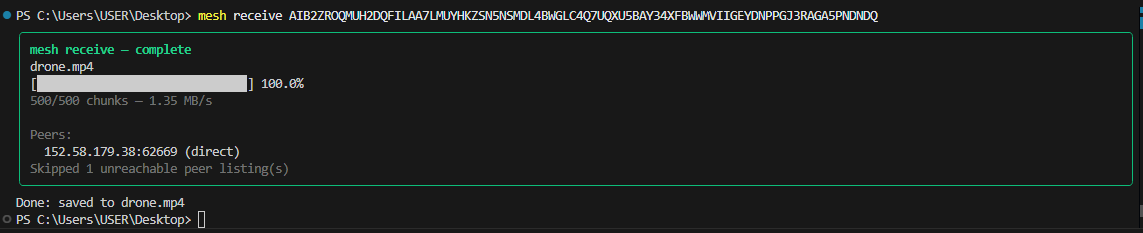
$ mesh receive AIB2ZROQMUH2DQFILAA5AURPD...
[██████████████████████████████] 100.0% ✔ saved to movie.mp4
What makes it different
Two mesh processes find each other over a Kademlia DHT and transfer the file directly, end-to-end encrypted, verifying every chunk against a Merkle proof. The entire network stack is implemented from scratch in this package — which is why npm install pulls zero runtime dependencies:
- 🕸 Kademlia DHT for peer discovery — the share code is self-contained (peer addresses + the file's SHA-256 Merkle root); no server interprets it
- 🔓 NAT traversal ladder — direct TCP → automatic UPnP port-mapping → TURN relay fallback, tried in order, automatically
- 🔐 End-to-end encryption — ephemeral X25519 key exchange, HKDF, AES-256-GCM; relays only ever see ciphertext
- ✅ Cryptographic integrity — every chunk ships with a Merkle proof chained to the root embedded in the share code; corrupt or malicious data is rejected and re-fetched
- 🚦 Reliable transport over UDP — hand-written sliding-window ARQ with exponential backoff, built to survive mobile-hotspot stalls
- 💪 Self-healing — if every connection drops mid-transfer, the receiver re-discovers the seeder via the DHT and continues from the last verified chunk automatically
- ⏸ Pause / resume —
Ctrl+Ccheckpoints progress to a.meshstatesidecar; run the same command again to continue - 🌱 Chain seeding —
--seedkeeps serving after your download completes, so swarms grow like BitTorrent - 📦 One-file install — the published package is a single bundled script (~500 kB, 3 files)
Commands
| Command | Purpose |
|---|---|
| mesh send <file> | Index, seed, and print a share code. Keeps serving until Ctrl+C |
| mesh receive <code> | Discover, connect (direct or relayed), download with per-chunk verification |
| mesh receive <code> --out <path> | Choose where the file lands |
| mesh receive <code> --seed | Keep seeding to other peers after your download finishes |
| mesh daemon | Run a public DHT bootstrap node (for self-hosters, e.g. on a VPS) |
| mesh diagnose | Report LAN IP, STUN-observed public IP, and UPnP support |
Zero-flag by design
mesh send ./file just works: the package ships a default public DHT bootstrap node (the same way BitTorrent clients ship default DHT routers) and fetches short-lived TURN relay credentials automatically — no secret is embedded in this package. Everything is overridable for self-hosting:
| Flag | Env var | Purpose |
|---|---|---|
| --bootstrap <host:port> | MESH_BOOTSTRAP | Use your own DHT bootstrap node (--no-bootstrap to join none) |
| --turn-host / --turn-port / --turn-secret | MESH_TURN_HOST / _PORT / _SECRET | Use your own coturn (--no-turn disables the relay tier) |
| — | MESH_TURN_API | URL returning { iceServers } credentials (like the signaling server's /turn) |
| --public-ip <ip> | MESH_PUBLIC_IP | Skip discovery; announce this address (VPS with static IP) |
| --port / --dht-port | — | Pin the TCP transfer / UDP DHT ports |
| --no-upnp / --no-stun / --no-tui | — | Disable router mapping / public-IP discovery / the fancy terminal UI |
How a transfer actually works
mesh sendstreams the file once, hashing every chunk (adaptive 64 kB–32 MB) into a Merkle tree — the root becomes the file's identity.- It works out how the world can reach it: UPnP mapping if your router allows, otherwise STUN for your public address, plus a TURN allocation as the guaranteed fallback — then announces itself on the DHT every 25 s.
- The share code encodes up to 4 address candidates + the 32-byte Merkle root in base32. It is not a lookup key — it is the connection information.
mesh receivebootstraps into the DHT from those candidates, finds all seeders inO(log N)hops, and climbs the connection ladder per peer: parallel direct dials first, encrypted relay-to-relay through TURN if both sides are NATed.- Chunks download pipelined across up to 30 seeders; each is decrypted, hash-checked, and Merkle-verified before being written at its exact offset. Peers serving bad data get five strikes, then eviction.
Requirements
Node.js 18+. Windows, macOS, Linux.
The bigger project
This CLI is half of mesh — there's also a browser version at mesh-share.vercel.app (WebRTC, same Merkle verification, streams multi-GB files to disk, plays videos while they download). Source, architecture docs, and the signaling/TURN deployment for self-hosting live in the monorepo:
→ github.com/SubhodeepSamanta/Mesh
ISC © Subhodeep Samanta