
moduix
v1.0.5
Published
Composable React UI components built on Base UI primitives.

Maintainers
 blinks44
Readme
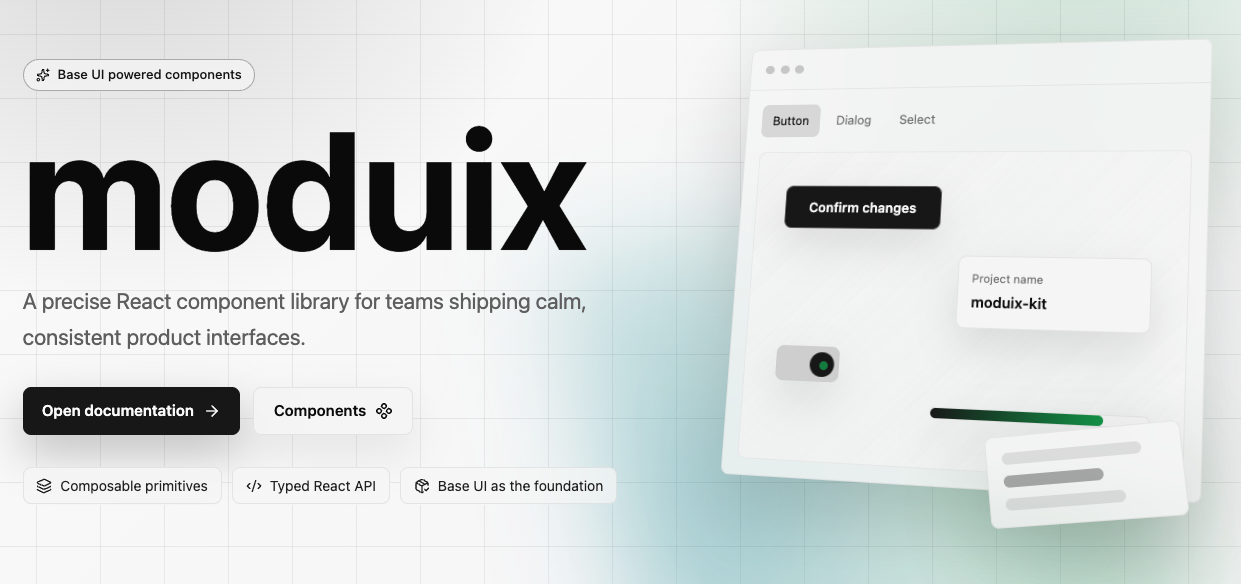



moduix
Composable React components for product interfaces, built on top of Base UI primitives.
moduix gives you ready-made components with accessible behavior, native CSS styles, and a composition-first API. It is inspired by the clarity of shadcn/ui, and it is trying to combine two useful workflows: install components as a regular npm package when that fits your project, or copy component source when you need direct ownership.
Why It Exists
moduix started as an internal tool for shared product UI. We needed a component library that was practical enough for real application screens, predictable enough to use across teams, and small enough to stay easy to understand.
The library is now public because it may be useful outside of the original company context. If it helps another team build consistent interfaces faster, that is already a good outcome.
Principles
- Base UI underneath. Components are built on accessible Base UI primitives instead of reimplementing low-level interaction behavior.
- Small dependency surface. Base UI is the only external UI primitive layer. The package keeps the runtime stack intentionally small and does not bring a styling framework with it.
- Two installation paths. Use moduix as an npm package, or copy component source into your project when direct ownership is more important than package-managed updates.
- Composable API. Components are exposed as named parts, so complex UI can be assembled without hiding important structure.
- Native CSS. Styles are distributed as CSS, use CSS custom properties, and are designed to work with your existing styling approach.
- Not a shadcn/ui competitor. shadcn/ui is a major inspiration for the developer experience. moduix explores whether package-managed components and copy-owned components can coexist in one library.
Installation
moduix supports two installation paths:
- Install the library as a regular npm package when you want package-managed updates.
- Install component source into your own project with
shadcnwhen you want direct ownership.
| Choose this path | When it fits best |
| --------------------------- | ---------------------------------------------------------------------------------------------------------------------- |
| npm package | You want the fastest setup, package-managed updates, imports from moduix, and styles from moduix/style.css. |
| shadcn copy-owned install | You want generated source files inside your app, direct local customization, and imports from @/components/moduix/*. |
npm package
npm install moduix @base-ui/reactreact, react-dom, and @base-ui/react are peer dependencies. They stay in your application
bundle, so moduix does not ship duplicate React or Base UI runtimes.
shadcn copy-owned install
shadcn can install selected moduix components from the GitHub registry directly into your project.
The files become part of your codebase instead of staying in node_modules.
Make sure your project resolves the @/* alias to src/* in both tsconfig.json and
tsconfig.app.json, and mirror it in your bundler config.
Create components.json in the project root. Current workaround while shadcn custom registry
base init still fails for this setup:
{
  "$schema": "https://ui.shadcn.com/schema.json",
  "style": "new-york",
  "rsc": false,
  "tsx": true,
  "tailwind": {
    "config": "",
    "css": "src/index.css",
    "baseColor": "neutral",
    "cssVariables": true,
    "prefix": ""
  },
  "iconLibrary": "lucide",
  "rtl": false,
  "aliases": {
    "components": "@/components",
    "utils": "@/lib/utils",
    "ui": "@/components/ui",
    "lib": "@/lib",
    "hooks": "@/hooks"
  },
  "registries": {}
}
npx shadcn@latest add Blinks44/moduix/button
npx shadcn@latest add Blinks44/moduix/accordionThe registry install also pulls in the shared moduix foundation files those components need, such as styles, icons, and small utilities.
Import the generated foundation stylesheet once in your application entry point:
import '@/lib/moduix/styles/style.css';If you want the optional reset in the copy-owned path, import it explicitly before the main stylesheet:
import '@/lib/moduix/styles/reset.css';
import '@/lib/moduix/styles/style.css';
With the aliases above, generated files land in src/components/moduix/* and src/lib/moduix/*.
Usage
Import the required foundation stylesheet once in your application entry point:
import 'moduix/style.css';This stylesheet is required. It provides the shared design tokens and base styles that component CSS depends on.
If you want the optional reset, import it explicitly before the main stylesheet:
import 'moduix/reset.css';
import 'moduix/style.css';
Then import and compose the components you need:
import { Button, Dialog, DialogContent, DialogTitle, DialogTrigger } from 'moduix';

export function Example() {
  return (
    <Dialog>
      <DialogTrigger render={<Button />}>Open dialog</DialogTrigger>
      <DialogContent>
        <DialogTitle>Project settings</DialogTitle>
      </DialogContent>
    </Dialog>
  );
}
style.css ships the shared design tokens and base styles. Component imports still bring along only
the component CSS they use.
Styling
Components accept className where customization is expected and expose stable data-slot
attributes for targeted styling. Theme values are regular CSS custom properties:
:root {
  --color-primary: oklch(0.205 0 0);
  --button-radius: 0.5rem;
}
Library CSS is organized with cascade layers:
@layer ui.reset, ui.tokens, ui.components;This keeps defaults predictable while still letting application styles override tokens, classes, or component-level variables.
What Is Included
The package exports composed components for common product UI needs, including Accordion, AlertDialog, Autocomplete, Avatar, Button, Checkbox, Dialog, Drawer, Field, Form, Input, Menu, NavigationMenu, Popover, Select, Tabs, Toast, Tooltip, and supporting primitives.
Documentation
- Documentation: https://moduix.blinks44.workers.dev/
- npm package: https://www.npmjs.com/package/moduix
- UI package README:
packages/ui/README.md - Docs app README:
apps/docs/README.md
Repository Quick Start
From the monorepo root:
npm install
npm run build:ui
npm run dev
Acknowledgements
This project could not exist without the work of these teams and communities:
- Base UI for the accessible React primitives that power the components.
- shadcn/ui for the API inspiration and the culture of practical, readable component composition.
- Tailwind CSS for the reset.css implementation.
- Fumadocs for the documentation foundation.
- TanStack for the application tooling used by the docs.
- Voidzero for awesome JS tools
Contributing
Contributions are welcome, especially bug reports, accessibility fixes, documentation improvements, and focused component improvements.
Before opening a pull request:
Install dependencies from the repository root:
npm installBuild the UI package when your change affects
packages/uior documentation examples:npm run build:uiRun the required checks:
npm run fmt:fix
npm run lint:check
npm run tsc:check
Keep pull requests small and specific. For component changes, update the related stories, exports, and documentation so the package and docs stay in sync.
Feel free to use agents or code generation tools, but
please review the result before submitting. The components are intentionally small and direct,
so the goal is to keep the code readable, maintainable, and free from unnecessary abstractions.
I added the skills folder so code written with agents stays consistent with the rest of the
library components.