
n8n-nodes-bion2n
v0.0.3
Published
Provides a set of nodes for n8n to interact with biodiversity informatics APIs including Bionomia, Barcode of Life (BOLD), Catalogue of Life (COL), ChecklistBank, Global Biodiversity Information Facility (GBIF), Global Names Architecture, Global Biotic In


Readme
n8n-nodes-bion2n
Biology Node to Node (BioN2N) is an open source project to develop biodiversity informatics nodes for the powerful workflow automation platform, n8n.io, which enables building complex data workflows fast with little to no programming experience.
Contents
Abstract
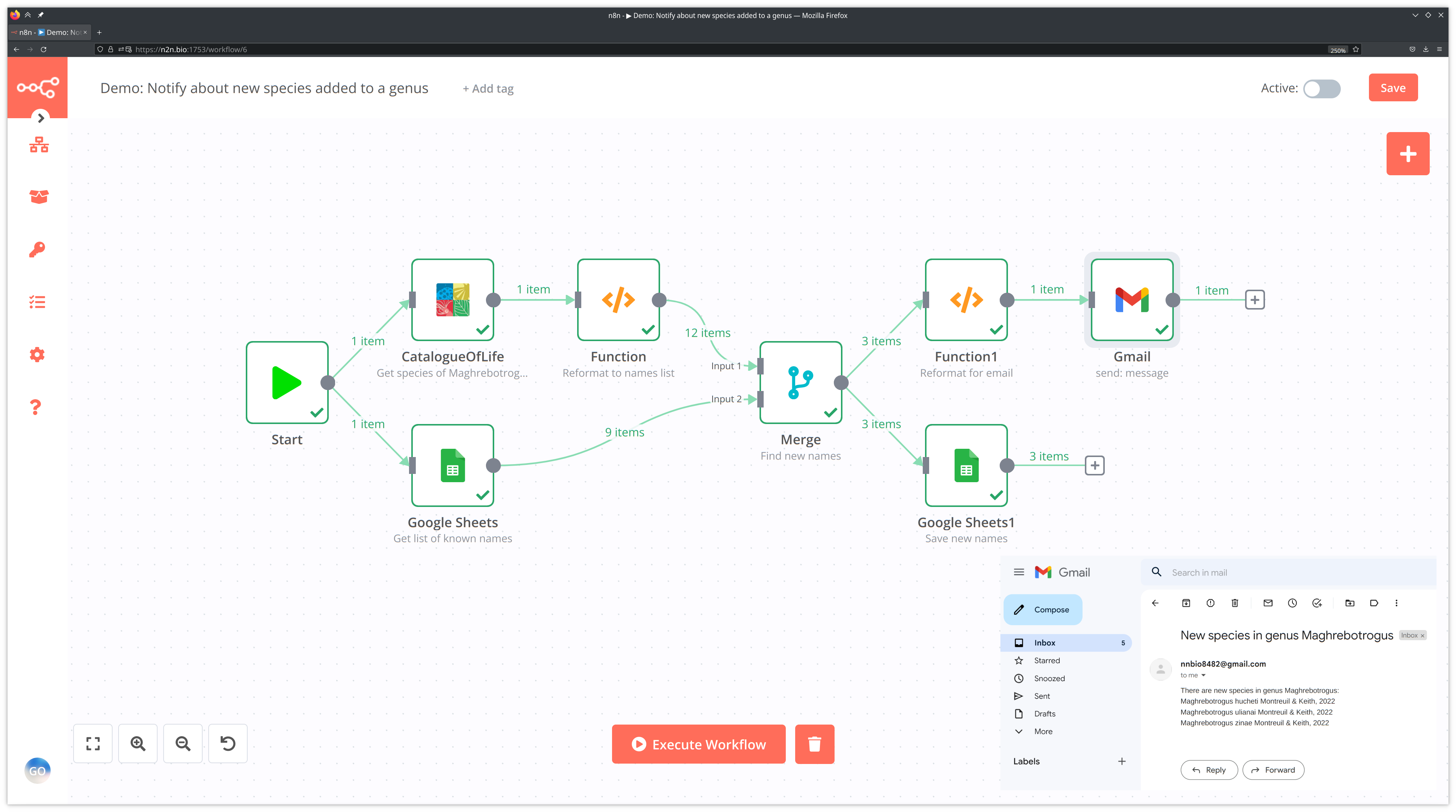
A vast amount of biodiversity data is available from many different biodiversity informatics APIs. However, in order for scientists with little to no programming experience to use data from these APIs for their research, it could potentially require a significant time investment to learn a programming language, develop, and rigorously test the software. The emergence of no-code and low-code software architecture [1, 2] could potentially empower non-programmers with the ability to utilize biodiversity informatics APIs, helping to make these APIs more accessible to a broader number of people. Instead of writing scripts, no-code/low-code applications offer flexible graphical user interfaces that can make it easier to explore and learn APIs, and quickly construct complex data processing workflows. One such open source low-code application is n8n.io, which is a powerful workflow automation platform. Within n8n, nodes are the basic unit of work and can take input, perform processing, and return output. To build an automation workflow, any nodes needed are added to the workspace and their inputs and outputs are connected together. For example, if you wanted to be notified about new species added to a genus in Catalogue of Life (CoL), you could query the CatalogueOfLife node for all species in genus Maghrebotrogus, use the GoogleSheet node to check if each species is in your known list of species spreadsheet, use the Gmail node to send an email notification about any new species, save any new species to your list of known species with the GoogleSheet node, and run the automated workflow on a schedule (see Demo 1). Over 220 popular internet APIs have been wrapped into nodes within n8n, which could additionally allow integrating scientific knowledge with many other services on the internet. A major advantage offered by the n8n automation platform is that reusable workflows can be shared as templates, which could enable building a collaborative community of biodiversity informatics API users.
BioN2N is an open source project to develop and maintain n8n nodes to wrap biodiversity informatics APIs that will be contributed back upstream to the n8n project. So far nodes have been developed for Barcode of Life, Bionomia, Catalogue of Life, ChecklistBank Datasets, Global Biodiversity Information Facility, Global Names, Integrated Taxonomic Information System, Open Tree of Life, TaxonWorks, Wikidata, ZooBank, and additional nodes are under development (please open an issue ticket if you want a biology API wrapped).
Available nodes
Currently these APIs have nodes provided through BioN2N:
- Barcode of Life (BOLD)
- Bionomia
- Catalogue of Life (COL)
- ChecklistBank Datasets
- Global Biodiversity Information Facility (GBIF)
- Global Biotic Interactions (GloBI)
- Global Names Architecture (GNA)
- Integrated Taxonomic Information System (ITIS)
- OpenAlex
- OpenRefine
- Open Tree of Life
- TaxonWorks
- Unpaywall
- Wikidata
- ZooBank
Need other nodes? Please open an issue ticket. Code contributions are also welcome!
Installation
Follow the n8n guide on self-hosting the community edition of n8n.
Login to your local installation of n8n, which following the standard installation process will be located at: http://localhost:5678
Navigate to the community nodes settings.
Click the
Install a community nodebutton.Type in n8n-nodes-bion2n, check the box indicating that you understand the risks of installing unverified code from a public source, and click install.
The BioN2N nodes will be available in your workspace. Search for any of the nodes.
Demo workflows
The bulk of this work focused on developing a generalized workflow automation tool by creating biodiversity informatics nodes for n8n. The biodiversity informatics community will very likely come up with much better use cases, but here are some simple examples of potential workflow automations to demonstrate how n8n works:
Demo 1: Notifying about new species in a genus
This automated workflow checks if new species have been added to the genus, Maghrebotrogus, using the CatalogueOfLife node. If a species is not in the GoogleSheet list of known species, an email notification is sent using the Gmail node, and the new species are added to the list of known species GoogleSheet.
Demo 2: How to use the Wikidata external identifier registry to access biodiversity informatics APIs
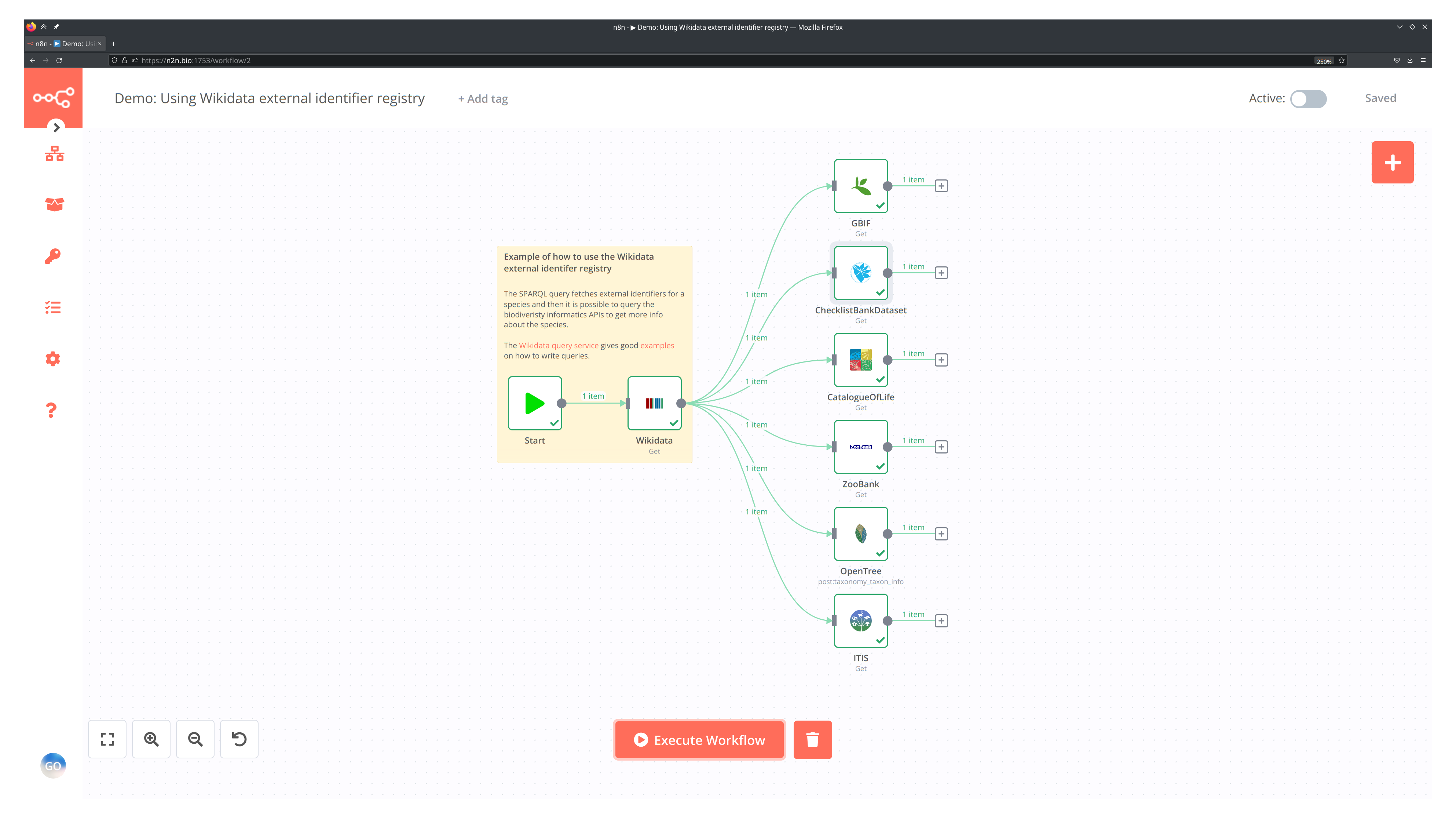
This demo shows how to use the Wikidata Query Service to access biodiversity informatics external identifiers, which in turn can be used to access data about species from the biodiversity informatics nodes.
Demo 3: Recording scientific names mentioned on social media
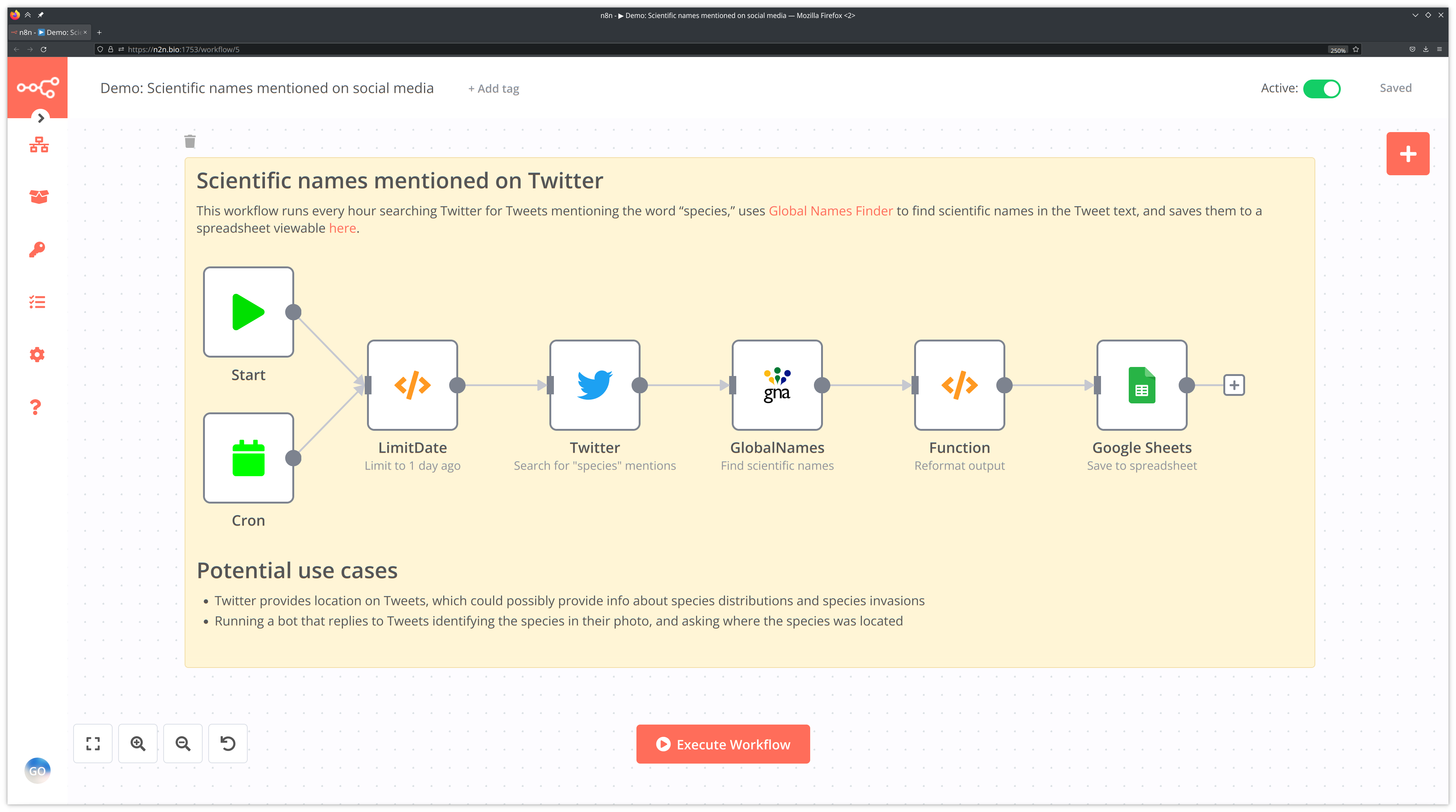
This automatic workflow searches for mentions of "species" within a sample of Twitter tweets posted in the last 24 hours, uses the GlobalNames node wrapping the GNFinder service to find any scientific names mentioned in the tweet text, and saves the output to a GoogleSheet spreadsheet.
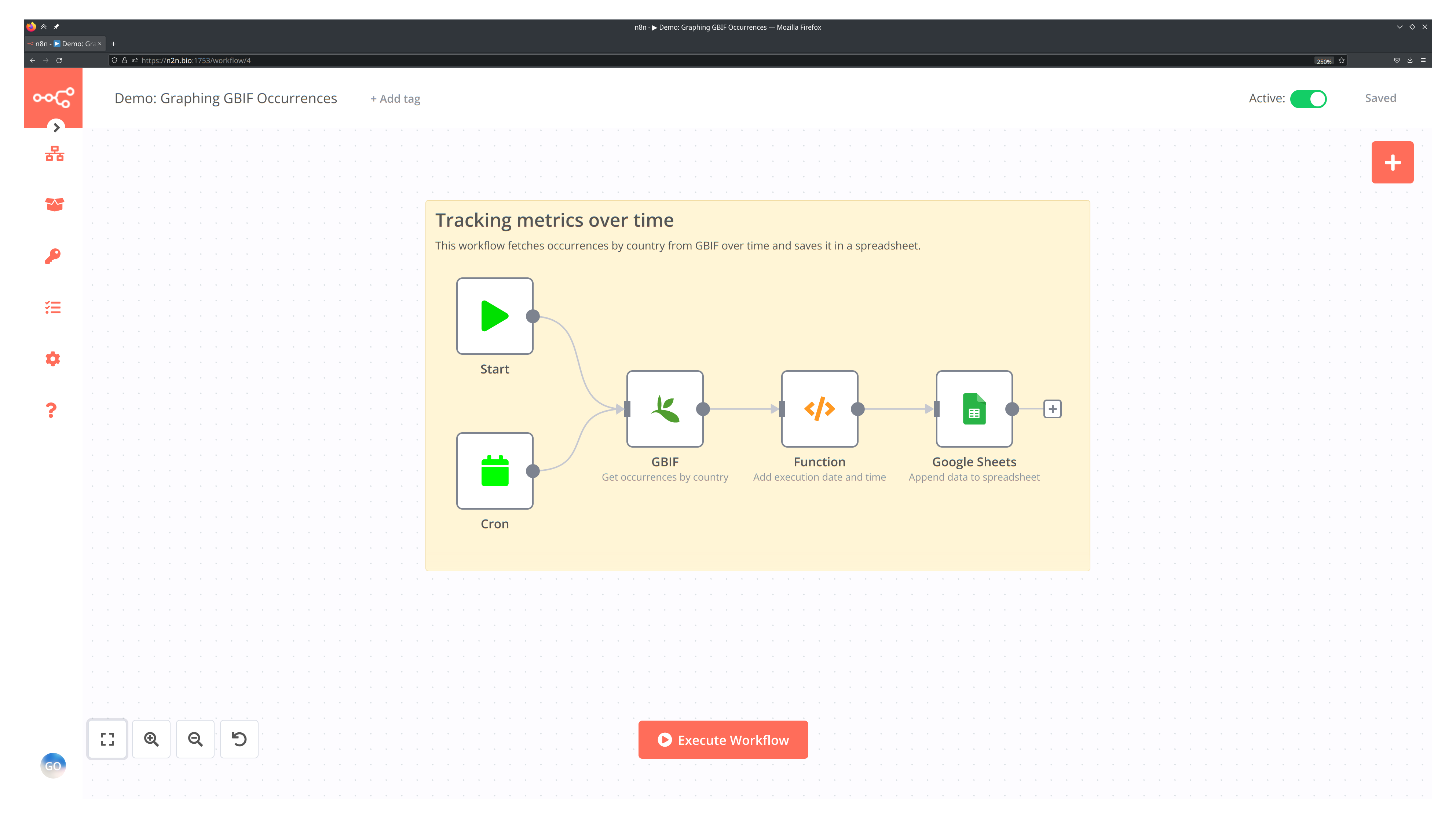
Demo 4: Tracking GBIF occurrences by country over time
Occurrences by country are recorded hourly from the GBIF API using the GBIF node, and the output is saved to a GoogleSheets spreadsheet.
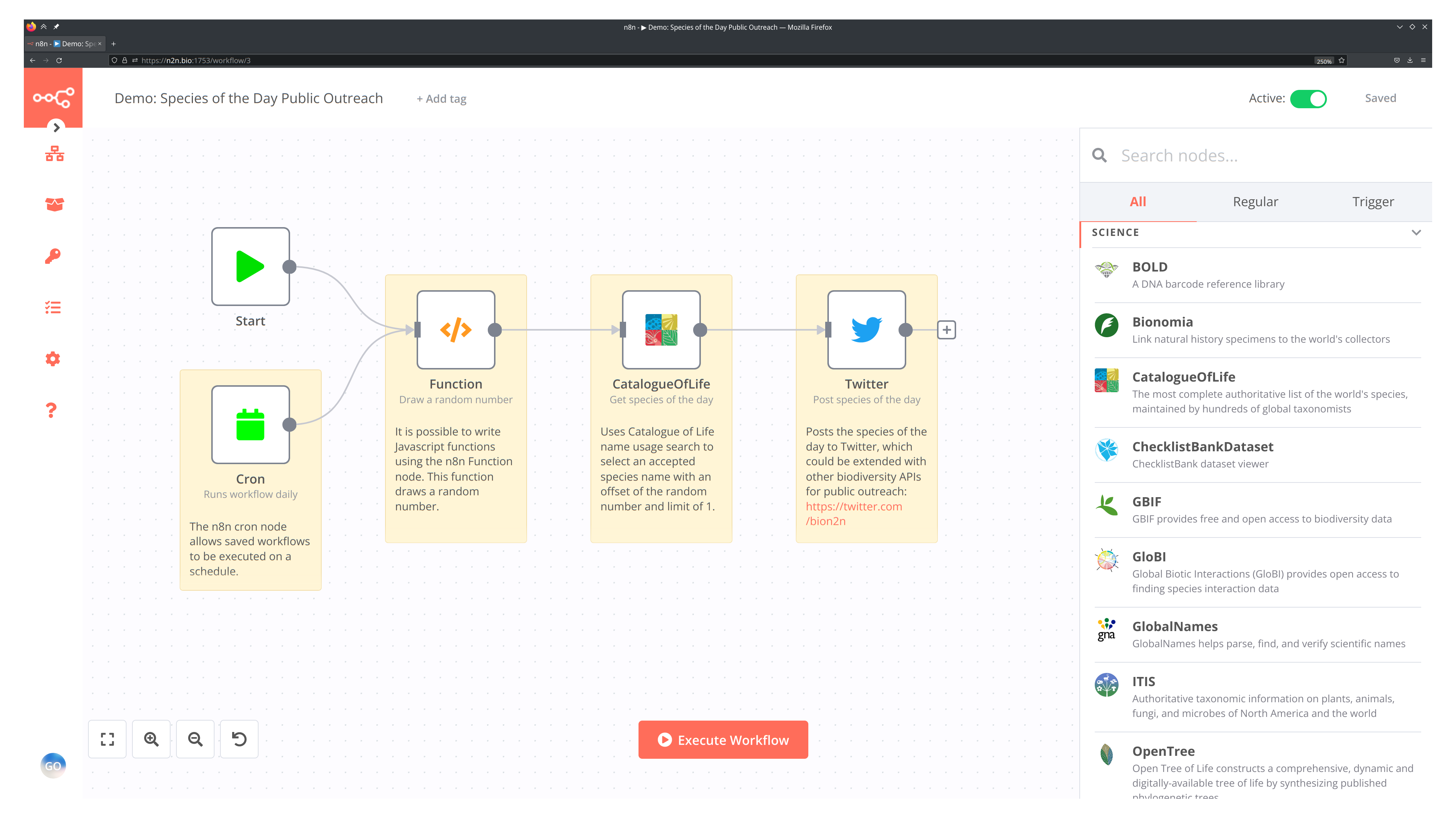
Demo 5: Promoting a species of the day on social media
This automated workflow draws a random species from Catalogue of Life and sends Species of the Day tweet.
Development
N8N has excellent documentation on community node development including how to test nodes that are under development.
Contributing
Bug reports and pull requests are welcome on GitHub. This project is intended to be a safe, welcoming space for collaboration, and contributors are expected to adhere to the code of conduct.
License
The BioN2N nodes are available as open source under the terms of the MIT license.
References
1
Caballar, R. D. 2020. Programming Without Code: The Rise of No-Code Software Development. IEEE Spectrum. https://spectrum.ieee.org/programming-without-code-no-code-software-development
2
Miller, A. 2021. Low Code vs No Code Explained. BMC Blogs. https://www.bmc.com/blogs/low-code-vs-no-code/