
nuxt-input-dialog
v1.1.0
Published
A beautiful, framework-agnostic input dialog module for Nuxt 3 and Nuxt 4 — text, password, number, textarea, select, and autocomplete fields with validation. No Vuetify required.
Downloads
217

Maintainers
 osameh_ir
Readme
nuxt-input-dialog


A beautiful, zero-dependency input dialog module for Nuxt 3 and Nuxt 4 — no Vuetify or icon-font required. Drop it in, call useInputDialog().promptText(...), await the typed value.
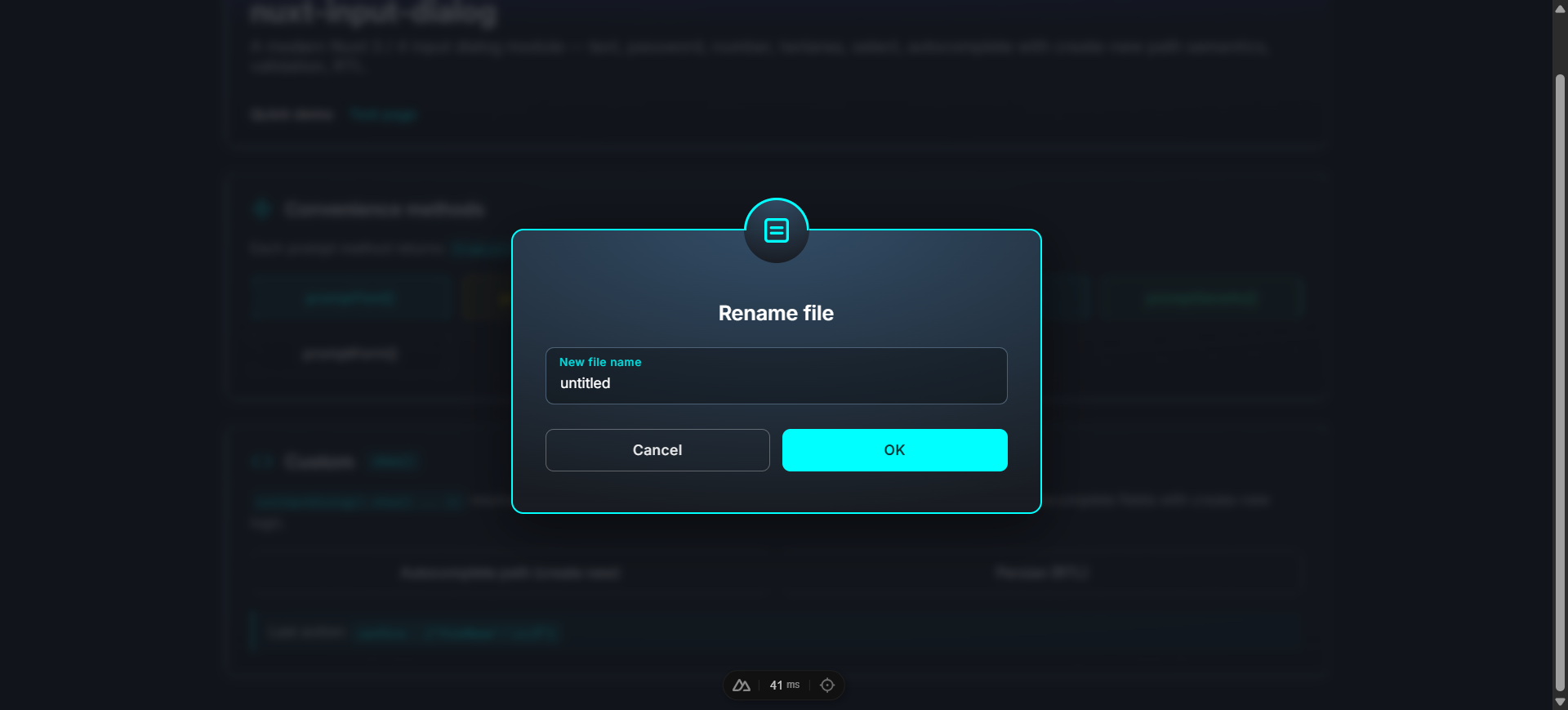
- 🎨 Polished look — dark radial gradient, colored borders per type, decorative top icon, blurred backdrop
- 🧩 Standalone — no Vuetify, no MDI, no extra CSS framework
- ⚡️ Auto-mounted — no boilerplate, just call
useInputDialog().promptText('Rename', 'New name') - 🎯 Promise-based API —
await dialog.promptText(...)returns the value ornull;show()returns{ action, values } - 🧠 Fully typed — written in TypeScript with full IntelliSense
- 📝 7 field types —
text,password,email,number,textarea,select,autocomplete - ✅ Validation rules —
(value) => true | string, runs on blur and on submit - 🔍 Smart autocomplete — type a value not in the list to "Create new", with optional path-formatting (auto trailing slash) or custom formatter
- 🔘 1 / 2 / 3 button layouts — default Cancel/Submit or custom buttons with named actions
- ⌨️ Keyboard friendly —
Entersubmits,Esccancels, focus moves to first field on open and is restored on close - 🔤 Modern typography — bundled Shabnam for Persian/Arabic + Inter for Latin (both opt-out)
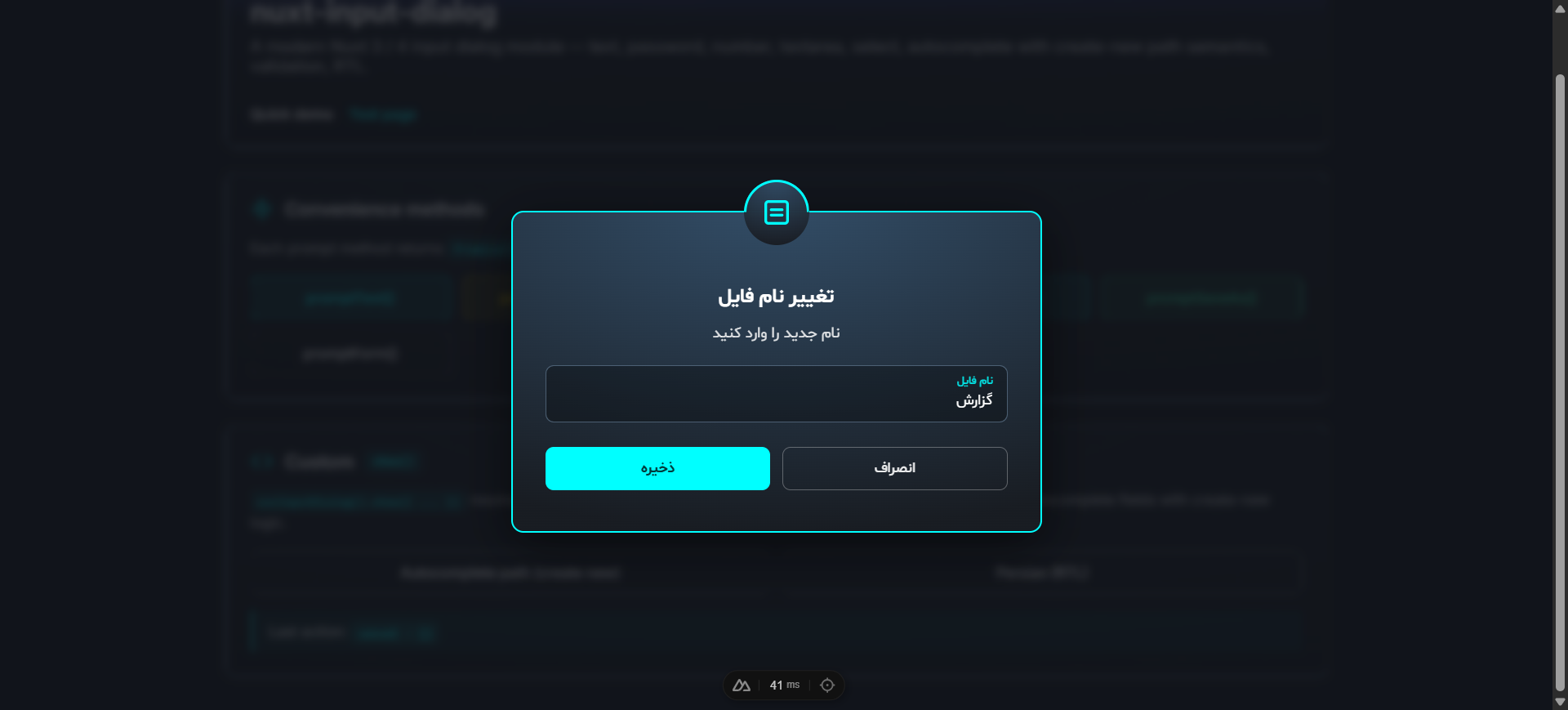
- 🌐 Auto RTL — dialogs containing Arabic/Persian script switch to
dir="rtl"automatically (detection runs across title, message, warning, and every field's label/placeholder/hint) - ♿ Accessible —
role="alertdialog",aria-modal,aria-labelledby
Table of contents
- Installation
- Quick start
- Module options
- Composable API —
useInputDialog() - Field types
- Validation rules
- Autocomplete with create-new
- Custom buttons
- Component API
- Theme
- Customization
- TypeScript
- Development
- License
For deeper technical reference (architecture, design rationale, contributing), see docs/.
Installation
npm install nuxt-input-dialog
# or
pnpm add nuxt-input-dialog
# or
yarn add nuxt-input-dialog
// nuxt.config.ts
export default defineNuxtConfig({
modules: ['nuxt-input-dialog'],
})That's it — useInputDialog() is auto-imported and an <InputDialogContainer> is mounted automatically on the client.
Quick start
<script setup lang="ts">
const dialog = useInputDialog()

const onRename = async () => {
  const newName = await dialog.promptText('Rename file', 'New file name', {
    defaultValue: 'untitled',
    rules: [v => (typeof v === 'string' && v.length > 0) || 'Name is required'],
  })
  if (newName !== null) await api.rename(newName)
}

const onSaveAs = async () => {
  const result = await dialog.promptSaveAs('document', {
    extensions: ['.txt', '.md', '.json'],
    defaultExtension: '.md',
  })
  if (result) await api.save(result.fullName)  // 'document.md'
}

const onSignup = async () => {
  const values = await dialog.promptForm('Create account', [
    { key: 'username', type: 'text',     label: 'Username', rules: [v => /^[a-z0-9_]{3,20}$/.test(String(v)) || 'Invalid'] },
    { key: 'email',    type: 'email',    label: 'Email',    rules: [v => /\S+@\S+\.\S+/.test(String(v)) || 'Invalid email'] },
    { key: 'password', type: 'password', label: 'Password', rules: [v => String(v).length >= 8 || 'At least 8 chars'] },
    { key: 'role',     type: 'select',   label: 'Role',     items: ['Member', 'Admin'], defaultValue: 'Member' },
  ])
  if (values) await api.signup(values)
}
</script>
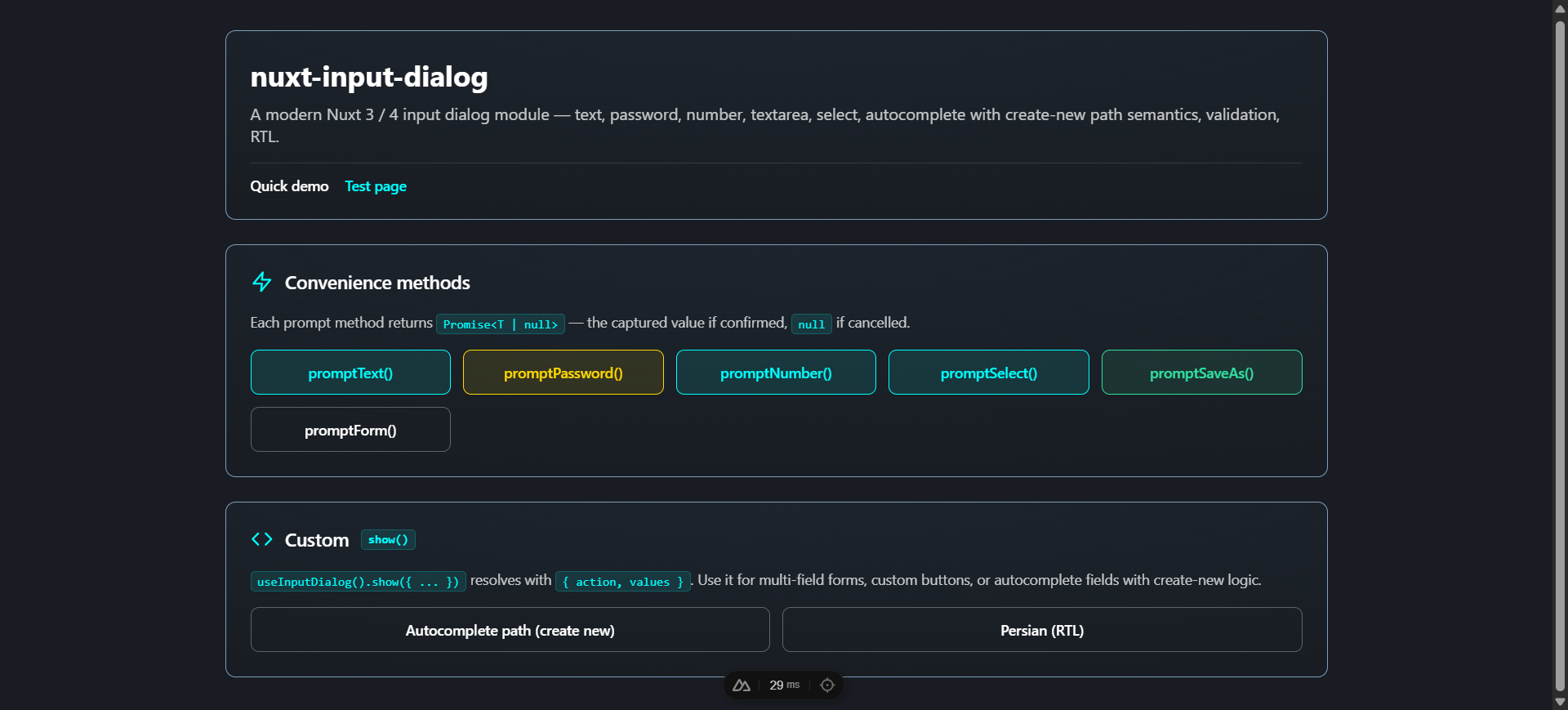
The bundled playground exercises every feature — convenience methods, custom show(), validation, autocomplete with create-new, multi-field forms, and Persian RTL:
Module options
Configure under the inputDialog key in nuxt.config.ts:
export default defineNuxtConfig({
  modules: ['nuxt-input-dialog'],
  inputDialog: {
    autoMount: true,
    closeOnBackdropClick: false,
    escapeToCancel: true,
    prefix: 'Input',
    loadShabnamFont: true,
    loadInterFont: true,
  },
})
| Option | Type | Default | Description |
| ---------------------- | --------- | ----------- | ----------- |
| autoMount | boolean | true | Mounts an <InputDialogContainer> automatically on the client. |
| closeOnBackdropClick | boolean | false | Backdrop click cancels. Default off so a misclick doesn't lose typed data. |
| escapeToCancel | boolean | true | Escape key cancels. |
| prefix | string | 'Input' | Component name prefix. With the default, components are <InputDialog> and <InputDialogContainer>. |
| theme | 'dark' \| 'light' | 'dark' | Initial visual theme. Switch at runtime with useInputDialog().setTheme(...) or override per-container with the theme prop. |
| loadShabnamFont | boolean | true | Inject the bundled Persian "Shabnam" font (gated by unicode-range). |
| loadInterFont | boolean | true | Add Inter (Google Fonts) via a <link> in the head. |
Composable API — useInputDialog()
const dialog = useInputDialog()show(options)
Open a dialog. Returns Promise<{ action, values }>. Always resolves, never rejects.
const { action, values } = await dialog.show({
  title: 'Rename',
  fields: [{ key: 'name', type: 'text', label: 'New name' }],
})
if (action === 'confirm') console.log(values.name)
| Option | Type | Default |
| -------------- | ----------------------------------------------- | ------------- |
| type | 'success' \| 'warning' \| 'error' \| 'info' | 'info' |
| title | string | required |
| message | string \| null | null |
| fields | InputField[] | required |
| initialValues| Record<string, unknown> | {} |
| warningText | string \| null | null |
| confirmText | string | 'Submit' |
| cancelText | string | 'Cancel' |
| buttons | InputDialogButton[] \| null | null |
Convenience methods
All return primitive values (or null on cancel) — no boilerplate to extract from values:
const name:    string       | null = await dialog.promptText('Title', 'Label')
const pwd:     string       | null = await dialog.promptPassword('Authenticate')
const qty:     number       | null = await dialog.promptNumber('Quantity', 'How many?')
const color:   string       | null = await dialog.promptSelect('Color', 'Pick', ['red', 'green', 'blue'])
const file = await dialog.promptSaveAs('document', { extensions: ['.md', '.txt'] })
//        ↑ { fileName, extension?, fullName? } | null

const values: Record<string, unknown> | null = await dialog.promptForm('Title', [...fields])
Field types
interface InputField {
  key: string
  type: 'text' | 'password' | 'email' | 'number' | 'textarea' | 'select' | 'autocomplete'
  label: string
  placeholder?: string
  hint?: string | null
  rules?: InputFieldRule[]
  defaultValue?: unknown
  // for textarea
  rows?: number
  // for select / autocomplete
  items?: unknown[]
  // for autocomplete
  createNew?: false | 'path' | ((rawValue: string) => string)
}
| Type | Renders | Notes |
| ------------- | ------------------ | ----------------------------------------------- |
| text | <input type=text> | Pressing Enter submits the form |
| password | <input type=password> | |
| email | <input type=email> | Use the @ validation rule of your choice |
| number | <input type=number> | |
| textarea | <textarea> | rows controls initial height |
| select | Custom dropdown | Single-select from items array |
| autocomplete| Custom search-box | Filter items, optionally suggest a new value |
Validation rules
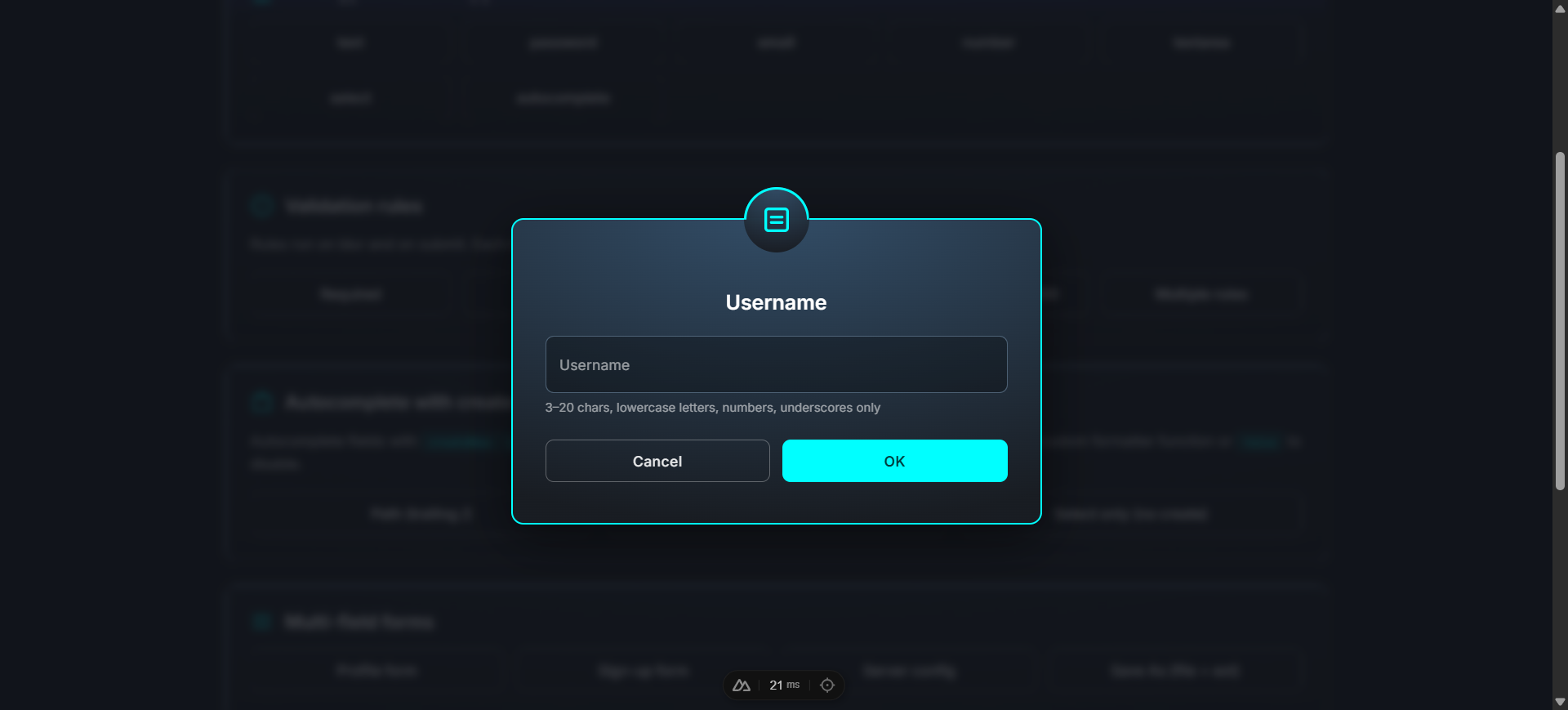
A rule is a function that takes the value and returns true (valid) or a string (error message). Multiple rules per field run in order.
{
  key: 'username',
  type: 'text',
  label: 'Username',
  hint: '3–20 chars, lowercase letters, numbers, underscores only',
  rules: [
    v => (typeof v === 'string' && v.length >= 3) || 'At least 3 chars',
    v => (typeof v === 'string' && v.length <= 20) || 'At most 20 chars',
    v => /^[a-z0-9_]+$/.test(String(v)) || 'Only lowercase letters, numbers, and underscores',
  ],
}
Rules run on blur (after the first interaction) and on submit (all fields). Field-level errors render below each field; a form-level error appears under the form when any rules fail on submit.
Autocomplete with create-new
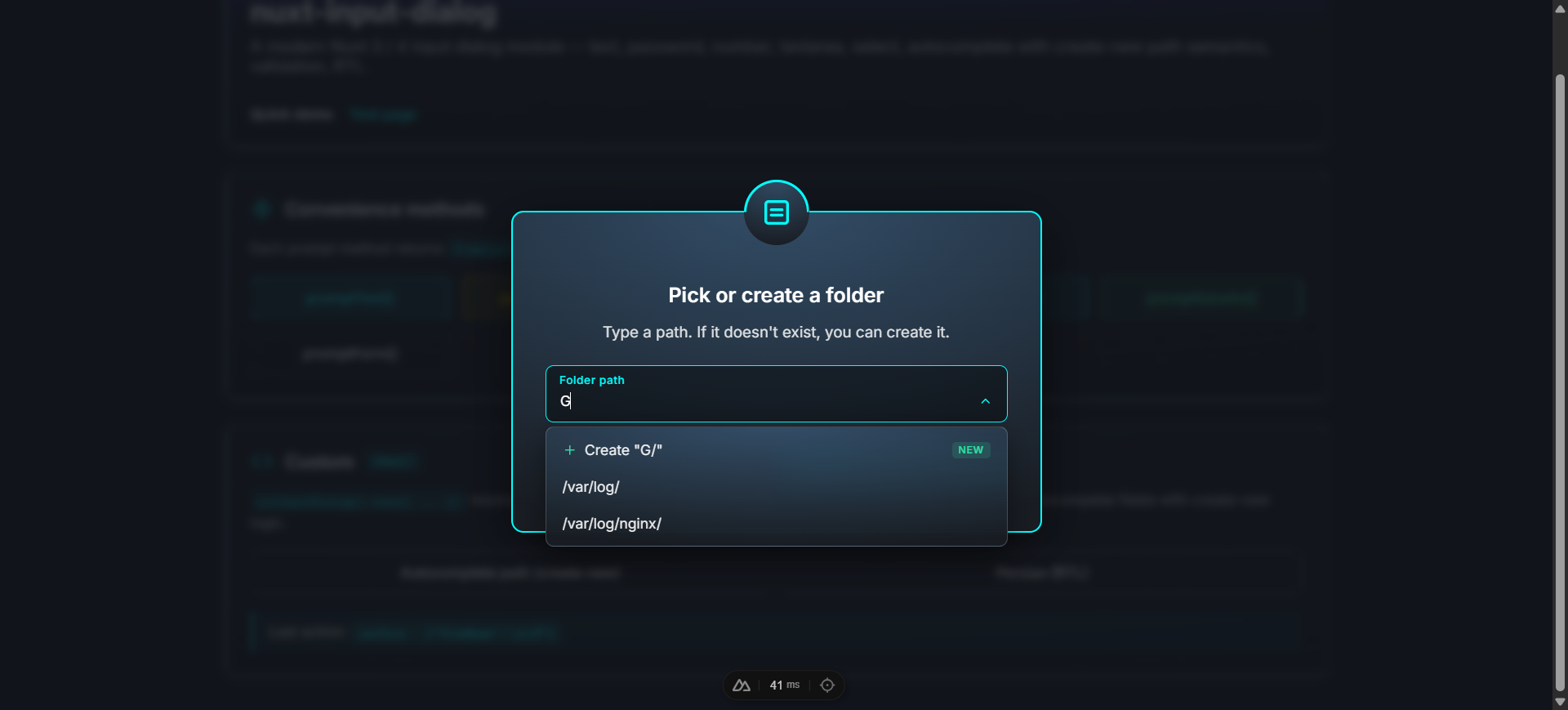
Autocomplete fields can suggest creating a new value when the typed text isn't in items. Three modes via the createNew option:
// Mode 1 — disabled (filter-only autocomplete; default)
{ key: 'country', type: 'autocomplete', label: 'Country', items: [...], createNew: false }

// Mode 2 — 'path' formatter (built-in: appends a trailing slash if missing)
{ key: 'folder', type: 'autocomplete', label: 'Folder', items: ['/var/log/'], createNew: 'path' }
//   typing  '/etc'  →  Create "/etc/"

// Mode 3 — custom formatter function
{
  key: 'name',
  type: 'autocomplete',
  label: 'Constant',
  items: ['MAX_RETRIES'],
  createNew: (raw: string) => raw.toUpperCase().replace(/\s+/g, '_'),
}
//   typing  'min retries'  →  Create "MIN_RETRIES"
When create-new mode is on, an extra "Create" item appears at the top of the dropdown with a + icon and a "New" badge. Press Enter in the input to commit the typed (formatted) value, or click the suggestion.
Custom buttons
Pass a buttons array to override the default Cancel/Submit pair. Supports 1, 2, or 3 buttons.
await dialog.show({
  title: 'Save changes?',
  message: 'You have unsaved edits.',
  fields: [{ key: 'note', type: 'textarea', label: 'Note (optional)' }],
  buttons: [
    { text: 'Cancel',  action: 'cancel',  variant: 'outlined', color: 'default' },
    { text: 'Discard', action: 'discard', variant: 'flat',     color: 'default' },
    { text: 'Save',    action: 'save',    variant: 'flat',     color: 'info' },
  ],
})
// resolves with action: 'cancel' | 'discard' | 'save'
| Field | Type | Default |
| ---------- | ------------------------------------------------------------- | -------------------------------------- |
| text | string | required |
| action | string | 'confirm' |
| variant | 'flat' \| 'outlined' | 'outlined' for cancel, else 'flat' |
| color | 'success' \| 'warning' \| 'error' \| 'info' \| 'default' | dialog type for confirm |
| disabled | boolean | false |
Component API
<InputDialogContainer>
The container that renders the active dialog. Auto-mounted by default — only use this directly if autoMount: false.
| Prop | Type | Default | Description |
| ---------------------- | --------- | ------- | ----------- |
| teleport | boolean | true | Render into document.body via <Teleport> so the overlay always covers the viewport. |
| closeOnBackdropClick | boolean | false | Backdrop click cancels. |
| escapeToCancel | boolean | true | Escape key cancels. |
<InputDialog>
The single-dialog component. You normally don't render this directly — useInputDialog() and <InputDialogContainer> handle it. Exposed for static / non-composable usage with v-model.
Emits: update:modelValue, confirm (with values), cancel, action (with name + values).
Theme
Ships with a dark theme (default) and a light theme. Switch globally at runtime, or override per-container.
// nuxt.config.ts — initial theme
inputDialog: { theme: 'light' }
<script setup lang="ts">
const dialog = useInputDialog()
console.log(dialog.theme.value) // 'dark' or 'light'
dialog.setTheme('light')
// Optional: follow the user's system preference
const sync = () => dialog.setTheme(
window.matchMedia('(prefers-color-scheme: dark)').matches ? 'dark' : 'light',
)
sync()
window.matchMedia('(prefers-color-scheme: dark)').addEventListener('change', sync)
</script>Per-container override:
<InputDialogContainer theme="light" />The theme prop, when set, takes precedence over useInputDialog().theme. Type-color borders (#30e0a1 / #FFD700 / #DC143C / #00FFFF) stay constant in both themes — only the card, overlay backdrop, input field colors, dropdown panel, and outlined-button neutrals swap.
Customization
The auto-mounted container lives at #nuxt-input-dialog-root. Override styles globally by targeting that root:
/* assets/css/main.css */
#nuxt-input-dialog-root .dialog-card {
  max-width: 600px;
  border-radius: 16px;
}

#nuxt-input-dialog-root .dialog-input {
  font-family: ui-monospace, monospace;
}
Fonts
Two fonts loaded by default:
- Inter (English / Latin) — Google Fonts via
<link>. Disable withloadInterFont: false. - Shabnam (Persian / Arabic) — bundled woff2 (5 weights), gated by
unicode-range. Disable withloadShabnamFont: false.
Right-to-left support
When the title, message, warning text, or any field's label/placeholder/hint contains Arabic / Persian script, the dialog auto-switches to dir="rtl". Detection is per-instance — you can mix LTR and RTL dialogs in the same app without configuration.
Manual mounting
// nuxt.config.ts
inputDialog: { autoMount: false }
<!-- app.vue -->
<template>
<NuxtLayout><NuxtPage /></NuxtLayout>
<InputDialogContainer />
</template>The state is global — only one dialog is active at a time, by design. If you mount a container inside an element with backdrop-filter, transform, filter, perspective, will-change, or contain, <Teleport to="body"> ensures the overlay still covers the viewport.
TypeScript
import type {
  InputDialogType,         // 'success' | 'warning' | 'error' | 'info'
  InputFieldType,          // 'text' | 'password' | 'email' | 'number' | 'textarea' | 'select' | 'autocomplete'
  InputField,              // single field definition
  InputFieldRule,          // (value) => true | string
  InputDialogButton,       // { text, action?, variant?, color?, disabled?, loading? }
  InputDialogOptions,      // arg to show()
  InputDialogResult,       // { action, values }
  InputDialogInstance,     // shape of currentDialog.value
} from 'nuxt-input-dialog'
ModuleOptions is also exported.
Development
npm install
npm run dev:prepare
npm run dev            # playground at http://localhost:3000

npm run lint
npm run test
npm run prepack        # build dist/
The playground at playground/ exercises every field type, every validation pattern, real-world forms (sign-up, server config, save-as), the autocomplete with create-new, and Persian / RTL.
CI
GitHub Actions runs lint (Node 22) and tests + build (Node 20 and 22) on every push and PR against main.