
open-autonomy
v0.4.4
Published
Compile an agent profile onto a substrate (GitHub Actions or a local termfleet loop) — the open-autonomy CLI.

Maintainers
 aaronvolter
Readme
open-autonomy

Documentation for open-autonomy v0.4 — the doc-version marker (machine-checked by
bun run check:release-consistency). npm0.4.0/0.4.1are known-broken oncompile(OA-01/F-1); install0.4.2+once published. Older docs: read them at their version tag, e.g.blob/v0.4.0/.
open-autonomy makes a repository drive its own maintenance work: work items become reviewed,
gated, merged changes, produced by bounded AI agents under deterministic guardrails.
It is substrate-agnostic — the same setup compiles onto GitHub Actions or onto a local
machine loop. The repo also runs open-autonomy against itself (it's its own first user).
Want to run it on your own repo? Jump to Run it on your repo — two independent axes (runner: GitHub Actions or your machine; code host: GitHub PRs+auto-merge or a local-git board), so three setups: fully hosted, local agents → auto-merging GitHub PRs, or fully local (closed-source, no GitHub).
The model
You write a profile (a recipe) and compile it onto a substrate, producing an installation you run:
compile(profile, substrate) → installation- profile — a substrate-agnostic recipe: which agents (skills), which workflows, which policy —
expressed as an IR (
autonomy.ir.v1). - substrate — where/how it runs = a trigger executor (fires workflows) + a runner
(runs agents), over a box (the agent's POSIX environment).
githubandlocalare peers. - installation — the materialized files laid into a repo for one substrate.
Each agent is a credentialed job whose token is scoped to its capabilities; it acts directly
(edits code, pushes a branch, opens an auto-merging PR). The merge boundary is a permission split:
no single agent holds both code:review (statuses:write — blesses) and code:propose (contents:write
— pushes), so none can both write code and bless it. GitHub native auto-merge lands a PR once ci +
agent-review are both green. The agent gets bounded model access (no raw keys) and can never merge.
(This scoped-token enforcement is the hosted substrate; on a local runner the agents share your token —
your CI + supervision are the boundary. See OPERATIONS.md.)
Read docs/SPEC.md for the full model and conformance contract, and
docs/ARCHITECTURE.md for the vocabulary and layout.
Run it on your repo
Two independent choices (a profile compiles to any valid combination — install with one npx
command, no clone required):
- Runner — where agents execute: GitHub Actions (hosted jobs) or local (your machine, via termfleet, using your own logged-in Claude Code / Codex).
- Code host — where code lives and how it merges: GitHub (the agent opens a PR; CI + an
agent-reviewstatus gate native auto-merge — the reviewer is independently enforced on the hosted runner; on a local runner the agents share your token, so your CI is the real gate) or local-git (a tracker on disk, PR-free — no GitHub).
The runner is orthogonal to the code host: you can run agents on your own machine and still land auto-merging PRs on GitHub. Three setups people actually use:
| Setup | Runner | Code host | Profile | Best for |
|---|---|---|---|---|
| Hosted | GitHub Actions | GitHub | self-driving (new/dedicated repo) or simple-gh-sdlc (your existing repo) | public/team repos — fully autonomous in the cloud, /agent issue-comment control, a bounded model-token proxy |
| Local agents, GitHub PRs | local | GitHub | simple-gh-sdlc | run the agents on your machine/IP & your own model subscription, but still get PRs + native auto-merge on GitHub |
| Fully local | local | local-git | simple-sdlc | closed-source — no GitHub at all; work comes from a local ztrack board, PR-free |
self-drivingis a whole-repo SCAFFOLD, not an overlay — it carries README.md/package.json/.gitignoreas resources (this repo's own dogfood setup). Compiling it into a directory with existing, different copies of those files makes those replacements explicit in the candidate commit. Adopting into an existing repo? Usesimple-gh-sdlc/simple-sdlc/helloinstead — they're purely additive (see the overlay note inOPERATIONS.md).
cd my-repo

# Hosted, NEW/dedicated repo (GitHub Actions runner, GitHub code host, whole-repo scaffold):
npx open-autonomy compile self-driving gh-actions .   # then wire repo vars/secrets + branch protection

# Hosted, EXISTING repo (GitHub Actions runner, GitHub code host, additive overlay):
npx open-autonomy compile simple-gh-sdlc gh-actions .  # generates no package.json/README/.gitignore

# Local agents → GitHub PRs (local runner, GitHub code host) — step 3 of the checklist below:
npx open-autonomy compile simple-gh-sdlc local .       # agents on your machine; PRs auto-merge on GitHub

# Fully local (local runner, local-git code host) — step 3 of the checklist below:
npx open-autonomy compile simple-sdlc local .          # no GitHub; or `hello` for a zero-tracker demo
For a Git repository, compile never writes those files into the working tree. The worktree must be
completely clean; OA builds one candidate commit in an isolated worktree and prints its complete diff.
After the installing agent reviews that exact SHA, accept it separately:
open-autonomy accept <full-candidate-sha> --target .Acceptance refuses if the worktree became dirty or HEAD moved. --force and the old upgrade --apply
overwrite path cannot bypass this boundary. Compiling to a non-Git directory remains a build-output mode,
not a repository installation.
The two
locallines above are a teaser, not an entry point — they're step 3 of 8 in the ordered checklist. Don't start here on a real repo: deps, sign-in, and the termfleet ports/pin come first. Follow the full checklist end to end →docs/OPERATIONS.md#local-install-checklist.
One-command local install —
oa install.bin/install.ts(theopen-autonomy installverb, aliasoa install) chains the entire flow above into one command: detect → select → direction → authorize → execute → validate → hand-off → prove-advancing, pausing at the human gates plus a mandatory installing-agent review of the complete candidate commit and printing exactly which flag to add to resume. It's the recommended path for the local runner once you've cloned this repo:git clone https://github.com/volter-ai/open-autonomy && cd open-autonomy bun bin/install.ts /path/to/your-repo --pick simple-gh-sdlc --substrate local --owner-repo <owner>/<repo> # review the complete diff it prints, then repeat with: bun bin/install.ts /path/to/your-repo <same-options> --accept <full-candidate-sha> # or fully local, no GitHub at all: bun bin/install.ts /path/to/your-repo --pick simple-sdlc --substrate localIt calls the exact manual commands above and below internally (
compile, the candidate commit, branch- protection provisioning, …) — the manual paths remain valid and are whatoa installitself calls into; use them directly for fine-grained control over any one step, or readdocs/INSTALL-AGENT.mdfor the phase-by-phase referencebin/install.tsimplements.bun bin/install.ts --helplists every gate-answer flag.Honest caveat — source-checkout only today: the published
npx open-autonomy install/oa installlooks forbin/install.tsin the current working directory (i.e. you must run it from inside a source checkout of this repo); that file is dev-time-only monorepo tooling and is never bundled into the npm tarball, so it exits1with an explicit "clone the repo" message instead of silently doing less than advertised (verified live:node dist/cli.js install --helpoutside this checkout prints exactly that and exits 1). Until it ships in a release, use it via the clone above; the plainnpx, no-clonecompilecommands above remain the only no-clone install path today.
Full step-by-step for the hosted GitHub Actions runner (repo vars/secrets, branch protection) →
docs/OPERATIONS.md. self-driving and
simple-gh-sdlc run on either runner; simple-sdlc is local-git (no code host). See
the CLI for all verbs and options.
Installing with an agent? Point it at
docs/INSTALL-AGENT.md— a guided detect → ask → execute → verify playbook: it reads your repo, asks you only the judgment calls (the merge gate, identity, the first issue), runs the overlay, and proves the loop merges a PR before calling it done.
What it does (the GitHub substrate)
issue or PM sweep -> develop (a credentialed skill agent, bounded model token)
  -> the agent edits code + opens its own PR with auto-merge queued
  -> CI + an independent reviewer post the required `ci` + `agent-review` statuses
  -> GitHub native auto-merge lands it (no agent can merge), or human-required escalation
(The scoped-token reviewer independence above is the hosted substrate; a local runner runs the same
loop with the agents on your token — see OPERATIONS.md.)
Operators steer it with /agent issue comments (see Commands). The local substrate runs the same
loop with a scheduler loop + a termfleet runner instead of GitHub Actions.
Repository layout
The engine — substrate-agnostic, reusable (packages/):
packages/core— the IR, the Runner contract, the conformance battery, the compiler framework.packages/substrate-local— the local substrate: emit a local-loop installation + the termfleet runner.packages/substrate-github— the github substrate: emit the manifest + workflows + operator control plane + the github runner.bin/autonomy-conformance.ts— check any runner against the core contract.
The GitHub app — open-autonomy running on the github substrate (the complete, dogfooded substrate today):
scripts/— the github runtime: the model-proxy mint/exchange/revoke clients, the credentialed skill runner (scripts/claude-agent-run.ts), the operator control handler (.github/agent-control.mjs),runner.ts, and the preflight/proof-audit tooling. Each agent is a skill run by Claude Code under a capability-scoped token.services/agent-model-proxy/— a Cloudflare Worker that mints bounded, revocable model tokens (no raw keys) and meters spend against a sponsor-funded budget ledger..open-autonomy/,.codex/skills/,.github/workflows/— this repo's own installation (the dogfood).
Recipes & demos:
profiles/— profiles (recipes) that compile to a runner × code host:hello(minimal),self-driving(open-autonomy's own dogfood; gh-actions + local),simple-gh-sdlc(generic GitHub-code-host SDLC; gh-actions + local),simple-gh(local Manager/Planner/Kaizen with human roadmap triage), andsimple-sdlc(fully-local, PR-free).
Docs: ARCHITECTURE.md (the github app's design + trust boundaries + canonical vocabulary + layout),
SPEC.md (the substrate-agnostic model + the four catalogs),
ROADMAP.md.
Develop on open-autonomy itself
This is contributor setup — clone this repo to hack on open-autonomy. You do not need it to use open-autonomy on your own repo (for that, see Run it on your repo).
bun install
bun run check                  # typecheck + conformance + tests (proxy + runtime + examples)
bun run autonomy conformance exec   # check the Runner contract on the reference runner
The open-autonomy CLI
One command is the front door — open-autonomy <verb> (alias oa):
open-autonomy compile <profileName|profileDir> <local|gh-actions> [outDir] [--force]  # --force is build-output-only; Git targets always produce a reviewed candidate
open-autonomy accept <full-candidate-sha> [--target <git-worktree>]       # accept exactly what the installing agent reviewed
open-autonomy lint <profileDir>                                          # validate a profile of your own — writes nothing
open-autonomy preflight                                                  # make an adopter repo install-ready (run after installing the runner deps)
open-autonomy conformance <exec|termfleet|gh-actions>                    # run the substrate conformance battery ("github" still accepted)
open-autonomy upgrade --profile <dir> --target <dir> --substrate local|gh-actions [--prune] # prepare and print one reviewed upgrade candidate
The first argument is a bundled profile name (self-driving, simple-gh-sdlc, simple-sdlc, hello — shipped with the
package) or a path to your own profile dir. open-autonomy is published (npmjs.com/package/open-autonomy) —
no clone required: npx open-autonomy <verb> (or bunx open-autonomy <verb>). The published package is a
self-contained Node bundle, so plain Node works; bun is not required to use it. From a clone (bun-native,
runs TypeScript directly): bun run autonomy <verb> or bun bin/open-autonomy.ts <verb>. The published
bundle is produced by bun run build.
To adopt open-autonomy into your own repo, compile a profile into it — see
Run it on your repo for the runner ⟂ code-host setups and the follow-up
guides (OPERATIONS.md for the GitHub Actions runner,
OPERATIONS.md for the local runner). From a clone, a
profile path also works: open-autonomy compile profiles/self-driving gh-actions ../my-repo.
Operator commands
These are the GitHub code host's control plane (issue comments). On a local-git board you steer the
fleet with termfleet directly and the tracker instead — see
docs/OPERATIONS.md.
Operator commands work only for maintainers (repo OWNER/MEMBER/COLLABORATOR); a comment from anyone
else is ignored. To launch an agent by comment, name it: /agent <agent> (the workflow name).
/agent develop— ask the developer to work on the issue./agent reviewer— run the reviewer on an agent PR./agent pause//agent resume— pause or resume issue-level work (theagent-pausedlabel)./agent status— comment the recent runs of that agent's workflow./agent retry— relaunch this issue's agent workflow after a failed check on its agent PR (a fresh run, fresh model spend); reports when there is nothing to retry./agent cancel— cancel active workflow runs (proxy run slots are not revoked; they expire at token TTL, ~2h)./agent approve <full-head-sha>— authorize that exact PR head for thehuman-approvalgate. This is equivalent for that status to a native maintainer Approve and works when GitHub forbids approving your own PR. A profile may separately require native GitHub reviews (for example, SOC 2 separation of duties)./agent decide <decision>//agent answer <answer>— resolve ahuman-required/needs-infoitem: records your decision/answer and clears the block so the PM re-triages and resumes (the human seam'sout).
Repo-wide kill switch (not an /agent verb): set the repository variable
PUBLIC_AGENT_REPO_PAUSED=true (gh variable set PUBLIC_AGENT_REPO_PAUSED --body true) — every
agent job skips while it is set; clear it to resume the fleet.
Security
open-autonomy runs semi-untrusted agents and operates a model-token/funding proxy. See
SECURITY.md for the trust model and private vulnerability reporting. Provided
AS-IS (Apache-2.0, no warranty) — if you deploy it, you own the secrets, spend, and access you grant.
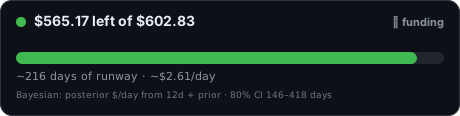
Why a funding platform lives here
services/agent-model-proxy is what makes autonomous runs safe and affordable: it mints bounded,
revocable model tokens so untrusted agent jobs get model access without raw provider keys, and meters
spend against a sponsor-funded budget. It is infrastructure for the agent loop, not a separate product.
Commercial boundary
open-autonomy is the OSS implementation. volter-autonomy can build on it as a paid hosted product
with managed proxy infrastructure, dashboards, org policy, and support.
License
Apache-2.0.