
opencode-navigator
v0.18.1
Published
Search, navigate, and manage OpenCode sessions from the TUI

Maintainers
 st1ggy
Readme
OpenCode Navigator
Search, navigate, and manage OpenCode sessions from the TUI. Navigator combines Search Everything, task and subagent views, skills, MCP presets, and quick actions with a configurable sidebar.
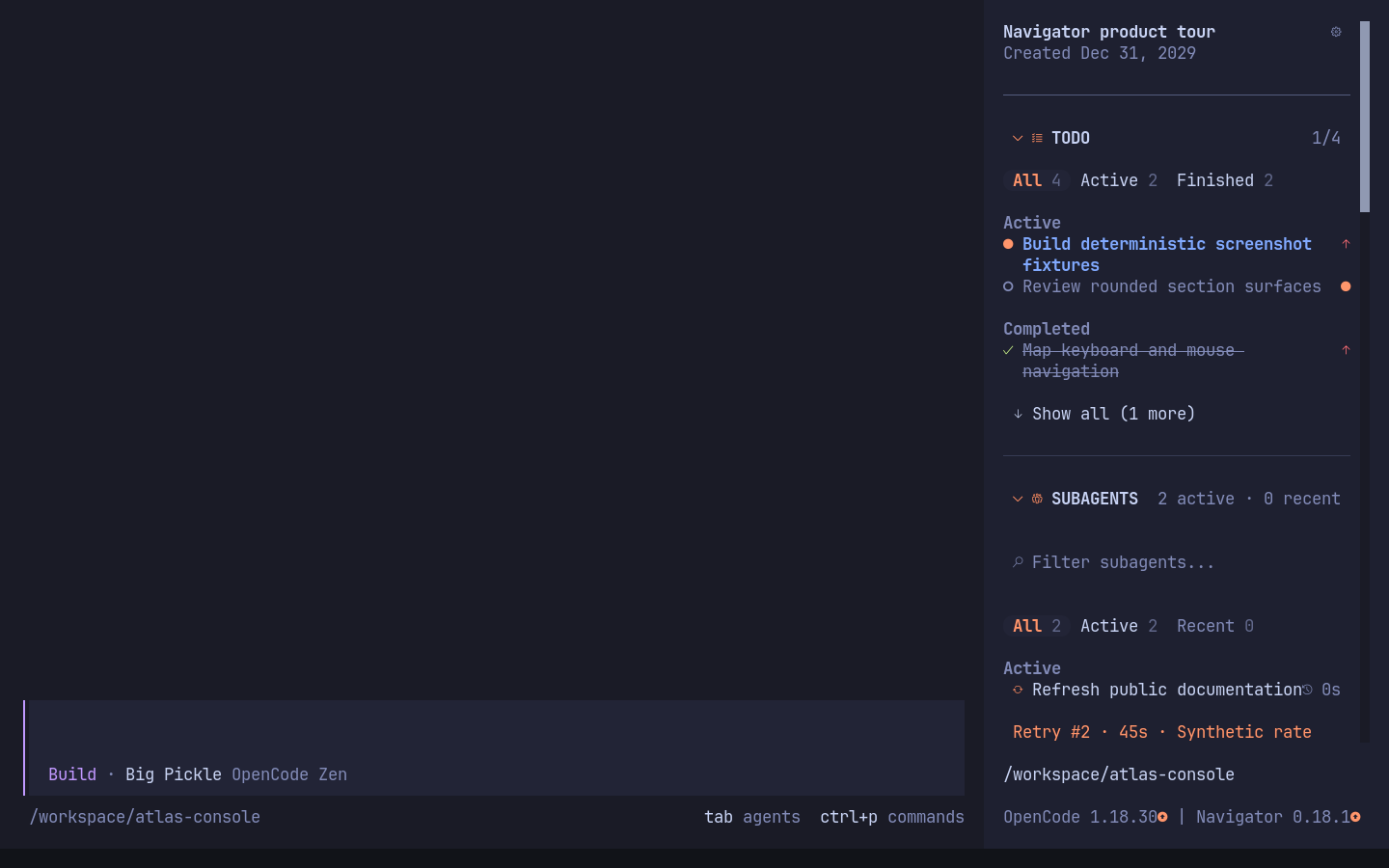
See the changelog for release-by-release changes.
Features
- Theme-aware session title with the session creation date
- First-run setup guide with interactive section settings
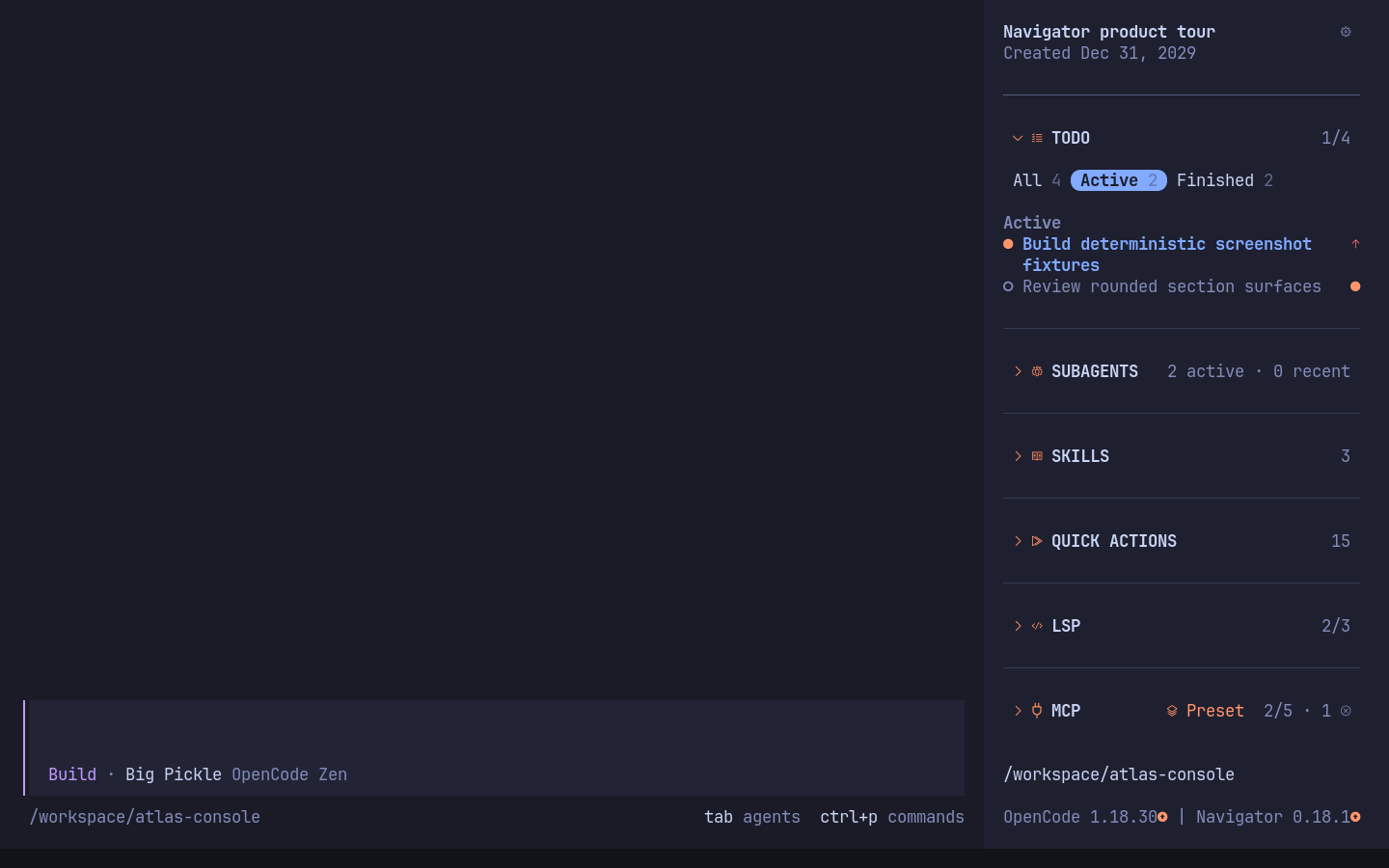
- Collapsible Todo section with status filters, grouped tasks, progress and priority indicators; OpenCode 2 adds session-owned tasks and optional model-context instructions
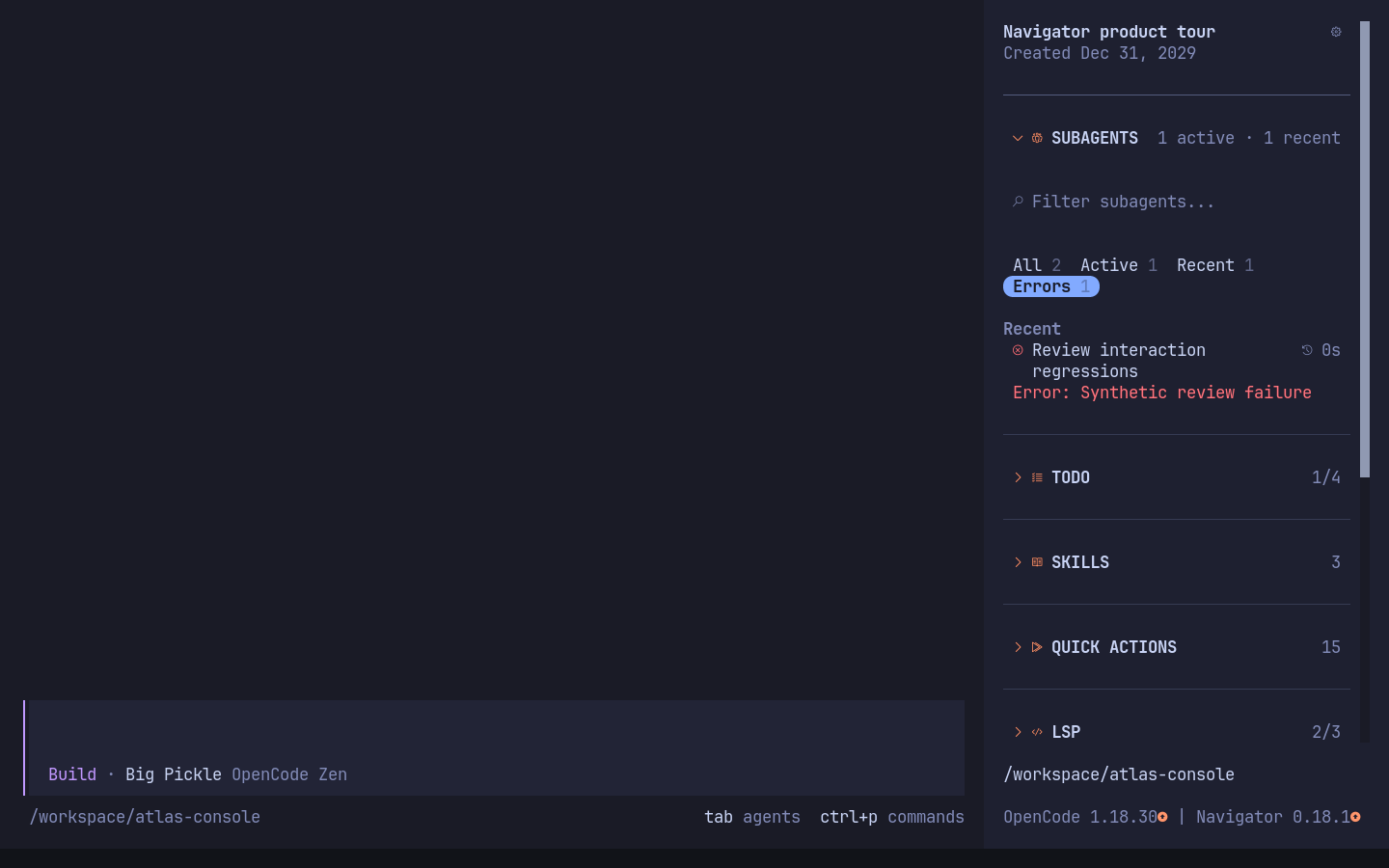
- Active subagent list with live statuses and click-to-open navigation, including dev-team workers running in separate local processes
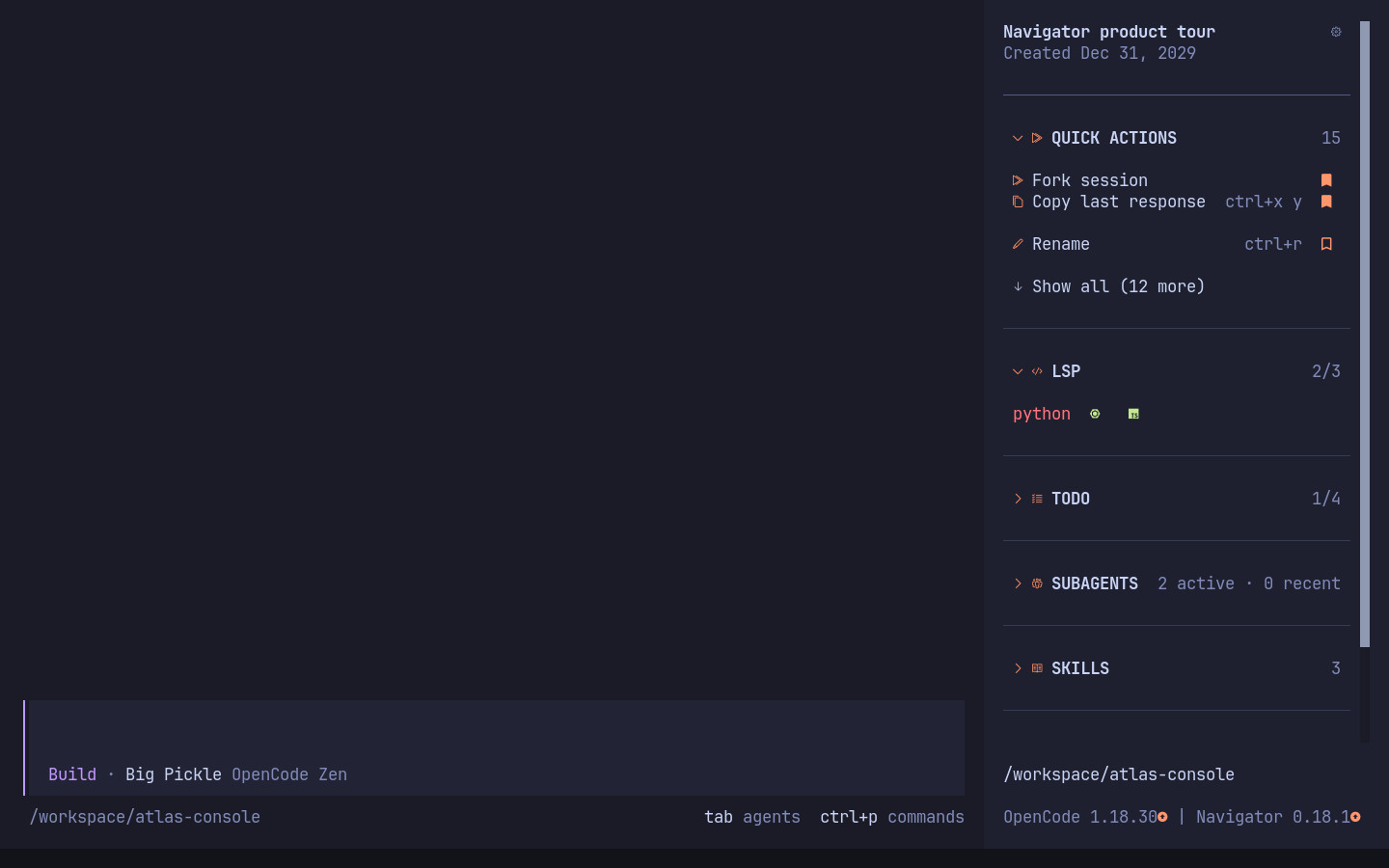
- Compact, searchable workspace skill list with user-wide favorites, recent skills, source details, and click-to-confirm slash commands
- Configurable host quick actions, including the auto-approve toggle, with user-wide bookmarks and availability reasons
- Live LSP connection status with error-first sorting and badges that reveal server names in place
- Searchable MCP section with live radio-style connection controls
- Click any MCP row to connect or disconnect it
- Connect or disconnect every eligible MCP server with per-server progress and failed-only retry
- Save named MCP state presets and apply them from the MCP section heading
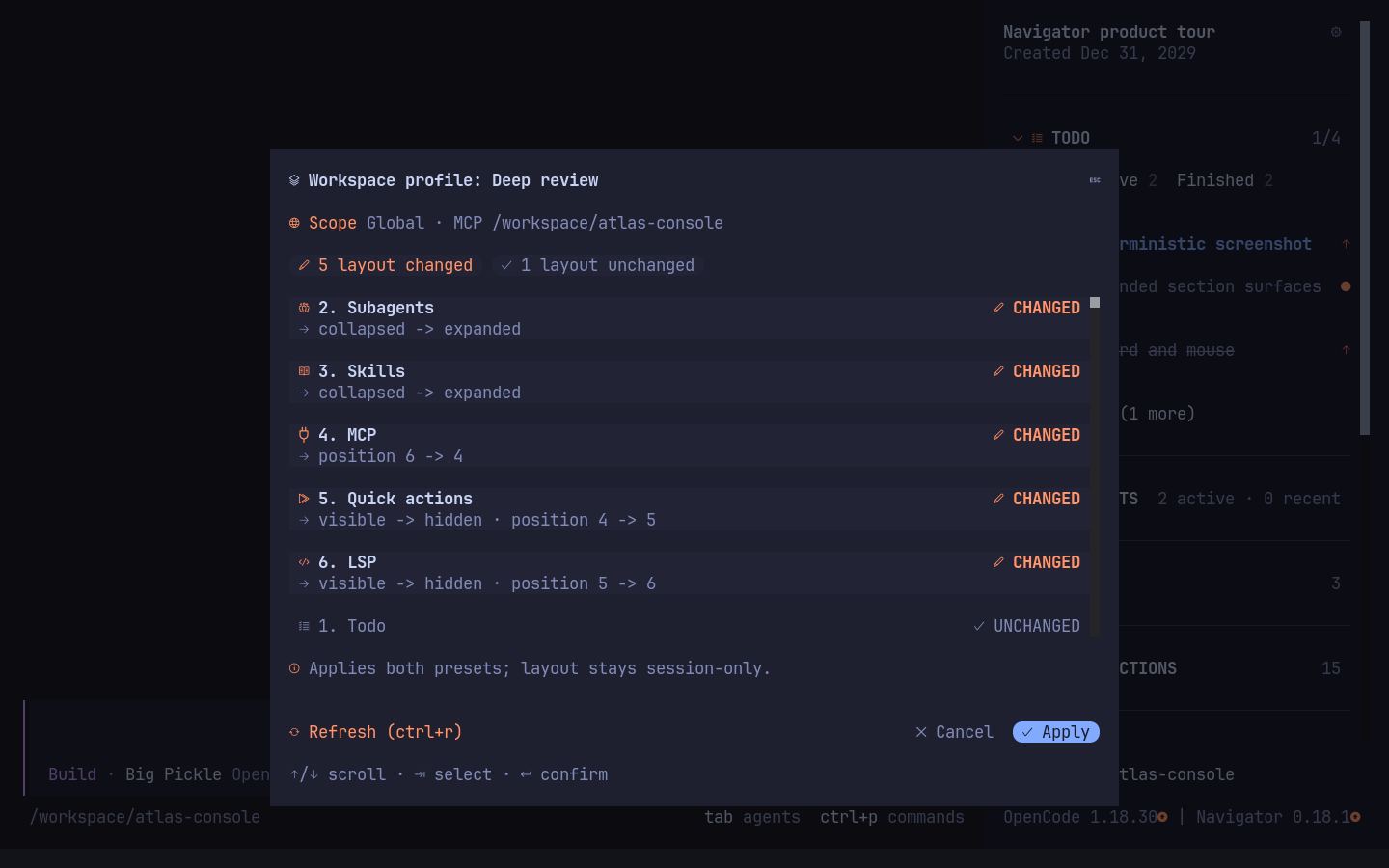
- Optionally link a layout preset with an MCP preset and apply both through one workspace-profile preview
- Persist enabled and disabled MCP server states globally or per worktree and reapply them between sessions
- Keep favorite MCP servers first across workspaces
- Organize MCP servers into user-wide custom groups while retaining assignments for servers absent from the current workspace
- Search Everything in a keyboard-first modal with category tabs and fuzzy results
- Show or hide each sidebar section independently
- Hide the session title or its creation date independently in OpenCode 1.x without losing the settings control
- Configure section visibility and order from the sidebar settings button
- Separate adjacent sections with quiet theme-aware dividers instead of background cards
- Save visibility, expansion, and order globally or for the current worktree
- Copy the selected scope's layout and MCP states as versioned JSON, then validate and preview imports
- Focus the sidebar with
Ctrl+Shift+F, then navigate with arrows orj/k - Open sidebar shortcut mode with
Ctrl+Shift+B; presshto toggle the panel - Optionally open new sessions directly in an empty chat with the sidebar, skipping Home on startup and from New session
- Keep OpenCode's compact footer while showing host and Navigator versions with independent update indicators; click a version label or its update icon to confirm an in-place update through the current installation method and scope
Todo starts expanded. Subagents, skills, quick actions, LSP, and MCP start
collapsed. Use Save current layout as default in sidebar settings to reuse the
current visible/hidden, expanded/collapsed, and ordering states in new sessions.
Supports OpenCode 1.18.30 and newer, including OpenCode 2.x. OpenCode 2.0.16 does not expose host Todo or LSP data to TUI plugins. Navigator supplies its own session Todo list through a separately configured server plugin in 2.x. Without that plugin, Todo stays visible with setup guidance. LSP is hidden on 2.x while retaining Subagents, Skills, Quick Actions, MCP, Search, settings, and presets. All interface icons use Nerd Font glyphs by default (Codicons for controls, keyboard symbols for hints, language logos for LSP). Use a Nerd Fonts v3 terminal font, or select Settings → Behavior → Icon style → Text fallback. The switch applies to the entire interface, including Quick Actions, search tabs, section headings, statuses, favorites, and dialogs. Components read the live style through the shared icon context; host-mounted and nested dialogs inherit the same context through the dialog adapter. Highlighted rows, tabs, and buttons use rounded ends in Nerd Font mode; multiline selections use inverse corner masks over a solid background from the additional OpenCode Navigator Corners fallback font. Installing that font is required for rounded multiline selections; Nerd Fonts alone do not contain these four custom glyphs. Without it, disable Multiline corner font in Behavior: Nerd Font icons and single-line rounded controls remain enabled, while multiline highlights become clean rectangles. Text fallback changes all icons as well. Rounded edges stay inside the control's padding and remain clickable. Navigator uses the full available sidebar slot width; the current OpenCode TUI fixes the outer panel at 42 columns. Long preset labels are truncated to keep the MCP heading and server count on one line.
Interface tour
The sidebar title keeps the session creation date visible without a redundant status icon. Todo and live Subagents remain readable while the rest of the session stays uncluttered. Filters expose active and finished tasks, live workers, and recent failures without mixing their states:
Skills, Quick Actions, compact LSP badges, MCP controls, favorites, filters, and muted section dividers share the same narrow sidebar:
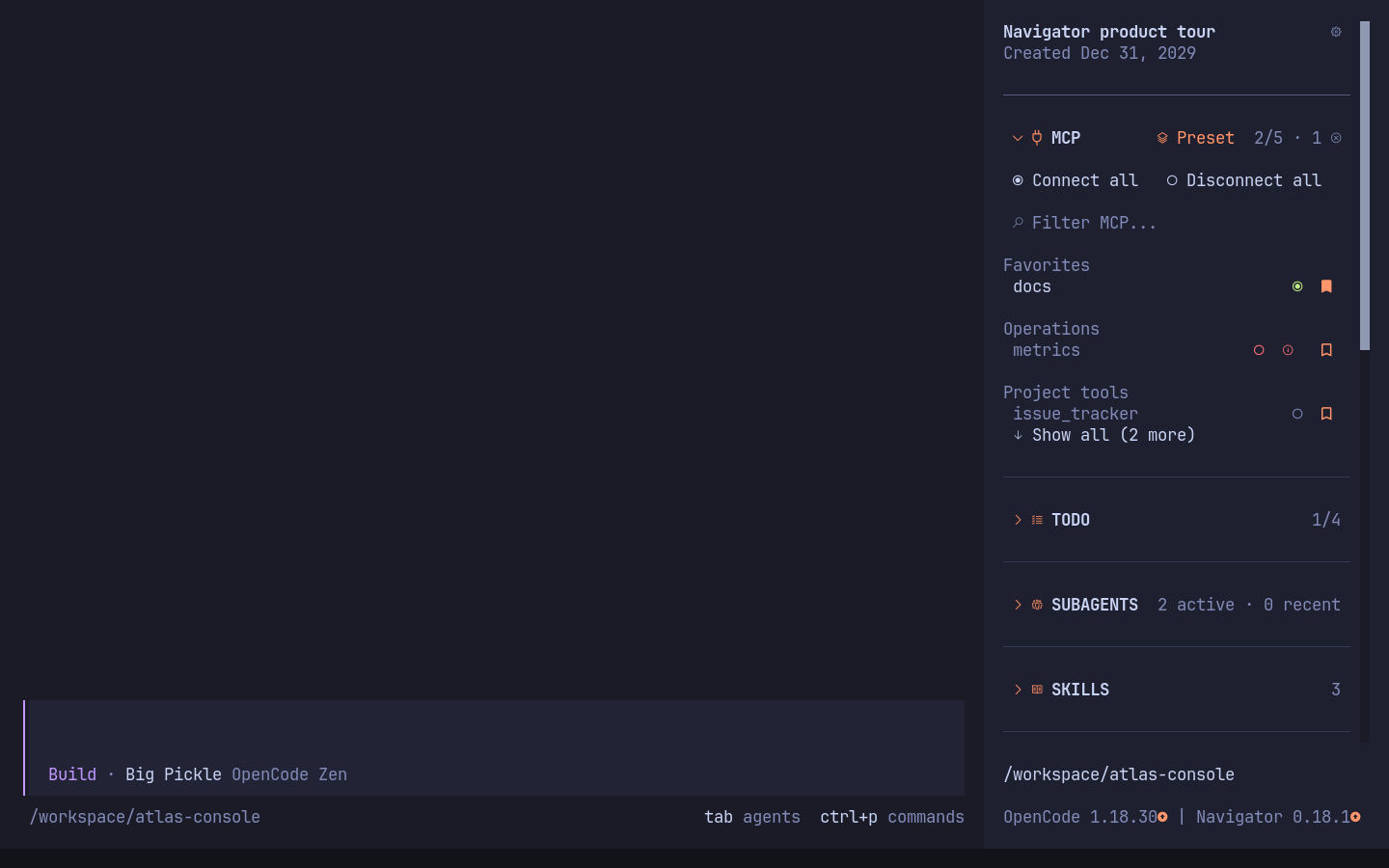
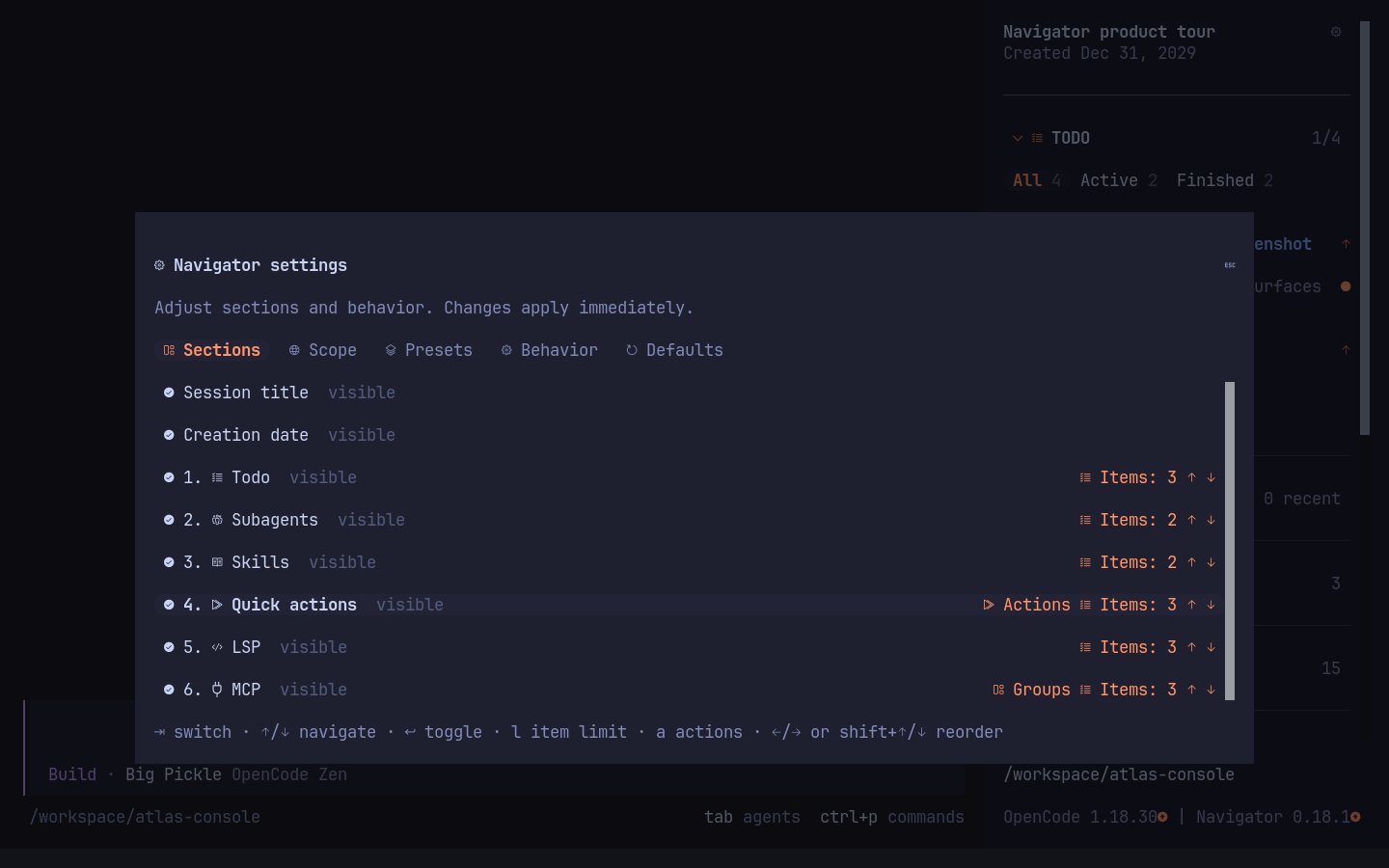
MCP groups are managed from Settings → Sections → MCP → Groups. Favorites remain in a leading bucket; custom groups and their servers sort alphabetically. Assignments can select an existing group or open an input to create a new one.
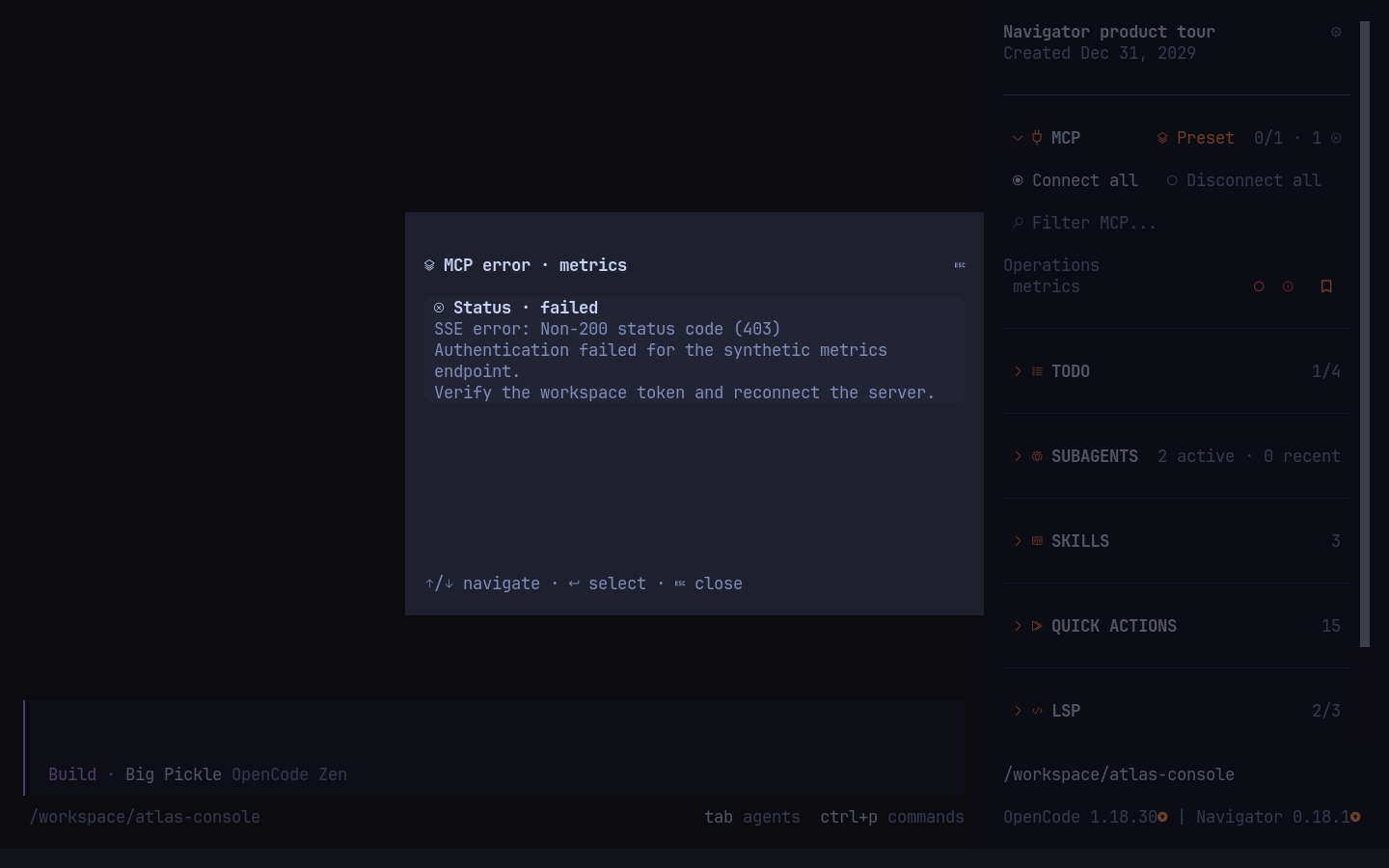
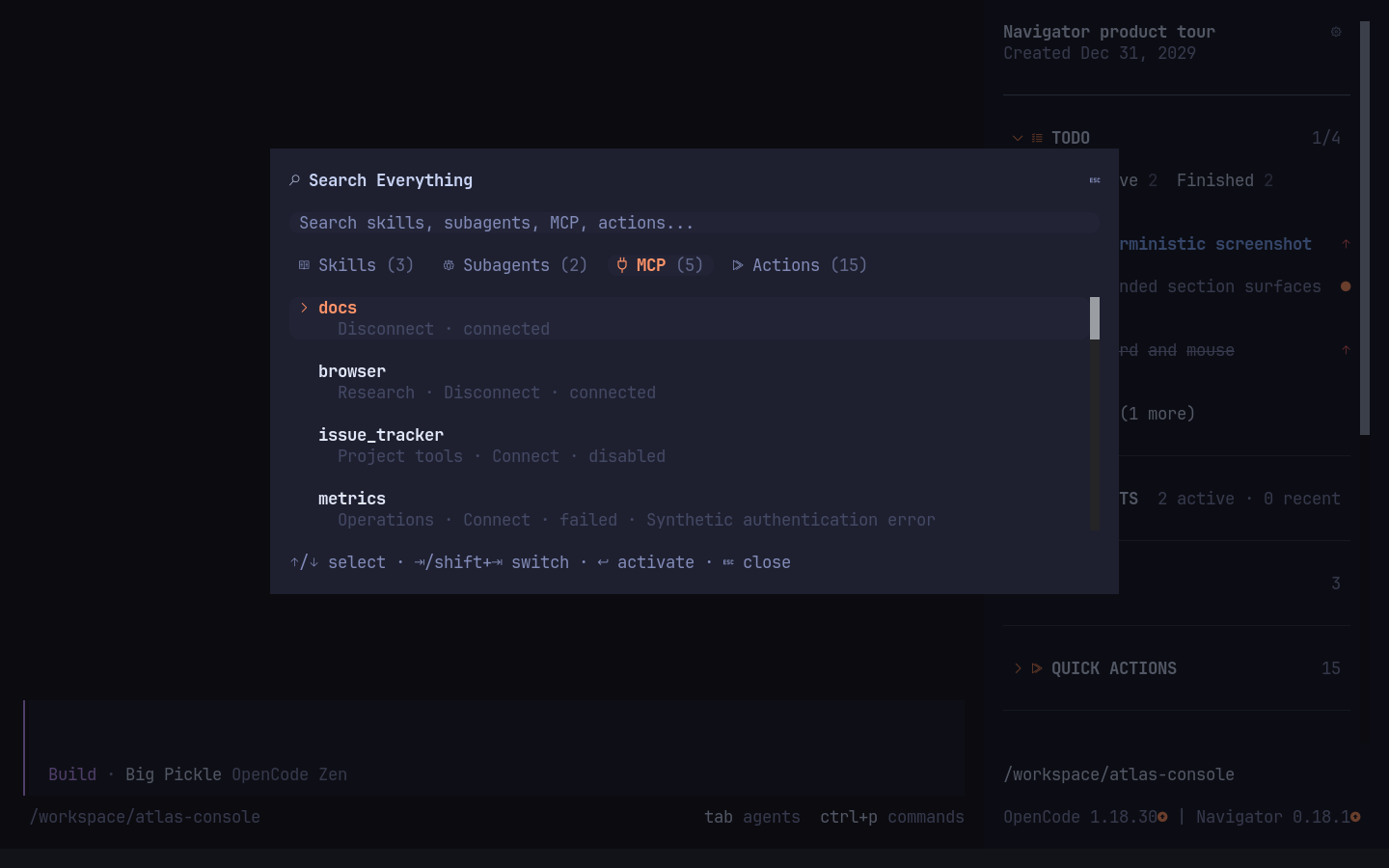
Search Everything preserves one query across Skills, Subagents, MCP, and Actions:
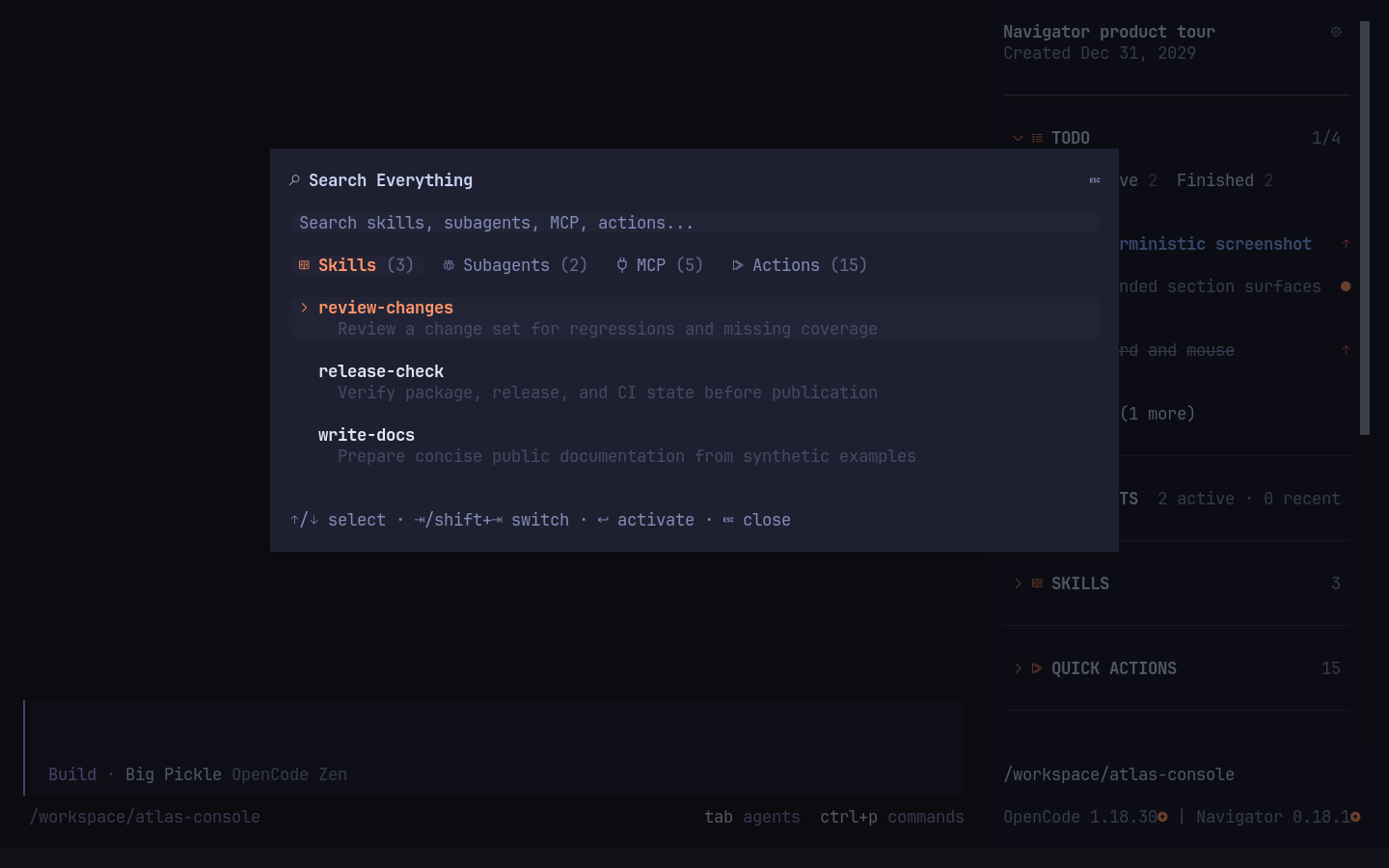
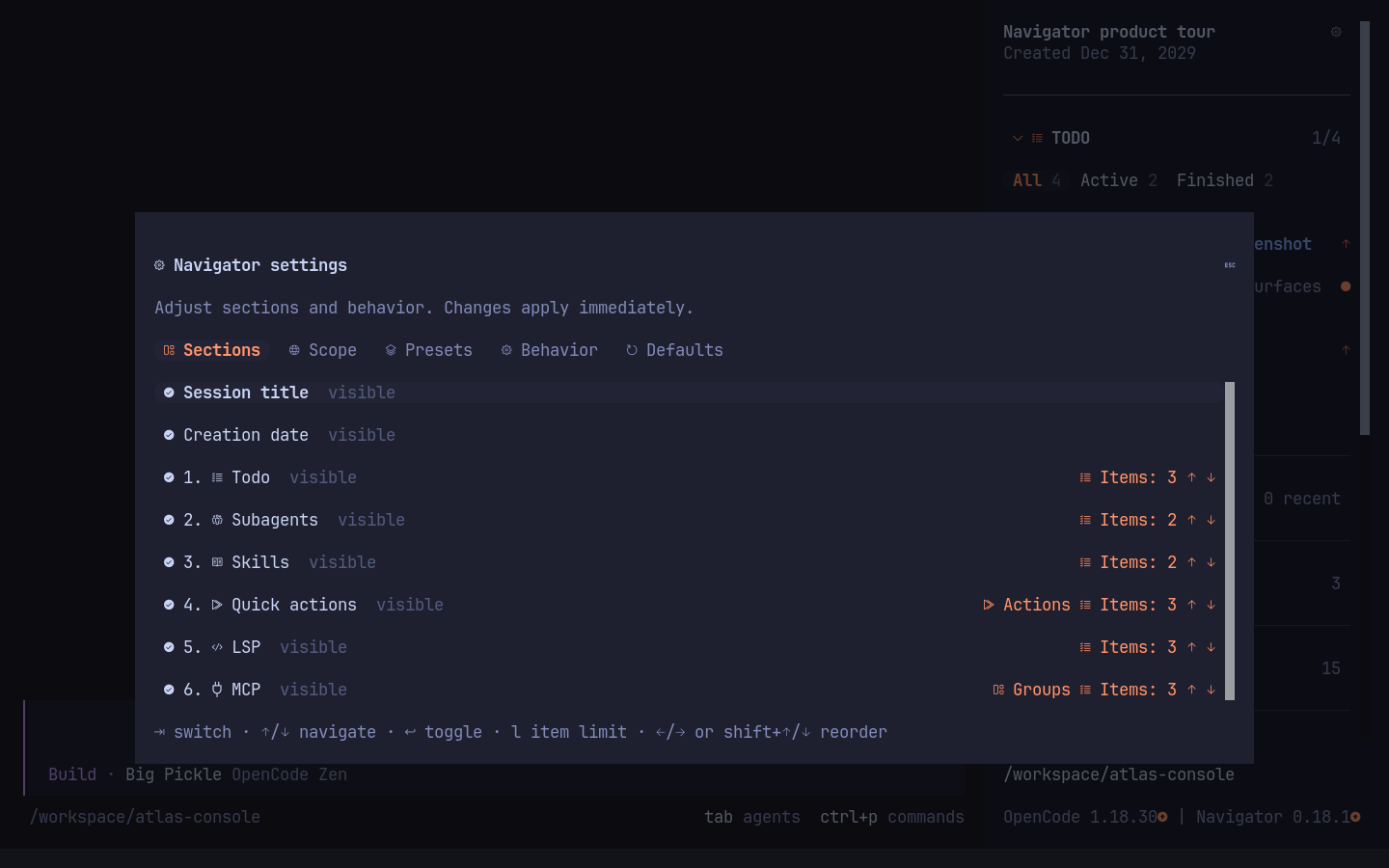
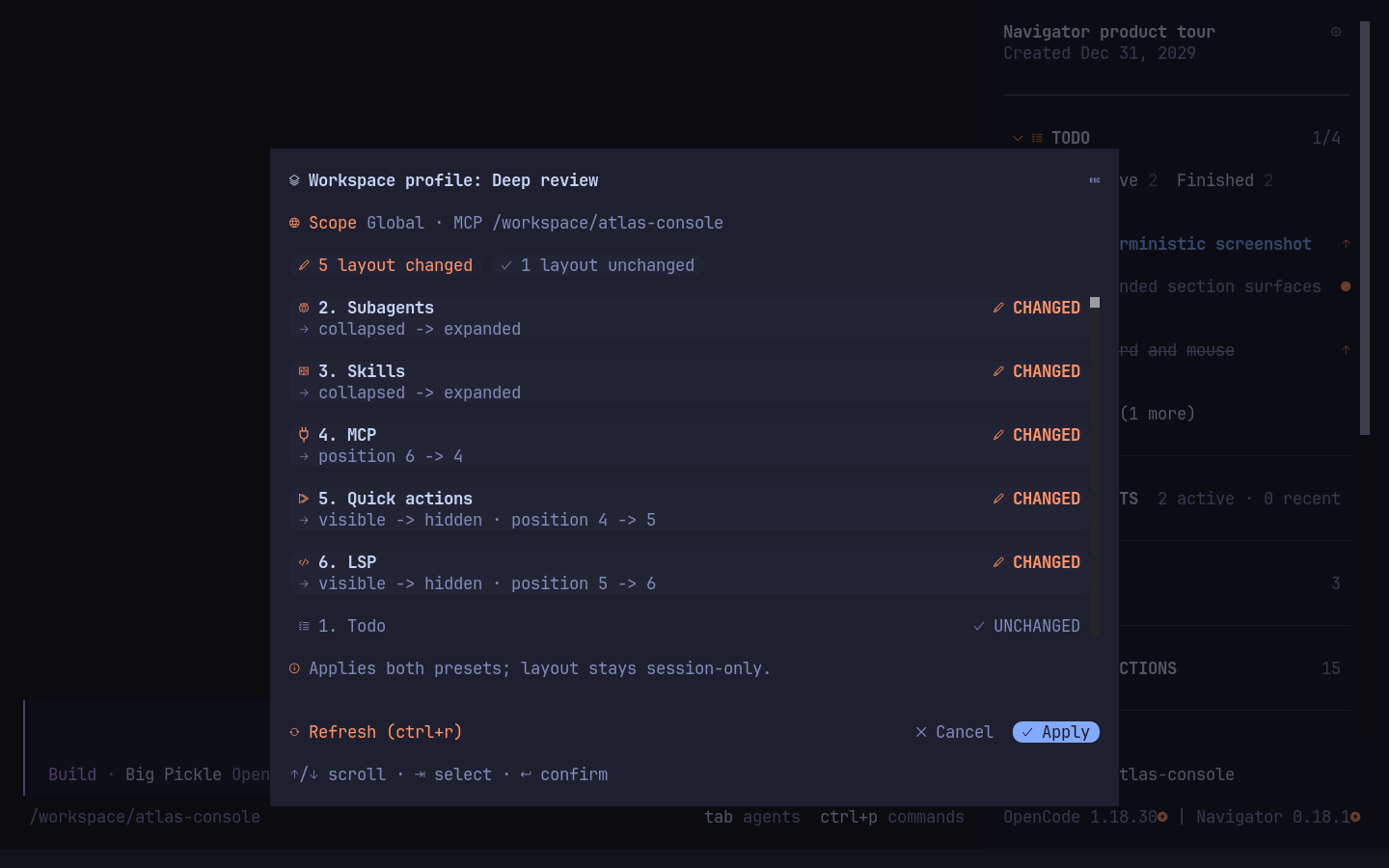
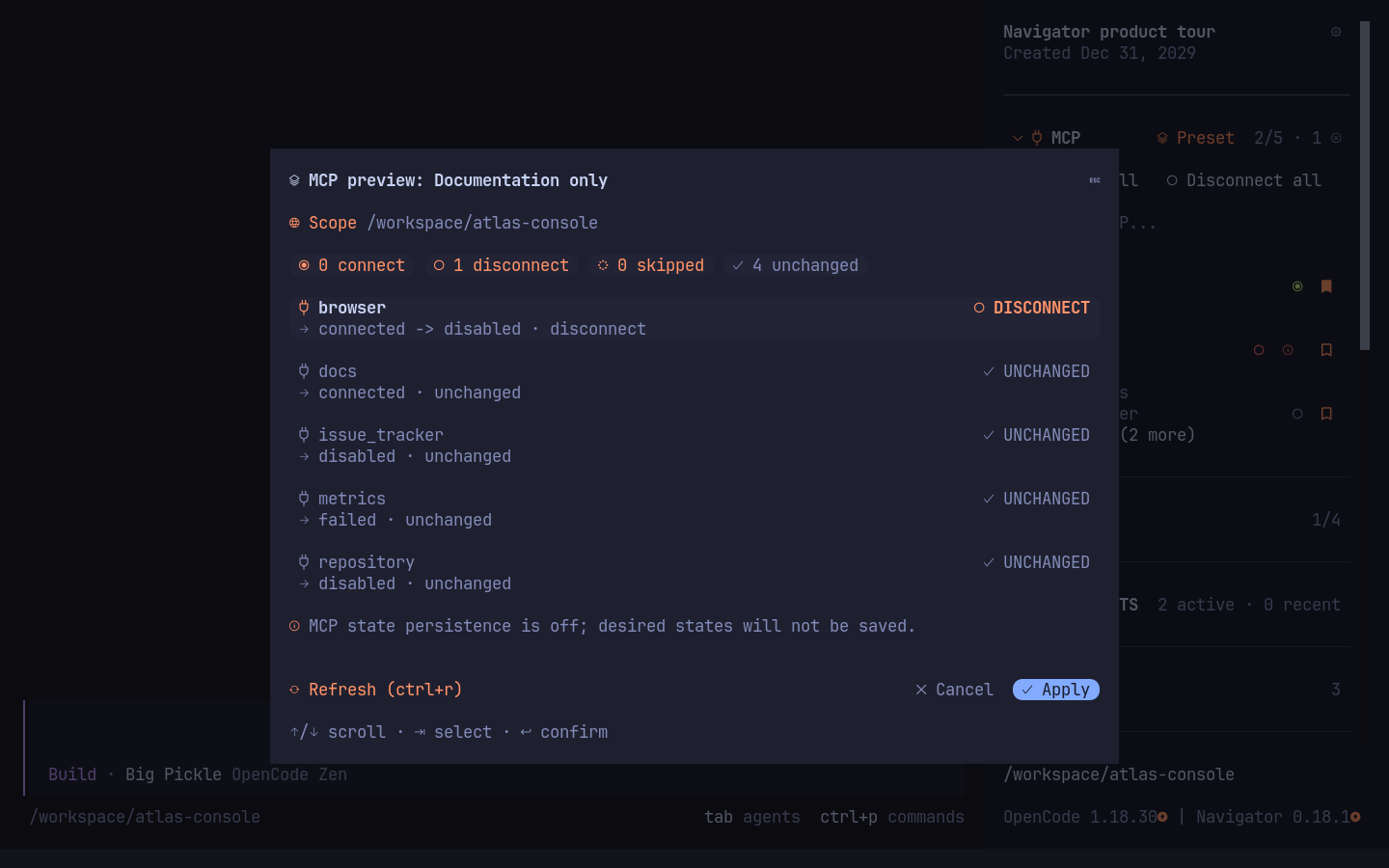
Settings and preset previews keep layout and MCP changes explicit before Apply:
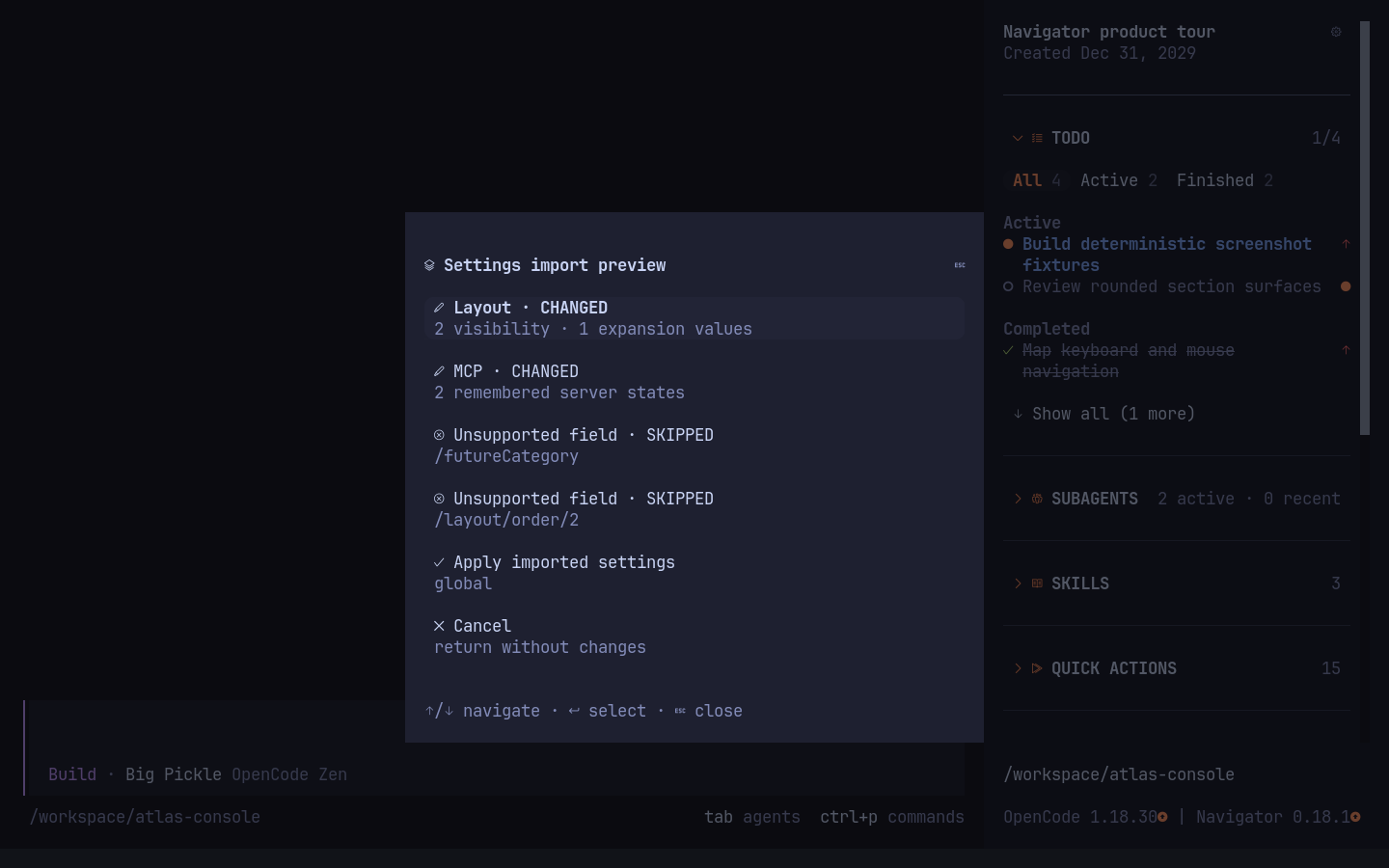
Portable settings use the terminal clipboard for export and pasted JSON for import. The preview separates supported layout/MCP changes from future fields that will be skipped:
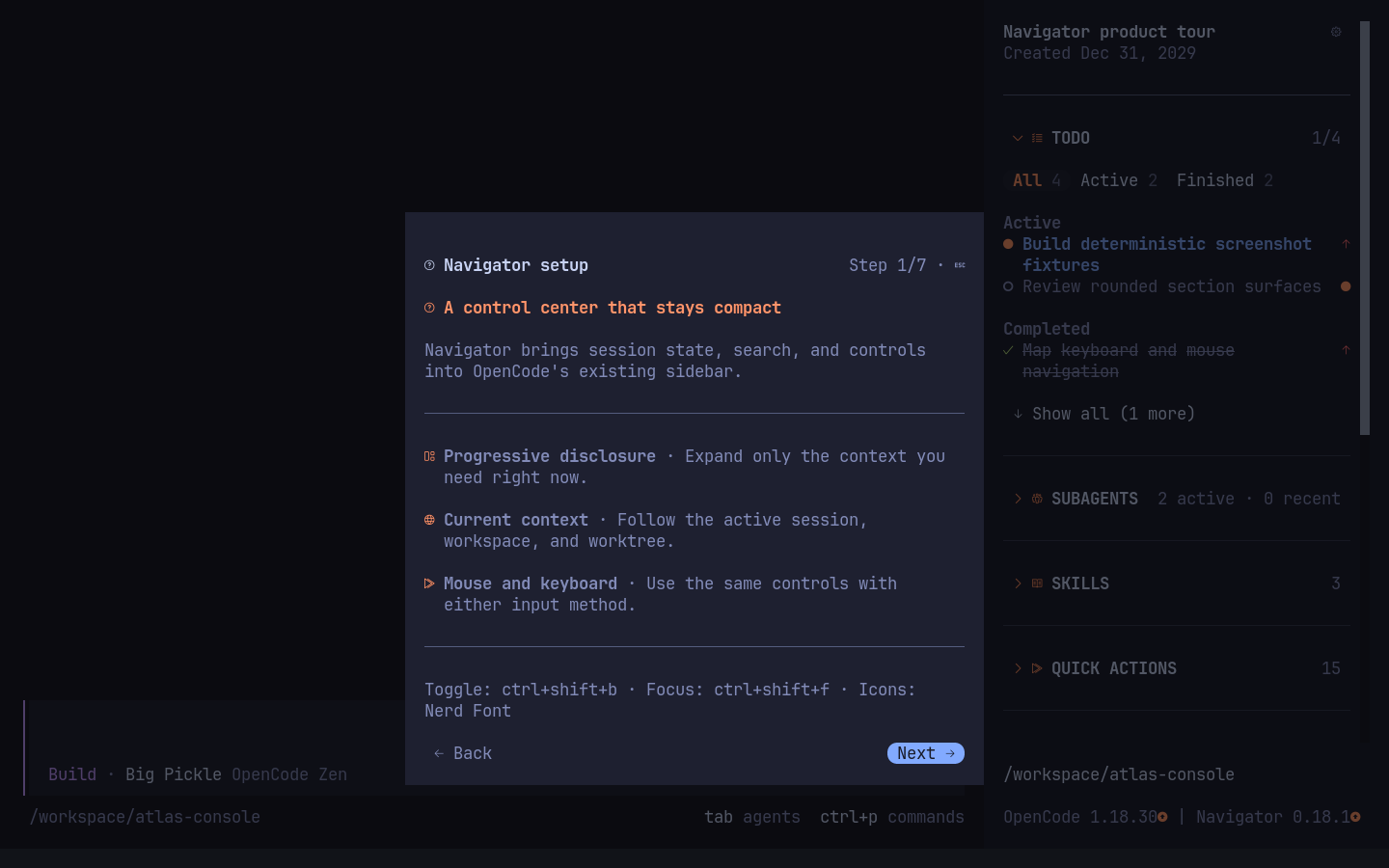
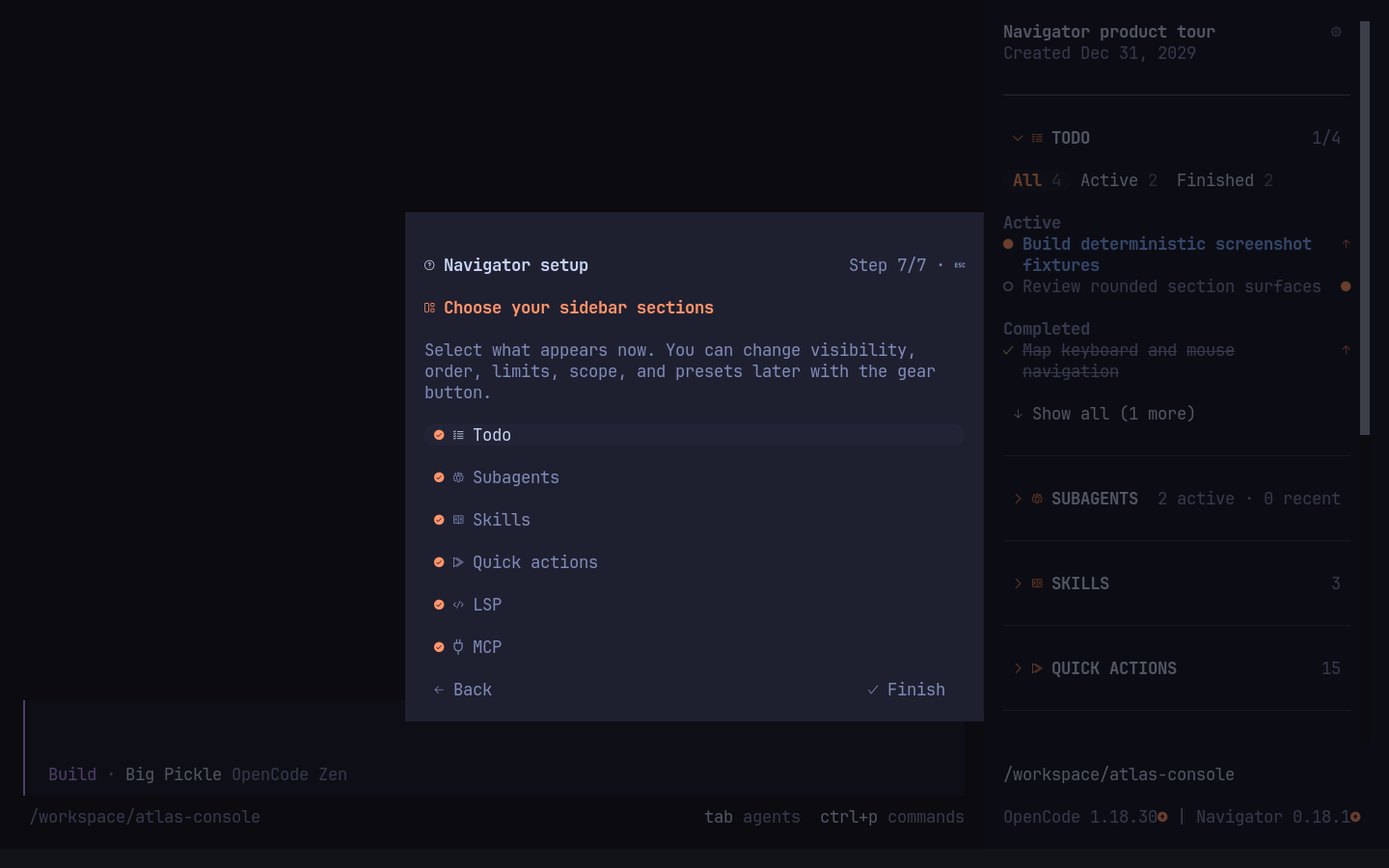
The first-run guide configures visible sections, while Text fallback keeps every control readable without Nerd Font icons or the corner font:
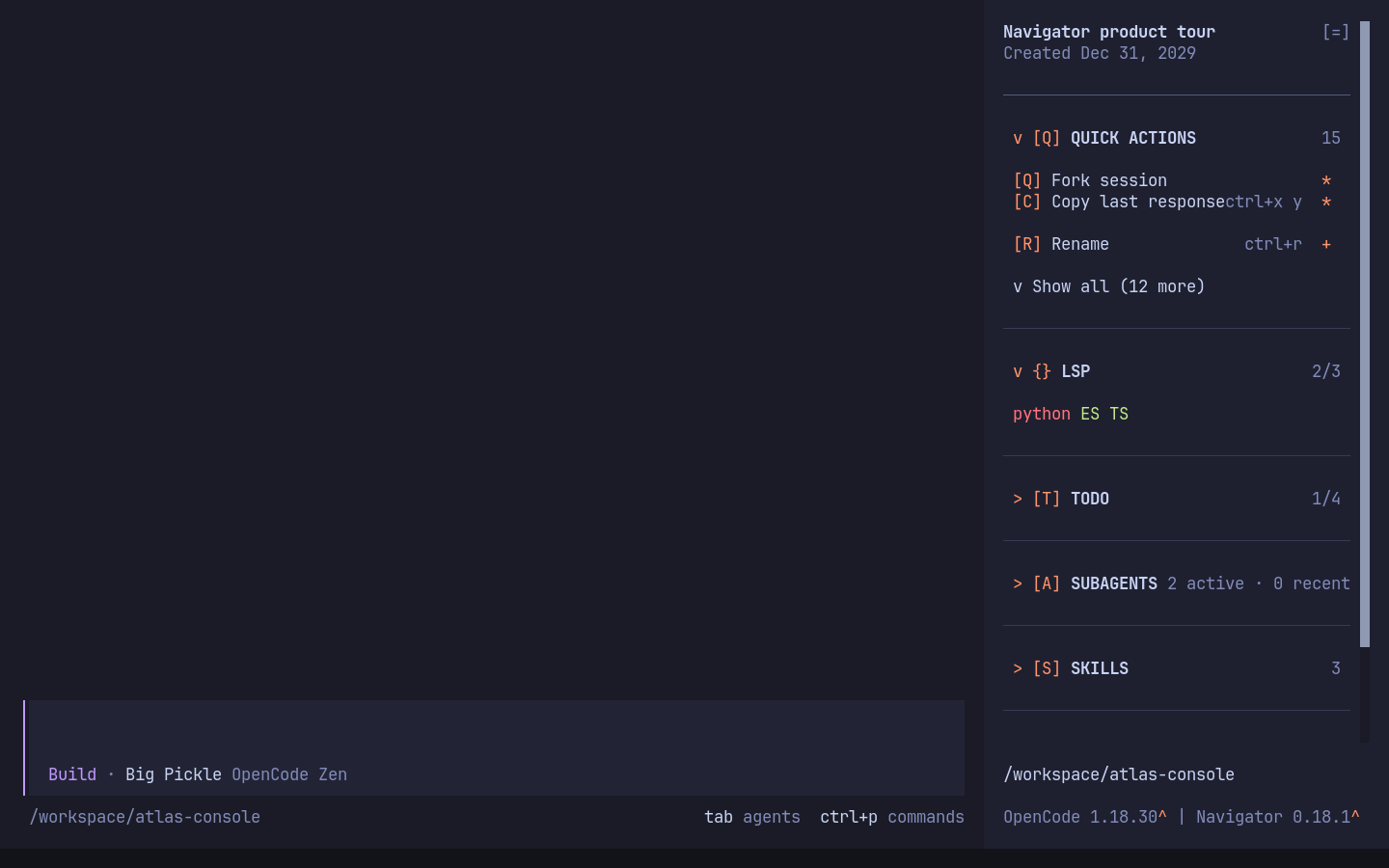
The harness also captures Nerd Font mode without the additional corner font, so the uninstalled-font result remains visible rather than being documented only in text:
The complete 37-state screenshot gallery shows every Todo and Subagent filter, sidebar section, Search and Settings tab, preset menu and preview, confirmation, keyboard-help, setup, and icon-fallback state.
Installation
OpenCode 1.x
Install the plugin for the current project:
opencode plugin opencode-navigatorUse --global to install it for every project:
opencode plugin --global opencode-navigatoropencode plug is an alias for opencode plugin.
OpenCode 2.x
Install Navigator through the OpenCode 2 plugin manager:
opencode plugin add opencode-navigatorThis installs the package and adds it to the plugins array in the global
~/.config/opencode/cli.json. The equivalent configuration is:
{
  "$schema": "https://opencode.ai/v2/cli.json",
  "plugins": ["opencode-navigator"]
}
OpenCode 2.x CLI plugins are global terminal settings; there is no project-local
cli.json. Navigator replaces the sidebar.content slot, so no built-in sidebar
plugin overrides are required. OpenCode validates cli.json strictly, so keep it
within the linked schema and restart OpenCode after changing it.
To enable Todo in OpenCode 2.x, also install the server half of Navigator.
Add the same package to ~/.config/opencode/opencode.json (or the project
opencode.json):
{
  "$schema": "https://opencode.ai/config.json",
  "plugin": ["opencode-navigator"]
}
For a local source installation, use the directory containing Navigator's
server.js in the plugin array. Keep the TUI package in cli.json as above;
the server configuration alone does not replace it. Restart OpenCode after
configuring both. Todo items belong to the current session, survive restarts,
and update in the sidebar when the agent calls navigator_todo_write. The
Todo instructions: Off/On control in the Todo section is session-scoped and
starts Off: tasks and the agent tool work without adding Todo instructions
to the model's context. OpenCode 1.x continues to show the host's Todo list.
If you use both OpenCode 1.x and 2.x with the same global opencode.json, keep
that shared server config compatible with 1.x. Place the server-plugin entry
in a separate JSON file and set OPENCODE_CONFIG to its path only when
launching OpenCode 2.x. The TUI configuration in cli.json remains separate;
the OpenCode 1.x launch must not load Navigator's 2.x server plugin.
Install the corner font
Required for rounded multiline selections in Nerd Font mode. Run the font installer on the computer displaying your terminal, even if OpenCode runs over SSH on another machine:
npx --yes --package=opencode-navigator opencode-navigator-fontThis command requires Node.js 20+ and npm. It installs the small bundled
OpenCodeNavigatorCorners.ttf
for your user account. Version 1.001 contains four corner masks and preserves the
four legacy filled corners. It is licensed under MIT. Keep your existing Nerd Font selected as the terminal font; the new
font supplies only the missing corner characters through font fallback.
Fully quit and reopen the terminal application, then start OpenCode again. Restarting only OpenCode may leave the terminal's old font cache in use.
The installer uses ~/Library/Fonts on macOS, the user font directory under
XDG_DATA_HOME (or ~/.local/share/fonts) on Linux, and the per-user Windows font
directory and registry. Linux requires fc-cache from Fontconfig.
The bundled metrics are tested with IoskeleyMono Nerd Font Propo; see
assets/README.md for generating a matching font for other metrics.
If you skip font installation, turn off Settings → Behavior → Multiline corner
font (or set behavior.cornerFont / the legacy corner_font option to false).
This preserves Nerd Font icons and single-line rounded controls while using clean
rectangles for multiline highlights. Text fallback remains available when Nerd
Font icons are also unavailable.
To remove only the additional font:
npx --yes --package=opencode-navigator opencode-navigator-font --uninstallTurn off Multiline corner font before uninstalling it, then restart the terminal.
Configure OpenCode 1.x sidebar sections
The opencode plugin command adds the package to the plugin array in tui.json. To avoid
duplicating sidebar sections, also disable the overlapping built-in plugins:
{
  "$schema": "https://opencode.ai/tui.json",
  "plugin": ["opencode-navigator"],
  "plugin_enabled": {
    "internal:sidebar-context": false,
    "internal:sidebar-mcp": false,
    "internal:sidebar-lsp": false,
    "internal:sidebar-todo": false
  }
}
Use .opencode/tui.json for a project installation or
~/.config/opencode/tui.json for a global installation. Restart OpenCode after
changing the configuration.
Upgrading from Pretty Sidebar
OpenCode Navigator is the new name of opencode-pretty-sidebar. Replace the old
package entry in tui.json with opencode-navigator rather than loading both.
If you disabled the plugin through plugin_enabled, rename that key to
opencode-navigator as well.
Existing settings, presets, favorites, recent skills, Quick Action bookmarks, and shortcuts are retained:
Navigator uses the established opencode-pretty-sidebar/preferences.json and its
lock under OpenCode's state directory. No file copying is required. Public
opencode-pretty-sidebar.toggle, .focus, .focus.<section>, and .search
commands remain available as aliases for custom keybindings.
Develop locally
OpenCode uses your configured global Navigator installation when opened in this
repository. Local .opencode/tui.json and .opencode/cli.json files are ignored
by Git; keep any host-specific preferences and plugin paths there if needed.
Rebuilding dist/tui.js does not replace the global installation. The PTY
smoke tests load the working build with isolated temporary configurations.
bun install
bun run font:install
Fully restart the terminal once after installing the corner font, then run:
opencodeOpenCode reads TUI configuration at startup. Restart it after changing the
plugin or tui.json.
On first launch, a seven-step setup wizard introduces monitoring, Search Everything,
Skills, Quick Actions, LSP, MCP controls, presets, and workspace customization
before letting you choose which sections to show. The guide is shown once and can be opened again
later from the sidebar settings button. The settings dialog also selects global
or current-worktree scope, manages named layout presets, and controls section
order, MCP state persistence, icon style, and the sidebar shortcuts without
a restart. Settings are grouped into tabs; use Tab and Shift+Tab to switch
tabs. In the Sections tab, use Left/Right or Shift+Up/Shift+Down to
reorder the selected section.
The Sections tab combines visibility, ordering, and the number of visible items
for each section. Click Items: All / Items: N, or press L on the selected
section, to edit its item limit. Enter toggles visibility; the arrow controls
change section order.
Every section defaults to All (0). A positive limit reveals Show all (N more);
Show less restores the configured limit. Limits count items, not wrapped terminal
lines, and apply after filtering and sorting. Temporary expansion resets when the
target, filter, or limit changes. MCP bulk actions still operate on the full server
list. Limit changes persist immediately in the selected Global or Current worktree
scope; Restore configured behavior removes that scope's limit overrides.
On the Quick Actions row, click Actions or press A to choose individual
actions and their order. Enter toggles visibility; Left/Right or Shift+Up/Down
reorders the selected action. Changes save in the selected Global or Current
worktree scope. Escape returns to the Quick Actions row in Sections. Navigator
keeps an explicit allowlist of argument-free host commands, including OpenCode's
global permission.mode auto-approve toggle. Bookmarks are user-wide and move
selected actions to the front in their configured order in both the sidebar and
Search Everything. Usage never changes the order. Visibility remains independent,
so any action, including a bookmarked one, can be hidden from the sidebar while it
remains searchable. Unavailable actions stay visible with a route- or host-specific reason.
Configuration sources
Navigator validates and deep-merges three simultaneous sources in this order:
- The
optionsdictionary in Navigator'sopencode.jsonplugin tuple. OpenCode 1.x also passes the same dictionary from itstui.jsontuple. ~/.config/.opencode-navigator/settings.jsonfor user-wide configured defaults..opencode/navigator.jsonin the current worktree for commit-safe project defaults.
Later sources override earlier sources. Object fields merge independently, while ordered arrays are replaced and normalized. A malformed file is ignored with a warning without discarding the other sources. Saved Global and Current worktree preferences remain above all three configured sources; current-session layout is the final temporary layer.
Use this object directly as either settings file, or as the second item in the Navigator plugin tuple:
{
  "behavior": {
    "toggleKey": "ctrl+shift+b",
    "focusKey": "ctrl+shift+f",
    "searchKey": "ctrl+shift+k",
    "persistMcp": true,
    "startInChat": false,
    "showSessionTitle": true,
    "showSessionDate": true,
    "cornerFont": true,
    "lspIconStyle": "nerd",
    "rowDensity": "compact",
    "sectionItemLimits": { "todo": 0, "skills": 5, "mcp": 5 },
    "quickActionOrder": ["session.rename", "session.copy", "session.fork"],
    "quickActionVisibility": { "session.export": false }
  },
  "layout": {
    "sections": { "todo": true, "skills": true, "lsp": false },
    "expanded": { "todo": true, "mcp": true },
    "order": ["todo", "subagents", "skills", "quick_actions", "mcp", "lsp"]
  },
  "mcp": { "docs": "enabled", "metrics": "disabled" },
  "layoutPresets": {
    "Review": {
      "sections": { "quick_actions": false },
      "expanded": { "todo": true },
      "order": ["todo", "subagents", "skills", "mcp", "quick_actions", "lsp"]
    }
  },
  "mcpPresets": { "Docs": { "docs": "enabled", "metrics": "disabled" } },
  "workspaceProfiles": { "Review": "Docs" },
  "mcpServerGroups": { "docs": "Documentation", "metrics": "Operations" }
}
For example, the schema-valid opencode.json entry is:
{
  "$schema": "https://opencode.ai/config.json",
  "plugin": [["opencode-navigator", { "behavior": { "rowDensity": "comfortable" } }]]
}
Behavior keys control the optional start-in-chat flow, shortcuts, MCP persistence, nerd/text icon style, row
density, item limits, and Navigator's safe Quick Action allowlist. Unknown values,
sections, actions, and MCP states are discarded. The previous snake_case tuple
options (toggle_key, focus_key, search_key, persist_mcp, start_in_chat, show_session_title,
show_session_date, corner_font, icon_style,
lsp_icon_style, row_density, section_item_limits, quick_action_order,
quick_action_visibility, sections, and section_order) remain compatible;
canonical nested fields win when both forms are present.
Start new sessions in chat is off by default. Turn it on under Settings → Behavior to open an empty session directly when starting OpenCode on Home or choosing New session. Opening an existing session or explicitly navigating Home is unaffected. The setting follows the selected Global or Current worktree scope.
Navigator also records its last observed version in private preferences. On the first launch after an update, it shows the release notes between that version and the new installation from the bundled changelog. Updates through Navigator save the previous version before installation; updates made outside OpenCode are detected on the next launch. Fresh installations show no upgrade dialog, and each updated version is shown once. When upgrading from an older version that did not record version history, the first launch establishes the baseline for subsequent updates.
In OpenCode 1.x, Settings → Sections also has separate switches for the session title and creation date. These follow the selected Global or Current worktree scope, and hiding both leaves the settings control available. OpenCode 2.x renders its own title and has no supported visibility slot for these switches, so they are omitted there.
For a recognized pinned local Navigator snapshot, a confirmed update downloads
the next version into a separate snapshot and switches its existing local
wrapper only after installation succeeds. The OpenCode plugin source in
tui.json or cli.json does not change. This update path requires Node.js and
npm on the machine running OpenCode; restart OpenCode afterward. Unknown local
sources are left untouched.
Configured files may define behavior, layout, desired MCP states, layout and MCP presets, workspace-profile links, and MCP groups. Navigator deliberately ignores favorites, recent-item history, trusted skills, onboarding state, paths, and other private mutable data. The files are read-only defaults: UI changes continue to use the concurrency-safe preferences file under OpenCode's state directory. Resetting a scope removes only its saved override and reveals configured values again.
Choose Global or Current worktree before editing from the sidebar gear button.
Behavior changes apply immediately in the selected scope. Section visibility,
expansion, and order remain in memory until Save current layout as default is
selected. Save as… captures current visibility, expansion, and section order;
saved presets can be applied, updated, renamed, or deleted.
Choose Preview & apply in a saved layout preset's menu to review visibility,
expansion, and position changes before applying it. Changed sections appear first,
with their destination positions. Opening the preview does not change the layout;
select Apply to confirm or Cancel / Escape to return to the preset menu.
Applying a preset updates the in-memory layout for the selected scope. Use
Save current layout as default to persist it.
In Defaults & Help, Copy portable settings exports the selected scope's effective layout and desired MCP states as deterministic versioned JSON through the terminal clipboard. Import portable settings… accepts pasted JSON and opens a preview before writing. Unknown future fields and section IDs are listed as skipped; malformed versions or invalid known values are rejected. Apply replaces only the supplied layout and MCP blocks in the still-selected scope in one atomic preferences update. Paths, shortcuts, favorites, history, trust choices, and other private preferences are never imported or exported.
Keyboard controls
Press Ctrl+Shift+F to focus the sidebar. Use Up/Down or k/j to move,
Enter to activate the selected row, Escape to return to the previous focus,
? to open the keyboard help, and Ctrl+, to open Navigator Settings directly.
When a Skills or MCP filter owns focus,
typing edits the query and the first Escape returns to sidebar navigation.
The filter icon, placeholder, entered text, clear control, and cursor use the same
contrasting focus palette; the field follows actual input focus and blur.
The command palette also exposes Focus sidebar and direct commands for Todo,
Subagents, Skills, Quick Actions, LSP, and MCP. Both sidebar shortcuts can be
changed at runtime in settings.
Search Everything
Press Ctrl+Shift+K or run Search Everything from the command palette. Use
the Skills, Subagents, MCP, and Actions tabs to choose a category. The query is
shared across tabs; each tab shows its matching result count, including zero.
Tab icons match the sidebar sections and section entries in settings.
Search covers names, descriptions, skill source paths, and subagent IDs in the
current workspace/session. It uses full source lists, regardless of sidebar
visibility and item limits; actions hidden from the sidebar are still searchable.
Bookmarked actions are remembered user-wide and lead the configured base order in
both views. Usage never changes their order. Actions unsupported by the current
OpenCode version or unavailable on the current route remain searchable and show
why they cannot run.
Up/Down: select a result in the current tab;Tab/Shift+Tabor a click: switch tabs. Each tab remembers its selection and scroll position until the query changes.Enter: insert a skill (honouring its confirmation preference), open a child session, connect/disconnect an MCP server, or run a built-in action.- MCP toggles keep the search open and update the server status in place, preserving the query, selection, and scroll position.
Escape: close and return focus;Ctrl+R: retry loading sources.
Results use compact title/preview rows. Background refresh preserves the current scroll position and does not flash a refresh indicator. Cached results remain available when a source refresh fails. Busy MCP actions are disabled; session actions on the home screen explain that a session is required. Changing session or workspace closes the search dialog to prevent stale actions.
OpenCode initializes enabled MCP servers before TUI plugins. A server remembered
as disabled can therefore connect briefly during startup before this plugin
disconnects it. Servers remembered as enabled are connected after the plugin
initializes. Connect all and Disconnect all run eligible server changes in
parallel, retain successful results when some servers fail, and offer a retry for
only the failed servers.
Use the Preset selector in the MCP heading to save the current enabled/disabled
state, apply a preset, update it from the current scope, rename it, or delete it.
Preview & apply refreshes the current server states and shows the planned
connections, disconnections, unchanged servers, and unavailable or missing servers
that will be skipped. Changes appear first. The preview updates when the preset or
server state changes; Ctrl+R refreshes it again. Applying is disabled while states
are loading, a refresh has failed, or another MCP mutation is running.
Use Up / Down to scroll a preview, Tab or Left / Right to select its
buttons, and Enter to confirm. Buttons also support mouse activation. Changing
the target scope/workspace closes the preview, and deleting the preset disables
its Apply action.
Preset application runs only the necessary server changes and keeps per-server progress and failed-only retry behavior. Servers in a preset that are not present in the current scope are skipped at application time; their desired states are retained when MCP state persistence is enabled.
A layout preset can optionally link to one MCP preset as a user-wide workspace
profile. Opening it shows one combined change preview; only the separate Apply
action changes either side. Applying does not save the layout as the default and
profiles are never applied automatically when entering a workspace.
Failed MCP rows expose an information control instead of placing the error inline. It opens a scrollable dialog containing the server, status, and complete error text.
The MCP bookmark control saves favorites user-wide by server name. Favorites appear first, alphabetically within each group, with a blank separator before other servers. The bookmark does not connect or disconnect the server.
LSP servers with connection errors appear first, followed by alphabetical ID and root order. Activate any badge, including a custom server, to toggle its full ID in place. Navigator does not open a root/status dialog because OpenCode may report an empty root and does not expose the underlying diagnostic error text.
Todo priorities are read-only in the sidebar. OpenCode 1.x provides host Todo data without a TUI mutation API; on 2.x, Navigator's agent tool writes tasks.
Todo offers All, Active, and Finished views with counts. Active shows running
tasks before pending tasks. Finished contains separate Completed and Cancelled
groups. The selected view is temporary and resets to All when changing sessions.
The header always reports completed tasks against the full task count.
Subagents show observed run duration, retry countdowns, and execution errors. An
already-running child discovered by the sidebar uses a clock icon (~ in Text
fallback) because its exact start time is unknown. Recent keeps the last 10 observed
finished runs per parent session in memory across navigation, until OpenCode exits.
An idle transition is labelled Finished, not a guarantee of successful task
completion; errors and cancellations retain their own labels. A worker timeout
displays status unavailability and does not mark its last confirmed active run as
finished.
Active runs precede Recent under the shared Subagents item limit.
Local session events update subagents immediately; snapshot and worker-status
polling runs every five seconds. Background refresh is silent after the initial
load, including when a section is empty, so it does not shift the list.
Use All / Active / Recent / Errors and the text filter to narrow the subagent
list before applying its item limit. Filters reset on a target change. In a child
session, Parent session opens the parent even when no subagents are listed.
Selecting a skill opens its description with Accept and Cancel controls before
appending its /<name> command to the current prompt. Select "Don't show again
for this skill" to skip that confirmation later. The sidebar settings dialog
lists trusted skills under Defaults, where trust can be revoked individually or
for every skill. Select the bookmark beside a skill, or the
same control in its confirmation dialog, to keep it ahead of non-favorite skills
in every workspace. The last 10 successfully inserted
skills are remembered user-wide by source location and appear after favorites,
most recent first, marked with a history icon (~ in text mode). Other skills
remain alphabetical. Skill rows do not show a separate information control;
the confirmation dialog contains the description and full source location.
Quick actions invoke OpenCode's built-in
commands and display the active keybindings from your configuration.
Nested dialogs support back navigation: Escape, Cancel, and close controls return to the previous menu. Settings retain the selected tab and row; Search Everything also restores its query, selection, and scroll position. Escape at the root closes the dialog. Completing an action closes its confirmation, and changing the search session or workspace dismisses the entire search dialog chain.
Scripts
Development requires Bun 1.4.2 and Node.js 24.16 or newer. Install dependencies with
bun install --frozen-lockfile.
ESLint uses the Solid preset from
@st1ggy/linter-config; Prettier uses its
common preset. eslint.config.js documents project-specific adaptations for
OpenTUI callbacks, SDK compatibility, and test fixtures. Type-aware linting covers
application code, tests, build scripts, and JavaScript configuration files.
bun run test
bun run test:e2e
bun run typecheck
bun run lint
bun run lint:fix
bun run format
bun run format:check
bun run font:install
bun run build
bun run bundle:size
bun run screenshots
bun run screenshots:verify
bun run check
bun run check runs the tests, TypeScript, ESLint, bundle-size guard, and formatting
check. The unminified TUI bundle is limited to 360,000 bytes.
Font generation is a separate development task: bun run font:build and
bun run font:check use uv and the pinned FontTools dependency. Users install
the already generated font; Python and FontTools are not needed at runtime.
CI checks that the bundled font matches its generator.
bun run screenshots builds a pinned Linux ARM64 image and captures the real TUI
through Ghostty on Xvfb. The image includes the bundled corner font and a pinned
JetBrainsMono Nerd Font; every displayed task, session, workspace, path, skill,
server, error, and preset is synthetic. bun run screenshots:verify renders the
same 37 scenes to a temporary directory and fails if any PNG differs. Three scenes
keep the pinned Nerd Font but remove the Navigator corner font so the uninstalled-font
experience remains reproducible beside the required-font captures. The harness
requires Docker with Linux ARM64 support. These commands are available for harness
development; the committed release captures are generated by the manual
Prepare Release GitHub Actions workflow.
Publishing
Publishing is handled by .github/workflows/publish.yml when a GitHub Release
is published. The release tag must match the package version, for example
v1.2.3 for version 1.2.3.
Before creating the release, run the manual Prepare Release workflow on the
default branch. It renders all screenshots twice to verify reproducibility, creates
a pull request when PNG files changed, dispatches CI for the exact generated commit,
and squash-merges it automatically after the checks pass. The workflow uses its
short-lived, repository-scoped GITHUB_TOKEN; no persistent bot token is required.
Wait for the generated screenshot pull request to merge before creating the release
tag.
The workflow uses npm Trusted Publishing with provenance. Configure
St1ggy/opencode-navigator and publish.yml as the trusted GitHub Actions
publisher in the package settings on npmjs.com before publishing a release.
The new npm package needs its own trusted-publisher configuration; the old
package's settings are not transferred by renaming the GitHub repository.