parseman
v0.7.1
Published
Parser combinators that compile to optimized JavaScript — use as a library or as a build-time macro
Maintainers
Readme
Parséman (PAR-zə-mahn)
Write parsers in TypeScript — fast enough to run as-is, and blazing fast when the bundler macro kicks in. Same code either way; no grammar files, no generated output to check in. Drop the plugin in tests or anywhere a bundler isn't around and everything still works.
Benchmarks
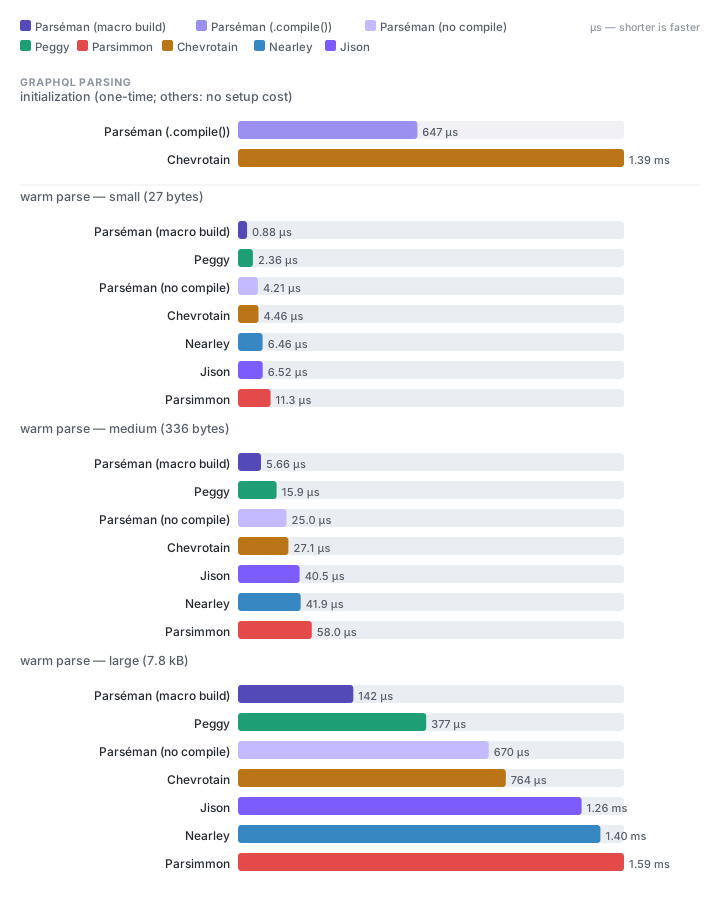
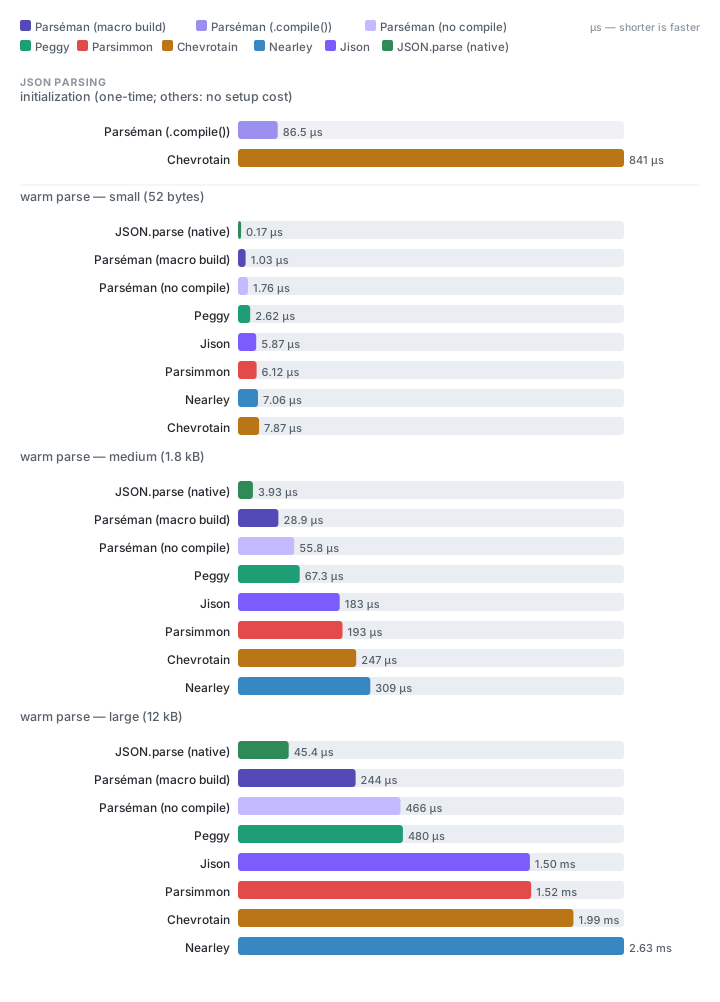
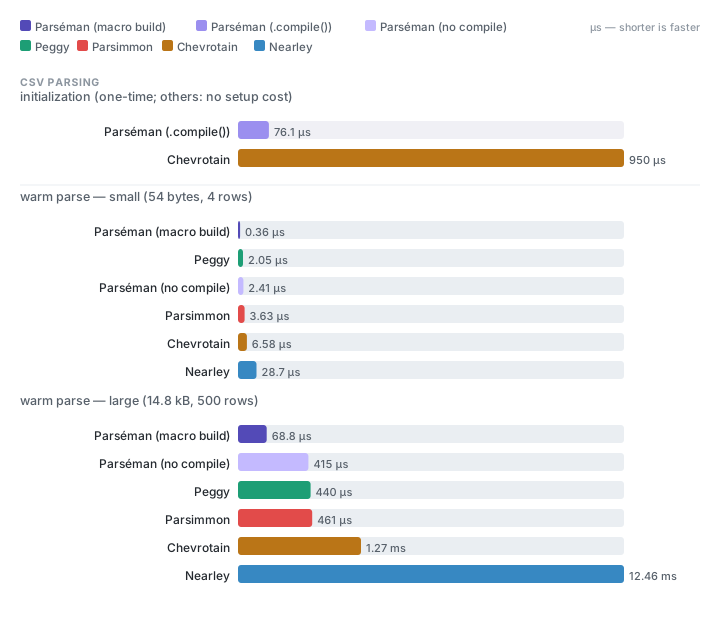
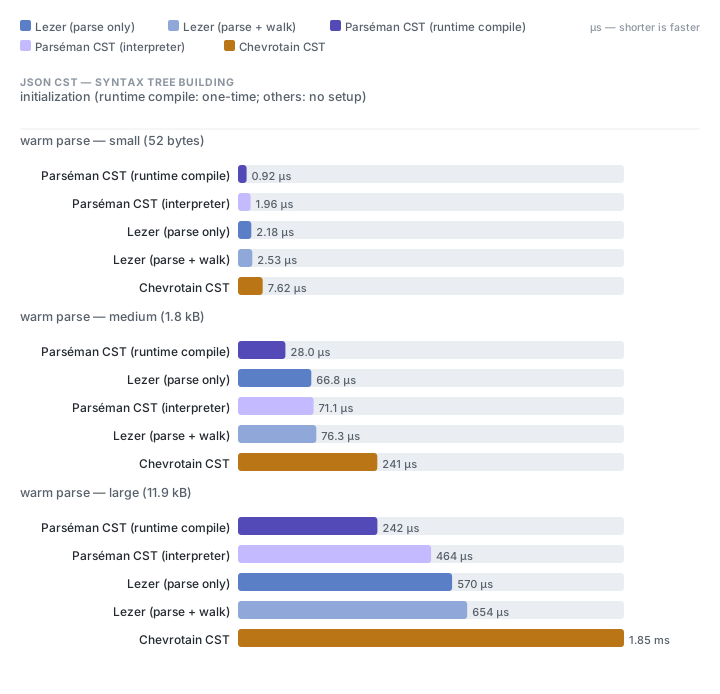
Measured on Apple M2 Pro. Bars show µs per parse — shorter is faster. Refresh: pnpm bench, then pnpm bench:svg (updates assets/bench-*.svg).
Compared parsers: Parséman, Peggy, Parsimmon, Chevrotain, Nearley, and Jison (plus JSON.parse on JSON). Each implements the same parsing work on the bench fixtures — building JS values / row arrays / GraphQL AST nodes, not syntax-only validation. Peggy grammars in bench/*.pegjs are the reference; Nearley JSON uses kach/nearley examples/json.ne; other Nearley and Jison grammars are ports of those Peggy files (bench/vendor/).
Parséman has three modes — interpreter (zero setup, works anywhere), macro build (compiled by the bundler plugin at build time, zero runtime cost), and .compile() (optional runtime JIT). Most production use lands on one of the first two. The initialization section only shows parsers with a nonzero setup cost: .compile() costs 75–650 µs depending on grammar size; Chevrotain always costs 840–1,400 µs. Parsers not listed there start for free. (Init numbers are pinned on the charts — they're noisy run-to-run; warm-parse bars are the meaningful comparison.)
On JSON, CSV, and GraphQL, Parséman macro beats Peggy at every fixture size in the charts above (e.g. GraphQL large: 142 µs vs Peggy 400 µs). For CST-building grammars (node() rules with trivia capture), the interpreter runs ~2× faster than Chevrotain on the JSON CST fixture while building an equivalent tree.
Install
npm install parseman
# pnpm add parsemanQuick start
import { literal, sequence, choice, regex, transform, parse } from 'parseman'
const method = choice(literal('GET'), literal('POST'), literal('PUT'), literal('DELETE'))
const target = regex(/[^\s]+/)
const version = regex(/1\.[01]/)
const requestLine = transform(
sequence(method, literal(' '), target, literal(' HTTP/'), version),
([verb, , path, , ver]) => ({ verb, path, version: `HTTP/${ver}` })
)
parse(requestLine, 'GET /api/v1 HTTP/1.1')
// { ok: true, value: { verb: 'GET', path: '/api/v1', version: 'HTTP/1.1' }, span: ... }Macro mode
Add the plugin once — your parser imports are evaluated and compiled at build time. The parseman import disappears from the bundle entirely.
1. Register the plugin
// vite.config.ts
import parseman from 'parseman/plugin'
export default { plugins: [parseman()] }// rollup.config.js
import parseman from 'parseman/plugin'
export default { plugins: [parseman.rollup()] }// webpack.config.js
const parseman = require('parseman/plugin')
module.exports = { plugins: [parseman.webpack()] }2. Import with with { type: 'macro' }
import { literal, sequence, choice, regex, transform } from 'parseman' with { type: 'macro' }Same combinators, no other changes. The plugin walks the initializer, evaluates it at build time, and replaces it with an inline function.
What gets emitted
// Before (source):
const method = choice(literal('GET'), literal('POST'), literal('PUT'), literal('DELETE'))
// After (bundle output):
const method = function(input, _pos, _ctx) {
const _code = _pos < input.length ? input.codePointAt(_pos) : -1
if (_code === 71) { /* G-E-T */ }
else if (_code === 80) { /* P-O-S-T */ }
else if (_code === 68) { /* D-E-L-E-T-E */ }
else return { ok: false, expected: ['"GET"', '"POST"', ...], span: { start: _pos, end: _pos } }
...
}Disjoint first characters → single codePointAt dispatch. Regex parsers → sticky /pattern/y hoisted to closure scope. No objects allocated on failure paths.
Debugging still works
The plugin emits a precise source map via magic-string. Breakpoints set on the original choice(...) lines are hit when the compiled function runs; step-through shows original combinator source, not emitted charCode checks.
If with { type: 'macro' } is stripped (older bundlers, test runners), the attribute is silently ignored and the interpreter runs instead — identical results, no errors.
What gets compiled
Combinator trees — literal, regex, sequence, choice, many, oneOrMore, optional, sepBy, transform, skip, not, scanTo, balanced — plus rules() factories (including mutually recursive ones), parser({ trivia }) / noTrivia() wrappers, and node() rules (CST capture and all). A full grammar built as a rules() factory of node() rules compiles end to end: each rule becomes an independently-callable function, terminal/trivia capture is emitted inline, and every build/transform callback is inlined with its source span. Grammars with no node() emit zero capture code, so they compile byte-identically. Parsers that close over external variables the evaluator can't resolve stay as-is — the plugin compiles what it can and quietly leaves the rest alone.
Combinators
Terminology: In this README, combinator means any building block that matches input (literal, choice, sequence, …). The parser() function is different — it wraps a root combinator with document-level options (trivia, line tracking) and gives you .parse(input). Same word family, two roles: combinators compose the grammar; parser() configures how you run it.
A combinator reads from the input at the current position and succeeds or fails (returning a value on success). Composing combinators with sequence, choice, many, etc. is how you express parsing decisions.
makeWord, rules, and parser are helpers: definition-time factories or wrappers that produce combinators. They never match input themselves.
| Combinator | Description |
|---|---|
| literal(s, opts?) | Exact string match. opts.caseInsensitive for locale-aware comparison. |
| word(s, boundary?) | Single keyword with automatic word-boundary guard. |
| keywords(words, opts?) | Match one of many keywords (longest-first), with optional boundary and case folding. |
| regex(pattern) | Match a regex at the current position. Patterns are optimized via regexp-tree. |
| sequence(...combinators) | Match all in order; returns a tuple [v1, v2, ...]. Skips trivia between terms when trivia is set. |
| choice(...combinators) | Ordered alternatives (PEG — first match wins). Disjoint first chars → O(1) dispatch. |
| many(combinator) | Zero or more; compiles to a while loop. |
| oneOrMore(combinator) | One or more; fails if nothing matches. |
| optional(combinator) | Zero or one; returns null on no match. |
| sepBy(combinator, sep) | Zero or more combinator matches separated by sep. |
| transform(combinator, fn) | Map the result: fn(value, span) → newValue. |
| skip(main, skipped) | Match main then skipped; return main's value. |
| label(name, combinator) | Attach a string label to a combinator arm (metadata). Used on trivia choice branches for per-chunk kind capture — see Whitespace and comment skipping. |
| node(type, combinator, build) | CST/AST rule: captures the combinator's terminals into children/rawChildren and trivia offsets into a flat triviaLog, then calls build(children, rawChildren, span, triviaLog). |
| ref<T>() | Low-level forward declaration slot (use rules() in most cases). |
| not(combinator) | Negative lookahead — succeeds (consuming nothing) when the combinator fails. |
| guard(predicate) | Succeeds only when predicate(ctx) returns true; used for context-sensitive rules. |
| withCtx(extra, combinator) | Merge extra into the user context for the duration of the combinator. |
| recover(combinator, sentinel) | On failure, skip input until sentinel matches; returns a CSTError node. |
| scanTo(sentinel, opts?) | Scan forward until sentinel matches (sentinel not consumed). Pass opts.skip to treat certain patterns as opaque blobs that may contain the sentinel character. Pass opts.orEOF: true to succeed at end-of-input. |
| balanced(open, close, opts?) | Match a single balanced delimited region — e.g. (…) or […] — including the delimiters. Primarily used as an element of scanTo's opts.skip list. |
Helpers (produce combinators at definition time)
| Helper | Description |
|---|---|
| trivia(combinator) | Label a combinator as skippable filler (whitespace, comments). Does not skip by itself — pass the result to parser({ trivia }) to turn on auto-skipping between tokens. |
| makeWord(boundary?) | Returns (str) => Combinator with a fixed word-boundary class. Not a combinator — see keyword disambiguation. |
| rules(factory) | Named, mutually-recursive rule bundle. See Named and recursive rules. |
| parser({ trivia }, combinator) | Wrap a root combinator with document-level trivia skipping. trivia: null clears trivia for that scope (see noTrivia). See Whitespace and comment skipping. |
| noTrivia(combinator) | Run combinator with the active trivia cleared — no trivia is skipped between its sequence/many terms, so they must be contiguous in the input. (Trivia is whatever parser({ trivia }) installed — often whitespace/comments, but it's grammar-defined.) The inverse of parser({ trivia }); re-enable trivia in a nested region with parser({ trivia }, …). For a static glued token just use one literal/regex — reach for noTrivia when a glued part is itself a structured sub-rule (e.g. a head that must touch a [subscript] or (args)). See Contiguous tokens. |
| triviaEntries(log, labels?, opts?) | Indexed view over a trivia log — .start(i), .end(i), .kind(i), .text(i, input). The log is a flat number array (no per-entry objects); each entry is a fixed-size run of consecutive numbers, so entry i starts at i * stride. Root _triviaLog: [start, end] (stride 2). Per-node triviaLog (pass { nodeLog: true }): [start, end, insertIdx] (stride 3). Passing labels appends a kind index per entry (+1 to stride). |
Performance: collapse opaque shapes into one regex
The single biggest grammar-level perf lever is the number of combinator boundaries on the hot path. Every sequence / regex / oneOrMore step is a function call plus a result-object allocation plus — in a node() rule — a leaf push. Fewer, fatter combinators beat many thin ones.
Measured on a repeated 3-shape group (name1 1px #111 …, ~29 KB), parsing the same content three ways:
| Approach | Interpreted | Compiled |
|---|---|---|
| oneOrMore(sequence(ident, sp, num, sp, hex, sp)) | 0.289 ms | 0.167 ms |
| same, with inline regex(…) instead of shared refs | 0.281 ms | 0.183 ms |
| one regex(/…ident…num…hex…/) per group | 0.055 ms | 0.042 ms |
Two takeaways:
- Shared combinator ref vs inline
regex(…)literal makes no difference. Both produce the identical runtime structure (oneregexcombinator either way), and the compiler inlines aregextest at every use site regardless of sharing — there's no function-call indirection to eliminate (that only exists forref()/rules()entries). Factor out shared terminals for readability; it costs nothing. - Collapsing a fixed multi-token shape into a single
regexis 4–5× faster in both the interpreter and compiled output, because it erases the per-step call + allocation overhead.compile()is a real but smaller win (~1.7×) and stacks with collapsing.
When to collapse: only where the CST treats the group as opaque text — a dimension \d+px, a hex color, an nth expression, a simple ident-run. A single regex yields one leaf, not structured sub-nodes.
When NOT to collapse: keep the parts as separate combinators wherever the builder needs them as distinct CST children — for per-field source spans (fieldSpans/valueSpans), for trivia recovered between the parts, or for distinct typed nodes. Correctness first; collapse only the genuinely opaque runs.
For library-level codegen and macro optimizations (not grammar authoring), see PERF_IDEAS.md.
Whitespace and comment skipping
Skipping filler between tokens is a two-step setup:
- Define what counts as filler — usually
regex(/\s+/), comments, or both — and wrap it withtrivia(). This only sets a metadata flag (isTrivia); it does not change when the parser runs. - Activate skipping by passing that combinator to
parser({ trivia }, combinator). That installs it on the parse context sosequence,sepBy,choice, etc. consume matching filler automatically between terms.
import { parser, regex, trivia, sepBy, literal } from 'parseman'
const ws = trivia(regex(/\s*/)) // "this pattern is filler" — not skipped yet
const word = regex(/[a-z]+/)
const list = parser({ trivia: ws }, sepBy(word, literal(','))) // skipping on
list.parse('foo , bar , baz')
// { ok: true, value: ['foo', 'bar', 'baz'], ... }Multiple trivia types — whitespace and comments — combine with choice() and many():
const lineComment = sequence(literal('//'), regex(/[^\n]*/))
const blockComment = sequence(literal('/*'), scanTo(literal('*/'), []))
const ws = trivia(many(choice(regex(/\s+/), lineComment, blockComment)))Label trivia arms so each captured chunk records its kind in _triviaLog / per-node triviaLog:
const rw = trivia(oneOrMore(choice(
label('whitespace', regex(/[ \t\n\r\f]+/)),
label('blockComment', regex(/\/\*(?:[^*]|\*(?!\/))*\*\//)),
)))
// After parse, resolve kinds lazily:
import { triviaEntries } from 'parseman'
const entries = triviaEntries(triviaLog, rw._meta.triviaKindLabels)
entries.kind(0) // 'whitespace'
entries.text(0, input) // slice on demandlabel(name, parser) names a trivia arm; node('Ruleset', …) names a CST node — different namespaces, no conflict.
When all trivia arms are labeled, each captured chunk appends a kind index to the log (stride +1). Root _triviaLog entries are [start, end, kind]; per-node triviaLog entries are [start, end, insertIdx, kind]. Without labels, strides are 2 and 3 respectively.
Contiguous tokens (no trivia between them)
Trivia skipping is ambient: once parser({ trivia }) installs it, sequence/many/choice skip filler between every term. (Filler is whatever you passed as trivia — usually whitespace/comments, but it's grammar-defined.) Sometimes you need the opposite — parts that must touch.
If the whole thing is static, don't reach for noTrivia — just write one literal/regex: a decimal is regex(/[0-9]+\.[0-9]+/), an operator is literal('>='). noTrivia earns its keep only when a glued part is itself a structured sub-rule you can't fold into one pattern — usually recursive, or with its own trivia-enabled interior. The classic case is a head that must touch a bracket, wrapping a sub-expression that does allow spaces:
const ws = trivia(regex(/[ \t\n]+/))
// `arr[i + 1]` — `arr` is glued to `[` (no `arr [i]`), but the bracketed
// subscript is a full, space-tolerant expression. A regex can't express that:
// `expr` is recursive. Turn trivia back on for a region by nesting another
// parser({ trivia }) — the innermost one wins, and reverts on exit.
const indexed = noTrivia(sequence(
name,
parser({ trivia: ws }, sequence(literal('['), expr, literal(']'))),
))Put the whole trivia-tolerant region inside the nested parser({ trivia }) — including its leading [. sequence skips trivia only between terms, never before its first, so a [ left outside the nested parser would glue fine but then reject a space right after it (arr[ i ]). Two rules of thumb: wrap the whole contiguous run in noTrivia (an enclosing sequence skips trivia before a term, so wrapping just the inner part leaks leading trivia), and wrap the whole spaced region in the nested parser({ trivia }). noTrivia(child) is exactly parser({ trivia: null }, child).
Ordered choice and keyword disambiguation
choice() uses PEG ordered-choice semantics: first match wins. Order matters.
For keywords — where if should not match the prefix of ifdef — use the word combinator. Pass a custom boundary (the character class that must not follow the match) per call, or use makeWord to bake one boundary into a small factory:
import { word, makeWord, choice, regex } from 'parseman'
word('true') // combinator — default boundary
word('color', 'A-Za-z0-9_-') // combinator — one-off custom boundary
// Helper — returns a function that produces combinators (not a combinator itself)
const kw = makeWord()
const cssKw = makeWord('A-Za-z0-9_-')
const token = choice(
kw('if'), // each call yields a combinator
kw('else'),
cssKw('color'),
regex(/[a-zA-Z_]\w*/), // ident fallback
)makeWord is optional — (s) => word(s, 'A-Za-z0-9_-') is equivalent.
Or build the boundary guard by hand with not():
const wordChar = regex(/\w/)
const keyword = (s: string) => transform(sequence(literal(s), not(wordChar)), ([kw]) => kw)
const ident = regex(/[a-zA-Z_]\w*/)
const token = choice(
keyword('if'),
keyword('else'),
keyword('return'),
ident,
)When alternatives share a prefix, put the longer one first:
// Wrong: choice(literal('in'), literal('instanceof')) — 'instanceof' never reached
const op = choice(literal('instanceof'), literal('in'), literal('if'))Named and recursive rules
Use rules() when your combinators need to reference each other by name. Pass a factory that receives all rule names as ready-to-use references and returns the definitions:
import { rules, parser, choice, sequence, literal, sepBy, transform, trivia, regex } from 'parseman'
import type { Combinator } from 'parseman'
type JSON = null | boolean | number | string | JSON[] | Record<string, JSON>
const ws = trivia(regex(/[ \t\n\r]*/))
const { value } = rules<{ value: Combinator<JSON> }>(g => {
const comma = literal(',')
const array = transform(
sequence(literal('['), sepBy(g.value, comma), literal(']')),
([, items]) => items as JSON[]
)
const pair = transform(
sequence(jsonString, literal(':'), g.value),
([key,, val]) => [key, val] as [string, JSON]
)
const object = transform(
sequence(literal('{'), sepBy(pair, comma), literal('}')),
([, pairs]) => Object.fromEntries(pairs) as Record<string, JSON>
)
return {
value: choice(object, array, jsonString, jsonNumber, jsonBool, jsonNull) as Combinator<JSON>,
}
})
export const jsonParser = parser({ trivia: ws }, value)
jsonParser.parse('{ "a": 1 }')g.value is a reference that works anywhere inside the factory regardless of order. Local helpers (comma, pair, object) that don't need to be cross-referenced can be plain const. Only put a rule in the returned object if other rules need to reach it as g.xxx.
Macro and
rules(): The plugin fully compilesrules()factories, including recursive ones. It emits mutually recursive named functions (_pf0etc.) so the cycle is broken. Addwith { type: 'macro' }to your import and the entire grammar — recursive rules included — is inlined at build time. Both binding forms compile:const { value } = rules(...)(each rule becomes a top-level function) andconst grammar = rules(...)(an object literal of compiled rules, sogrammar.value(...)works).If the plugin meets a macro-imported declaration it can't compile statically (it closes over a runtime value, or isn't a recognized combinator shape), it leaves that declaration for the interpreter, strips the
with { type: 'macro' }attribute so the import stays valid, and emits a build warning ([parseman] file:line — …) pointing at it — so a silent fallback never goes unnoticed.
ref<T>() — low-level forward declaration
rules() handles forward references automatically. ref<T>() is the lower-level primitive it uses internally, exposed for cases where you need a single forward slot outside of a rules() call:
const value = ref<JSON>()
// ... build parsers that use value ...
value.define(choice(object, array, str, num, bool, nil))Grammars that build an AST
For grammars that produce a typed CST/AST, support incremental re-parsing, or care about trivia, wrap each rule in node(type, combinator, build). parseman captures the rule's terminals into children / rawChildren and records trivia as flat [start, end, insertIdx, …] entries in triviaLog (three numbers per whitespace/comment chunk), then hands all four to build(children, rawChildren, span, triviaLog). Capture is the library's job: you don't wrap terminals to recover their spans, and you don't reconstruct trivia — it's collected as the parser runs, in both the interpreter and the compiled build. Use buildTriviaIndex(tree, input) to turn triviaLog into a before/after lookup table.
import { rules, parser, node, regex, literal, sequence, many, trivia } from 'parseman'
import type { Combinator } from 'parseman'
// Any node shape works as long as it satisfies NodeLike (see below).
type N = { _tag: 'node'; type: string; span: { start: number; end: number }; state: unknown; children: unknown[] }
const ws = trivia(regex(/\s+/))
export const { Expr, Num } = rules<{ Expr: Combinator<N>; Num: Combinator<N> }>(g => {
const num = node('Num', regex(/[0-9]+/),
(children, raw, span, _triviaLog) => ({ _tag: 'node', type: 'Num', span, state: null, children: [...children] }))
const expr = node('Expr', parser({ trivia: ws }, sequence(g.Num, many(sequence(literal('+'), g.Num)))),
(children, raw, span, _triviaLog) => ({ _tag: 'node', type: 'Expr', span, state: null, children: [...children] }))
return { Expr: expr, Num: num }
})
Expr.parse('1 + 2 + 3', 0, { trackLines: false })
// value is a Node whose children are the captured Num sub-nodes and '+' leaveschildren— structural items in source order: spannedCSTLeafterminals ({ _tag:'leaf', value, span }) and sub-nodes (whatever a nestednode()'sbuildreturned). Abuildthat returns a bare string is recorded by the parent as a spanned leaf, so single-item "collapsing" rules keep their source span.rawChildren— structural children only (same items aschildren, without trivia tokens).triviaLog— flat[start, end, insertIdx, …]entries for whitespace/comments consumed between terms.insertIdxis therawChildrenindex before which the trivia was consumed. Pass the tree tobuildTriviaIndex(tree, input)for abefore/aftermap of trivia tokens — useful for whitespace-sensitive syntax (e.g. CSSdiv pvsdiv.p).
Each rule returned from the factory is independently callable — Expr, Num above are the rule registry incremental re-parsing needs. Wrap a rule's inner combinator in parser({ trivia }, combinator) so trivia-skipping is baked in regardless of which rule you start from; the macro compiles the wrapper (and all capture) away to flat JS.
transform(p, fn)is still the tool for plain value-mapping (no children/trivia).node()is for CST/AST rules — it adds the capturetransformdoesn't. Both compile under the macro.
Incremental re-parsing
makeFunctionalDoc(registry, rootRule, input, opts?) wraps a parse in a document that re-parses incrementally on edits. The registry is the object rules() returns (rule name → parser fn); the parser functions stay stateless, all incremental state lives in the doc.
import { makeFunctionalDoc } from 'parseman'
const registry = { Expr, Num } // straight from rules()
let doc = makeFunctionalDoc(registry, 'Expr', src)
doc.tree // your Node root, or null on failure
doc.errors // ParseFail[], empty on success
doc.input // the source string
// edit(from, to, replacement) — two byte offsets into the OLD text + the
// replacement. "Select from→to, type replacement" — the three things every
// editor knows on each keystroke. Returns a new doc; the old one is untouched.
doc = doc.edit(changeStart, changeStart + changeLength, newText)edit() finds the smallest node containing the change, re-parses just that rule from its start offset using the node's saved state, and grafts the result back in when the new span end lands where the edit's delta predicts. Nodes unaffected by the edit are shared by reference between old and new docs. For class-instance ASTs that can't be shallow-spread, pass opts.rebuild(node, children) to control how a parent is reconstructed when a child is replaced.
In an IDE extension, keep one registry per language and one doc per open document. Each keystroke gives you the changed range as byte offsets — pass them straight to edit():
const docs = new Map<string, ReturnType<typeof makeFunctionalDoc<Node>>>()
vscode.workspace.onDidOpenTextDocument(d => {
docs.set(d.uri.toString(), makeFunctionalDoc(registry, 'Stylesheet', d.getText()))
})
vscode.workspace.onDidChangeTextDocument(event => {
const uri = event.document.uri.toString()
let doc = docs.get(uri)!
for (const change of event.contentChanges) {
doc = doc.edit(change.rangeOffset, change.rangeOffset + change.rangeLength, change.text)
}
docs.set(uri, doc)
// walk doc.tree for diagnostics, folding ranges, semantic tokens, etc.
})Extending grammars
Don't copy a rules() factory to make a variant — export what stays the same and pass in (or wrap) what changes. examples/json/ is the template:
| File | What changes |
|------|----------------|
| parser.ts | Base grammar + makeJSONParser(customWs) |
| jsonc.ts | Trivia only — makeJSONParser(jsoncWs) |
| jsonl.ts | Document shape — sepBy(jsonValue, '\n') with tighter trivia |
// jsonc.ts — same recursive grammar, different trivia
export const jsoncValue = makeJSONParser(jsoncWs)
// jsonl.ts — reuse jsonValue, wrap at the top
export const jsonl = parser({ trivia: lineWs }, sepBy(jsonValue, literal('\n')))makeJSONParser in parser.ts is the knob: one rules() body, trivia passed in, parser({ trivia }, value) returned. Unchanged core → parameterize; unchanged rule, different document → wrap the export.
Context-sensitive parsing
withCtx and guard implement context-sensitive rules without mutating shared state, and they compose into rules() like any other combinator.
withCtx(extra, combinator) merges extra into the user context for the duration of the combinator. guard(predicate) succeeds only when predicate(ctx) returns true, gating a rule behind runtime context.
import { rules, withCtx, guard, many, sequence, choice, literal, regex, trivia, parser } from 'parseman'
import type { Combinator } from 'parseman'
const ws = trivia(regex(/\s*/))
export const { Program } = rules<{ Program: Combinator<unknown> }>(g => {
const expr = regex(/[a-z]+/)
const ret = sequence(guard((ctx: { inFn?: boolean }) => ctx.inFn === true), literal('return'))
const stmt = choice(ret, expr)
const body = withCtx({ inFn: true }, many(sequence(stmt, ws)))
return { Program: parser({ trivia: ws }, many(body)) }
})return is only reachable inside a body because guard rejects it when inFn is not set. Incremental edit() replays the correct context because each node records the ctx.state snapshot (node.state) active when it was parsed.
Error recovery
recover(combinator, sentinel) wraps a combinator so that on failure it skips forward until sentinel matches, then returns a CSTError node instead of bailing on the whole parse. Error recovery is never pretty, but at least you can keep going.
import { recover, scanTo, balanced, literal } from 'parseman'
// Skip to ';' if a statement fails to parse
const stmt = recover(g.Stmt, literal(';'))
// Consume everything up to '}', skipping balanced () and [] pairs
const block = scanTo(literal('}'), [balanced(literal('('), literal(')')), balanced(literal('['), literal(']'))])scanTo vs balanced — when to use each
Both are position arithmetic: pure cursor-advance with zero CST allocation. Neither pushes terminals into the enclosing node()'s child list; only the final scanned span appears as a single leaf.
scanTo(sentinel, opts?) — use when you need to consume an open-ended region whose boundary is a specific token. It scans character-by-character, stopping the moment sentinel matches. Pass opts.skip to declare patterns that should be treated as opaque blobs so their content never accidentally looks like the sentinel:
// Consume a CSS at-rule prelude up to '{' or ';',
// but don't stop inside parentheses or strings.
const prelude = scanTo(choice(literal('{'), literal(';')), {
skip: [balanced('(', ')'), singleStr, doubleStr],
})balanced(open, close, opts?) — use when you want to match a single self-contained delimited region and get its full text back (delimiters included). This is the natural building block for scanTo's skip list:
const parenGroup = balanced('(', ')') // matches (a + b) including the parens
const bracketExpr = balanced('[', ']') // matches [0] including the bracketsbalanced can itself accept a skip list for deeply nested structures:
// Match (…) allowing strings inside to contain unbalanced parens
const parenWithStrings = balanced('(', ')', { skip: [singleStr, doubleStr] })The key difference: scanTo scans until a boundary; balanced matches across a known delimited region. Use balanced inside scanTo's skip to prevent the scanner from stopping at a sentinel that appears inside a nested structure.
Line / column tracking
const r = parse(myParser, 'hello\nworld', { trackLines: true })
if (r.ok) {
r.span.startLine // 1
r.span.startColumn // 1
r.span.endLine // 2
r.span.endColumn // 6
}Line lookup is O(log n) via binary search on a precomputed newline index built once per input string. When trackLines is false (the default), no index is built and spans carry only byte offsets.
compile() — runtime compilation
compile() runs the same optimizer as the plugin, but at runtime — handy when you're assembling a grammar dynamically, or just want the speed without a build step:
import { choice, literal, compile } from 'parseman'
const compiled = compile(choice(literal('yes'), literal('no')))
compiled.parse('yes', 0, { trackLines: false }) // { ok: true, value: 'yes', ... }
compiled.source // generated JS source string
compiled.inlineExpression // self-contained expression (what the plugin inlines)CSP:
compile()usesnew Functionunder the hood, so it cannot run in environments with a strict Content Security Policy that blocks'unsafe-eval'. Use the interpreter or the macro build plugin instead.
ParseResult types
type ParseOk<T> = { ok: true; value: T; span: Span }
type ParseFail = { ok: false; expected: string[]; span: Span }
type ParseResult<T> = ParseOk<T> | ParseFail
type Span = {
start: number // byte offset, inclusive
end: number // byte offset, exclusive
startLine?: number // 1-based; only when trackLines: true
startColumn?: number
endLine?: number
endColumn?: number
}Node and document types
Any AST your transform callbacks produce participates in incremental re-parsing as long as it satisfies NodeLike — that's the whole contract:
type NodeLike = {
readonly _tag: 'node'
readonly type: string // the rule name — used as the registry key on re-parse
readonly span: Span
readonly state: unknown // ctx.state snapshot at parse time; replayed on edit
readonly children: ReadonlyArray<{ readonly _tag: string }>
}
// makeFunctionalDoc<N>(registry, rootRule, input, opts?) → FunctionalDoc<N>
type Registry<N> = Record<string, (input: string, pos: number, ctx: ParseContext) => ParseResult<N>>
interface FunctionalDoc<N extends NodeLike> {
readonly tree: N | null
readonly errors: ParseFail[]
readonly input: string
edit(from: number, to: number, replacement: string): FunctionalDoc<N>
}
type FunctionalDocOptions<N> = {
state?: unknown // initial ctx.state for the root parse
rebuild?: (node: N, children: ReadonlyArray<unknown>) => N // override for class-instance ASTs
}children only needs items carrying a _tag so traversal can tell sub-nodes (_tag: 'node') from anything else. The type string must match the rule name in the registry so edit() can re-parse the right rule.
Developing
pnpm install
pnpm test # Vitest — interpreter + compiler parity + ordered-choice semantics
pnpm typecheck # TypeScript 7
pnpm build # ESM + CJS + .d.ts → dist/
pnpm bench # Parséman vs Peggy, Parsimmon, Chevrotain, Nearley, Jison
pnpm bench:svg # refresh assets/bench-*.svg after bench
pnpm bench:compile-grammars # regenerate Peggy / Nearley / Jison parser output in bench/License
MIT © Matthew Dean