
pi-browser-use
v0.11.1
Published
Opinionated browser automation via chrome-devtools-mcp: native Pi extension and portable Agent Plugins 1.0 skills + MCP server.

Maintainers
 0xplayerone
Readme
pi-browser-use
Native Pi extension and Agent Plugins 1.0 / standalone MCP server, sharing the same curated browser runtime. See portable installation and configuration.
Opinionated browser-use for the Pi coding agent, powered by chrome-devtools-mcp — not Playwright.
Why this exists
- Persistent Pi browser by default — self-launched headless Chrome on
~/.pi/browser-profile(log in once viabrowser_setup); MCP attaches over an ephemeral loopback port. No window, no focus steal, no consent popups. - Fresh clean room on request —
mode: freshfor anonymous checks; nothing persists. - Existing-Chrome escape hatch —
mode: existingbrokers background tabs into the collapsedpi-browser-usegroup via the bundled extension (extension/). - CLI-first policy bundled —
skills/browser-policytells agents to prefergh/wrangler/ APIs and web fetching before driving the browser. - Safer proxying —
browser_-prefixed tools, noisy/privileged tools excluded, sensitive network headers redacted, background/focus-safe page defaults.
Not affiliated with @amaster.ai/pi-browser-use or @narumitw/pi-chrome-devtools.
Install
pi install npm:pi-browser-useRequires Node.js ^20.19.0 || ^22.12.0 || >=23 and Chrome stable or newer.
Configure
Settings key is pi-browser-use in ~/.pi/agent/settings.json (user) or .pi/settings.json (trusted project, wins):
{
  "pi-browser-use": {
    "mode": "persistent",
    "headed": false,
    "visionModel": { "provider": "openai", "model": "gpt-4o" }
  }
}
persistent is already the default; the snippet above pins it explicitly. There is no consent popup in this mode — Chrome's per-session "Allow remote debugging?" gate applies to existing only.
| mode | Behavior |
| ---------------------- | ---------------------------------------------------------------------------- |
| persistent (default) | Pi's own browser: saved profile with your logins (~/.pi/browser-profile) |
| fresh | Isolated clean room, thrown away each session |
| existing | Attach to your running Chrome — consent popup each session, avoid by default |
headed: true shows the window (both modes default headless); existing is always headed. visionModel enables browser_analyze_screenshot; omit it and the tool stays unregistered.
All browser behavior plus the policy skill in one install; .pi/settings.json is purely for overrides.
Per-project identity composes: user settings set the default, trusted project settings win per repo. Example — separate agent profiles per project:
// ~/Developer/work/.pi/settings.json
{ "pi-browser-use": { "mode": "persistent", "userDataDir": "~/.pi/browser-profile-work" } }
mode overrides sessionMode/headless when present; headed overrides headless.
Full option reference (advanced)
| Option | Type | Default | Description |
| ---------------------- | ---------- | ---------- | ------------------------------------------------------------------------------ |
| sessionMode | string | isolated | persistent, isolated, or existing |
| headless | boolean | true | No window at all (the only true hide on macOS) |
| channel | string | — | canary, dev, beta, stable |
| browserUrl | string | — | Attach to a running debuggable Chrome via HTTP URL |
| wsEndpoint | string | — | Attach via DevTools WebSocket endpoint |
| executablePath | string | — | Custom Chrome executable |
| viewport | string | — | Initial viewport, e.g. 1280x720 |
| userDataDir | string | — | Custom profile dir (persistent mode defaults to ~/.pi/browser-profile) |
| autoConnect | boolean | false | Auto-attach to a local running Chrome (implies existing) |
| tabBridgePort | number | 31973 | Loopback port for the Existing-mode tab-broker bridge (0 disables it) |
| chromeArgs | string[] | — | First-class Chrome flags, forwarded as --chrome-arg= |
| extraArgs | string[] | — | Raw escape hatch, forwarded verbatim to chrome-devtools-mcp |
| visionModel | object | — | { provider, model } from Pi's registry; enables browser_analyze_screenshot |
| allowedUrlPattern | string[] | — | Cage navigation to matching URL patterns |
| blockedUrlPattern | string[] | — | Block matching URL patterns (mutually exclusive with allow) |
| redactNetworkHeaders | boolean | true | Strip sensitive headers from network results |
| acceptInsecureCerts | boolean | false | Ignore self-signed/expired certificates |
First-class chromeArgs only apply when chrome-devtools-mcp launches Chrome itself — never with autoConnect/browserUrl. On macOS --start-minimized is ignored; only headless: true truly hides the window.
Hosts where process.execPath is not a directly executable Node runtime can set PI_BROWSER_USE_NODE to the Node command used for the MCP subprocess.
Persistent mode self-launches Pi-owned Chrome and attaches MCP via browserUrl. Set PI_BROWSER_USE_LEGACY_PERSISTENT=1 to restore the pre-Phase-2 behavior (MCP launches Chrome itself).
Tools
Upstream chrome-devtools-mcp tools are proxied as browser_* (navigation, snapshot, click/fill/hover/drag/type, emulation, console, network, screenshots, dialogs, uploads, waits). Noisy, slow, or privileged ones (lighthouse_audit, performance traces, screencast, extension management) are excluded. On top, this package adds:
browser_save_artifact
Writes a screenshot or the rendered HTML to disk (default ~/.pi/browser-artifacts/) and returns the path. Prefer it over inline captures for evidence, visual QA, and artifact sharing.
With annotate: true, screenshots get numbered badges over interactive elements plus a coordinate map for coordinate click tools — badges are removed after capture:
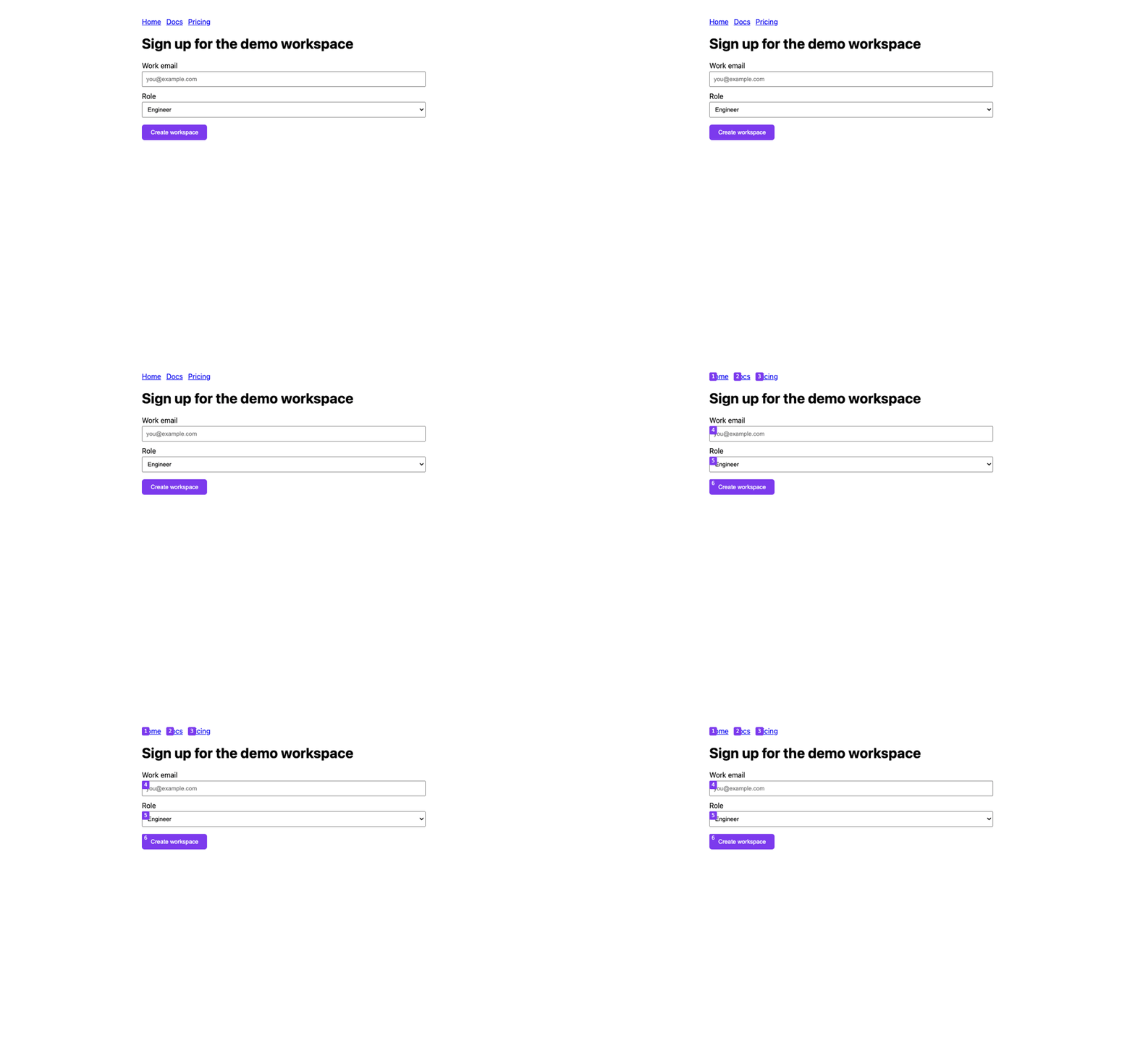
browser_save_artifact({ "pageId": 1, "kind": "screenshot", "annotate": true })
# Saved screenshot to ~/.pi/browser-artifacts/page-....png
# Annotated elements:
# 1: (342, 49) a "Home"
# 2: (394, 49) a "Docs"
# 6: (394, 298) button "Create workspace"
browser_switch_mode
Switch backends without restarting: fresh (isolated clean room), persistent (Pi-owned Chrome on the saved profile with your logins), or existing (attach to your running Chrome). Fresh and persistent default to headless — pass headed: true to watch. Tabs do not transfer; call browser_list_pages after switching. Prefer fresh; escalate to persistent only on login walls. rememberSite: true pins the last-visited site's visibility (headless vs headed-background) for next time.
browser_setup
First-run setup for the persistent profile: opens a plain headed Chrome window (no automation attached) for a human to sign in, and completes when the window closes. If the profile is already initialized it says so and points at browser_reauth instead.
browser_status
Plain-language status — profile readiness, execution mode, next step — without touching any page. Bootstrap initializes the profile; it never proves a site session.
browser_reauth
Reauthenticate the persistent profile: shuts headless Chrome down cleanly, opens a headed window for the human to verify, then resumes headless. variant: plain opens a dependency-free window for providers that reject instrumented browsers.
browser_open_background_tab
Existing mode only: opens a URL as an inactive tab in the collapsed pi-browser-use group via the Pi extension (see extension/). Fails clearly when the extension bridge is unavailable — never a foreground tab.
browser_doctor
Self-diagnostics: effective mode, backend ownership (Pi-owned vs MCP-launched vs attached), profile health, tab-bridge URL, and upstream tool availability. Run it first when browser tools misbehave — it touches no pages.
browser_analyze_screenshot
Vision analysis for canvas/WebGL scenes and coordinate clicks the accessibility tree cannot describe. Enabled only when visionModel is configured (see below); credentials resolve from Pi's model registry automatically.
{
  "pi-browser-use": {
    "visionModel": { "provider": "openai", "model": "gpt-4o" }
  }
}
Page-scoped tools
Call browser_list_pages first, then pass its numeric pageId to page-scoped tools. Click-family calls blocked by an overlay are retried once automatically after dismissing it with Escape; stale element references get a refresh hint. Hard blocks escalate on their own: login walls in a fresh session suggest the switch call, while login walls and bot challenges in an authenticated session rebuild headed and prompt the human — once per call, never looping. See skills/browser-policy/SKILL.md for the full agent policy.
Browser profile
The persistent browser lives in a Chrome profile directory named pi-browser-use inside ~/.pi/browser-profile (one-time automatic migration from legacy Default/Profile 1 layouts while Chrome is stopped), so Pi's cookies and logins are always distinguishable on disk from anything else.
On startup the default persistent profile is checked for accessibility. A root-owned or unreadable default (typically from running under sudo) is moved aside to ~/.pi/browser-profile.inaccessible-<timestamp> so Chrome starts fresh instead of showing a preferences dialog. An explicit custom userDataDir in the same state fails fast with an ownership remediation hint. Never run the agent (or anything launching this browser) via sudo.
Performance
npm run bench times the tool stack headless over 5 iterations (fixture setup excluded, matching vercel-labs/agent-browser's scenario set). Baseline on Apple Silicon: navigate ~1ms, snapshot ~3ms, screenshot ~37ms, evaluate ~206ms, full agent-loop cycle ~422ms. Re-run on your hardware before quoting numbers.
npm run perf:audit reports cold-import memory/time plus published package and dependency footprint; Code Foundry's dedicated performance job enforces the stable regression budgets with npm run perf:check. See Performance audit and budgets for the M0 measurements, thresholds, and reproducible local/CI commands.
Bundled skills
browser-policy— CLI-first decision order, session modes, bot-wall and safety rules.gmail-auth— Gmail inbox verification, challenge handling, headless/headed pinning.auth-bootstrap— first-run login flow for the persistent profile.playwright-handoff— when to stop clicking and run a repo Playwright spec instead (npm-first, bun alternatives, no repo changes required).triage-console— snapshot → console errors → failed network → screenshot.visual-qa— viewport matrix and canvas/WebGL discipline, including the annotate flow.derive-client— turn repeated flows into standalone fetch clients; stop driving solved problems.dogfood— charter-based exploratory bug hunts with severity discipline.
Troubleshooting
| Symptom | Likely cause | Fix |
| ---------------------------------- | --------------------------------------------------------------------------------------- | ------------------------------------------------------------------------------------ |
| Chrome windows pop and steal focus | Headed mode (headless: false, persistent, or existing) | Switch to fresh headless defaults; on macOS no flag hides a headed window |
| --chrome-arg has no effect | Attached session (autoConnect/browserUrl) — flags only apply to MCP-launched Chrome | Move to isolated/persistent mode |
| Login wall / Turnstile loop | Bot check needs a human | Solve once in the persistent profile, then continue; never retry-loop a challenge |
| profile is already in use | Two sessions sharing one userDataDir | Use isolated mode or separate dirs per session |
| Stale uid errors | Page re-rendered after your snapshot | Take a fresh snapshot; ids invalidate on every action |
| Vision tool missing | No visionModel configured | Add it; otherwise use tree uids, or the global vision skill for vision-less models |
| "Allow remote debugging?" popup | Chrome 144+ consent gate for MCP auto-attach in Existing mode | Click Allow (once per Pi session); persistent mode never triggers it |
| Pi tab closed the wrong tab | Page IDs shift when tabs close — fixed | Existing close_page now refuses tabs Pi didn't open unless force: true |
License
MIT