
pi-fold
v4.2.4
Published
Lossless context folding for the Pi coding agent: only the oldest context changes; the fresh window stays untouched.

Maintainers
 shaneconner
Readme
pi-fold


Rotate stale text out of the context window without losing it, and spend the prefix cache once per commit instead of continuously. The oldest part of a session collapses into short briefs while the exact originals stay on disk, one tool call away. Folding is automatic and needs no agent participation. The shipped shape is deterministic briefs paired with a durable memory store, which is the cheapest configuration measured that kept recall intact.
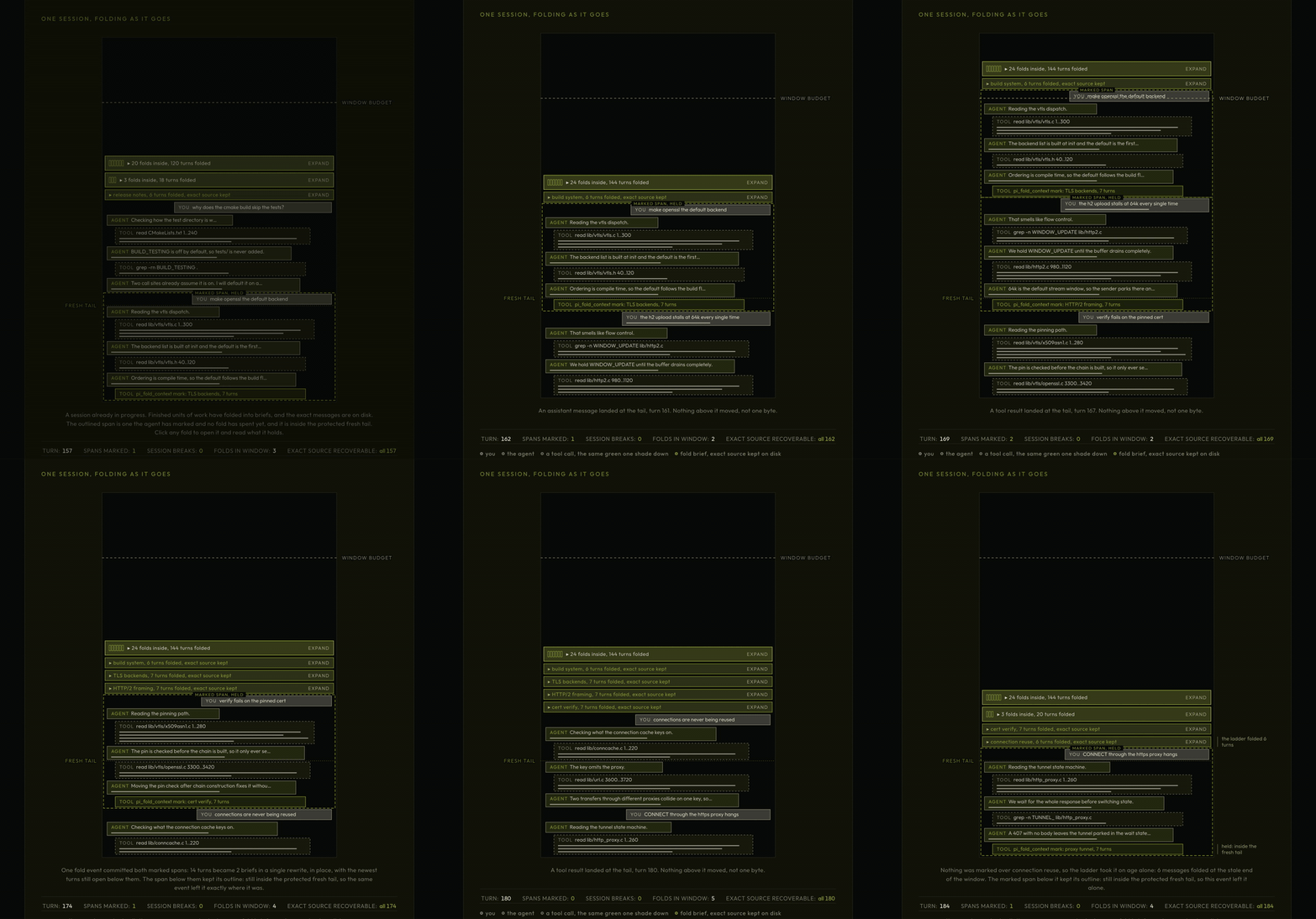
Marks outline spans as they complete and move nothing; the next commit applies every standing mark in one rewrite. Expanding a brief brings the exact messages back byte for byte. Illustrative animation drawn on the 2.x surface, where the agent laid the marks; since 3.0 the runtime lays them.
Install
pi install npm:pi-foldNode 22 or later and Pi 0.83 or later. Pi 1.0 is supported and requires Node 22.19 or later. MIT licensed. Pi supplies the extension's runtime packages; they are declared as host-provided peers, not private dependencies.
Folding does not require a memory store, but every best result measured came from pairing it with one. The campaigns used pi-canon, installed separately. The two began as a single working setup and were split into separate extensions for modularity, and the experiments are what established that they work better as complements than either does alone. Only that pairing has been measured. Any durable long-term memory store is expected to compose the same way, though that is a suspicion rather than a result.
What it does
Compaction replaces the transcript with a summary and discards the originals. Folding replaces stale spans with briefs and keeps the originals retrievable.
A fold takes a contiguous span of session entries and replaces it, in the window only, with a short brief. The entries go to a fold store byte for byte, addressed by their SHA-256 hash. The brief carries a handle, the handle resolves to the original, and expansion restores the exact bytes after verifying the hash.
The package registers one tool, pi_fold_context, with nine actions over the transcript: status, peek, brief, expand, refold, pin, unpin, reboundary and unmark. A session that never calls the tool still folds; it degrades into lossless hierarchical compaction.
The fold bar
In an interactive session one compact, full-height bar sits directly above Pi's footer.
The forty-column bar uses full-height half-blocks for eighty steps of fill, reading Pi's getContextUsage() directly whenever the session moves, on the same key Pi's footer re-reads on (session, leaf entry, entry count, model), so a repaint never pays for a fresh reading. Its percentage uses Pi's full context window, the same scale as Pi's footer, including Pi's estimate of messages since the last provider response. Within that fill, colours show the estimated visible composition, grouped by distance from compression: Consolidated Folds, Span Folds, Tool Folds, Marked, Raw, Pinned. The first three are compressed now, deepest first; marked content folds at the next commit; raw content is eligible later; pinned content is held against every commit until released. The six shades, from consolidated to pinned, are read off a colour map, Crameri's Batlow end to end by default, so the bar reads as a gradient from most compressed to most settled. /fold-settings offers Batlow, viridis, plasma, magma and cividis, and where on the chosen map the two ends sit, so a slice of a map or a reversed one is a keypress away; the bar repaints on each step. Whatever the choice, each shade's lightness is moved away from the background, hue held, until it clears 4.5:1 on dark and light terminals, and label colours match the bar. Each nonempty category keeps at least one half-cell when the measured fill has room; remaining width follows relative mass. This visibility floor makes small compressed categories visible, so individual category widths are not token-exact. At very low occupancy, the largest shares take the available space. There are no individual fold edges, scores, or height differences.
The suffix reads 34% · commit at 55% · N Folds (X Cons., Y Span, Z Tool, X Mark, Y Pin), naming only the kinds with something to count, in the bar's order; a fresh session reads 0 Folds. N Folds counts visible compressed folds; Mark counts pending marks and Pin counts protected entries, not additional compressed folds. A tool fold is lossless compression of tool-result context, not a count of tool calls. /fold-status retains the detailed token and nesting figures. Its Budget row and the editor's Budget header report the separate serving budget and the tokens remaining before a commit.
Two dotted marks stand in the band's edge cells: one where a commit aims to land and one where automatic folding is triggered. minTarget and maxTarget remain shares of the serving budget; the marks and displayed commit point are converted to Pi's full-window scale, so the trigger does not move. With a 272,000-token window and the default 255,616-token serving budget, the 80% trigger appears at about 75% of Pi's window. The usage label rounds down to a whole percentage, matching pi-cc's footer; bar fill and folding decisions keep the unrounded value. The displayed commit point rounds to the nearest whole percentage. Each is drawn over the fill's own colour in a deeper tone of that same hue, so the fill continues behind the mark; on the empty track they stand in muted ink. Neither takes a colour of its own or a warning colour. When Pi reports unknown usage, including immediately after native compaction, the row says not measured yet; no saved count or local estimate fills the gap. After a fold commit it identifies the old reading until the provider measures again. Crossing the target is routine runtime work, not a user action item. On reload, saved session context supplies the fold counts and composition without a new model message; the next real context event replaces that read-only view. Unavailable composition is stated as mapping; if folding stops, FOLDING STOPPED replaces the bar. Non-truecolor terminals use the theme's own colours.
The chat
The chat shows the model's window. Pi paints its chat from every session entry and only native compaction clears it, so without this a long folded session would keep its whole transcript on screen. Each fold the model holds collapsed appears as one muted row, ▸ consolidation · 59 entries · <brief>, in place of the messages it covers. When the model expands a fold, its messages return where they were. The view follows the model one way: it changes when a commit, an expansion or a refold changes what the model sees, or when Pi repaints the chat, and nothing done in the chat changes the model's context. /fold-editor remains the place to read inside a fold.
Results
One 64-stage assignment over the curl C repository, run as a single agentic turn. Same model, same 251,520-token serving budget, every run. After all 64 stages landed, one withheld message asked sixteen questions about material from across the whole session.
| Condition | Correct of 16 | Wrong | Cost | Fresh input | Cached input | Wall clock | | --- | ---: | ---: | ---: | ---: | ---: | ---: | | Compaction | 4 | 3 | $151.24 | 7.64M | 160.2M | 6.9h | | Compaction + memory store | 14 | 0 | $201.70 | 9.65M | 231.7M | 9.0h | | pi-fold, deterministic briefs | 11.3 avg | 3.5 avg | $93.65 | 5.74M | 91.2M | 4.6h | | pi-fold + memory store | 14 | 0 | $100.85 | 5.57M | 102.2M | 5.2h | | pi-fold, agent-written briefs | 3 | 9 | $111.96 | 7.12M | 108.8M | 5.4h |
Fresh input is what the provider had to read for the first time; cached input is what it replayed. The deterministic-briefs row averages four runs that scored 14, 14, 9 and 8.
Compare the two store-paired rows. Both scored 14 correct with none wrong, and folding cost half. That gap is request count rather than price: compaction needed roughly twice the provider requests for the same work, plus summarizer calls that never show up in its own ledger.
Compaction alone abstained nine times and was wrong three, so its dominant failure was declining rather than inventing, but it did invent. And the fold's deterministic runs are bimodal rather than average: two answered 14 with nothing wrong, two lost old material, and cost did not predict which. The store was tried once on each arm and both came back with nothing wrong, which is suggestive, not a rate.
Agent-written briefs scored worst of anything measured, which is why that invitation ships off.
Four papers with figure sources, redacted per-request ledgers and campaign logs are on Zenodo: design and trace evaluation, working memory under context shedding, ephemeral retrieval, and rotation and retention, which is the campaign above. Narrative versions on Medium, interactive versions at shaneconner.com, and the full chronology in the experiment log.
Limits
- Native compaction is strong and is the right default for most sessions. It needs no installation and no tool surface. This is an alternative for workflows where the numbers above matter, not a replacement.
- The benchmark is narrow by construction. It was built to reproduce specific things compaction handles badly, one to four runs per condition, and it says nothing about production behavior.
- Folding is not a memory store. It rotates transcript source out of the window; durable placement of what a session learned is a separate job, and the pairing is where the measured value sat.
Configuration
registerPiFold(pi) works with no arguments, and the defaults are the configuration the campaign above actually ran: deterministic briefs, the invitation off, the tool-call diet at half the window, and a 0.80/0.20 band. Nothing here needs tuning.
The one thing worth adding is a long-term memory store. Rotation and retention are different jobs: folding gets stale material out of the window, a store keeps what the session learned. A handoff summary tries to do both in one record, written once under time pressure, bounded by the window it has to fit in. Folding is the rotation half and only that half.
Seven options, and every other name is refused.
| Option | Default | Effect |
| --- | --- | --- |
| thresholds | { maxTarget: 0.80, minTarget: 0.20, consolidateAfter: 10, minFoldChars: 8000 } | The band, set whole or not at all. The first two are proportions of the serving budget. consolidateAfter is how many visible roots a parent is owed. minFoldChars is the size a fold has to reach to be worth making, and the floor a gap between folds has to clear to stay raw. Validated atomically; an impossible policy is refused by name rather than clamped. |
| providerInputBudget | derived from Pi's context window | The tokens this deployment may actually put in a request, already net of any output reservation when supplied. Without it, folding retains its default headroom of 16,384 tokens, capped at 10% of the window. This is a folding allowance, not a measured provider output reservation or a read of Pi's per-model compaction settings. Thresholds use this serving budget; the fold bar uses Pi's full-window scale. |
| blacklistAutoFoldTools | new Set() | The exception list. Every completed tool batch is foldable without an agent mark; name a tool here and its results stay raw. |
| toolFoldThreshold | 0.50 | The tool-call diet: a share in [0, 1) naming the oldest fraction of the window whose tool results are clipped in view. 0 turns it off. |
| preCommitNotice | false | The notice switch. False is the shape that won the campaign above: no carrier reaches the projection and every fold ships the runtime's own words. true states the window's status to the agent once per approach to a commit: where the commit fires, how far away it is, what is staged, what that frees, what is pinned and what the pin costs, with the verbs listed and no argument made for using any of them. |
| noticeLeadShare | 0.10 | How far below the commit trigger that notice speaks, as a share of the serving budget. A distance rather than a point, so it follows a band that moves. Read only when preCommitNotice is on. |
| palette | { map: "batlow", start: 0, end: 1 } | The fold bar's colours, and nothing about folding. map is one of batlow, viridis, plasma, magma, cividis; start and end are positions on it in [0, 1] for the most compressed and the pinned shade, which may not coincide and may run backwards. Set whole or not at all. |
Four commands ship for the human: /fold-status, /fold (commit every staged mark now), /fold-editor (the interactive map of the window) and /fold-settings (edit the options above; each change is saved to ~/.config/pi-fold/settings.json and takes effect in the running session).
How it works
The cache invariant
A provider prefix cache is positional. It replays the longest byte-identical prefix of the prompt, so one changed byte at offset K discards everything cached after K. The cost of a mutation has nothing to do with its size.
So the runtime may move a byte in the window only at a moment it is already rewriting the window, which is a commit or a fold. Everything else is a pure append, and an appended byte is never later altered, shortened, removed or repositioned. Never mutate the window, and never show something and then take it back. The second half is the one that costs features: anything that displays state and then updates it in place is out, because updating in place is a mid-prefix write with better manners.
Marks and commits
A mark moves nothing. The moment a tool batch or chapter closes, the runtime cuts it into a pending mark, up to eight cuts per pass, stalest first. The mark lives in durable state outside the window, so the projection stays byte-identical and the cached prefix survives. Marks accumulate for free until one commit applies all of them in a single rewrite.
What the agent owns is the words. brief writes its own sentence onto a pending fold for free, because that brief reaches the window only when the commit writes the placeholder for the first time. A supplied brief is kept verbatim; an unbriefed fold commits with the deterministic brief the runtime writes from the span itself, and the provenance records which happened. Curation stays correctable until the commit: reboundary re-cuts a span, unmark withdraws a pending mark, and a pending brief can be rewritten any number of times at no cost. A standing fold's brief is never rewritten, because that rewrites the projection at its placeholder.
The band
A commit fires on one condition: occupancy reaching maxTarget of the serving budget. It applies marks stalest first and stops at minTarget, so the newest events stay raw and a mark past the bound waits for the next epoch. Below maxTarget the window is quiet, because a commit is an epoch transition that risks the whole prefix cache and the right cadence is the fewest commits that keep the window inside its budget.
272,000  Pi's full context window
255,616  default serving budget, after folding headroom
─────────────────────────────────────────────────────
~250k    peak: inflow continues while the epoch computes
204,493  maxTarget 0.80   ← about 75% on Pi's scale
   ⋮                        marks accumulate, free, quiet
 51,123  minTarget 0.20   ← about 19% on Pi's scale
─────────────────────────────────────────────────────
Every commit re-reads roughly minTarget of the budget uncached, so a shallower cut buys less runway for nearly the same bill: the rewrite tax is minTarget / (maxTarget - minTarget), 0.33 at 0.80/0.20 against 1.0 at 0.80/0.40.
Peek and expand
peek returns a fold's exact SHA-256-verified source as a tool result at any depth, with the ancestors still collapsed. It appends and never edits the prefix, so checking what a fold holds costs nothing a commit has to pay for. It takes offset and bytes for a bounded slice and reads any child fold by id, so a large fold has a narrow read.
A peek is ephemeral by default: the bytes ride the window until the model's next message, then their place holds a one-line placeholder and the reply that used them is the surviving trace. Peeking again is lossless and costs one append. The default follows what the agent chose: on the run measured for it, six of seven peeks asked for ephemeral at first exposure. expand is the commitment, restoring the source in place until the fold is refolded. Looking is not the same as taking.
Clipping, pins and the compaction path
Tool results get a second, lighter treatment at the same commit. Results in the oldest toolFoldThreshold share of the projected window, half of it by default, are clipped in view: the identifying head stays, the rest becomes a marker naming the entry id that peeks it back, and the stored bytes are untouched, so a later fold of that span still encodes the full result.
Briefs are bounded at 2,000 characters each, so the visible index normally costs a low single-digit share of the window. Folds nest rather than partially overlap, and collapsed folds double as a browsable index: status with detail: "tree" lists every fold in transcript order with its depth and parent. pin holds entries raw through every fold and frees nothing, so pinned mass makes the rest of the window fold sooner; a pinned-share cap stops that from becoming a window nothing can reclaim.
Pi's automatic compaction stays enabled underneath and is intercepted by kind. A threshold pass is cancelled, because the fold commit fires first. An overflow pass becomes an automated recovery: the session branches back to the last message before the error, and the retried pass folds and commits before transmitting. Manual /compact passes through untouched as the escape hatch.
Evidence ingestion writes read-only artifacts under the session directory's pi-fold-evidence/ at mode 0444, under a 512 MB session cap. It is always on: the artifacts are what an oversized result folds against, so a deployment that stopped writing them would keep its folds and lose what makes them lossless.
Prior work
Two recent lines inform this one. Lossless hierarchical compaction, exemplified by LCM (arXiv:2605.04050) with a walkthrough at losslesscontext.ai, builds a summary DAG over older messages with lossless pointers to every original. Agentic context management, exemplified by Letta and by arXiv:2510.11967, gives the agent tools over its own memory. See also arXiv:2607.00692.
What this one adds is an efficiency result, arrived at by running the mechanism repeatedly and following the bill. Rotation is the part every approach here shares. The cost sits in where the rewrites land, because a prefix cache charges by position rather than by size, so each fold is staged as a mark that moves nothing and one commit spends the cache for all of them at once. The same campaigns settled the recommended shape: deterministic briefs paired with a durable memory store, which held recall at the lowest cost and wall clock measured. Agent control over boundaries and brief text stays available, and the invitation to use it ships off.