
pi-webfind
v0.6.0
Published
Claude Code-style web research for the pi coding agent — WebSearch, query-aware fetch (PDFs, Wayback, site adapters, markdown extraction), Stack Overflow, GitHub, HN, Wikipedia, npm. 100% free, no API keys.

Maintainers
 jawwadzafar
Readme
Install
pi install npm:pi-webfindor straight from GitHub:
pi install git:github.com/jawwadzafar/pi-webfindWhat it does
Same muscle memory as Claude Code's WebSearch — ⏺ Web Search("query")
headers, live status, ✓ 8 results · ddg+brave · 2.1s, expandable rows,
document reading, grouped synthesis. No cost, no keys.
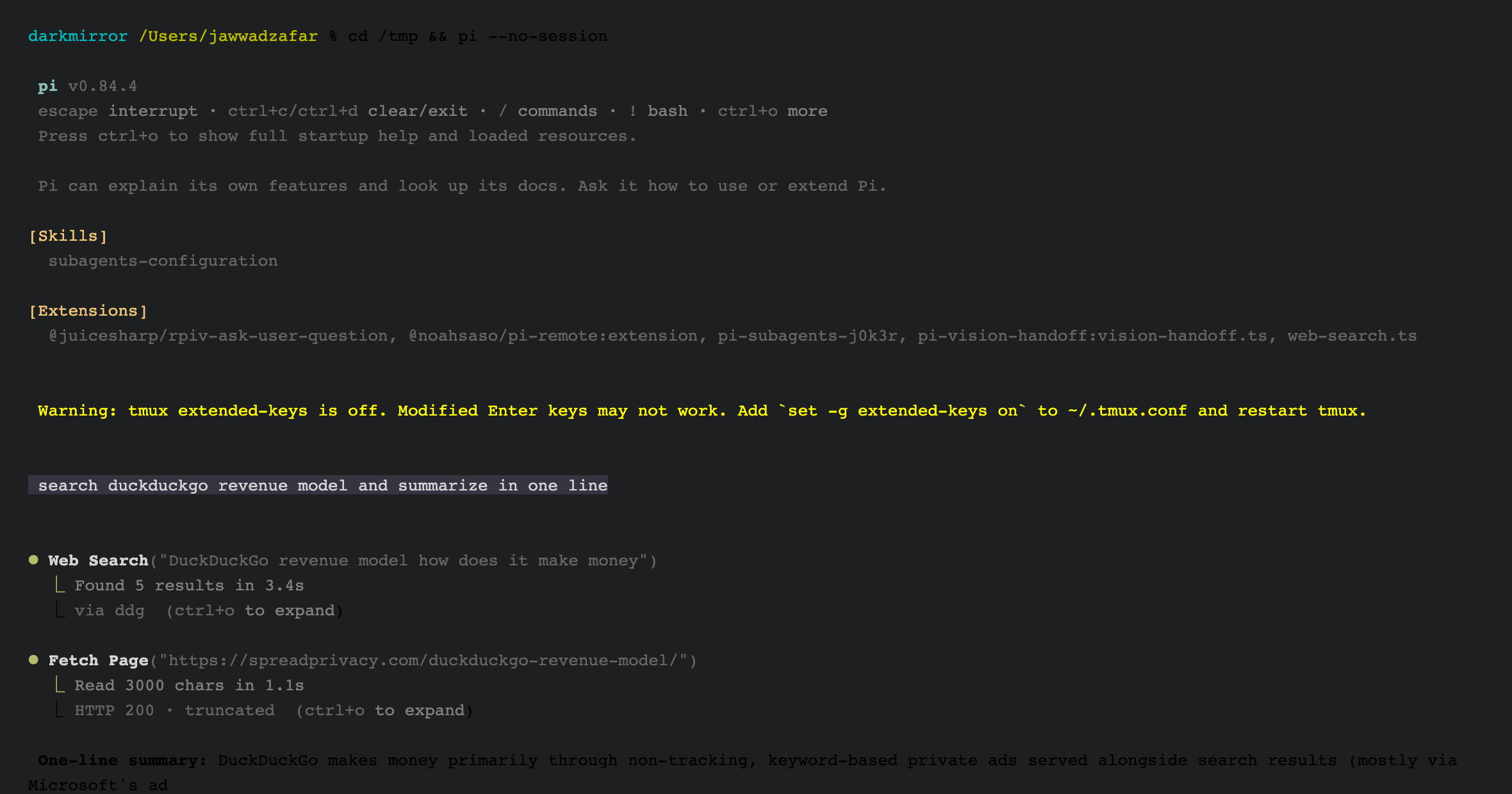
7 tools + 1 command:
| Tool | Best for |
|---|---|
| web_search | news, articles, broad queries — DuckDuckGo + Brave + Bing RSS, RRF-fused |
| fetch_page | read any URL — HTML/PDF/JSON, query-aware passages, bot-wall busting |
| search_stackoverflow | error messages, debugging |
| search_wikipedia | definitions, concepts, history |
| search_npm | JS/TS packages with quality scores |
| search_github | repos, stars, languages |
| search_hn | tech community opinion, launches |
| /research <topic> | parallel multi-source research → grouped briefing |
Reading comprehension, not just fetching
fetch_pagewithquery— returns the intro plus the most query-relevant passages (BM25, heading trails), not the first 8,000 characters. The difference between an infobox dump and the two paragraphs that answer you.web_searchwithdeep: true— reads the top results in parallel and attaches a query-relevant excerpt to every row. Factual questions often answer themselves without a single fetch.- Markdown extraction — density-scored article detection turns pages into
structured markdown; Wikipedia arrives as prose, not
{{cite web}}soup. - Site adapters — GitHub repos/issues/PRs/files, Stack Overflow, HN,
Reddit and Wikipedia skip scraping entirely and come from their clean free
APIs. The output header tells you which served you (
github-issue-api,stackexchange-api, …).
When engines fight back
Every search and fetch walks a fallback ladder before admitting failure:
web_search   DDG html → lite → POST → r.jina.ai proxy → Bing RSS
             → engine "multi": DDG ∥ Brave ∥ Bing in parallel, RRF-fused
             → any primary failure auto-retries via multi

fetch_page   site adapter (GitHub/SE/HN/Reddit/Wikipedia APIs)
             → direct fetch (browser UA, 3× backoff)
             → 401/403/429/503 → Wayback Machine snapshot
             → thin/SPA page → r.jina.ai headless render
             → block-page detection (never shows fake content as success)
Disk-backed caches (~/.pi/agent/cache/webfind/) survive restarts: 10-min
search, 1-h fetch. refresh / no_cache flags skip them.
Security
pi-webfind runs with full system access like any pi extension. What it does with it:
- Outbound HTTPS only — search engines, public APIs, pages you fetch
- SSRF-guarded — localhost, private ranges and link-local addresses are blocked
- Never executes or writes fetched content; it reads URLs and returns text
- Politeness throttle per host; fake-browser UA only where required, honest
pi-webfind/x.yUA everywhere it matters - The only optional credentials are listed below. Everything else is keyless by design.
Optional accelerators (still fully free without them)
| Env var | Effect when set | Without it |
| --- | --- | --- |
| GITHUB_TOKEN | Lifts GitHub API from 10 to ~30 req/min in site adapters | 10 req/min anonymous |
| JINA_API_KEY | Reader relay throttle 3.5 s → 300 ms; enables s.jina.ai search leg in engine:"multi" | 3.5 s gap, no jina search leg |
| BRAVE_API_KEY | Adds Brave's official JSON API as the first engine:"multi" attempt | scraped Brave only |
| TAVILY_API_KEY | Adds Tavily as a engine:"multi" attempt | no Tavily |
Every var is optional; with none set, behavior is identical to the baseline: keyless scraping with the fallback ladder. Keys are never required and never sent anywhere except their own API host.
Limits (be honest about free)
- Scraped engines tighten defenses anytime — the fallback ladder is the mitigation
- Unauthenticated GitHub is 10 req/min (see
GITHUB_TOKENabove) - Result dates appear only when engines provide them (DDG stamps, Bing pubDates)
- Public SearXNG instances rate-limit cloud IPs; jina proxy + Brave cover that gap
Docs
Full tool reference, parameters and guides at jawwadzafar.github.io/pi-webfind.
License
MIT