
playwright-shard-balancer
v0.1.2
Published
Duration-balanced Playwright sharding: every shard finishes at about the same time, with no orchestration job.

Maintainers
 qa.gary.parker
Readme
playwright-shard-balancer
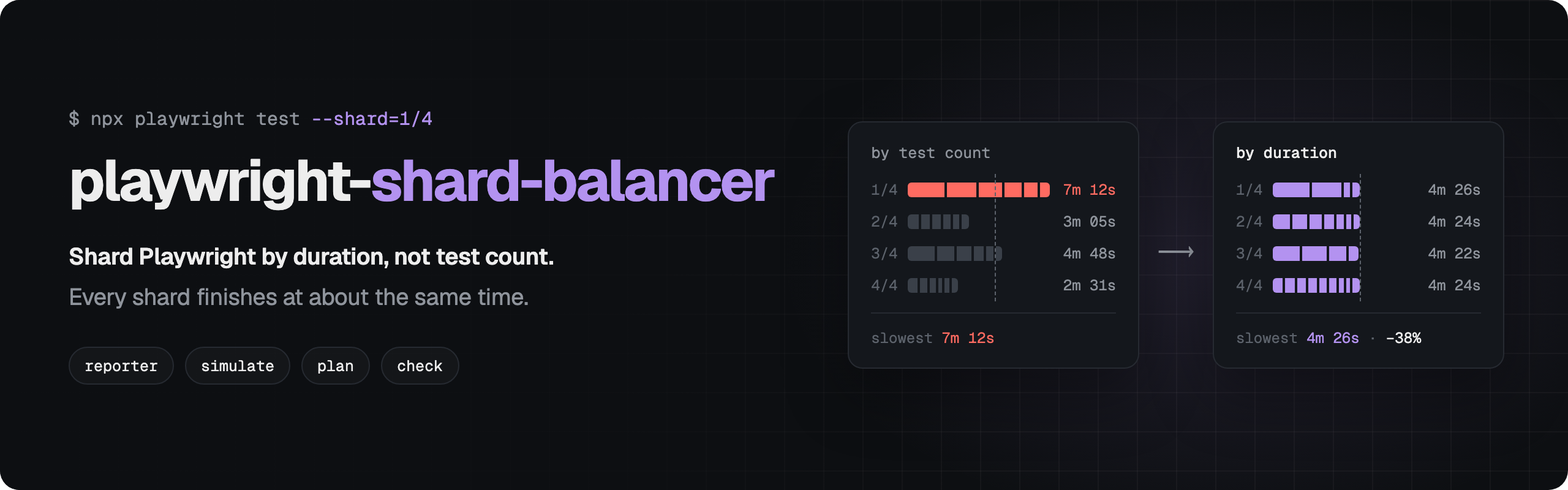
Duration-balanced sharding for Playwright. Every shard finishes at about the same time, so a sharded run takes the even split of the work instead of the slowest count-based shard.
- No orchestration job. CI keeps
npx playwright test --shard=k/n. Each shard reads the same timings file and computes the same plan through Playwright'spreprocessreporter hook (Playwright 1.62+). - Keeps Playwright's own test groups whole: a file without
fullyParallel, a serial describe, tests that share a lock. Splits by test where Playwright would. - Plans for the slowest shard's wall time: workers per shard, and the setup projects each shard has to run.
- Matches a brute-force optimum on every small suite in its tests, and reaches the lower bound on a 10,000-group suite in well under a second. Deterministic: the same test list, timings file, shard count and
workersoption give the same plan on every machine. - Fails open by default: a missing or broken timings file gives Playwright's built-in split. Strict mode fails the shard instead, so no shard can split the suite differently from the others; the GitHub Action turns it on once timings exist.
- Proves the run.
checkfails the build when a test ran twice, ran nowhere, or did not run, and writes predicted against actual shard times to the job summary. - Answers "how many shards?".
simulatereplays your suite at any shard count, overhead included, before you change CI. planwrites--test-listfiles for Playwright 1.56 to 1.61, or for CI that prefers one planning job.
Quick start
npm install -D playwright-shard-balancerAdd the reporter next to your other reporters:
// playwright.config.ts
export default defineConfig({
  reporter: [
    ['html'],
    ['playwright-shard-balancer', { timings: 'shard-timings.json', record: 'shard-records/run-{shard}.json' }],
  ],
});
Teach it your durations from any full run, then see what balancing would save:
npx playwright test --reporter=json > report.json
npx playwright-shard-balancer update --timings shard-timings.json report.json

PLAYWRIGHT_JSON_OUTPUT_NAME=list.json npx playwright test --list --reporter=json > /dev/null
npx playwright-shard-balancer simulate --timings shard-timings.json --list list.json --shards 2-8 --overhead 90s --target 10m
For each shard count it prints the slowest shard with Playwright's split and with balancing, and the best possible. With --target, it names the fewest shards that finish in time.
Shard as usual with npx playwright test --shard=k/n. Each shard logs one line: its files, tests and estimate, the range across all shards, the largest group, and the timings and plan shas.
Then keep the timings fresh from CI. See CI.
How it works
- Every shard loads the full test list, as Playwright does before it shards.
- The reporter groups tests the way Playwright's own scheduler does, estimates each group from the timings, and splits the groups into
nshards. - It removes the other shards' tests and turns Playwright's built-in split off for the run.
All shards compute the same plan independently. The log line shows the timings sha and the plan sha, and check compares them across shards.
Estimates. A test costs the median of its last 5 passing durations, retries included. A new test costs the median of its describe, else its file, else its project, else the suite. A test skipped before it runs costs nothing. Failed and interrupted runs are not sampled, because a failure often runs to the timeout.
Groups. Tests in a file that is not in parallel mode stay together. In parallel mode (fullyParallel or describe.configure({ mode: 'parallel' })) each test can go to any shard, except that a serial describe stays together. Tests that share a lock go to one shard, since shards run at the same time. Setup and teardown projects are never split: they run on every shard whose tests need them, and their time counts on each of those shards. Setup projects that Playwright starts in the same phase share the shard's workers, so with more than one worker their times overlap; a teardown waits for the tests. Parallel tests under a beforeAll or afterAll hook are split per test, where Playwright chunks them; each shard that gets some of them runs the hook.
Splitting. Largest-first and Karmarkar-Karp starts, each refined by moves and swaps, then a branch-and-bound search with a fixed node budget. With more than one worker per shard, a second pass packs each shard for wall time. When projects need different setup projects, it also tries giving each family its own shards, and a largest-first pass that counts the setup each group adds to a shard, then refines the two best plans with setup counted. It also scores Playwright's own split and keeps whichever plan finishes first, so it never predicts a slower run than the built-in split.
Config
| Option | Default | Meaning |
|---|---|---|
| timings | shard-timings.json | Timings file, relative to the config file. |
| record | none | Where each run writes its record for update and check. {shard} becomes the shard number. Relative to the config file. |
| granularity | auto | auto follows Playwright's groups. file keeps every file whole. |
| workers | 1 | Workers per shard that the plan packs for. Set it to your CI's fixed per-shard workers. The plan does not read config.workers, because Playwright resolves that from each machine's CPUs. |
| strict | false | Fail the run instead of falling back to the built-in split. Also on with PLAYWRIGHT_SHARD_BALANCER_STRICT=1. |
CI
GitHub Actions
jobs:
  e2e:
    strategy:
      fail-fast: false
      matrix:
        shard: [1, 2, 3, 4]
    steps:
      # checkout, setup-node, npm ci, playwright install
      - uses: qa-gary-parker/playwright-shard-balancer/actions/restore@v0
      - run: npx playwright test --shard=${{ matrix.shard }}/${{ strategy.job-total }}
      - if: ${{ !cancelled() }}
        uses: actions/upload-artifact@v7
        with:
          name: shard-record-${{ matrix.shard }}
          path: shard-records/
          overwrite: true

  shard-timings:
    needs: e2e
    if: ${{ !cancelled() }}
    steps:
      # checkout, setup-node, npm ci
      - uses: actions/download-artifact@v8
        with:
          pattern: shard-record-*
          path: shard-records
          merge-multiple: true
      - uses: qa-gary-parker/playwright-shard-balancer/actions/finish@v0
The full workflow is in examples/github-actions.yml.
restoretakes the newest timings from the cache and pins that copy to the workflow run. Every shard, and every re-run of a failed shard, plans from the same bytes. On a first run it pins an empty file, so every shard uses the built-in split. Once the pinned file has timings, it turns strict mode on.- On a pull request from a fork, the cache is read-only, so
restorecannot pin. It writes empty timings instead, and every shard uses the built-in split. finishmerges the durations into the newest cached timings withupdate, runscheck(job summary included), and saves the result for the next run. It saves even whencheckfails, but not whenupdatefails. It runs the project's installed CLI, so install the project's dependencies in that job too. Without an installed CLI it runsnpx playwright-shard-balancer@<version>; set theversioninput to pin it.overwrite: truelets a re-run of a failed shard replace that shard's record.- The actions'
pathandrecordsare relative to the workspace. The reporter'stimingsandrecordare relative to the config file. With the config ine2e/, passpath: e2e/shard-timings.jsonto both actions and uploade2e/shard-records/. - A matrix with another dimension, such as browser and shard, needs its own
prefix, record folder andfinishjob for each browser. - Run the shards and
finishon the same OS family. The cache does not share entries between Windows and other runners.
Other CI
The reporter needs only the timings file on each shard. Restore one copy per pipeline, pass it to every shard, and run update and check on the collected records afterwards. GitLab, CircleCI and Buildkite give the shard as CI_NODE_INDEX/CI_NODE_TOTAL, CIRCLE_NODE_INDEX/CIRCLE_NODE_TOTAL or BUILDKITE_PARALLEL_JOB/BUILDKITE_PARALLEL_JOB_COUNT; pass it as --shard. CircleCI and Buildkite count from 0, so pass --shard=$((CIRCLE_NODE_INDEX + 1))/$CIRCLE_NODE_TOTAL or --shard=$((BUILDKITE_PARALLEL_JOB + 1))/$BUILDKITE_PARALLEL_JOB_COUNT.
Commands
playwright-shard-balancer update   --timings <timings.json> <report.json | run-record.json>...
playwright-shard-balancer simulate --timings <timings.json> --list <list.json> --shards <n | a-b> [--workers <n>] [--granularity file|test] [--overhead <90s>] [--target <12m>] [--out <file>]
playwright-shard-balancer plan     --timings <timings.json> --list <list.json> --shards <n> --out-dir <dir> [--workers <n>] [--granularity file|test]
playwright-shard-balancer check <run-record.json>... [--list <list.json>] [--summary <file.md>]updatemerges durations from Playwright JSON reports or run records. An input it has already merged is skipped, so a re-uploaded artifact is not counted twice. Merge blob reports first withnpx playwright merge-reports --reporter json.simulateprints, per shard count, the slowest shard with the built-in split and with balancing, and the lower bound. It splits by test for afullyParallelsuite and by file otherwise, unless--granularitysays. Splitting by test needs a list from Playwright 1.63+, which marks serial describes.--workersmatches your CI's workers per shard.--overheadadds per-shard CI time (install, browsers) toelapsed_msandmachine_ms.--targetpicks the fewest shards that finish in time.planwritesshard-<k>.txtfornpx playwright test --test-list shard-<k>.txt, plusplan.json. A--test-listline selects by title prefix and by the file that defines a test, soplanrefuses a list where that would run a test twice or not at all:--repeat-eachcopies, names that contain›or a line break or that start or end with a space, tests defined in a shared helper file, and a test whose title path starts another's.--granularity testneeds a list from Playwright 1.63+, which marks serial describes. Runs of these lists have no--shard: give each job its ownrecordpath, and runcheckwith--list.checkexits 1 when a shard record is missing, the shards used different timings or plans, some shards fell back to the built-in split and others did not, a test ran in two shards, a test ran in none, or a test did not run (interrupted, max failures, or a failed setup project). It names up to 10 tests for each problem.--listfinds tests that ran nowhere.--summaryappends a markdown table; pass$GITHUB_STEP_SUMMARY.
Exit codes: 0 done, 1 error or failed check, 2 bad arguments.
Files
shard-timings.json is written by update; sorted keys, so it diffs cleanly if you commit it:
{
 "version": 1,
 "applied": ["4be1c0d2a9f3"],
 "tests": {
  "[chromium] › auth/login.spec.ts › login › signs in": { "samples": [4120, 3980, 4310], "seen": "2026-10-15" }
 }
}
A key is [project] › spec file › titles, which is also the test's --test-list line unless a shared helper defines it. Entries unseen for 30 days are dropped. A setup test that every shard ran gives one sample per update.
A run record holds the shard, the strategy (balanced, or builtin with the reason), the timings, plan and test-set shas, each shard's predicted time, the measured times, and each test's outcome and duration.
Compared with other tools
As of 2026-10-15, from each tool's published source and docs.
| | this | @flakiness/playwright 2.0.2 | @nsxbet/playwright-orchestrator 2.0.1 |
|---|---|---|---|
| Extra CI job | no | no | yes (orchestrate) |
| Playwright | 1.62+ (1.56+ with plan) | 1.62+ | 1.56+ |
| Serial describes kept whole | yes | yes | no |
| Lock groups kept on one shard | yes | not found | not found |
| Setup projects counted per shard | yes | yes | no |
| Workers per shard in the plan | yes | no | no |
| Algorithm | LPT and KK, refined, then bounded search | LPT with setup families | branch and bound up to 50 tests, else LPT |
| Duration estimate | median of last 5 | max across runs | EMA |
| New test | describe, file, project, suite median | 1 s | file average, else suite average, else 30 s |
| Missing timings | built-in split, or run fails in strict mode | run fails | built-in split |
| Every-test-ran-once check | yes | no | no |
| Shard-count advice | yes | no | no |
| Predicted against actual | job summary | log | no |
Caveats
- A
--reporterflag on the command line replaces the config's reporters, which turns balancing off. If a shard has noplaywright-shard-balancer:log line, the reporter did not run. autogroups read Playwright internals:_parallelModefor parallel and serial groups, and_locksfor lock groups. If a release removes_parallelMode, the reporter keeps whole files. If it removes_lockson Playwright 1.63+, lock groups may split. Either way the log line says so.- The JSON list that
simulateandplanread does not showdescribe.configure({ mode: 'default' })inside a parallel file, or locks. Use--granularity filethere, or the reporter. - Workers in a shard take groups in Playwright's load order; the plan's wall-time estimate assumes that order.
plancannot express--repeat-eachcopies, or names that contain›or a line break or that start or end with a space. It refuses such lists.- A JSON list from Playwright before 1.64 does not say which projects are setup projects, so
simulateandplantreat their tests as ordinary tests.check --listtakes them from the run records. simulatemodels Playwright's built-in split from the list, which does not show worker-fixture groups or hook chunks. Its built-in times are estimates.- Tests are keyed by project name, so give every project a unique name.
- Retry a failed shard by re-running its job, not with
--last-failedin the same job: the second run overwrites the shard's record. - Predicted times leave out Playwright's start-up; the job summary shows both test time and the whole run.
License
MIT