
precedent-cli
v0.1.10
Published
The decision layer for AI coding agents — retrieve, govern, record, and retire team decisions. One `npx precedent-cli init` to install into any repo.

Maintainers
 bbiangul
Readme
🔐 Precedent
The decision layer for AI coding agents — decisions that bind, enforced at the merge gate.



Install into any repo
npx precedent-cli initWires the engine + AGENTS.md / CLAUDE.md / the Claude skill / MCP / the CI gate into your repo —
Claude Code, Cursor, Codex, Copilot, Windsurf, Gemini — without overwriting your existing rules.
Requires Python 3.9+ (the engine is stdlib-only on the hot path).
Watch it stop a bad merge
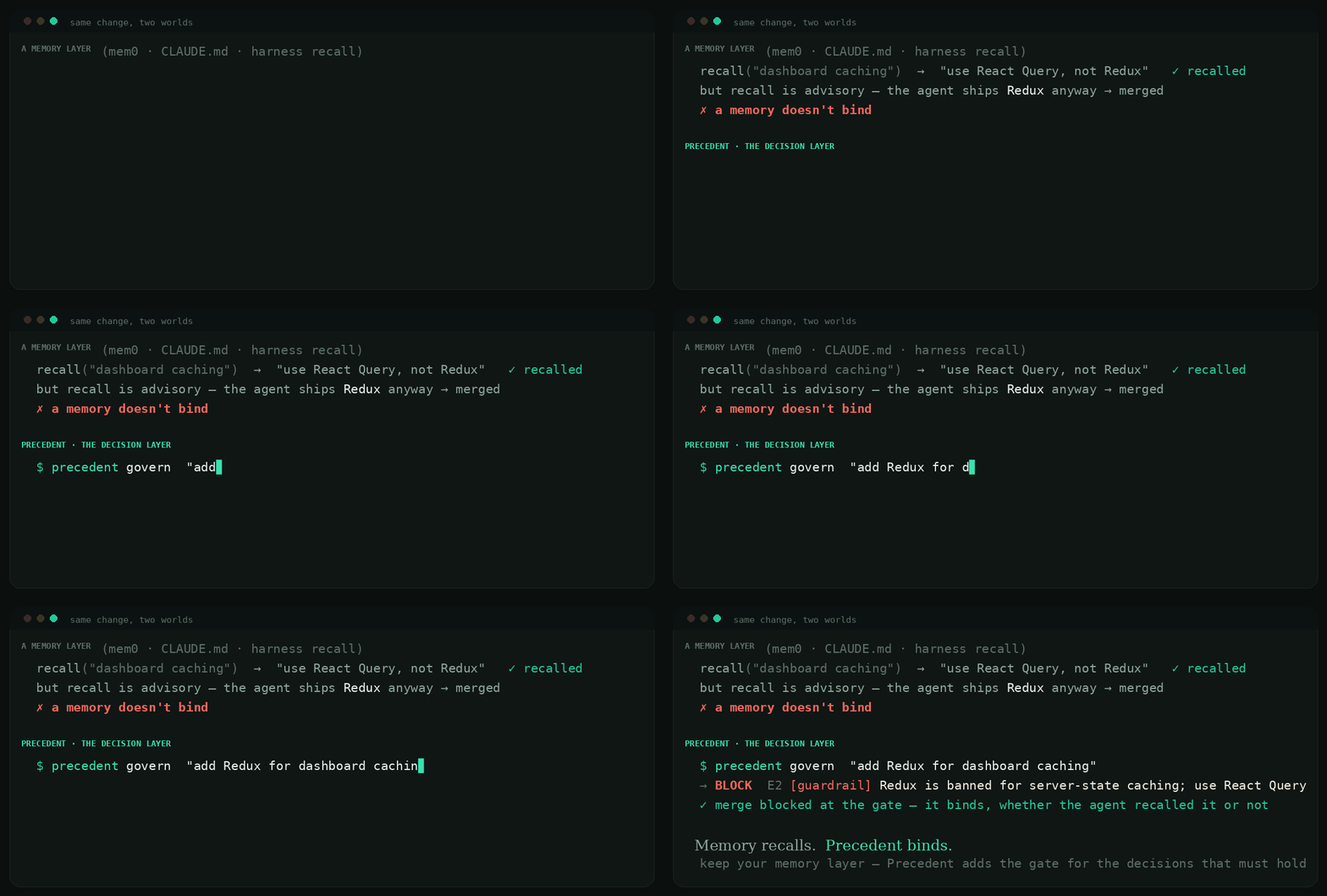
npx precedent-cli govern --paths web/store.ts --title "Add Redux for dashboard caching"⛔ BLOCK — denied: violates a guardrail (E2)
Redux is banned for server-state caching; use React QueryA memory layer would only recall that rule — the agent can ignore it. Precedent binds it: the same
check runs in CI and blocks the PR. A compliant change → ✅ ALLOW, auto-merged.
Quickstart · How agents use it · Concepts · Self-hosting · llms.txt
Why
An AI coding agent has no memory of your team's decisions. It reinvents a feature-flag system you standardized months ago, re-parses data a pipeline already prepared, reaches for Redux where your team banned it. The durable unit of knowledge isn't a fact — it's a decision: the situation, what was decided, why, and its authority.
Precedent captures decisions and puts them in the loop, two ways:
- In the session (Claude Code / Cursor / Codex / any MCP or hook-capable agent): before a
non-trivial action, the agent asks
govern()— is this already decided? may I act, should I flag, or must a human decide? — and records new decisions as it makes them. - At the boundary (the git/PR/CI gate): a deterministic check enforces the same decisions where it can actually block — auto-merge what has precedent and is low-risk, escalate what's new and consequential, deny a guardrail violation.
The two are symbiotic: the gate makes consulting worth it (the same rules block at merge), and the in-session layer makes the gate cheap (it prevents the bad change instead of just blocking it — and grows the decision store).
Not a mockup — the real verdict
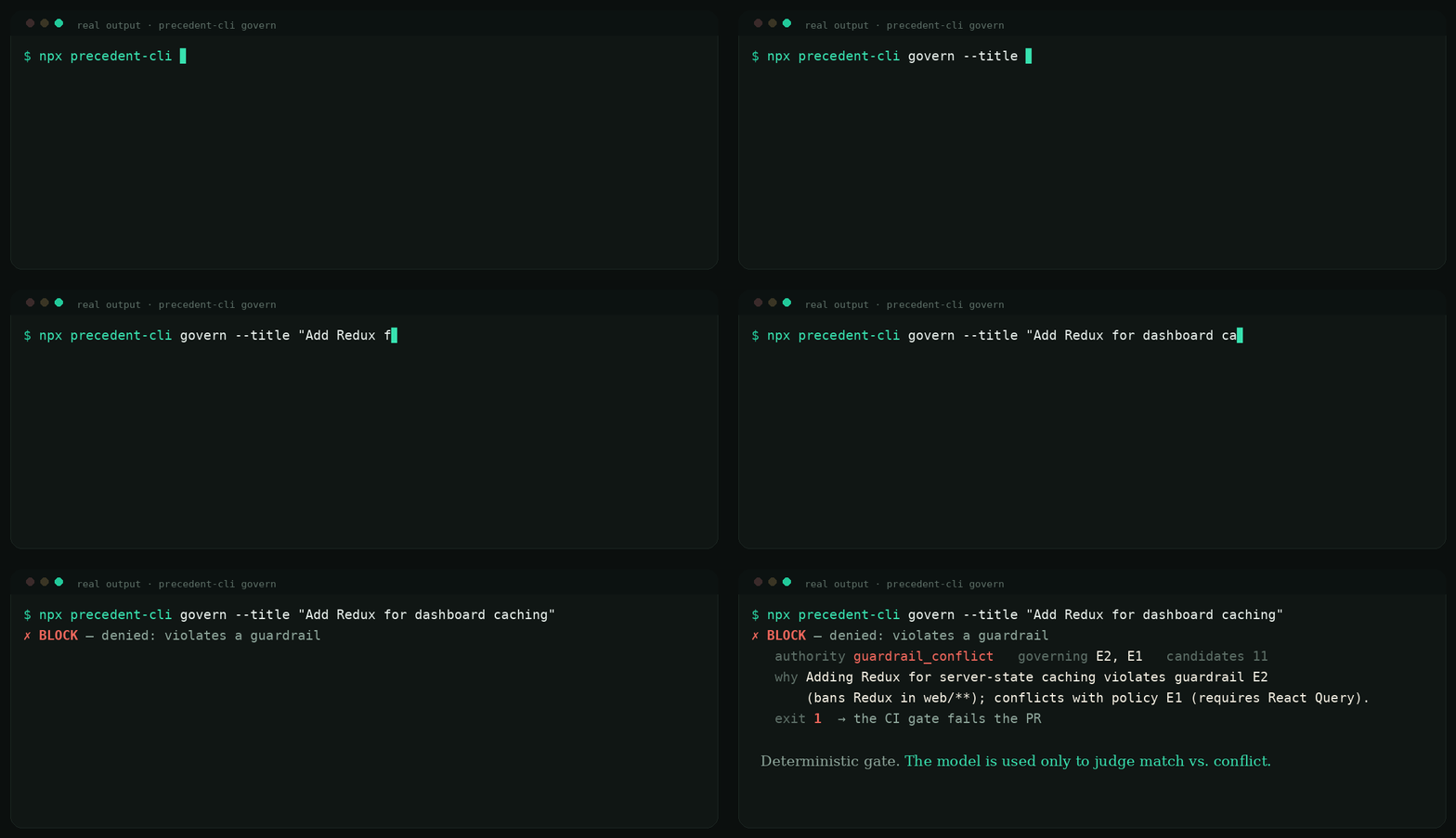
That's the actual output. The gate is deterministic (authority × risk → verdict); a model is used only to judge whether a change matches or conflicts with an in-scope decision — never to invent the verdict.
✨ Quickstart (60 seconds)
Install into your repo — one command
npx precedent-cli init # vendors the engine + wires every agent harnessinit drops Precedent into every agent you run without overwriting your existing rules —
it appends a marked block to AGENTS.md / CLAUDE.md / GEMINI.md / .github/copilot-instructions.md,
writes .cursor/rules + .windsurf/rules + the Claude Code skill, and merges the precedent
MCP server into .mcp.json / .cursor/mcp.json (keeping your other servers). Then:
npx precedent-cli retrieve "add a caching layer to the dashboard"
npx precedent-cli govern --paths web/Chart.tsx --title "Add Redux for server-state"
npx precedent-cli record "situation: …; decided …; because …; scope web/**"
npx precedent-cli hygiene --propose      # batch: contradictions + stale decisions
Requires Python 3.9+ on PATH (the engine is stdlib-only for the hot path — no heavy deps).
Or run from source
git clone https://github.com/bbiangul/precedent && cd precedent

# 1. See the autonomy matrix resolve on 12 example changes
python3 src/govern.py

# 2. Ask whether a change is allowed (uses the seed decisions in .precedent/)
python3 src/govern_cli.py --paths web/dashboards/Chart.tsx \
        --title "Add Redux for dashboard server-state caching"
#  ⛔ BLOCK — denied: violates guardrail E2 (Redux is banned for server-state caching)

# 3. Retrieve the decisions that apply to what you're about to do
python3 src/precedent.py retrieve "add a caching layer to the dashboard"

# 4. Record a new decision (the store grows itself)
python3 src/precedent.py record "situation: adding feature flags; decided flags go through the \
        superadmin panel; because central control; scope web/**"
An LLM key is only needed for the semantic steps (govern's match/conflict judgment, retrieval
embeddings). Set OPENROUTER_API_KEY (any OpenAI-compatible endpoint via ARM_MODEL). The
enforcement gate itself makes zero model calls — it's deterministic.
🤖 Built for agents first
Precedent is infrastructure for AI agents, and friendly for the humans who supervise them. An agent sets it up and uses it without you holding its hand:
| Surface | What the agent does |
|---|---|
| MCP server (src/mcp_server.py) | retrieve_precedent, govern, record_precedent as MCP tools — works in Claude Code, Cursor, Codex |
| CLI | govern_cli.py, precedent.py retrieve/record — for any harness that runs shell |
| Hooks (src/hooks/) | a PreToolUse tripwire that injects applicable decisions into the agent's context (≈30ms, 0 model calls) and a Stop nudge to record new decisions |
| Skill + AGENTS.md | drop-in guidance so the agent knows to retrieve-before / govern-before-merge / record-after |
| llms.txt | so ChatGPT/Claude/Cursor/Codex can discover and understand Precedent when they search |
See docs/for-ai-agents.md — including a copy-paste block you can hand any agent to have it wire Precedent into your repo.
Core concepts
- Decision —
situation → decision → why → authority, path- and level-scoped. - Authority ladder —
open-question → precedent → policy → guardrail. A guardrail overrides the agent's judgment; a conflict beats a match. - Levels —
org / team / repo. A team-transversal guardrail (e.g. never log PII) is enforced in every repo, not just where it was written. Promotion widens scope (repo → team → org). - Autonomy matrix —
authority × risk → verdict(act_silently / act_and_flag / require_review / escalate / deny). Risk is derived deterministically; the model only judges which decision applies and whether the change matches or conflicts. - Autonomy frontier — the metric: the fraction of agent work that runs with no human in the loop, with zero harmful silent actions.
Full write-up in docs/concepts.md.
Honest status
Precedent is early and built in the open, with its homework shown. What's solid, and what isn't:
- ✅ Enforcement (the deterministic gate) and the govern architecture (model-independent: matches frontier models on a small 31B model) are validated.
- ✅ Cross-harness: the loop closes end-to-end in real Claude Code and Codex sessions.
- ⚠️ Retrieval at scale is ~60–66% on one real repo (Backstage) — a ground-truth-quality problem, not a model one. Numbers are directional; a publishable claim needs multi-repo, human-labeled data.
- We run an adversarial review on our own results and retract what doesn't survive. See the
benchmark/write-ups (in the research branch) for the receipts.
Contributing
Issues and PRs welcome — see CONTRIBUTING.md. This repo governs itself with
Precedent: the CI gate runs govern(diff) on every PR, and design decisions are recorded in
.precedent/. Licensed under Apache 2.0.