
pte-interpolation-core
v1.5.0
Published
Framework-agnostic utilities for Portable Text variable interpolation

Maintainers
 jordanl17
Readme
pte-interpolation-core

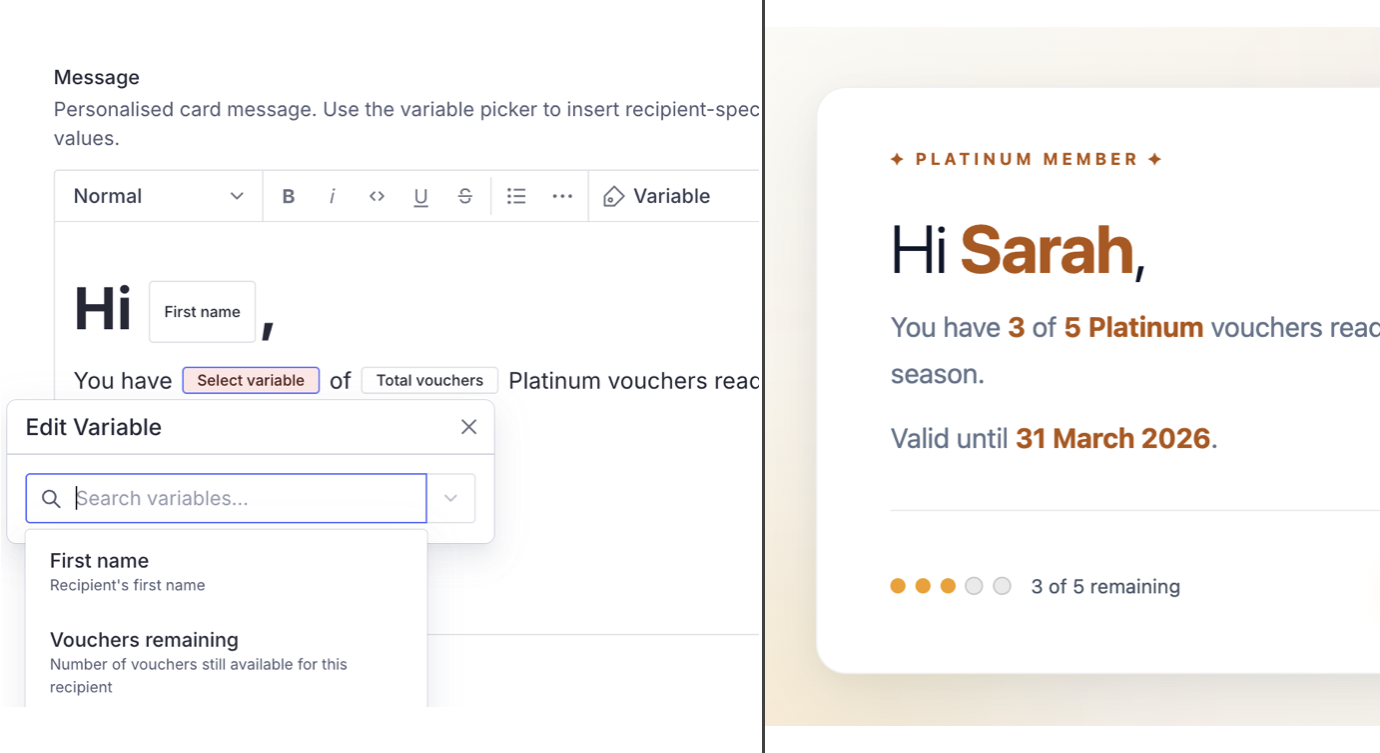
Framework-agnostic utilities for Portable Text variable interpolation. Extract variable keys from PTE blocks and resolve them to plain strings - with zero dependencies. Use this package when you need plain string output without a React dependency: email templates, PDF generation, Node.js scripts, SMS or push notifications, or any non-React framework (Vue, Svelte, Angular, etc.). For React rendering with rich text output, use pte-interpolation-react instead - it re-exports everything from this package.
Part of sanity-pte-interpolation. For adding variable picker inline blocks to Sanity Studio, see sanity-plugin-pte-interpolation. For React rendering with rich text output, see pte-interpolation-react.
Install
npm install pte-interpolation-coreNo peer dependencies required.
Usage
Extract variable keys
extractVariableKeys returns the unique variable keys found in an array of PTE blocks, in first-occurrence order:
import {extractVariableKeys} from 'pte-interpolation-core'

const keys = extractVariableKeys(blocks)
// ['firstName', 'vouchersRemaining']
Interpolate to a plain string
interpolateToString resolves PTE blocks to a plain string, substituting variable blocks with the provided values:
import {interpolateToString} from 'pte-interpolation-core'

const text = interpolateToString(blocks, {
  firstName: 'Sarah',
  vouchersRemaining: '3',
})
// "Hi, Sarah! You have 3 vouchers remaining."
Custom fallback for missing values
By default, unresolved variables render as {variableKey} (e.g. {firstName}). Provide a fallback function to customise this:
const text = interpolateToString(blocks, {}, (variableKey) => `[${variableKey}]`)
// "Hi, [firstName]! You have [vouchersRemaining] vouchers remaining."
Detect missing variables
getMissingVariableKeys returns the variable keys present in PTE content but absent from the provided values map - useful for validating before sending emails, notifications, or other interpolated content:
import {getMissingVariableKeys} from 'pte-interpolation-core'

const missing = getMissingVariableKeys(blocks, {firstName: 'Sarah'})
// ['vouchersRemaining']
Related Packages
This package handles resolution of variable blocks that already exist in Portable Text. To add the variable picker to Sanity Studio's Portable Text Editor, use sanity-plugin-pte-interpolation:
import {defineField} from 'sanity'
import {interpolationVariables} from 'sanity-plugin-pte-interpolation'

defineField({
  name: 'message',
  type: 'array',
  of: [
    interpolationVariables([
      {id: 'firstName', name: 'First name'},
      {id: 'vouchersRemaining', name: 'Vouchers remaining'},
      {id: 'totalVouchers', name: 'Total vouchers'},
      {id: 'expiryDate', name: 'Expiry date'},
    ]),
  ],
})
Data Shape
Variable blocks in stored Portable Text look like this:
{
  "_type": "block",
  "children": [
    {"_type": "span", "text": "Hi, "},
    {"_type": "pteInterpolationVariable", "variableKey": "firstName"},
    {"_type": "span", "text": ","}
  ]
}
The variableKey maps to the id defined in the Studio variable definitions and the keys in the values record passed to interpolateToString.
API Reference
extractVariableKeys(blocks)
Returns the unique variable keys from an array of PTE blocks, in first-occurrence order.
| Parameter | Type | Description |
| --------- | ------------------------- | ---------------------------- |
| blocks | PortableTextBlockLike[] | Portable Text blocks to scan |
Returns string[].
getMissingVariableKeys(blocks, values)
Returns the variable keys present in PTE content but absent from the provided values map. Keys are deduplicated and returned in first-occurrence order. An empty string "" is considered a provided value.
| Parameter | Type | Description |
| --------- | ------------------------- | ----------------------------------- |
| blocks | PortableTextBlockLike[] | Portable Text blocks to scan |
| values | Record<string, string> | Map of variable IDs to their values |
Returns string[].
interpolateToString(blocks, values, fallback?)
Resolves PTE blocks to a plain string, replacing variable blocks with the corresponding values. Multiple blocks are joined with newlines.
| Parameter | Type | Description |
| ---------- | --------------------------------- | ------------------------------------------------------------------------ |
| blocks | PortableTextBlockLike[] | Portable Text blocks to resolve |
| values | Record<string, string> | Map of variable IDs to their resolved values |
| fallback | (variableKey: string) => string | Optional function for unresolved variables (defaults to {variableKey}) |
Returns string.
VARIABLE_TYPE_PREFIX
The constant 'pteInterpolationVariable' - the _type string used for variable inline blocks in stored Portable Text. Exported for advanced use cases.
Types
| Type | Description |
| ------------------------------- | ----------------------------------------------------- |
| PortableTextBlockLike | Minimal block shape with optional children array |
| PortableTextChild | A child node within a block (span or variable) |
| PteInterpolationVariableBlock | A variable inline block with variableKey |
| InterpolationValues | Record<string, string> - variable ID to value map |
| InterpolationFallback | (variableKey: string) => string - fallback function |
License
MIT