
remark-obsidian-mdx
v1.1.1
Published
Remark plugin to support Obsidian markdown syntax
Downloads
21


Readme
remark-obsidian-mdx
This plugin is inspired by remark-obsidian
Read the blog post: How I'm Writing MDX with Obsidian


Remark plugin to support Obsidian markdown syntax with MDX output.
A blog built with this plugin is available at https://english.mjstudio.net, and you can see a real-world usage example at https://github.com/mym0404/english-blog.
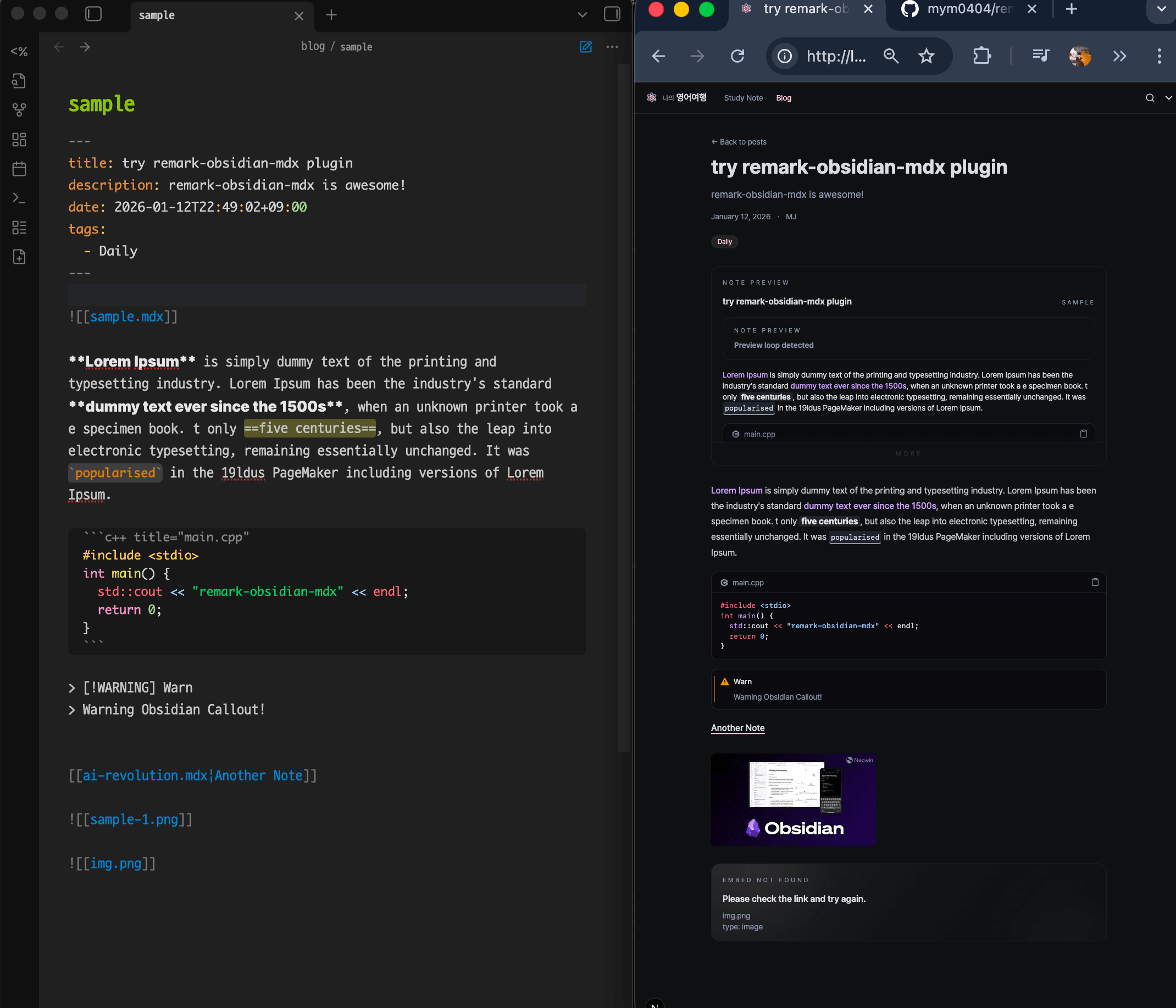
Features
> [!CALLOUT]to<Callout ...>(MDX JSX flow element)==highlight==to<mark>...</mark>(MDX JSX text element)[[Wiki link]]to mdastlinknodes (alias divider is|)[[#Heading]]uses a heading slug![[Embed]]to user-provided MDX JSX nodes (note/image/video renderers)![[image.png|alt text]]supports custom alt text for image embeds- Match notes, embeddings from the contentRoot recursively(mocking Obsidian's algorithm). You don't need to put entire path of resources. Just write [[img.png]]
Installation
pnpm add -D remark-obsidian-mdxUsage
MDX pipeline
import { compile } from "@mdx-js/mdx";
import remarkObsidianMdx from "remark-obsidian-mdx";

const result = await compile(source, {
  remarkPlugins: [remarkObsidianMdx],
});
If your MDX runtime does not provide a default Callout component, register it in your components map (for example, Callout from Fumadocs).
Unified to HTML
import { unified } from "unified";
import remarkParse from "remark-parse";
import remarkRehype from "remark-rehype";
import rehypeStringify from "rehype-stringify";
import remarkObsidianMdx from "remark-obsidian-mdx";

const { value } = unified()
  .use(remarkParse)
  .use(remarkObsidianMdx)
  .use(remarkRehype, {
    allowDangerousHtml: true,
    passThrough: [
      "mdxjsEsm",
      "mdxFlowExpression",
      "mdxJsxFlowElement",
      "mdxJsxTextElement",
      "mdxTextExpression",
    ],
  })
  .use(rehypeStringify, { allowDangerousHtml: true })
  .processSync("[[Hello world]]");
passThrough keeps MDX nodes intact when converting to HAST; without it, MDX JSX nodes are dropped.
Fumadocs ready-to-use setup
The examples below are taken from a working Fumadocs project and are ready to copy.
1) source.config.ts
import remarkObsidianMdx, { type PluginOptions } from "remark-obsidian-mdx";

export const docs = defineDocs({ ... });

export default defineConfig({
  mdxOptions: {
    remarkPlugins: [
      [
        remarkObsidianMdx,
        {
          contentRoot: "./content",
          contentRootUrlPrefix: "",
          wikiLinkPathTransform: ({ resolvedUrl }) =>
            resolvedUrl?.replace("/content", ""),
          embeddingPathTransform: ({ resolvedUrl }) =>
            resolvedUrl?.replace("/content", ""),
          callout: {
            componentName: "Callout",
            typePropName: "type",
            defaultType: "info",
          },
          embedRendering: {},
        } satisfies PluginOptions,
      ],
      remarkMath,
    ],
    rehypePlugins: (v) => [rehypeKatex, ...v],
  },
});
2) Assets route (content/assets/* -> /assets/*)
import fs from "node:fs/promises";
import path from "node:path";
import { NextRequest } from "next/server";

export const runtime = "nodejs";

const ASSET_ROUTE_PREFIX = "/assets/";
const ASSET_ROOT = path.resolve(process.cwd(), "content", "assets");

const toAssetPath = ({ pathname }: { pathname: string }) => {
  if (!pathname.startsWith(ASSET_ROUTE_PREFIX)) {
    return null;
  }

  const encodedPath = pathname.slice(ASSET_ROUTE_PREFIX.length);
  if (!encodedPath) {
    return null;
  }

  let decodedPath = "";
  try {
    decodedPath = decodeURIComponent(encodedPath);
  } catch {
    return null;
  }

  const resolvedPath = path.resolve(ASSET_ROOT, decodedPath);
  const withinRoot =
    resolvedPath === ASSET_ROOT || resolvedPath.startsWith(`${ASSET_ROOT}${path.sep}`);

  if (!withinRoot) {
    return null;
  }

  return resolvedPath;
};

const getContentType = ({ extension }: { extension: string }) => {
  switch (extension) {
    case "apng":
      return "image/apng";
    case "avif":
      return "image/avif";
    case "gif":
      return "image/gif";
    case "jpeg":
      return "image/jpeg";
    case "jpg":
      return "image/jpeg";
    case "png":
      return "image/png";
    case "svg":
      return "image/svg+xml";
    case "webp":
      return "image/webp";
    case "m4v":
      return "video/x-m4v";
    case "mov":
      return "video/quicktime";
    case "mp4":
      return "video/mp4";
    case "ogv":
      return "video/ogg";
    case "webm":
      return "video/webm";
    case "pdf":
      return "application/pdf";
    default:
      return "application/octet-stream";
  }
};

type ErrorWithCode = Error & { code?: string };

const isErrorWithCode = (value: unknown): value is ErrorWithCode =>
  value instanceof Error && "code" in value;

const createNotFoundResponse = () =>
  new Response("Not found", { status: 404 });

export const GET = async (request: NextRequest) => {
  const assetPath = toAssetPath({ pathname: request.nextUrl.pathname });
  if (!assetPath) {
    return createNotFoundResponse();
  }

  try {
    const file = await fs.readFile(assetPath);
    const extension = path.extname(assetPath).slice(1).toLowerCase();
    const contentType = getContentType({ extension });

    return new Response(file, {
      status: 200,
      headers: {
        "Content-Type": contentType,
        "Cache-Control": "public, max-age=3600",
      },
    });
  } catch (error) {
    if (isErrorWithCode(error) && error.code === "ENOENT") {
      return createNotFoundResponse();
    }

    return new Response("Failed to read asset", { status: 500 });
  }
};
3) Content layout
content/docsfor docscontent/blogfor blog postscontent/assetsfor images/video/etc served under/assets
Options
Example
import remarkObsidianMdx from "remark-obsidian-mdx";

remark().use(remarkObsidianMdx, {
  callout: {
    componentName: "Callout",
    typePropName: "type",
    defaultType: "info",
    typeMap: {
      note: "info",
      abstract: "info",
      summary: "info",
      tldr: "info",
      info: "info",
      todo: "info",
      quote: "info",
      tip: "idea",
      hint: "idea",
      example: "idea",
      question: "idea",
      warn: "warn",
      warning: "warn",
      caution: "warn",
      attention: "warn",
      danger: "error",
      error: "error",
      fail: "error",
      failure: "error",
      bug: "error",
      success: "success",
      done: "success",
      check: "success",
      idea: "idea",
    },
  },
  contentRoot: "/vault",
  contentRootUrlPrefix: "/blog",
  embedRendering: {
    note: ({ target }) => ({
      type: "mdxJsxFlowElement",
      name: "EmbedNote",
      attributes: [
        { type: "mdxJsxAttribute", name: "page", value: target.page },
      ],
      children: [],
    }),
    image: ({ target, resolvedUrl, imageWidth, imageHeight, alias }) => ({
      type: "image",
      url: resolvedUrl ?? target.page,
      alt: alias || "",
      data: {
        hProperties: {
          width: imageWidth ?? 640,
          height: imageHeight ?? 480,
        },
      },
    }),
    video: ({ target, resolvedUrl }) => ({
      type: "mdxJsxFlowElement",
      name: "video",
      attributes: [
        { type: "mdxJsxAttribute", name: "src", value: resolvedUrl ?? target.page },
      ],
      children: [],
    }),
  },
  embeddingPathTransform: ({ kind, resolvedUrl }) => {
    if (kind === "image" || kind === "video") {
      return resolvedUrl ?? null;
    }
    return null;
  },
  wikiLinkPathTransform: ({ resolvedUrl }) => {
    if (!resolvedUrl) {
      return null;
    }
    return resolvedUrl.replace("/notes/", "/docs/");
  },
});
callout
typeMapfully replaces the default mapping when provided.typeMapkeys are normalized to lowercase.- Empty mapped values fall back to
defaultType.
contentRoot
- Required. Builds an on-disk index for resolving
[[...]]and![[...]]. - Also passed to embed rendering for resolution checks.
contentRootUrlPrefix
- Prepends a URL prefix for resolved paths without changing
contentRoot. - Example:
contentRoot: "/vault/.content"withcontentRootUrlPrefix: "/blog"resolves[[ai-revolution]]to/blog/ai-revolution.
embedRendering
- Controls how
![[...]]is rendered. Heading (#) and block (^) embeds are ignored. - Unsupported embed types (non-note/image/video files) are ignored.
- Receives
resolvedUrl,imageWidth/imageHeight, andaliaswhen available. - For embeds,
resolvedUrlincludes extensions by default. - If a target cannot be resolved under
contentRoot, the default output is a plain text fallback. You can override this withembedRendering.notFound. - If
embedRendering.imageis omitted, the plugin emits a standardimagenode withdata.hProperties.width/heightinferred from the file andaltset from the alias (e.g.,![[image.png|My alt text]]). - If
embedRendering.videois omitted, it emits avideoMDX JSX node.
embeddingPathTransform
- Overrides resolved URLs for embeds based on embed kind.
- Returning a string overrides
resolvedUrl.
wikiLinkPathTransform
- Overrides resolved URLs for
[[...]]links. - Returning a string overrides
resolvedUrl. - For wiki links,
resolvedUrlexcludes extensions by default.
Asset url mapping
If your vault stores images under vault/assets/images, you should serve them via a route like app/assets/[[slug]].tsx so the resolved URLs can be fetched by the app.
License
This project is licensed under the GNU GPL v3.0 - see the LICENSE.txt file for details.