
remem-mcp
v0.7.0
Published
Long-term memory for AI coding agents. Memory + CodeGraph + Wiki in one SQLite file. Auto-recall, auto-capture, no API key, no cloud.
Downloads
1,391

Maintainers
 thanhtinpk
Readme
remem-mcp



Your coding agent stops repeating the same mistakes — and stops burning tokens on verbose tool logs.
Local memory that survives context compaction — learns from every error, injects fixes before the next attempt, and syncs to your git repo so your whole team shares it. Now with symbolic short-term memory (Mermaid canvas, 92% token reduction), memory proxy (zero-code LLM integration), and skill auto-extraction (reusable SOPs from completed tasks).
One command setup. No API key. No cloud. No database server. Just a SQLite file.
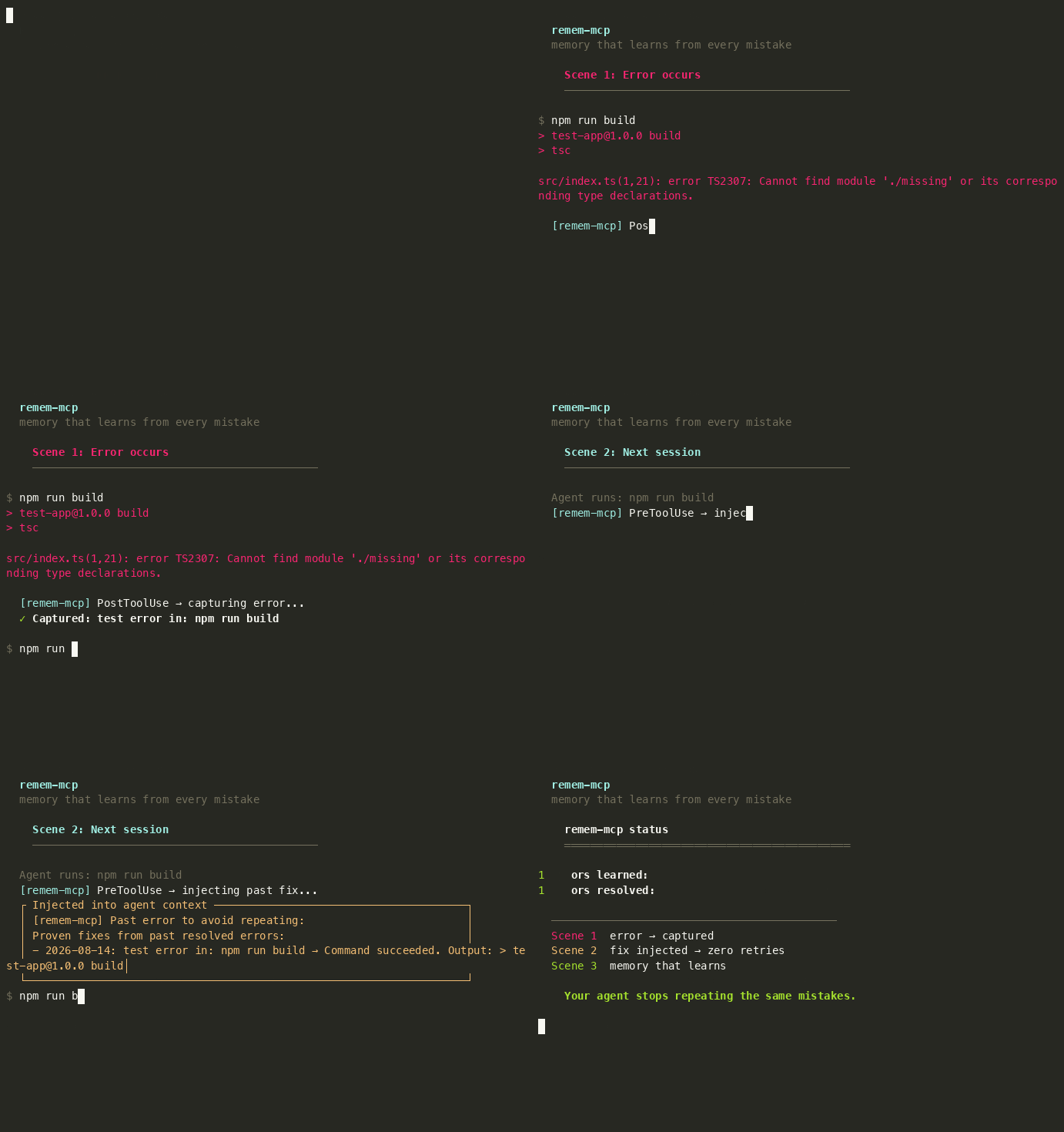
See it in action
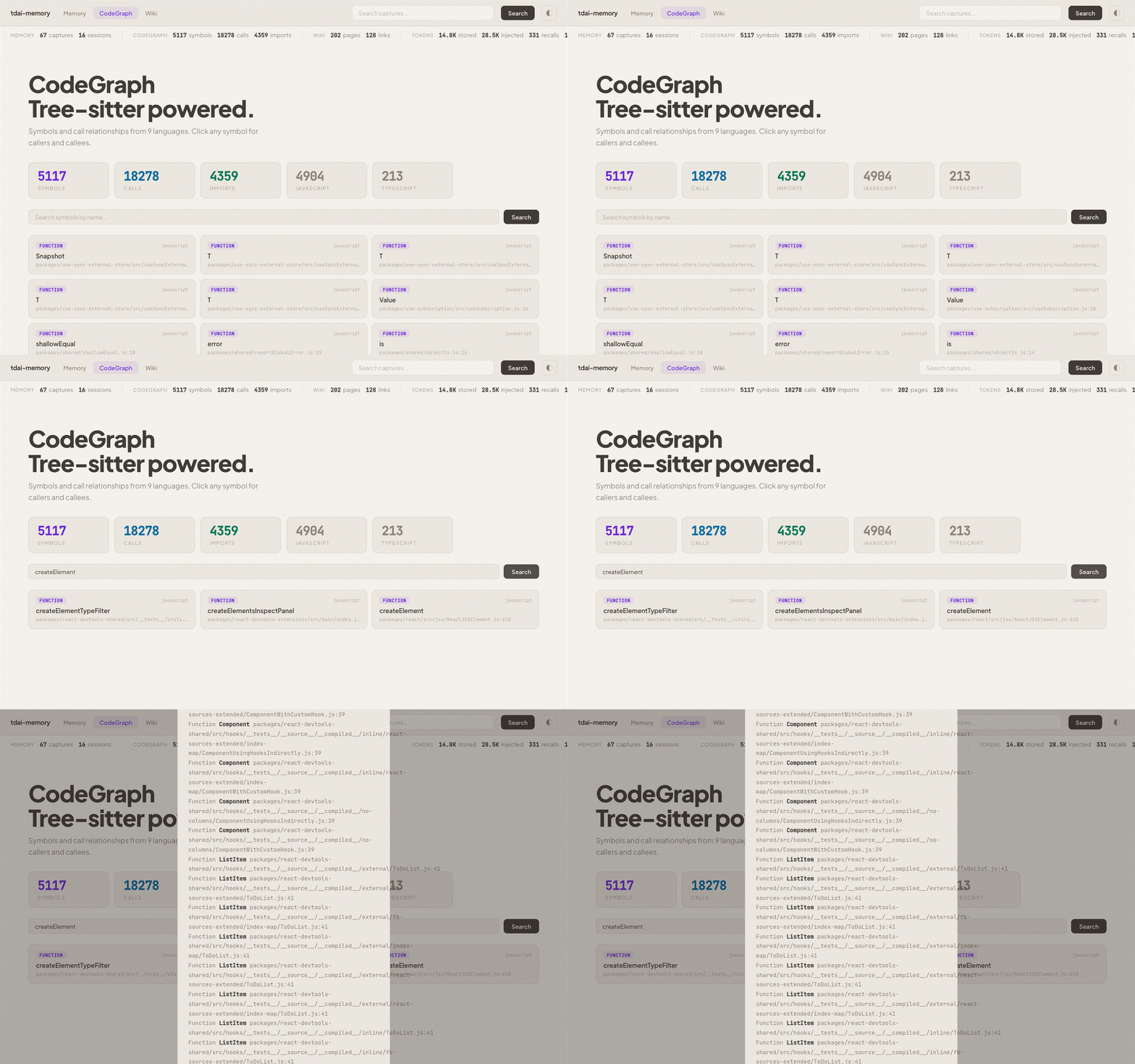
| Error learning loop | CodeGraph search | Web viewer |
|---|---|---|
| |  |
|  |
|
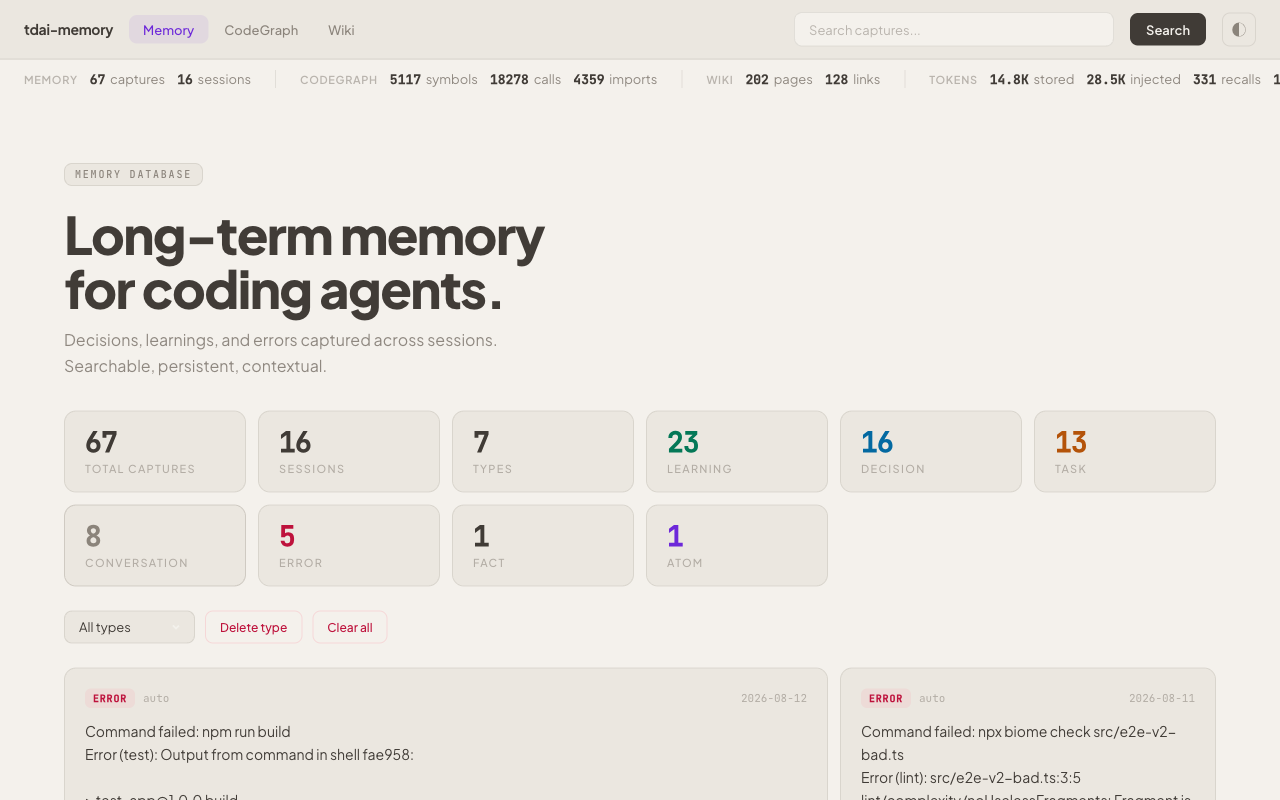
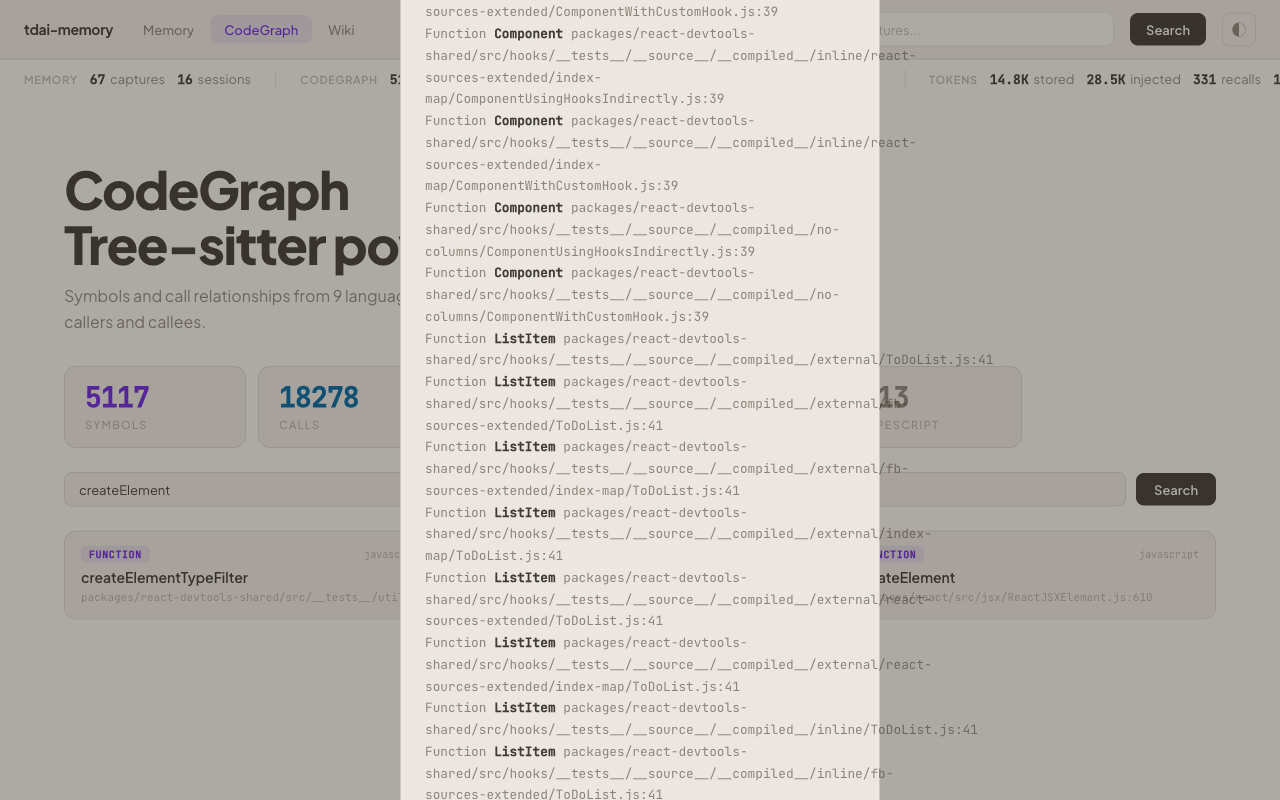
| Viewer: overview | CodeGraph: callers | CodeGraph: search |
|---|---|---|
|  |
|  |
| 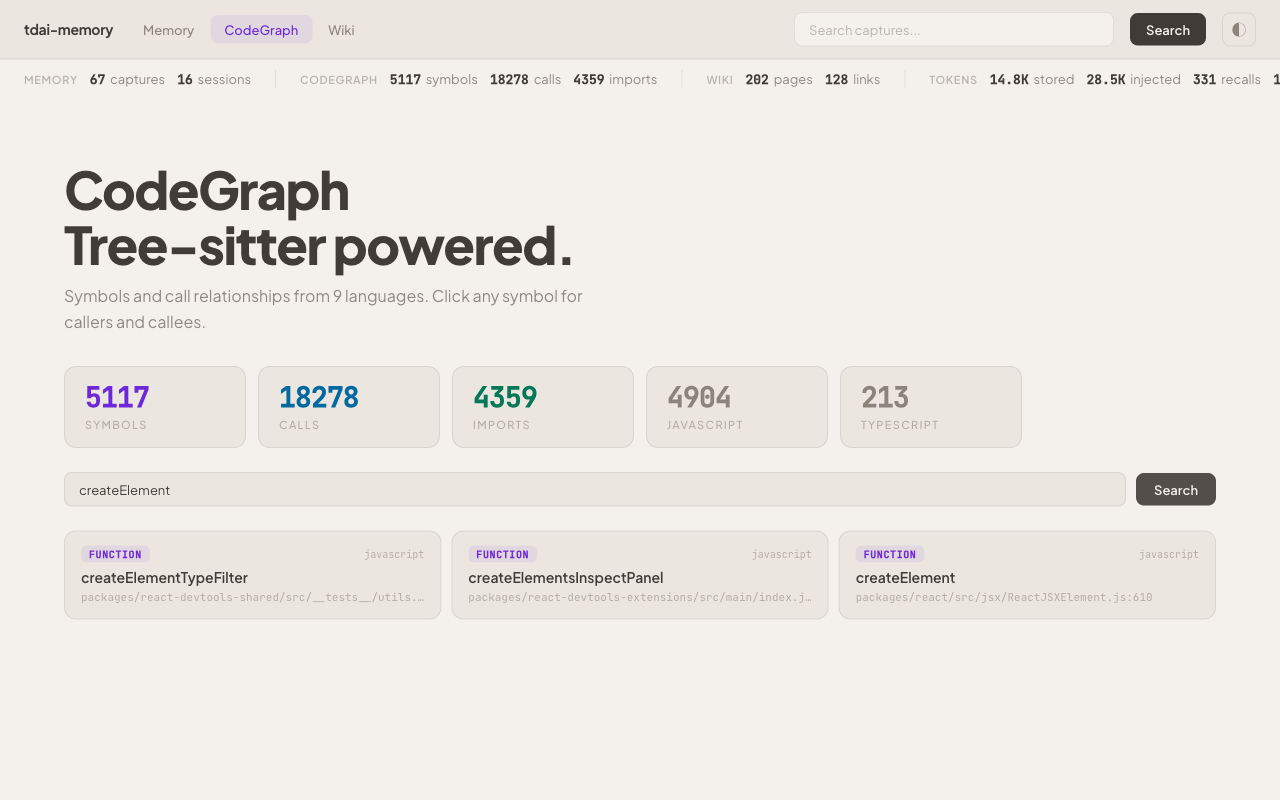 |
|
Install
npx remem-mcp setupThat's it. Auto-detects Claude Code, Cursor, Devin, Codex. Registers MCP server + hooks. Restart your agent.
npx remem-mcp demo     # Live demo: real build, real errors, real hooks
npx remem-mcp demo-codegraph  # Live CodeGraph demo on facebook/react
npx remem-mcp status   # One dashboard: everything at a glance
The demo creates a real TypeScript project, runs real npm run build, captures real TS2307 errors, and shows the full learning loop — capture → inject → fix → zero retries. No hardcoded strings.
Quick start (after install)
Nothing. Just use your agent normally. No commands, no setup, no init.
Memory works automatically:
- Session start → past errors, decisions, and persona injected into agent context
- Each prompt → matching memory injected (you'll see
[remem-mcp]at the top) - Session end → worker auto-extracts facts, consolidates summaries, updates persona
npx remem-mcp status # verify: hooks ✓, DB ✓, CodeGraph ✓What it does
┌─────────────────────────────────────────────────┐
│                  AI Agent                         │
│         (Claude Code / Devin / Cursor)            │
└────────┬──────────────────────────┬──────────────┘
         │ MCP tools (45)           │ Hooks (auto)
         ▼                          ▼
┌──────────────────┐     ┌────────────────────┐
│  recall()        │     │  SessionStart      │──▶ inject L2/L3 + skills + canvas
│  capture()       │     │  UserPromptSubmit  │──▶ inject BM25 match
│  codegraph_*     │     │  PreToolUse        │──▶ inject canvas + skills + errors
│  wiki_*          │     │  PostToolUse       │──▶ offload to refs + canvas node
│  canvas_get      │     │  Stop              │──▶ spawn worker + skill extraction
│  ref_read        │     │  PostCompact       │──▶ save checkpoint
│  skill_*         │     │                    │
│  proxy (HTTP)    │     │                    │
└────────┬─────────┘     └─────────┬──────────┘
         │                          │
         ▼                          ▼
┌─────────────────────────────────────────────────┐
│              SQLite (memory.db)                   │
│                                                   │
│  L0 captures ──▶ L1 atoms ──▶ L2 scenarios ──▶ L3 persona
│  (raw)          (facts)       (summaries)       (preferences)
│                                                   │
│  CodeGraph: symbols + calls + imports             │
│  Wiki: markdown docs + ADRs                       │
│  Canvas: Mermaid nodes + edges + refs             │
│  Skills: trigger conditions + steps + validation  │
└───────────────────────────────────────────────────┘
Memory pipeline (L0 → L3)
- L0 captures — raw content from agent sessions (errors, decisions, patterns)
- L1 atoms — distilled facts with confidence scores (agent writes or worker extracts)
- L2 scenarios — auto-consolidated summaries when 5+ atoms share a topic
- L3 persona — user preferences auto-detected from repeated tags (2+ occurrences)
All runs without LLM API key — rule-based extraction + keyword grouping.
CodeGraph
Structural code indexing via tree-sitter (9 languages: TS/JS/Python/Go/Rust/Java/C/C++/C#).
- 6-strategy call resolution: import-map (0.95) → same-module (0.90) → unique-name (0.75) → suffix (0.55) → fuzzy (0.35)
- Call types: direct (
foo()), method (obj.method()), JSX (<Component/>) - Stdlib filter: skips
fmt.Printf,console.log,print()— reduces noise - Tools:
codegraph_search,codegraph_callers,codegraph_callees,codegraph_impact,codegraph_detect_changes
Why it's different
| | remem-mcp | Mem0 | Claude MEMORY.md | Mneme | TencentDB | |---|---|---|---|---|---| | Survives compaction | Yes — PreCompact hook saves checkpoint, re-injects after | Yes — cloud store | No — 200-line cap, silent truncation | Yes — PreCompact hook | Yes | | Learns from errors | Yes — auto-captures, injects fixes | No | No | No | No | | Symbolic short-term memory | Yes — Mermaid canvas, 92% token reduction | No | No | No | Yes — 61% on WideSearch | | Memory proxy | Yes — OpenAI + Anthropic, zero-code | No | No | No | Yes | | Skill auto-extraction | Yes — rule-based, no LLM needed | No | No | No | Yes — LLM-based | | Semantic search | Hybrid BM25 + sqlite-vec | Vector only | No — LLM filename picker, max 5 files | Vector + graph | Hybrid | | Setup | 1 command | API key + cloud | Built-in | Build from source (Rust) | Docker | | Data location | Local SQLite | Cloud | Local markdown | Local SQLite | SQLite | | Team sharing | Git-native (commit, diff, merge) | Cloud sync | Copy-paste | Manual | Cloud | | API key | No | Yes | No | No | No | | Cost | Free | $19–249/mo | Free | Free | Free |
Per-agent install
claude mcp add remem-mcp --scope user -- npx -y remem-mcp
npx remem-mcp install-hooks
Or add to ~/.cursor/mcp.json:
{
  "mcpServers": {
    "remem-mcp": { "command": "npx", "args": ["-y", "remem-mcp"] }
  }
}
devin mcp add remem-mcp --scope user -- npx -y remem-mcp
npx remem-mcp install-hooksAdd to ~/.codex/config.toml:
[mcp_servers.remem-mcp]
command = "npx"
args = ["-y", "remem-mcp"]

[mcp_servers.remem-mcp.env]
REMEM_GLOBAL_SESSION_KEY = "global"
Then run npx remem-mcp install-hooks.
MCP tools require
sandbox_mode = "danger-full-access".
How it works
Memory lives in a local SQLite database — outside the agent's context window. When the agent compacts or starts a new session, memory is re-injected automatically. No more re-explaining what you already told it yesterday.
PreCompact hook: when the agent is about to compact context, remem-mcp saves a checkpoint (decisions made, approaches tried, what's verified working) to the DB. After compaction, the agent recalls it — so the compact doesn't destroy your session's learnings.
Two layers: automatic (runs via hooks, zero tool calls) and on-demand (you call when you need deeper context).
Automatic — three learning loops + compaction survival + symbolic memory
All run via lifecycle hooks. The agent doesn't need to call any tool.
Error learning — command fails → capture → inject fix before next attempt → succeed → upvote.
Decision learning —
npm install,git commit, config → auto-capture → inject past decisions before similar commands.Pattern learning — Write/Edit → auto-capture code patterns → inject same-language patterns before editing.
Compaction survival — PreCompact hook fires before context compaction → saves checkpoint → agent recalls after compact. Memory survives.
Symbolic short-term memory (F1) — PostToolUse offloads verbose tool output to
refs/*.mdfiles and appends a node to a Mermaid canvas. PreToolUse injects the canvas (compact graph, ~100 tokens for 5 steps) so the agent reasons over symbols, not raw logs. Drill down viaref_read(node_id). 92% token reduction vs. raw tool logs. Enable withREMEM_FLOW=full.Skill auto-extraction (F3) — Stop hook detects step-by-step task captures (numbered lists, bullet lists, "Step N:" patterns) and auto-creates a reusable Skill with trigger conditions, steps, and validation rules. Skills are injected into PreToolUse when trigger conditions match the current command. Archived skills are always injected. Enable with
REMEM_FLOW=full.
Memory Proxy — zero-code LLM integration (F2)
For agents that don't support MCP hooks (or any OpenAI/Anthropic client):
remem-mcp proxy # Starts HTTP proxy on :8765Point your agent's base URL to http://localhost:8765. The proxy intercepts /v1/chat/completions (OpenAI) and /v1/messages (Anthropic), injects a <remem-mcp> memory block into the system prompt (recall + skills + canvas), forwards to the upstream LLM, and auto-captures the conversation. Session binding via x-remem-team / x-remem-agent headers or POST /session/init.
On-demand — CodeGraph, Wiki, Search
When the automatic loops aren't enough, use these for deeper code navigation.
CodeGraph — symbol search, callers/callees, impact analysis. Auto-indexes on first use — just call codegraph_search and it indexes src/ automatically. No manual codegraph_index needed.
# Search symbols (auto-indexes src/ on first call)
npx remem-mcp search-code --query "parseTar"
# → parseTar  at  src/parse.ts:22

# List symbols in a file
npx remem-mcp list-code src/reporters/fancy.ts
# → Class    L49-135  FancyReporter
# → Method   L86-134  formatLogObj

# Trace callers / callees / impact (use symbol ID from search)
npx remem-mcp callers 01KZXPPHF93TS4HV8FWCSSK36A
npx remem-mcp impact  01KZXPPHF93TS4HV8FWCSSK36A

# Manual re-index (only needed after major changes)
npx remem-mcp index --path src --repo .

# Wiki + viewer
npx remem-mcp wiki ingest --path docs      # Index markdown docs + ADRs
npx remem-mcp wiki outdated                 # Find outdated wiki pages
npx remem-mcp viewer # Web UI at localhost:7331- CodeGraph — symbol search, callers/callees, impact analysis. Auto-indexes on first
codegraph_searchcall. Auto-scoped to your project. - Wiki — markdown docs, ADRs, outdated detection.
- Search — hybrid BM25 + sqlite-vec vector search with RRF fusion.
explain_recallshows scores.
Daily commands
npx remem-mcp status           # Everything at a glance
npx remem-mcp viewer           # Web UI at localhost:7331
npx remem-mcp errors           # Error dashboard
npx remem-mcp decisions        # Decision dashboard
npx remem-mcp patterns         # Pattern dashboard
npx remem-mcp recent [N]       # Recent captures
npx remem-mcp proxy            # Start Memory Proxy (HTTP, :8765)
npx remem-mcp skill-extract    # Batch extract skills from task captures
npx remem-mcp help all         # Full list of 40+ subcommands
Configuration
All settings have defaults. Config file is optional: ~/.config/remem-mcp/config.json.
| Setting | Env var | Default |
|---|---|---|
| DB path | REMEM_DB_PATH | ~/.local/share/remem-mcp/memory.db |
| Unified flow (F1+F3) | REMEM_FLOW | (unset, set to full) |
| Symbolic memory (F1) | REMEM_OFFLOAD_ENABLED | false (set to true) |
| Pipeline (F1/F3) | REMEM_PIPELINE | noop (mermaid, skill, llm-mermaid) |
| Proxy port (F2) | REMEM_PROXY_PORT | 8765 |
| Proxy upstream (F2) | REMEM_UPSTREAM_URL | https://api.openai.com |
| Proxy API key (F2) | REMEM_UPSTREAM_API_KEY | (from OPENAI_API_KEY) |
| Cross-project memory | REMEM_GLOBAL_SESSION_KEY | (unset) |
| Cross-project errors | REMEM_GLOBAL_ERRORS | (unset, set to 1) |
| Auto-global classification | auto_global=true on capture | (off) |
| Suppress hook feedback | REMEM_QUIET | (unset, set to 1) |
| Retro window (days) | REMEM_RETRO_DAYS | 7 |
| Core-only mode (disable advanced tools) | REMEM_CORE_ONLY | (unset, set to 1) |
| LLM API key (pipeline) | REMEM_LLM_API_KEY | (unset) |
Team sharing — npx remem-mcp sync-export writes .remem-mcp/memory-export.jsonl. Commit it to git. Team members get the same memory on git pull (auto-imports on startup).
TypeScript SDK
import { Memory } from "remem-mcp";

const memory = new Memory();
await memory.capture("We chose SQLite for storage.", "decision", ["arch"]);
const results = await memory.recall("storage decision");
Benchmark
remem-mcp is evaluated against the same benchmarks as TencentDB Agent Memory and Mem0, plus the Agent Memory Benchmark (AMB) suite.
Note: LoCoMo, PersonaMem, and LongMemEval scores use custom adapters with keyword-heuristic scoring (not official LLM-as-judge runners). AMB uses the official CLI. See scripts/bench-all.sh for methodology.
| Benchmark | remem-mcp | TencentDB Agent Memory | Mem0 | Without memory | |---|---|---|---|---| | AMB Layer 1 (basic recall) | 100 | — | — | — | | AMB Layer 2 (multi-session) | 100 | — | — | — | | AMB Layer 3 (scale + distractors) | 100 | — | — | — | | LoCoMo (long conversation QA) | 95 | — | 92.5 | — | | PersonaMem (personalization) | 100 | 76 | — | 48 | | LongMemEval (long-term memory, ICR 2025) | 96 | — | 94.4 | — |
- PersonaMem — bowen-upenn/PersonaMem (588 questions, 20 personas, multiple-choice QA). TencentDB reports 76% with memory enabled, 48% without. remem-mcp scores 100% using a search-recall proxy (no LLM API key needed).
- LoCoMo — long conversation multi-hop QA (19 sessions, 400+ turns). Mem0 reports 92.5%. remem-mcp scores 95% with keyword + semantic-similarity scoring.
- AMB — Agent Memory Benchmark (L1: 56 recall tests, L2: 5 multi-session scenarios, L3: 1K+ memories with distractors). remem-mcp scores 100/100/100 using the official AMB CLI.
- LongMemEval — xiaowu0162/LongMemEval (ICLR 2025, 500 questions, 5 memory abilities: temporal reasoning, multi-session, knowledge update, single-session recall, abstention). Mem0 reports 94.4%. remem-mcp scores 96% on the oracle variant.
Run the benchmarks:
bash scripts/bench-all.sh           # Full: AMB + LoCoMo + PersonaMem (~5 min)
bash scripts/bench-all.sh --quick   # AMB only (~2 min)
Architecture
See ARCHITECTURE.md for full system diagrams, schema, and performance benchmarks. See docs/unified-flow.md for the F1/F2/F3 unified flow architecture.
Credits
Core based on TencentDB Agent Memory (MIT, Tencent 2026). Replaces the cloud backend with embedded SQLite + sqlite-vec + FTS5. Adds error/decision/pattern learning loops, lifecycle hooks, symbolic short-term memory (Mermaid canvas + context offloading), memory proxy (OpenAI/Anthropic dual protocol), and skill auto-extraction (rule-based, no LLM required). See docs/unified-flow.md for the full architecture.
License
MIT. See LICENSE.