
repo-pulse-mcp
v0.6.0
Published
Read-only MCP server that turns local git history into answers: PR review context, bug hotspots, code ownership and bus factor, change coupling and release notes.

Maintainers
 hasanyelaldi
Readme
repo-pulse-mcp





Turn git history into answers your AI assistant can act on: what is risky in this branch, who should review it, which files keep breaking and what changed since the last release.
repo-pulse is a read-only Model Context Protocol server for local git repositories. It runs over stdio, needs nothing but Node.js and git, never modifies a repository and never touches the network. Ask your assistant things like:
- 🔍 "I'm about to open a PR. What's risky, what did I forget, and who should review it?"
- 🐛 "Which files keep breaking? Where is the churn?"
- 👥 "Who knows the billing module best? Are we depending on a single person?"
- 🔗 "Which files always change together with this one?"
- 🚀 "What changed since the last release? Draft the release notes."
- 🧹 "Which branches are stale, and which are already merged?"
It works with any local git repository, whether it was cloned from GitHub, GitLab, Bitbucket or anywhere else, or has no remote at all. Platform data such as pull requests, issues or CI status is out of scope.
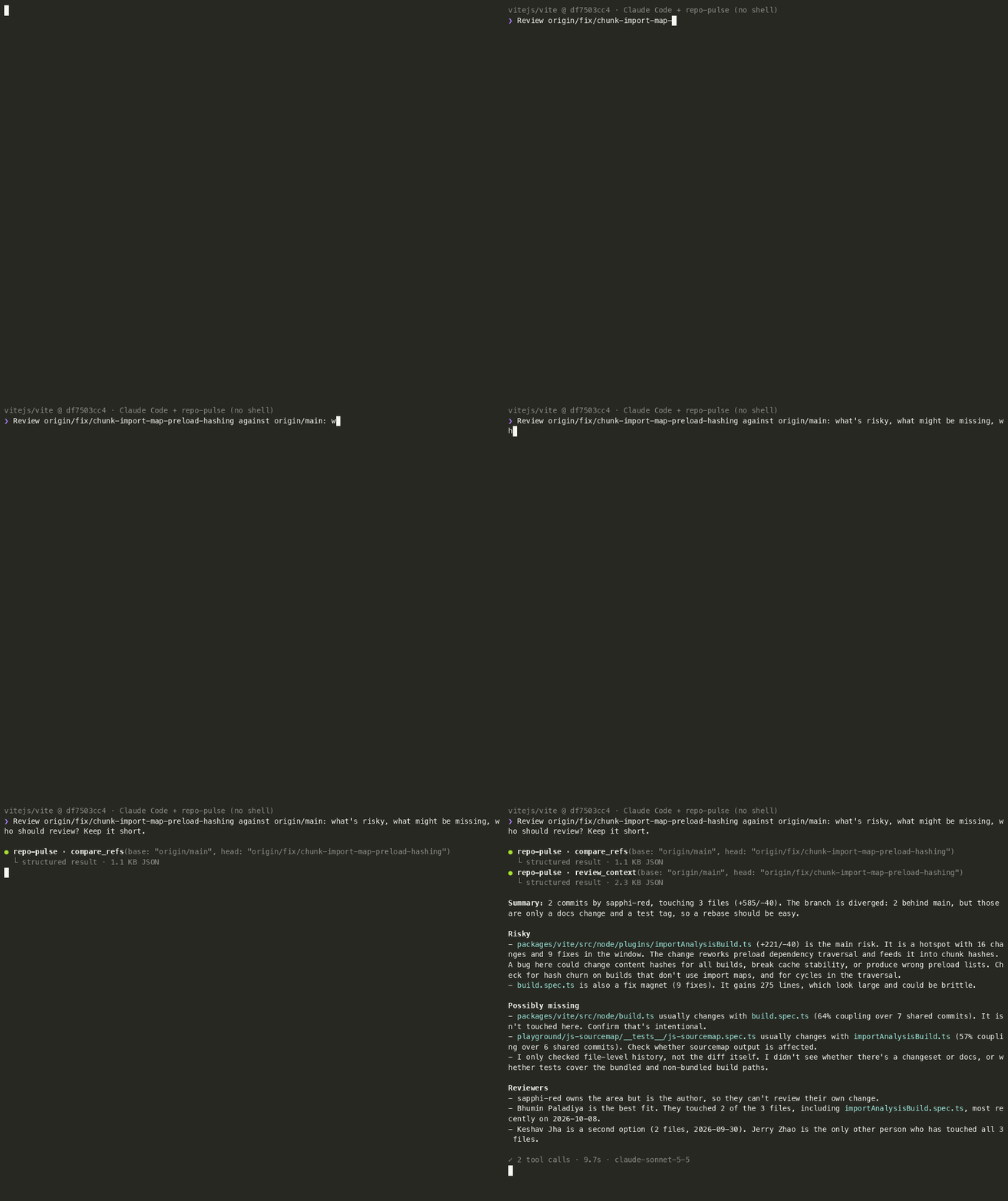
A real Claude Code session reviewing a branch of vitejs/vite with no shell, only repo-pulse. See how it was recorded.
Quick start
Requires Node.js 22.12+ and git. There is nothing to clone or build: the server runs from npm.
# Claude Code: run inside the repository you want to ask about
claude mcp add repo-pulse -- npx -y repo-pulse-mcp --repo "$PWD"
Then ask "What changed since the last release?", or review your branch with the built-in prompt:
/mcp__repo-pulse__review_branch main. For Claude Desktop and other MCP clients, see
Installation.
Features
13 tools, grouped by the question they answer. 🆕 marks the newest ones.
🔍 Code review and risk
| Tool | What it answers |
| ------------------- | ---------------------------------------------------------------------------------------------------------------------------------------------------- |
| review_context 🆕 | One-call briefing for a branch or PR: changed files ranked by past churn and fixes, files that usually change with them but were left out, reviewers |
| file_hotspots | Files ranked by how often they changed, with how many changes were bug fixes. types: ["fix"] finds the files that keep breaking |
| change_coupling | File pairs that keep changing in the same commits: hidden dependencies that imports do not show |
👥 Ownership and team
| Tool | What it answers |
| --------------------- | ------------------------------------------------------------------------------------------------------------------- |
| knowledge_map 🆕 | Who knows a file or directory, weighted toward recent work, plus the bus factor and files that depend on one person |
| code_age 🆕 | How long ago each file last changed, the oldest directories and files whose last author has left |
| contributor_summary | Commits per author in a time window, optionally for one path |
🚀 Releases and branches
| Tool | What it answers |
| --------------------- | --------------------------------------------------------------------------- |
| release_notes_draft | Commits between two refs grouped by conventional-commit type, plus Markdown |
| list_tags | Tags newest first, the latest release on HEAD and how much is unreleased |
| compare_refs | Ahead/behind counts and the commits between two branches, tags or commits |
| stale_branches | Branches with no commits for N days, and whether each is already merged |
🕒 History and activity
| Tool | What it answers |
| ----------------- | -------------------------------------------------------------------- |
| recent_activity | Commits from the last N days, filterable by author and path |
| commit_search | Commits whose message mentions a ticket id, feature name or any text |
| file_history | One file's commits with line stats, following it across renames |
📦 Also included
| Kind | Name | What it does |
| -------- | --------------------------- | ---------------------------------------------------------------------------------- |
| Resource | repo://{name}/overview | Current branch, last commit, latest tag, commit/branch/tag counts |
| Prompt | review_branch 🆕 | Review briefing for a branch: risky files, forgotten files, reviewers, a checklist |
| Prompt | release_notes 🆕 | Polished release notes since the last tag, with a suggested next version |
| Prompt | ownership_report 🆕 | Owners, bus factor and knowledge at risk for a directory, with next steps |
| Prompt | cleanup_branches 🆕 | Stale branches split into safe to delete and needs a decision, with the commands |
| Prompt | explain_file 🆕 | What to know before changing a file: its history, who to ask, what changes with it |
| Prompt | refactor_candidates 🆕 | Files that change and break most, ranked, with a plan for where to start |
| Prompt | trace_change 🆕 | Where a ticket or feature landed: timeline, people and the release that shipped it |
| Prompt | weekly_engineering_update | Guides the model to gather data with the tools and write an update |
All tools are annotated readOnlyHint: true, declare an outputSchema, and return both
structuredContent and a JSON text block for older clients. Full inputs and outputs are in the
Tool reference.
Example conversations
You: I'm about to open a PR for
feature/search. Anything I should know?Assistant (calls
review_contextwithbase: "main",head: "feature/search"): 4 commits touching 6 files.src/api.tsis the risky one: it changed 14 times onmainin the last six months and 6 of those were bug fixes. You may have forgottentest/api.test.ts: it changed together withsrc/api.tsin 9 of 10 commits but is not in this branch. Suggested reviewer: Alice, who holds most of the recent knowledge of these files.
You: Who knows
src/billing/best? Are we depending on one person?Assistant (calls
knowledge_mapwithpath: "src/billing"): The bus factor is 1. Carol holds 72% of the recent knowledge and is the main owner of 11 of 14 files; 9 of them depend on her alone. Bob is a distant second at 18%. Pairing Bob with Carol on the next billing change would spread the knowledge…
You: Which parts of the code has nobody touched in a long time?
Assistant (calls
code_agewithminAgeDays: 365): Half of the files haven't changed in 18 months.src/legacy/is the oldest directory (median 3.2 years), and 41 of its files were last changed by people who no longer commit here. That's where knowledge is being lost…
You: Where is the churn this quarter, and what keeps breaking?
Assistant (calls
file_hotspotswithdays: 90):src/core/insights.tschanged in 23 commits by 3 people, far more than anything else, and 9 of those commits were fixes. That's a good candidate for splitting up or adding tests…
You: What changed since the last release?
Assistant (calls
release_notes_draftwith defaults: latest tag → HEAD): Since v0.2.0 there are 14 commits. One breaking change: the config file moved torepo-pulse.json. New features: an author filter for activity and branch merge detection. Three bug fixes, mostly around empty repositories. Here's a Markdown draft you can paste into the GitHub release: …
You: Can we clean up some branches?
Assistant (calls
stale_brancheswithdays: 30): 6 branches haven't seen a commit in 30+ days. 4 of them are already merged intomainand are safe to delete: …
You: (selects the
weekly_engineering_updateprompt)Assistant (calls
recent_activity,contributor_summary,file_hotspots,stale_branches): Highlights — …
The conversations are illustrative: names and numbers are made up.
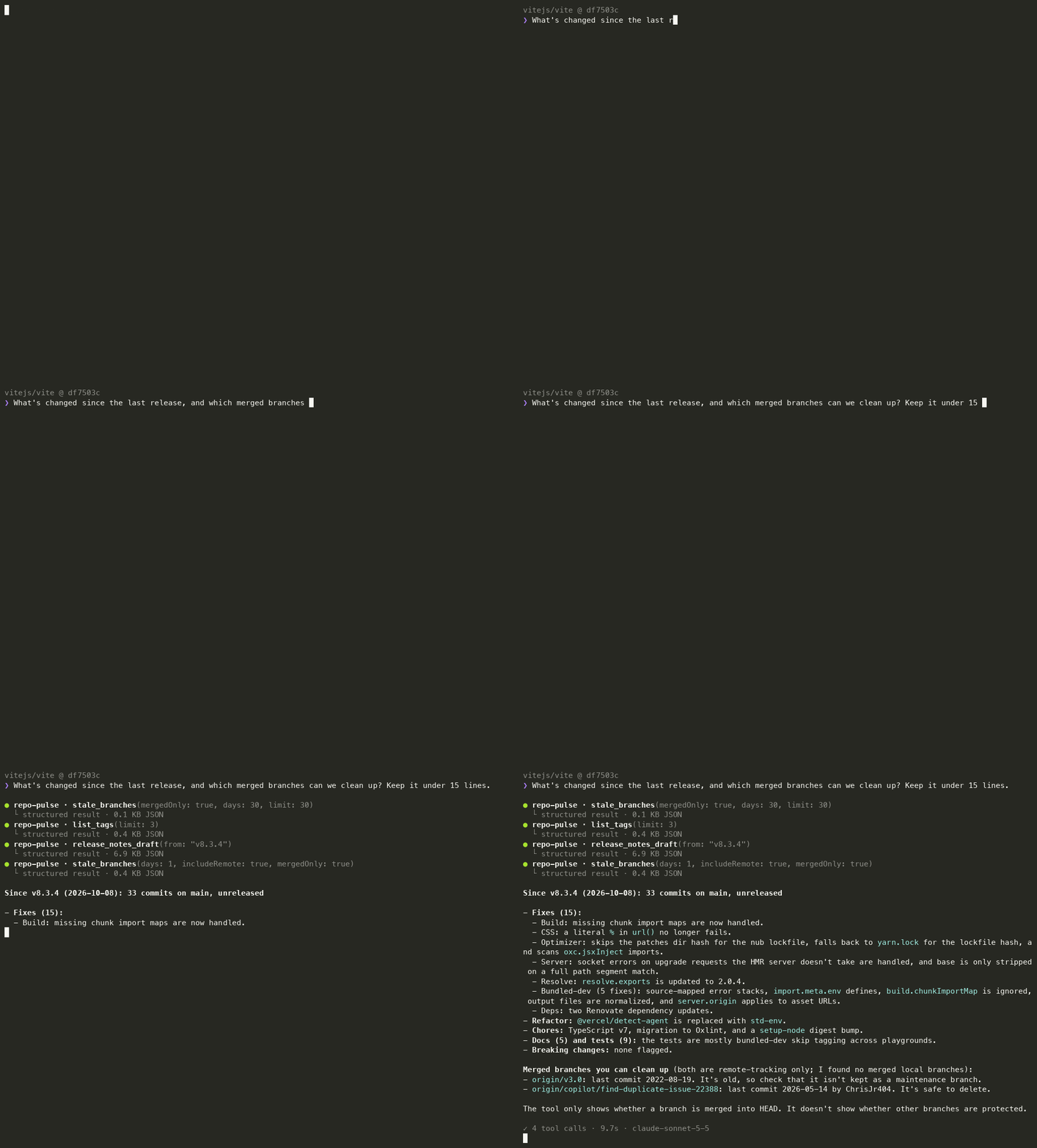
And a real session on vite, asking about unreleased changes and stale branches:
Why repo-pulse?
There are already MCP servers for GitHub, GitLab and git itself, and coding agents with a shell
can run git log directly. repo-pulse does not try to replace them. It does a different job: it
turns local git history into answers and is safe to auto-approve.
| | repo-pulse | GitHub / GitLab MCP | Generic git MCP / shell | | -------------------------------- | ---------------------------- | -------------------------- | ----------------------- | | Returns | Aggregated insights | Platform API objects | Raw git output | | Can modify anything | No, enforced by an allowlist | Usually yes (token scopes) | Yes | | Needs a token or network | No | Yes | No | | Sees local and unpushed branches | Yes | No | Yes | | Works without a hosting platform | Yes | No | Yes | | Sees pull requests, issues, CI | No | Yes | No |
What that means in practice:
- Fewer steps, correct numbers. Questions like "where is the churn?", "what goes into the
release notes?" or "which branches are merged and stale?" otherwise take several shell commands
and hand-written counting pipelines, which can be silently wrong. repo-pulse does the counting
in tested code and returns deterministic JSON that says which filters it applied. Some tools
go further than any single git command:
review_contextcombines churn, fix history, change coupling and ownership for a branch in one call. - Read-only you can verify. Every tool is annotated
readOnlyHintand backed by a git subcommand allowlist (see Security model), so a client can run it without asking for approval each time. You would not give the same permission to a shell or to a git server that can commit and push. - Useful where there is no shell. Chat clients such as Claude Desktop cannot run
git. With repo-pulse, an engineering manager or tech lead can ask about a repository directly. - Works with anything git can open. It works offline and in air-gapped environments, on self-hosted or remote-less repositories, and it never returns author email addresses.
Use it alongside a platform server, not instead of one. Pair it with the GitHub or GitLab MCP
when you also need pull requests, issues or CI status. If you work in a coding agent that already
has a shell and you only need the occasional git log, you probably do not need repo-pulse.
Benchmark
Claude Code (Sonnet 5.5) answered the same four questions about vite and express twice: once with only a read-only shell and once with only repo-pulse. Full method, answers and caveats are in bench/README.md.
| Question | Shell: turns · time · result | repo-pulse: turns · time · result |
| --------------------------------- | ---------------------------- | --------------------------------- |
| Top 10 hotspots, last 90 days | 2 · 6.6 s · ✅ | 2 · 6.5 s · ✅ |
| Files coupled to config.ts | 2 · 7.4 s · ❌ undercounted | 2 · 8.6 s · ✅ |
| Release notes, latest vs previous | 3 · 14.0 s · ✅ | 3 · 12.5 s · ✅ |
| Merged branches stale for 90 days | 5 · 15.9 s · ✅ | 2 · 4.3 s · ✅ |
The benchmark was run with v0.3.0 (10 tools). The honest summary: repo-pulse is not cheaper in tokens for simple one-off questions, because a good model writes compact shell pipelines and repo-pulse's tool definitions cost tokens in every session (about 4k for the current 13 tools). It wins on multi-step questions, on getting the numbers right, and in clients that have no shell at all.
Requirements
- Node.js 22.12+
- git 2.24+ (for
--end-of-options)
Installation
The package is published on npm, so there is nothing to clone or build. The server only serves
repositories you explicitly allow. Pass them as CLI arguments or an environment variable
(separated by : on macOS/Linux, ; on Windows):
npx -y repo-pulse-mcp --repo ~/code/my-app --repo ~/code/my-lib
# or, as plain arguments
npx -y repo-pulse-mcp ~/code/my-app ~/code/my-lib
# or
REPO_PULSE_REPOS=~/code/my-app:~/code/my-lib npx -y repo-pulse-mcp
Without any configured repository the server refuses to start. It is also listed in the
MCP Registry as io.github.hasanyelaldi/repo-pulse-mcp.
Choosing tools
Every enabled tool's definition costs tokens in every session, about 4k for all 13. If you only
need some of them, enable just those with --tools (or REPO_PULSE_TOOLS), using the groups
from Features, single tool names, or both:
| Toolset | Tools | Definitions |
| ----------- | -------------------------------------------------------------------- | ------------ |
| review | review_context, file_hotspots, change_coupling | ~1.3k tokens |
| ownership | knowledge_map, code_age, contributor_summary | ~950 tokens |
| releases | release_notes_draft, list_tags, compare_refs, stale_branches | ~950 tokens |
| history | recent_activity, commit_search, file_history | ~800 tokens |
| all | Everything (the default) | ~4k tokens |
npx -y repo-pulse-mcp --repo ~/code/my-app --tools review,list_tags
# or
REPO_PULSE_TOOLS=review,ownership npx -y repo-pulse-mcp ~/code/my-app
An unknown name stops the server at startup with the list of valid names. Prompts follow the
tools: review_branch needs review_context, release_notes needs release_notes_draft,
ownership_report needs knowledge_map, cleanup_branches needs stale_branches,
explain_file needs file_history, refactor_candidates needs file_hotspots, trace_change
needs commit_search, and weekly_engineering_update needs the four tools it uses.
Claude Code
Run this inside the repository you want to ask about:
claude mcp add repo-pulse -- npx -y repo-pulse-mcp --repo "$PWD"Claude Desktop
Edit claude_desktop_config.json (macOS: ~/Library/Application Support/Claude/,
Windows: %APPDATA%\Claude\) and restart Claude Desktop. Use absolute paths:
{
  "mcpServers": {
    "repo-pulse": {
      "command": "npx",
      "args": ["-y", "repo-pulse-mcp", "--repo", "/absolute/path/to/your/repository"]
    }
  }
}
From source
git clone https://github.com/hasanyelaldi/repo-pulse-mcp.git
cd repo-pulse-mcp
npm ci
npm run build
node build/index.js --repo /absolute/path/to/your/repository
Podman / Docker
podman build -t repo-pulse-mcp .
podman run -i --rm \
  -v "$PWD:/repos/project:ro" \
  -e REPO_PULSE_REPOS=/repos/project \
  repo-pulse-mcp
The repository is mounted read-only. On SELinux hosts (Fedora, RHEL) add ,Z to the volume
options. Replace podman with docker if you prefer; the image uses no Docker-specific features.
For an MCP client, use podman as the command and the rest as args.
Tool reference
Every tool accepts an optional repo argument: a repository name (the directory name, shown
in the overview resource) or its absolute path. It defaults to the first configured repository.
Results are compact JSON, and commit lists carry shortHash (git's abbreviated hash, long enough
to be unambiguous in the repository) rather than the full hash; it works anywhere a ref is
accepted.
review_context
| Input | Type | Default | Notes |
| ------------------- | -------- | ------- | ----------------------------------------------------------- |
| base | string | – | Required. Target ref the changes would merge into |
| head | string | HEAD | Ref with the changes |
| days | integer | 180 | How far back to read the history of base |
| halfLifeDays | integer | 90 | Recency weighting for reviewers, as in knowledge_map |
| exclude | string[] | – | Up to 20 globs to skip, same syntax as file_hotspots |
| minShared | integer | 2 | Minimum shared commits for a missing companion |
| minDegree | integer | 50 | Minimum coupling degree (%) for a missing companion |
| maxFilesPerCommit | integer | 30 | History commits touching more files are skipped (see below) |
| limit | integer | 20 | 1–100, applies to each list separately |
Output: { repo, base, head, baseCommit, headCommit, windowDays, commits, truncated, changeAuthors, filesChanged, additions, deletions, historyScanned, scanTruncated, files: [{ path, additions, deletions, changes, fixes, lastChanged, owner, ownerShare }], missingCompanions: [{ path, coupledWith, sharedCommits, degree }], reviewers: [{ author, share, filesKnown, lastCommit }] }
One call that combines file_hotspots, change_coupling and knowledge_map for the files
changed in base..head, read against the history of base:
filesare the changed files, riskiest first: most fixes onbase, then most changes. New files have no history, sochangesis 0 andownerisnull.missingCompanionsare files that were not changed but usually change together with a changed file (samedegreeaschange_coupling), such as a test or config that may have been forgotten.reviewersare ranked by recent-weighted knowledge of the changed files and leave out the authors of the changes themselves.shareis relative to everyone's knowledge, change authors included.
The changed files come from the non-merge commits in base..head, so a file that was changed and
later changed back still counts. Commits touching more than maxFilesPerCommit files still count
toward changes and fixes, but not toward ownership or coupling. Renames are not followed.
file_hotspots
| Input | Type | Default | Notes |
| --------- | -------- | ------- | ------------------------------------------------------------------------------------------------ |
| days | integer | 90 | 1–3650 |
| path | string | – | Restrict to a subtree |
| exclude | string[] | – | Up to 20 globs to skip, e.g. ["*.lock", "dist/"]. No / = any depth, trailing / = directory |
| types | string[] | – | Only count these conventional-commit types, e.g. ["fix"] |
| limit | integer | 10 | 1–100 |
Output: { repo, windowDays, types, commitsScanned, scanTruncated, commitsMatched, fixesFromKeywords, filesChanged, hotspots: [{ path, changes, fixes, additions, deletions, authors, lastChanged }] }
Merge commits are excluded and renames are not followed, so a renamed file starts fresh. Use
file_history to trace a single file across renames.
fixes counts the commits among changes that were bug fixes: a file that changes often and
mostly through fixes is a better refactoring candidate than one that just grows. With
types: ["fix"] only fixes are counted, so the ranking shows the files that keep breaking.
Commit types come from conventional-commit headers (fix(api): …). A commit without one counts
as a fix when its subject mentions "fix", "bug" or "hotfix"; fixesFromKeywords says how many
fixes were found that way, so a non-zero value means the counts are an estimate. A header always
wins, so docs: fix typo is not a fix.
change_coupling
| Input | Type | Default | Notes |
| ------------------- | -------- | ------- | ------------------------------------------------------ |
| days | integer | 90 | 1–3650 |
| file | string | – | Only pairs that include this file |
| path | string | – | Restrict to a subtree |
| exclude | string[] | – | Up to 20 globs to skip, same syntax as file_hotspots |
| minShared | integer | 2 | Minimum shared commits for a pair to be listed |
| maxFilesPerCommit | integer | 30 | Commits touching more files are skipped |
| limit | integer | 10 | 1–100 |
Output: { repo, windowDays, commitsScanned, scanTruncated, commitsSkipped, pairCount, pairs: [{ fileA, fileB, sharedCommits, revisionsA, revisionsB, degree }] }
degree is the number of shared commits as a percentage of the average number of commits that
touched each file: 100 means the two files always change together. A high degree between files
that do not import each other usually points to a hidden dependency (duplicated logic, a config
or fixture that must be kept in sync). Large commits such as bulk renames or formatting runs are
skipped because they would couple every file they touch. Merge commits are excluded and renames
are not followed.
knowledge_map
| Input | Type | Default | Notes |
| ------------------- | -------- | ------- | ------------------------------------------------------ |
| path | string | – | A file or subtree; omit for the whole repository |
| days | integer | 365 | 1–3650 |
| halfLifeDays | integer | 90 | A commit counts half as much for every N days of age |
| exclude | string[] | – | Up to 20 globs to skip, same syntax as file_hotspots |
| maxFilesPerCommit | integer | 30 | Commits touching more files are skipped |
| limit | integer | 10 | 1–100, applies to authors and files separately |
Output: { repo, path, windowDays, halfLifeDays, commitsScanned, scanTruncated, commitsSkipped, filesAnalyzed, busFactor, concentratedFiles, authors: [{ author, share, filesOwned, commits, lastCommit }], files: [{ path, owner, ownerShare, authors, commits, lastChanged }] }
Every commit that touches a file gives its author knowledge of that file, halved every
halfLifeDays, so someone who reworked a module last month outranks someone who wrote it three
years ago. Line counts are ignored so generated or reformatted diffs do not dominate. share and
ownerShare are percentages. busFactor is the fewest authors who together hold more than half
of the knowledge in the area; concentratedFiles counts files where one author holds at least
80%. files lists the most frequently changed files first with their main owner, which makes it
a quick reviewer suggestion for a path. Merge commits are excluded and renames are not followed.
code_age
| Input | Type | Default | Notes |
| -------------- | -------- | ------- | --------------------------------------------------------- |
| path | string | – | A file or subtree; omit for the whole repository |
| minAgeDays | integer | 0 | Only list files at least this old; the summary covers all |
| inactiveDays | integer | 180 | An author with no commit for this long counts as inactive |
| exclude | string[] | – | Up to 20 globs to skip, same syntax as file_hotspots |
| limit | integer | 20 | 1–100, applies to directories and files separately |
Output: { repo, path, inactiveDays, commitsScanned, scanTruncated, filesOnHead, medianAgeDays, ageBuckets: [{ label, files }], inactiveAuthorFiles, directories: [{ path, files, medianAgeDays, newestAgeDays }], files: [{ path, lastChanged, ageDays, lastAuthor, lastAuthorActive, commits }] }
Every file on HEAD gets the date and author of the last non-merge commit that changed it.
ageBuckets splits the files into under 30 days, 30–90 days, 90 days–1 year, 1–2 years and over
2 years. directories groups files by the first directory level below path (. for files
directly in it), oldest median first, which shows the parts of the code nobody works on any more.
lastAuthorActive is false when that person has not committed anywhere in the repository for
inactiveDays, merges included; inactiveAuthorFiles counts those files, a rough measure of
knowledge that has left. People who commit under several names with one email are counted once.
Which files are on HEAD comes from additions and deletions along the first-parent history, so
files that a merge added or deleted by itself are handled correctly. History is read up to 20,000
commits; beyond that scanTruncated is true and files last changed before the cut-off are
missing.
contributor_summary
| Input | Type | Default | Notes |
| --------------- | ------- | ------- | --------------------- |
| days | integer | 30 | 1–3650 |
| includeMerges | boolean | false | Count merges too |
| path | string | – | Restrict to a subtree |
| limit | integer | 20 | 1–100 |
Output: { repo, windowDays, totalCommits, scanTruncated, contributorCount, contributors: [{ author, commits, firstCommit, lastCommit }] }
release_notes_draft
| Input | Type | Default | Notes |
| -------- | ------ | ---------------------- | ------------------------------------- |
| from | string | latest tag before to | Exclusive. Tag, branch or commit hash |
| to | string | HEAD | Inclusive |
| format | string | markdown | markdown, sections or both |
Output: { repo, from, to, commitCount, truncated, markdown?, sections?: [{ key, title, entries: [{ shortHash, scope, description, author }] }] }
markdown is a ready-to-paste draft; sections is the same content as structured data. Only the
requested format is returned, because both together double the size of the result.
Sections, in order: Breaking Changes, Features, Bug Fixes, Performance, Refactoring,
Documentation, Tests, Build System, Continuous Integration, Chores, Reverts, Other Changes.
A commit is breaking if its header has ! (feat!: …) or its body has a BREAKING CHANGE:
footer; breaking commits also appear in their type section. Merge commits are skipped.
list_tags
| Input | Type | Default | Notes |
| ------- | ------- | ------- | ----- |
| limit | integer | 20 | 1–200 |
Output: { repo, totalTags, latestOnHead, commitsSinceLatest, tags: [{ name, date, shortHash, subject }] }
Tags are sorted by tag date, newest first. latestOnHead is the latest tag reachable from HEAD,
which can differ from the newest tag when maintenance releases are tagged on other branches.
commitsSinceLatest counts the commits after it, i.e. unreleased work.
compare_refs
| Input | Type | Default | Notes |
| ------- | ------- | ------- | ---------------------------------------------- |
| base | string | – | Required. Ref to compare against (e.g. main) |
| head | string | HEAD | Ref to compare |
| limit | integer | 20 | 1–100, applies to each commit list separately |
Output: { repo, base, head, baseCommit, headCommit, ahead, behind, status, truncated, aheadCommits: [{ shortHash, author, date, subject }], behindCommits: [...] }
ahead counts commits reachable from head but not base, behind the reverse. status is
identical, ahead, behind or diverged. Both refs go through the same validation as
release_notes_draft, and the counts include merge commits.
stale_branches
| Input | Type | Default | Notes |
| --------------- | ------- | ------- | ---------------------------------------- |
| days | integer | 30 | Minimum age of the latest commit |
| includeRemote | boolean | false | Also list remote-tracking branches |
| mergedOnly | boolean | false | Only branches already merged into HEAD |
| limit | integer | 50 | 1–200 |
Output: { repo, thresholdDays, totalBranches, staleCount, branches: [{ name, lastCommitDate, lastAuthor, daysSinceLastCommit, mergedIntoHead }] }
recent_activity
| Input | Type | Default | Notes |
| -------- | ------- | ------- | ----------------------------------------------- |
| days | integer | 7 | 1–3650 |
| author | string | – | Substring of the author name, matched literally |
| path | string | – | Repository-relative file or directory |
| limit | integer | 50 | 1–200 |
Output: { repo, windowDays, totalCommits, truncated, commits: [{ shortHash, author, date, subject }] }
commit_search
| Input | Type | Default | Notes |
| -------- | ------- | ------- | ----------------------------------------------------------- |
| query | string | – | Required. Literal, case-insensitive; matches subject + body |
| days | integer | – | 1–3650. Omit to search the whole history |
| author | string | – | Substring of the author name, matched literally |
| path | string | – | Repository-relative file or directory |
| limit | integer | 20 | 1–100 |
Output: { repo, query, windowDays, totalMatches, truncated, commits: [{ shortHash, author, date, subject }] }
file_history
| Input | Type | Default | Notes |
| ------- | ------- | ------- | ---------------------------------------------- |
| path | string | – | Required. Repository-relative file, as at HEAD |
| limit | integer | 20 | 1–100 |
Output: { repo, path, commitCount, truncated, renamed, commits: [{ shortHash, author, date, subject, path, additions, deletions }] }
Renames are followed, so older commits report the path the file had at the time and renamed is
true when the listed commits span more than one path. Merge commits are skipped; additions and
deletions are null for binary files.
Resource: repo://{name}/overview
One resource per configured repository (listed via resources/list, name completion supported):
{
  "name": "my-app",
  "path": "/home/me/code/my-app",
  "currentBranch": "main",
  "detachedHead": false,
  "lastCommit": { "hash": "…", "shortHash": "1a2b3c4", "author": "…", "date": "…", "subject": "…" },
  "latestTag": "v0.2.0",
  "commitCount": 412,
  "branchCount": 7,
  "tagCount": 9
}
Prompt: review_branch
Arguments (strings): base (required, e.g. main), head (default HEAD), repo. In Claude Code
it is a slash command:
/mcp__repo-pulse__review_branch main feature/searchIt tells the model to call review_context (and compare_refs, when that tool is enabled) and
write a review briefing: summary, risky files, possibly missing files, suggested reviewers and a
checklist of things to verify. It also tells the model that repo-pulse returns history, not the
diff, so the briefing does not claim to have read the code. Available whenever review_context is
enabled.
Prompt: release_notes
Arguments (strings, all optional): from (default: the latest tag before to), to (default
HEAD), version, repo. In Claude Code:
/mcp__repo-pulse__release_notesIt tells the model to call release_notes_draft and rewrite the grouped commits as user-facing
release notes: breaking changes first, then features and fixes, with internal chores left out.
Without version, it also calls list_tags (when enabled) and suggests the next semver version.
Available whenever release_notes_draft is enabled.
Prompt: ownership_report
Arguments (strings, both optional): path (default: the whole repository), repo. In Claude Code:
/mcp__repo-pulse__ownership_report src/billingIt tells the model to call knowledge_map and write a report on the owners, the bus factor and
the files that depend on a single person, ending with concrete recommendations. When code_age
and file_hotspots are enabled it also calls them, to flag files last changed by people who have
left and hotspots owned by one person. Available whenever knowledge_map is enabled.
Prompt: cleanup_branches
Arguments (strings, both optional): days (default 30), repo. In Claude Code:
/mcp__repo-pulse__cleanup_branchesIt tells the model to call stale_branches and split the result into merged branches that are safe
to delete, with one git branch -d command each, and unmerged branches that need a decision, with
their last author. The model is told not to run the commands itself. Available whenever
stale_branches is enabled.
Prompt: explain_file
Arguments (strings): path (required, a single file), repo. In Claude Code:
/mcp__repo-pulse__explain_file src/billing/invoice.tsIt tells the model to call file_history and write a briefing on how the file evolved and what
recent commits did to it, ending with what to watch out for before changing it. When
knowledge_map and change_coupling are enabled it also calls them, to name who to ask and which
files usually change together with it. Available whenever file_history is enabled.
Prompt: refactor_candidates
Arguments (strings, all optional): days (default 90), path (default: the whole repository),
repo. In Claude Code:
/mcp__repo-pulse__refactor_candidatesIt tells the model to call file_hotspots twice, for churn and for bug fixes, and rank up to five
files that both change and break often, with a short plan for the top ones and a list of files to
leave alone (changelogs, lockfiles, config). When change_coupling and knowledge_map are enabled
it also calls them, to show what each file drags along and who should do the work. Available
whenever file_hotspots is enabled.
Prompt: trace_change
Arguments (strings): query (required, e.g. a ticket id), path, repo. In Claude Code:
/mcp__repo-pulse__trace_change ABC-123It tells the model to call commit_search and write a summary, a timeline of the matching commits
(follow-up fixes and reverts grouped with what they fix or undo) and who worked on it. When list_tags
is enabled it also says which release first shipped the change, or that it is not released yet.
If nothing matches, the model suggests other search terms instead of guessing. Available whenever
commit_search is enabled.
Prompt: weekly_engineering_update
Arguments (strings, both optional): repo, days (default 7). Produces a user message that
tells the model which tools to call and how to structure a short stakeholder update.
Security model
The server is designed so that a confused or manipulated model cannot do damage:
- Strictly read-only. git runs through a single function that only allows
log,rev-list,rev-parse,describeandfor-each-ref. Anything else is rejected before a process starts. - No shell, ever. git is started with
child_process.execFileand an argument array, so arguments are never interpreted by a shell. - Repository allowlist. Only repositories passed via
--repo/REPO_PULSE_REPOSare served. Paths are canonicalized withrealpath(symlinks resolved) at startup and compared exactly; unknown repositories get the same error whether or not they exist on disk. If nothing is configured, the server does not start (fail closed). - Input validation. All inputs go through zod schemas with bounds. Refs must look like a
branch, tag, hash or
~N/^Nsuffix: no leading-, no..ranges, no@{}or:syntax, and they are passed after--end-of-options, then resolved withrev-parse --verify. Paths must be relative without..segments and are passed after--with--literal-pathspecs(no globbing). Author filters use--fixed-strings, so they are not regexes. - Bounded work. Result counts are capped per tool, scans stop at 5,000 commits, git output is capped at 16 MB, and every git call times out after 15 s. Truncation is reported in the output.
- Hardened git environment. Inherited
GIT_*variables (e.g.GIT_DIR) are dropped, prompts are disabled, optional locks are off,core.fsmonitoris forced off (a repository's own config could otherwise make git run a program), and external diff/textconv drivers are disabled where diffs are computed. - Less personal data. Only author names are returned, never email addresses.
Out of scope: the server trusts the git binary on PATH and the repositories you allowlist.
It is a local developer tool; it has no network transport and no authentication.
Architecture
src/
├── index.ts              # stdio entry point: config → registry → server → transport
├── server.ts             # MCP layer: tools, resource and prompt with zod schemas
├── config.ts             # --repo / REPO_PULSE_REPOS parsing, repo allowlist (RepoRegistry)
├── errors.ts             # InputError (safe to show) and GitError
├── core/
│   ├── insights.ts       # one method per feature: builds git args, aggregates results
│   ├── glob.ts           # exclude globs, matched in-process on paths git returned
│   └── release-notes.ts  # pure conventional-commit parsing, grouping and Markdown
└── git/
    ├── runner.ts         # the only place that spawns processes (allowlist, limits, env)
    ├── parsers.ts        # pure parsers for git output (no I/O)
    └── validation.ts     # ref / path / author validation
Design notes:
- Process I/O is isolated from parsing.
runner.tsis the only module that spawns processes;parsers.tsandrelease-notes.tsare pure functions tested with string fixtures. - Unambiguous output format. git output uses ASCII unit (
0x1f) and record (0x1e) separators instead of tabs or newlines, which can appear in commit subjects and file names. - Testable composition.
createServer()takes its dependencies (allowlist, git runner, clock) as arguments, so tests connect it to an in-memory transport with a fixed "now". - Errors become tool results. Validation and git failures surface as
isError: truetool results with an actionable message, so the model can correct itself instead of the session failing. - stdout is sacred. It carries JSON-RPC, so logging goes to stderr and ESLint forbids
console.log.
Built on the official MCP TypeScript SDK v2 (@modelcontextprotocol/server).
Development
npm ci
npm run dev -- --repo .     # run from source with tsx
npm test                    # unit + integration tests (vitest)
npm run lint                # ESLint
npm run format              # Prettier
npm run typecheck
npm run build               # compile to build/
npm run check               # everything CI runs
npm run inspect             # build first; opens MCP Inspector against this repository
Releasing. Bump the version in package.json, server.json (both version fields) and
SERVER_VERSION in src/server.ts (a unit test fails if they differ), merge, then push a tag:
git tag -a vX.Y.Z -m vX.Y.Z && git push origin vX.Y.Z. The release workflow runs the full check, publishes
to npm with provenance and registers the new version in the MCP Registry. Both use GitHub OIDC
(npm Trusted Publishing and the registry's github-oidc login), so no publishing token is
stored. If only the registry step fails, run the workflow manually (gh workflow run
release.yml): it skips npm and retries the registry.
Tests. Unit tests cover the parsers, validation, config parsing and release-notes grouping. Integration tests create a temporary git repository with a scripted history (fictional authors, fixed dates) and exercise every feature, both directly and end to end through a real MCP client over an in-memory transport, including the security checks.
MCP Inspector. npm run build && npm run inspect opens the Inspector web UI connected to this
repository. For scripted checks, the CLI mode works too:
npx @modelcontextprotocol/inspector --cli node build/index.js -e REPO_PULSE_REPOS="$PWD" \
  --method tools/call --tool-name release_notes_draft
Limitations and ideas
- Activity, hotspot and contributor tools look at commits reachable from
HEAD; work on unmerged branches is not counted. - Renames are not followed in
file_hotspots,change_coupling,knowledge_map,review_contextandcode_age: a renamed file counts as new from the rename on. - Each session pays about 4k tokens for the tool definitions, so on simple one-off questions a shell can be cheaper (see Benchmark). Choosing tools cuts this to the groups you use.
- Possible next steps: an HTTP transport for team use.