
return-scenario-engine
v0.1.0
Published
Portable historical return scenario calculations for normalized indexes.


Readme
return-scenario-engine
Dependency-free historical investment scenarios for caller-owned normalized index series. TypeScript and Python share a public contract and synthetic golden corpus.
npm install return-scenario-engine
# or: python -m pip install return-scenario-engine
import { calculateScenario } from 'return-scenario-engine';
const dates = ['2024-01-01', '2024-01-02', '2024-01-03'];
const result = calculateScenario({
amountCents: 100_000,
requestedStart: '2024-01-01',
requestedEnd: '2024-01-03',
assetA: { assetKey: 'sample-a', schemaVersion: 1, methodologyVersion: 'return-scenario-v1.0.0', seriesBasis: 'close_index', annualizationFactor: 365, dates, growthIndex: [100, 110, 121] },
assetB: { assetKey: 'sample-b', schemaVersion: 1, methodologyVersion: 'return-scenario-v1.0.0', seriesBasis: 'close_index', annualizationFactor: 365, dates, growthIndex: [100, 95, 100] },
});
console.log(result.status); // "ok"Each artifact provides its key, schema/methodology versions, series basis, annualization factor, ordered civil dates, and positive normalized index values. Results contain snapped dates, integer-cent ending values, display-rounded metrics, drawdown/recovery data, correlation, and a shared wealth path; invalid inputs return named errors.
roundHalfAwayFromZero / round_half_away_from_zero accept any positive safe
integer scale and reject nonfinite values, invalid scales, and unsafe results.
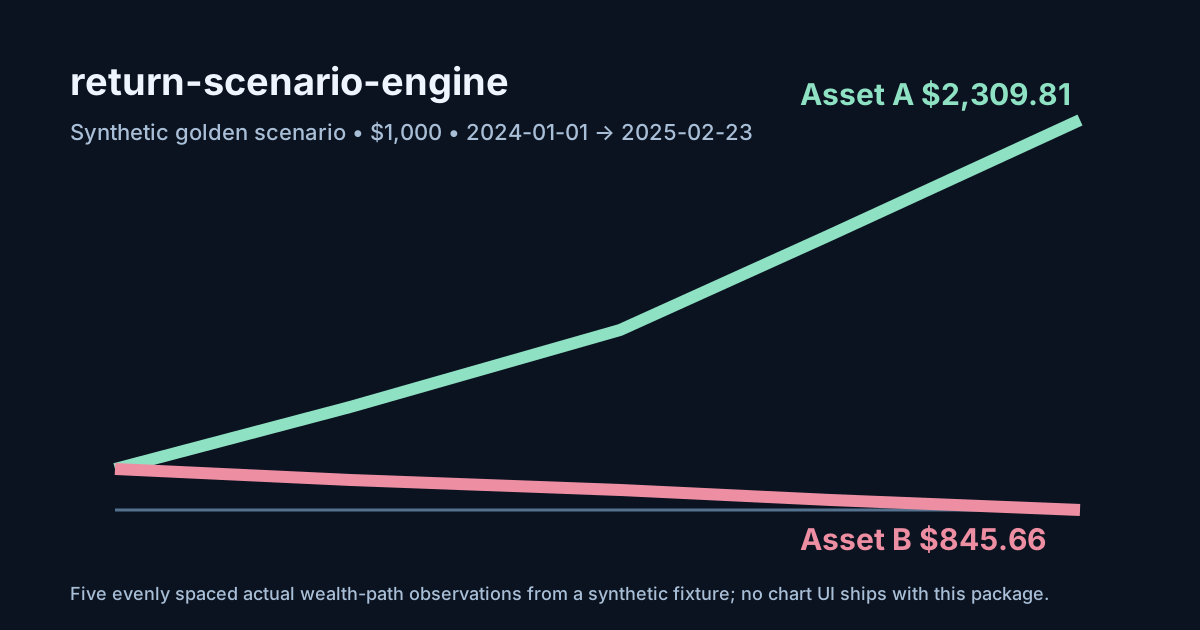
The visual is actual output from the synthetic crypto_crypto_long_window golden case: a $1,000 scenario ends at $2,309.81 for asset A and $845.66 for asset B. This is a headless library, not a chart UI.
Contract and limits
Node.js 20+ and Python 3.11+ are supported. Both 0.1.0 artifacts share the methodology JSON, public SHA-256 hash, and synthetic fixtures. Read return-scenario-v1.json before comparing outputs. The package does not fetch prices, select assets, retain provider data, or implement routes and UI. A partial paired registry upload must be completed or corrected before announcing the version.
Development
npm ci
python -m pip install -e './python[test]'
PYTHON_BIN=python3 npm test
python -m build python
npm test builds a temporary Python wheel and checks every golden scenario against both implementations. Fixtures are synthetic and contain no provider history.
First release
For the first npm release, publish the reviewed tarball interactively with 2FA
and configure npm trusted publishing for .github/workflows/release.yml and
its npm environment. Configure PyPI's pending trusted publisher, then run the
manual release workflow against the existing tag with target pypi to upload
the matching Python artifact. Verify both registries before creating the GitHub
Release. Later releases use the same manual workflow with target both; retry a
single failed side with npm or pypi. Never republish an immutable existing
version or treat a mismatched pair as successful.
Origin
This package was extracted from Gale Finance calculation work. Gale’s launch-bundle formats, UI, routes, analytics, market data, and asset policy stay private. Until migration, it is “extracted from Gale,” not evidence that Gale uses the published artifact.
Early commits reconstruct private-monorepo milestones. Author dates reflect original work; public content and hashes were rewritten to exclude private details. Some early development used Claude as a coding assistant; Sid Kalla selected, reviewed, and maintains this code.
Apache-2.0 covers this code and does not grant rights to Gale Finance branding. See CONTRIBUTING, SECURITY, and AGENT_INTEGRATION.
Maintenance is best effort; the latest release is supported unless its notes say otherwise.