
reviewer-lib
v4.3.0
Published
A library for code review using OpenAI API

Maintainers
 kh_juliett
Readme
Reviewer lib
AI code review powered by OpenAI. Analyze a code snippet or a pull-request diff and get structured, actionable findings — use it as a library, a CLI, or a GitHub Action.
Works with code in any language (Node is only needed to run it).
📖 Documentation — guides, CLI, GitHub Action, recipes, and the API reference.





Installation
Requires Node.js 20+ (the library depends on
openaiv6).
npm install -D reviewer-libUsage
Three ways to use it:
review()— structured findings (severity, file, line, fix). Best for PR comments and CI gates. Recommended.- Text methods (
submitCodeAssistanceMode,optimizeCode,securityAnalysis, …) — plain-text feedback. - CLI & GitHub Action — no code to write (see below).
By default the library uses the OpenAI Chat Completions API with o4-mini — a reasoning
model chosen for the fewest false positives. Pass any chat model as the model argument. Instruct
models (*-instruct) are auto-routed to the legacy Completions API, and reasoning models (o-series,
gpt-5.x) are handled automatically.
Tip: for a cheaper, faster review (with more low-severity noise) pass
gpt-4o-mini(--model gpt-4o-mini).o4-minicosts more per token and adds latency from reasoning tokens, but a PR review is infrequent so the absolute cost stays small.
Structured review (review)
review() returns typed findings instead of free text (chat models only), ready for
inline PR comments or a CI gate — this is the recommended entry point:
import { Reviewer, formatFindings, toReviewComments, hasBlockingFindings } from 'reviewer-lib';

const reviewer = new Reviewer(apiKey); // default model: o4-mini (reasoning; fewest false positives)

// Pass asDiff: true to review a unified diff — findings then carry file + line.
// Optionally hint the language with `language` (e.g. 'typescript', 'python').
const findings = await reviewer.review(diff, { asDiff: true, language: 'typescript' });

console.log(formatFindings(findings));        // markdown summary for a PR comment
const comments = toReviewComments(findings);  // [{ path, line, body }] for GitHub inline comments
if (hasBlockingFindings(findings, 'high')) process.exit(1); // fail CI on high+ severity
Each Finding has: severity (critical | high | medium | low), category,
file, line, message, and suggestion.
Large diffs are reviewed file-by-file (and by hunk for a single oversized file) automatically
and the findings merged (tune the threshold with the maxChunkChars option, default 20000).
Other review() options: filter: true runs a second-pass triage that drops low-value/defensive
findings (use filterModel to judge with a stronger model like gpt-4o while the review stays
cheap); cache: { dir } stores results by content hash to skip re-reviewing unchanged input; and
exclude: string[] drops files matching path globs (the CLI skips lockfiles and dist/ by default).
Free-text review
For plain-text feedback instead of structured findings:
import { Reviewer } from 'reviewer-lib';

const reviewer = new Reviewer(apiKey);
const feedback = await reviewer.submitCodeAssistanceMode(code);
console.log(feedback);
CLI
The package ships a reviewer-lib command, so you can review without writing any glue code
(OPENAI_API_KEY must be set):
# review your working changes locally
git diff origin/main | npx reviewer-lib review --fail-on high

# review a diff file as JSON
npx reviewer-lib review --diff pr.diff --format json

# in CI: fetch a PR diff and post inline comments + a summary
#   (needs GITHUB_TOKEN and GITHUB_REPOSITORY)
npx reviewer-lib review --pr 54 --post --fail-on high
Flags: --diff <file>, --pr <number>, --post, --code, --lang <language>,
--filter, --summary (add a "what changed" overview above the findings), --cache-dir <dir>,
--exclude <globs>, --model <name>, --format text|json, --fail-on <severity>,
--api-key <key>, --timeout <ms>, --max-retries <n>.
Run npx reviewer-lib --help for details.
Use as a GitHub Action
Add AI review to any repository. The action reads the PR diff (no checkout needed) and posts
inline comments plus a summary. Add OPENAI_API_KEY to the repo secrets and give the job
pull-requests: write permission.
Recommended config — request-only (add the ai-review label to a PR, or run it manually),
with the reasoning model, a change overview, a severity gate, and noise excluded:
name: AI code review

on:
  pull_request:
    types: [labeled]        # runs when you add a label (below) — not on every push
  workflow_dispatch:        # …or trigger manually from the Actions tab
    inputs:
      pr:
        description: PR number to review
        required: true

permissions:
  contents: read
  pull-requests: write

jobs:
  review:
    # only run for the "ai-review" label (or a manual dispatch)
    if: github.event_name == 'workflow_dispatch' || github.event.label.name == 'ai-review'
    runs-on: ubuntu-latest
    steps:
      - uses: JuliettKhar/reviewer-lib@v3
        with:
          openai-api-key: ${{ secrets.OPENAI_API_KEY }}
          pr-number: ${{ github.event.inputs.pr || github.event.pull_request.number }}
          model: o4-mini          # reasoning model — fewest false positives (default)
          summary: 'true'         # add a "what changed" overview above the findings
          fail-on: high           # fail the check only on high+ findings
          exclude: '*.md,dist/**,tsconfig.json'   # skip docs/build/config noise
Prefer reviewing every PR automatically? Use on: pull_request: (no types/if) instead of
the label trigger — just note it spends a review on each push.
Inputs: openai-api-key (required), github-token (default ${{ github.token }}),
pr-number (defaults to the event's PR), fail-on, model (default o4-mini; pass gpt-4o-mini
for a cheaper, noisier review), summary ('true' adds a "what changed" overview),
version (reviewer-lib version to run, default latest), exclude (extra comma-separated
path globs to skip; lockfiles and dist/ are skipped by default), app-id + app-private-key
(post comments as your own GitHub App instead of github-actions[bot] — see the
docs).
To trigger it manually instead, use workflow_dispatch and pass pr-number.
Local usage (no CI)
Don't want a pipeline? Run reviews straight from your terminal — no install needed
(npx pulls the package on demand). Set your key once per shell:
export OPENAI_API_KEY=sk-...Review your uncommitted changes:
git diff | npx reviewer-lib reviewTip: pipe
git diff -U30(more context lines) — the reviewer still comments only on the changed lines, but sees more surrounding code, which improves severity accuracy and cuts "missing guard/validation" false positives.
Review a whole branch before opening a PR (everything since main):
git diff main...HEAD | npx reviewer-lib review --fail-on highReview a single file, or get machine-readable output:
git diff -- src/app.ts | npx reviewer-lib review
git diff | npx reviewer-lib review --format json > review.json
Prefer a faster repeat experience? Install it globally: npm i -g reviewer-lib, then
drop the npx. You can also pass the key inline with --api-key instead of the env var.
Optional — review automatically before every push with a git hook. Save as
.git/hooks/pre-push and chmod +x it:
#!/bin/sh
git diff -U30 origin/main...HEAD | npx reviewer-lib review --fail-on high || {
  echo "reviewer-lib found blocking issues — push aborted (use 'git push --no-verify' to override)."
  exit 1
}
API
new Reviewer(apiKey, model?, maxTokens?, modelOptions?, clientOptions?) — creates a Reviewer instance.
Constructor params
apiKey(string): your OpenAI API key.model(string): model to use (defaulto4-mini, a reasoning model with the fewest false positives; passgpt-4o-minifor a cheaper, noisier review). Instruct models (*-instruct) route to the legacy Completions API automatically.maxTokens(number): max tokens for the response (default 1500).modelOptions(object): sampling options sent to the model —temperature,top_p,frequency_penalty,presence_penalty,n,stop.clientOptions(object): reliability —maxRetries(default 3) andtimeoutin ms (default 120000). The SDK retries transient failures (429/5xx) with exponential backoff automatically.
Methods
review(input, options?): structured review →Finding[](chat models only). Options:asDiff,language,maxChunkChars,filter,filterModel,cache. See Structured review above.submitCodeAssistanceMode(code)/submitCode(code): plain-text review (submitCodeuses the legacy Completions API for*-instructmodels).optimizeCode(code),securityAnalysis(code),generateTests(code),generateDocumentation(code),codeStyleRecommendations(code),historicalAnalysis(repoPath): plain-text helpers.getCurrentModels(): list available models.
Helpers (named exports): formatFindings(findings), toReviewComments(findings), hasBlockingFindings(findings, severity).
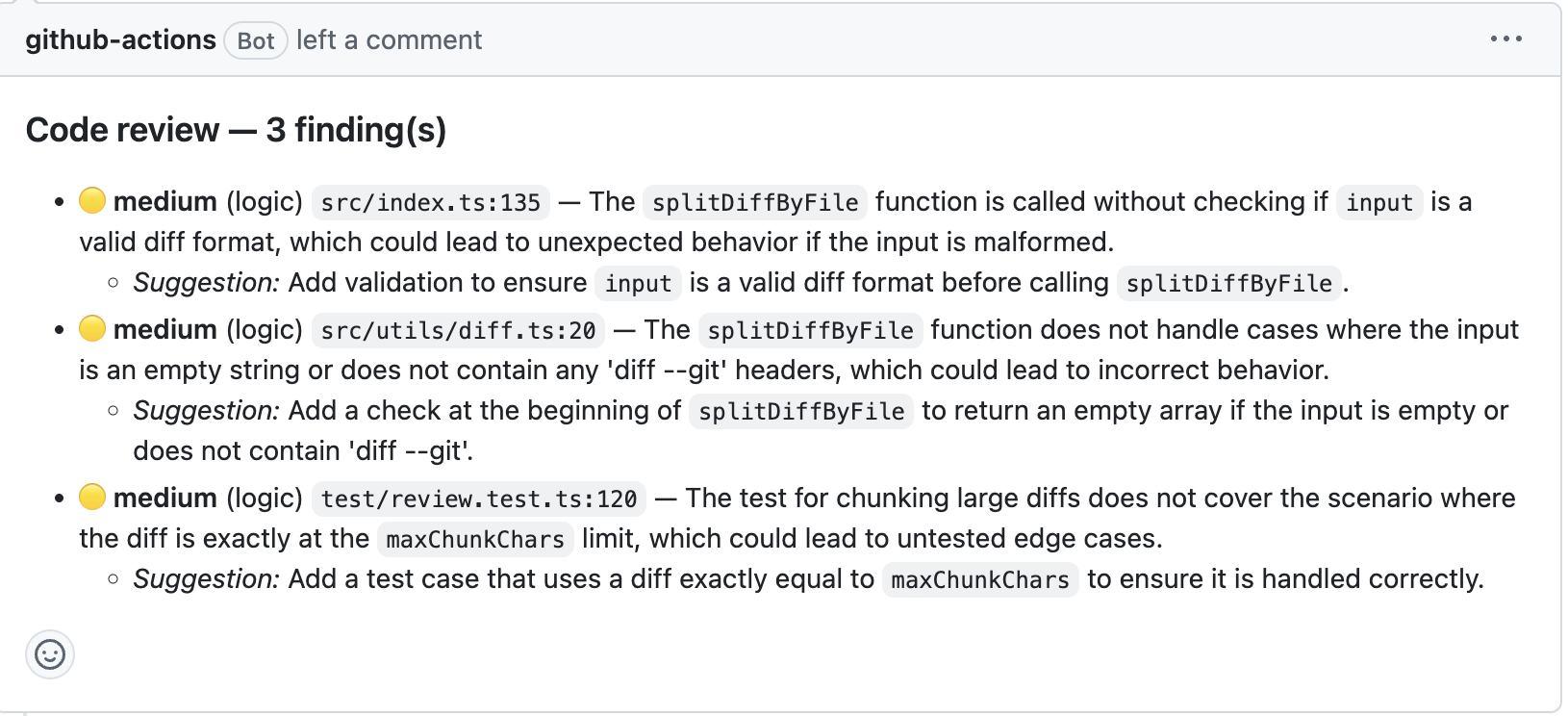
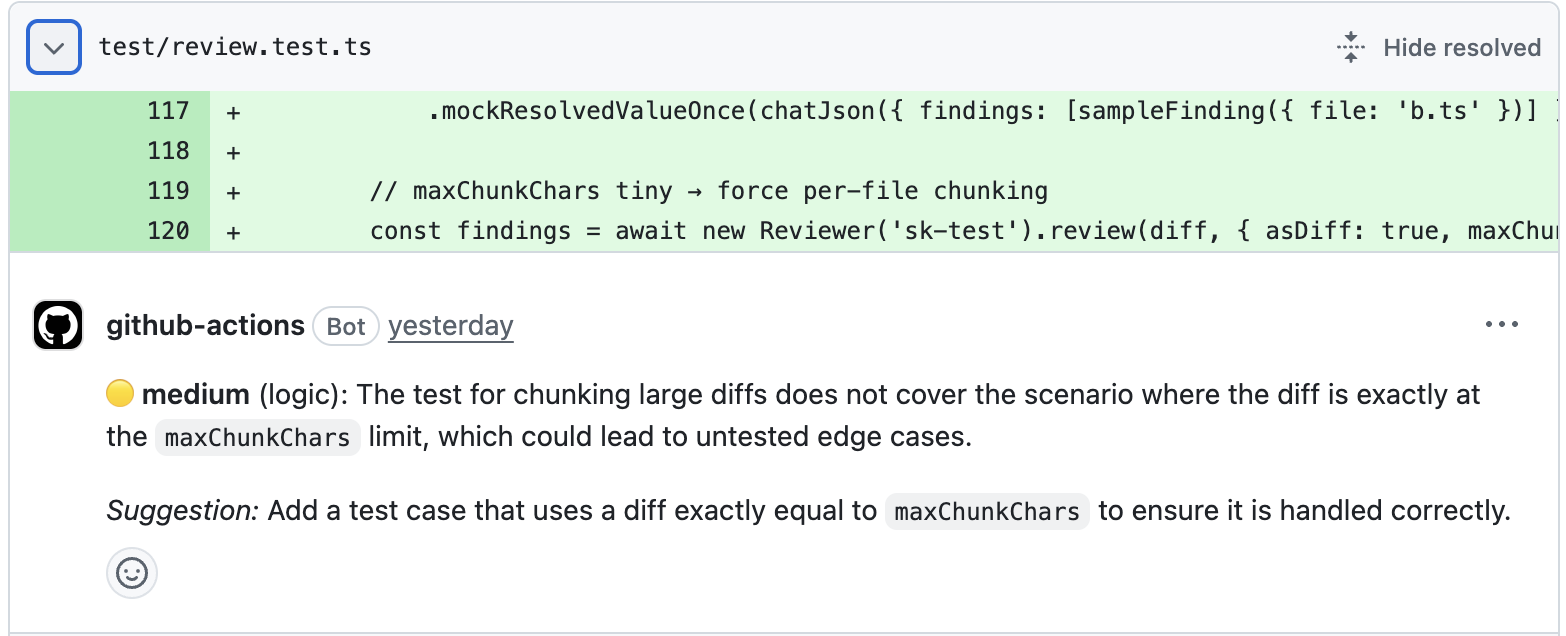
Example — a review posted on a pull request
The review posts a summary of findings plus inline comments on the changed lines:
References
Compatibility
Versions below 3.0.0 (the 1.x and 2.x lines) are deprecated on npm — please use 3.x. The 3.x line requires Node.js 20+ and defaults to the Chat Completions API; see the CHANGELOG for breaking changes and migration notes.