
rockbox-wasm
v0.1.2
Published
Rockbox audio decoders + DSP compiled to WebAssembly — a batteries-included browser player (FLAC/MP3/Vorbis/Opus/ALAC/AAC/WavPack/…, 10-band parametric EQ, live internet radio) with the wasm bundled in.

Maintainers
 tsiry
tsiryReadme
rockbox-wasm
The Rockbox audio decoders and DSP compiled to WebAssembly, wrapped in a small, batteries-included browser player.
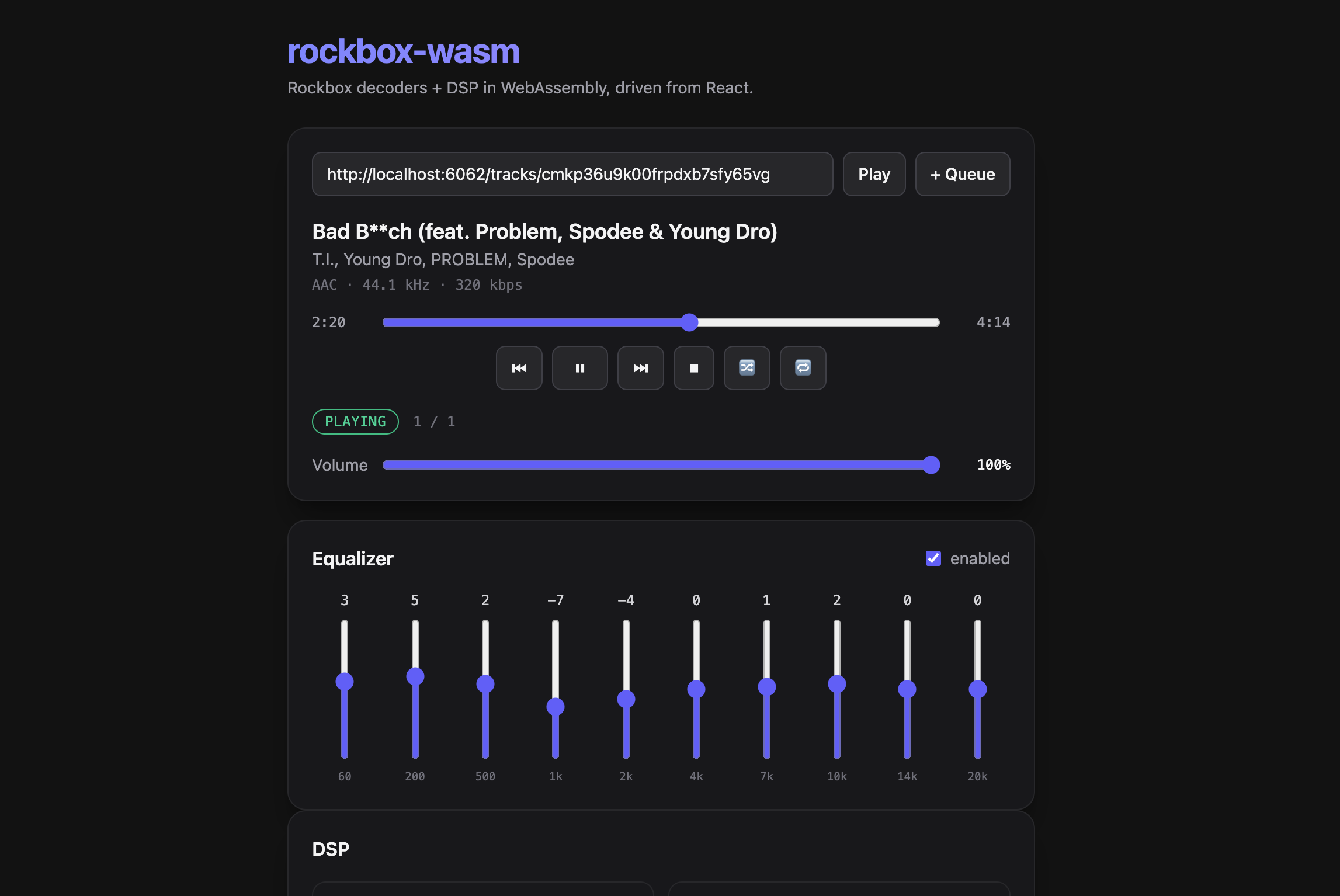
- 🎧 Decodes FLAC, MP3, Vorbis, Opus, ALAC, AAC, WavPack, WMA, APE, Musepack, WAV/AIFF and more — the real Rockbox codecs, not the browser's.
- 🎚️ 10-band parametric EQ, tone controls, ReplayGain, channel mixing, stereo width, crossfeed, PBE, surround and a compressor — the Rockbox DSP chain.
- 🎛️ Rockbox crossfade — the original pcmbuf algorithm (same modes and parameters: fade in/out delay + duration, crossfade/mix) ported to JS.
- 📻 Live internet radio (Icecast/SHOUTcast) with ICY now-playing metadata.
- 📦 The wasm is bundled in — one
npm install, nothing to download or serve separately. - ✅ No special server headers — single-threaded, so no
SharedArrayBufferand no COOP/COEP configuration. - 🧩 Framework-agnostic: a tiny
RockboxPlayerclass over Web Audio.
import { RockboxPlayer } from "rockbox-wasm";

const player = new RockboxPlayer();
await player.init();                       // call from a click
player.setQueue(["https://example.com/song.flac"], true);
Install
npm install rockbox-wasm
# or: pnpm add rockbox-wasm / yarn add rockbox-wasm / bun add rockbox-wasm
Serving the assets
The package ships four files under dist/ — the ESM facade, the wasm-embedded
core, the decoder worker and the audio worklet. The worker and worklet are
loaded at runtime, so they need to be reachable by URL. Two easy options:
1. baseUrl (works with any setup)
Copy node_modules/rockbox-wasm/dist/ into a folder your server serves
(e.g. public/rockbox/) and point the player at it:
const player = new RockboxPlayer({ baseUrl: "/rockbox" });// package.json — keep the copy in sync
"scripts": {
"postinstall": "cp -r node_modules/rockbox-wasm/dist public/rockbox"
}2. Let your bundler resolve them
With no baseUrl, the URLs resolve as siblings of the loaded module via
import.meta.url. Modern bundlers (Vite, webpack 5) emit the worker/worklet as
assets automatically. If a bundler doesn't, fall back to baseUrl.
3. From a CDN (no build step)
<script type="module">
  import { RockboxPlayer } from "https://esm.sh/rockbox-wasm";
  const player = new RockboxPlayer({
    baseUrl: "https://esm.sh/rockbox-wasm/dist",
  });
</script>
Quick start
import { RockboxPlayer } from "rockbox-wasm";

const player = new RockboxPlayer({ baseUrl: "/rockbox" });

document.querySelector("#play").addEventListener("click", async () => {
  await player.init();                    // boots on the user gesture
  player.setQueue(["/audio/song.flac"], /* autoplay */ true);
});

player.on("progress", (p) => console.log(`${p.elapsed_ms} / ${p.duration_ms} ms`));
player.on("track", (t) => console.log("now playing:", t.metadata?.title ?? t.url));
init()(and the firstplay()) must be reachable from a user gesture — browsers won't start anAudioContextotherwise.
There's a full React + TypeScript + Vite + Tailwind example in
example/ — all controls (transport, EQ, the whole DSP chain)
with settings persisted to localStorage via jotai.
Live radio
Queue a stream URL — no Content-Length is detected as a live stream, decoded
continuously, and reported with live: true and (when the station exposes it
over CORS) the ICY StreamTitle as now-playing metadata.
player.setQueue(["https://ice.example.com/stream.mp3"], true);
player.on("track", (t) => {
  if (t.live) console.log("📻", t.metadata?.artist, "–", t.metadata?.title);
});
API
Constructor
new RockboxPlayer({
  baseUrl?,                       // where the dist files are served from
  coreUrl?, workletUrl?, workerUrl?,   // or override each individually
})
Lifecycle & transport
| Method | Description |
| ----------------------------------- | ------------------------------------------ |
| await init() | Boot the audio graph + worker (from a click) |
| setQueue(urls, autoplay?) | Replace the queue |
| enqueue(url) / clearQueue() | Append / empty the queue |
| insert(urls, mode?, index?) | Rockbox insertion modes: InsertMode.PlayNext\|.PlayLast\|.Insert\|.Prepend\|.InsertShuffled\|.InsertLastShuffled\|.Replace\|.AtIndex |
| removeAt(i) | Remove a queue entry (current → hard-cut to slide-in) |
| play() pause() toggle() stop() | Transport |
| next() prev() skipTo(i) seek(ms) | Navigation |
| setShuffle(bool) | Toggle shuffle |
| setRepeat(mode) | RepeatMode.Off | .One | .All |
| setVolume(0..1) | Output volume (Web Audio gain) |
DSP / equalizer
| Method | Notes |
| --------------------------------------------------- | ---------------------------------- |
| setEqEnabled(bool) | 10-band parametric EQ |
| setEqBand(band, cutoffHz, q, gainDb) | band 0–9; gain/Q in plain units |
| setEqPrecut(db) | headroom before the EQ |
| setTone(bassDb, trebleDb) | shelving tone controls |
| setReplaygain(mode, noclip, preampDb) | ReplayGainMode.Off\|.Track\|.Album\|.Shuffle |
| setChannelMode(mode) / setStereoWidth(pct) | ChannelMode.Stereo\|.Mono\|… |
| setSurround(delayMs, balance, fx1, fx2) | Haas surround |
| setCompressor(thr, makeup, ratio, knee, rel, atk) | dynamic-range compressor |
| setCrossfade(mode, opts?) | CrossfadeMode.Off\|.AutoSkip\|.ManualSkip\|.Shuffle\|.ShuffleOrManualSkip\|.Always; opts: fade in/out delay + duration (s), mixMode |
Settings-value enums are exported (and each setter also accepts the raw int):
import { RockboxPlayer, RepeatMode, ReplayGainMode, ChannelMode } from "rockbox-wasm";

player.setRepeat(RepeatMode.All);
player.setReplaygain(ReplayGainMode.Album, /* noclip */ true, /* preamp dB */ 0);
player.setChannelMode(ChannelMode.Mono);
RockboxPlayer.EQ_BAND_CUTOFFS gives the 10 default band centre frequencies.
DSP/EQ settings persist to localStorage and re-apply on the next init().
M3U playlists
loadM3uUrl(url, autoplay?) / enqueueM3uUrl(url, mode?) fetch and load an
.m3u/.m3u8 into the queue (relative entries resolve against the playlist
URL); loadM3u(text, opts?) / enqueueM3u(text, opts?) work from text;
exportM3u() returns the queue as .m3u8 text; statics parseM3u,
serializeM3u, isM3uUrl for raw playlist handling.
Events
player.on(event, cb) / player.off(event, cb):
| Event | Payload |
| ---------- | --------------------------------------------------------------- |
| status | { state, index, queue_len, shuffle, repeat } |
| track | { index, url, live, metadata } |
| progress | { state, index, live, elapsed_ms, duration_ms, metadata } |
| queue | { urls, index } |
| error | { message, index? } |
state is "stopped" | "playing" | "paused"; repeat is a RepeatMode. Full
types ship in index.d.ts.
Supported formats
Everything in Rockbox's default codec set: FLAC, MP3, Ogg Vorbis, Opus, ALAC, AAC, WavPack, WMA / WMA Pro, Monkey's Audio (APE), True Audio (TTA), Musepack, Speex, AC3, ADX, and the WAV / AIFF / AU / ADPCM family.
Sources are http(s):// URLs (subject to CORS) or same-origin files.
How it works
your code ── RockboxPlayer ──▶ AudioContext + GainNode (volume)
                  │  postMessage
                  ▼
          decoder Worker  ── rockbox-core.wasm (codecs + DSP + metadata)
                  │  PCM via a MessagePort
                  ▼
             AudioWorklet ──▶ speakers
The worker decodes synchronously off the main thread and streams PCM to the
AudioWorklet over a MessagePort. Because there are no wasm threads and no
SharedArrayBuffer, the page needs no COOP/COEP headers. The .wasm is
embedded in rockbox-core.js (Emscripten SINGLE_FILE), so there's no separate
binary to fetch or serve.
Notes & limitations
- Live streams aren't seekable and report
duration_ms: 0. - Volume is a Web Audio
GainNode, not a Rockbox DSP stage. - ICY now-playing metadata only appears when the station allows it over CORS.
License
GPL-2.0-or-later — the compiled sources are Rockbox firmware code.
Built from the rockboxd
bindings/wasm package.