
rowstore
v0.1.6
Published
An in-memory row store that decides its own indexes by watching the queries you actually run. No index declarations, no configuration: it counts predicate shapes, builds an index the moment the arithmetic says it pays, maintains it incrementally through m

Maintainers
 destbreso
Readme
rowstore
An in-memory collection that decides its own indexes by watching the queries you actually run.
There is no ensureIndex. You hand it rows and ask questions; it counts which
predicate shapes come back, builds the access path the moment the arithmetic
says the loan repays, keeps it correct incrementally through mutations, and
tells you exactly what it did and why.
Every row carries a numeric _id, which is how the store addresses it. A row
without one, or a second row reusing one, is refused at the door rather than
quietly overwriting its neighbour.
import { RowStore } from "rowstore";

const rows = [
  { _id: 1, status: "open", score: 120 },
  { _id: 2, status: "closed", score: 80 },
];

const store = new RowStore(rows);

store.find({ status: "open" });                       // scans, and takes note
store.find({ status: "closed" });                     // builds a hash index, uses it
store.find({ status: "open", score: { gte: 100 } });  // and keeps going

store.stats();   // what it built, when, what it cost, what it saved
Install
npm install rowstoreZero runtime dependencies. TypeScript declarations, ESM and CommonJS, Node 18 and up.
How well does it guess
Measured by rowtoll, which counts field
reads through the records themselves and checks every answer against
Array.prototype.filter. The reference it is measured against is the best index
set that exists for each workload, found by exhaustive search, with a planner
that was handed the true selectivity of every predicate. It is allowed to know
the future. This is not.
Building on first sight (buildAfter: 1), it matches that optimum exactly on
22 of 24 workloads, mean 1.09x, worst 2.24x.
| where it loses | ratio | why |
|---|---|---|
| conjunct | 2.24x | it indexes all three repeated shapes; the optimum needed one |
| hash-trap | 2.00x | equality queries arrive first, so it builds a hash where the sorted index later covers both |
Both are the same thing: the offline optimum saw the whole workload before choosing. Neither is a bug to be fixed by a cleverer heuristic, and pretending otherwise would mean guessing, which is the one thing this store does not do.
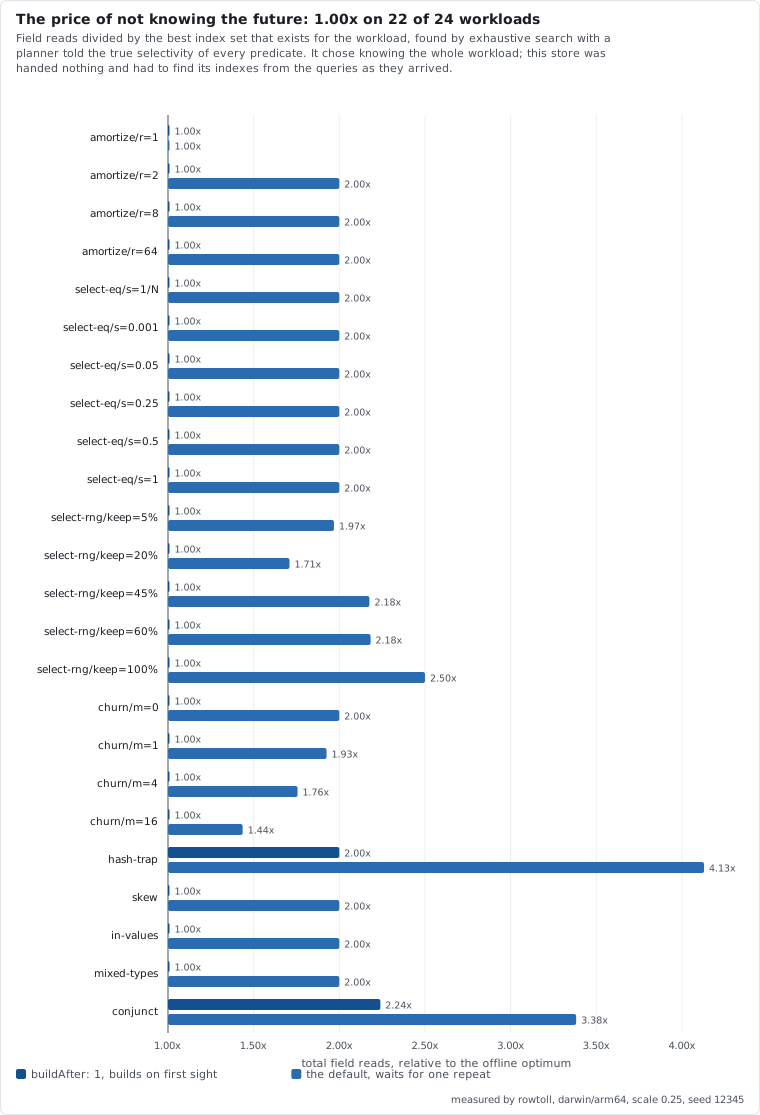
The default waits for a shape to repeat, and that wait is the whole difference:
mean 2.09x, worst 4.13x on hash-trap, exactly one unindexed pass per shape more
than the eager arm on every workload. The next section is why that trade is the
default anyway, and one line changes it. Both arms are in the table in
BENCHMARKS.md, workload by workload, alongside four other
engines.
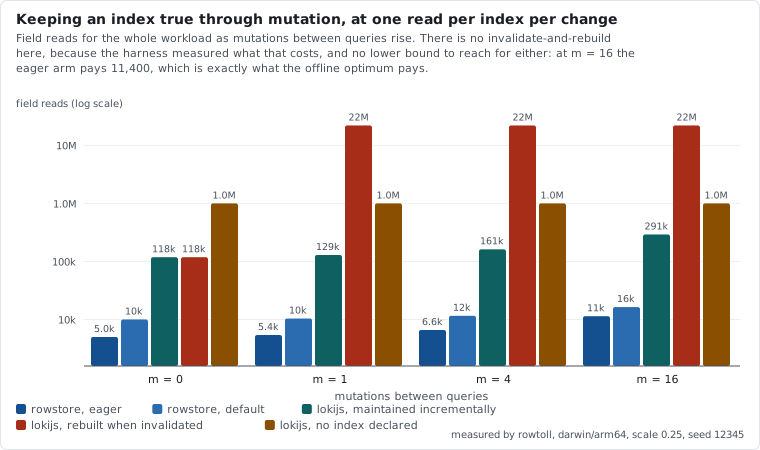
Against the incumbent, on the axis where the harness found the most loss
available. This is churn/m=16: 5,000 rows, 200 equality queries, and sixteen
insert-and-remove pairs between each of them, so 6,400 mutations in all.
| engine | field reads | queries/s | run to run |
|---|---:|---:|---:|
| rowstore, eager | 11,400 | 158,249 | +/- 23.9% |
| rowstore, default | 16,368 | 138,237 | +/- 4.6% |
| lokijs, index maintained incrementally | 291,388 | 6,944 | +/- 1.8% |
| lokijs, index rebuilt when invalidated | 21,981,027 | 387 | +/- 0.6% |
| lokijs, no index declared | 1,000,000 | 12,978 | +/- 2.6% |
| Array.prototype.filter | 1,000,000 | 18,769 | +/- 4.7% |
11,400 is also the offline optimum for that workload, so under mutation the
eager arm pays exactly what perfect foresight pays. Reads are exact and
reproducible from the seed. The clock column is a median over seven separate
processes, with the spread between them beside it, and the harness orders two
engines only when every one of those processes agreed on the direction. It
orders 27 of the 28 pairs in that table. The one it refuses is the two
rowstore arms against each other: the reads separate them by 4,968 and the
clock does not separate them at all.
Why the threshold is two
Building a hash index over a field reads every value once. That is exactly what the full scan it replaces reads. So on reads alone, building on first sight is weakly dominant: one query costs a pass either way, and every query after it is free. There is no crossover to find, not even at 100% selectivity, where an index still reads no record at all.
This store waits for the second sighting anyway, and the reason is the part reads cannot see. An index costs memory, and it costs maintenance on every mutation, and it has no instrument for either. One repeat is the cheapest possible evidence that a shape belongs to the workload rather than being a one-off, and the price of asking for it is exactly one unindexed pass, paid once per shape.
That price does not amortize, and the measurement says so plainly: where the
optimum's whole cost is a single build pass, one extra pass is 2.00x whether two
queries follow or two hundred. It is smaller only where the optimum has to read
rows anyway (down to 1.44x under heavy mutation) and larger where the wait
happens twice on one field (4.13x on hash-trap). Against no index at all, which
is the alternative in most real code, the same store is still ahead by a factor
that grows with every query.
new RowStore(rows, { buildAfter: 1 });   // build on first sight
new RowStore(rows, { buildAfter: 10 });  // be stingier
new RowStore(rows, { scanOnly: true });  // never build anything
The number of times a shape has been seen is the only input to the decision. Not a cost model, not an estimated selectivity. This store never decides anything using a number it made up about itself.
An index may never change the answer
This is the failure the package exists to avoid, and it is not hypothetical.
lokijs answers $in from its binary index without re-verifying the candidates,
and computes that index's range with type-loose comparators. Ten rows, five
holding the number 2 and five holding the string "2", and one query:
col.find({ $and: [{ v: { $in: [2] } }] });   // 5 rows
col.ensureIndex("v");
col.find({ $and: [{ v: { $in: [2] } }] });   // all 10, and nothing changed but the index
Reported as issue #909 in March 2022, still open, the only reply a stale bot. The
harness reproduces it on its own, from outside: on the mixed-types workload both
indexed lokijs arms fail the correctness gate and print no toll at all, because a
number for the wrong answer is not a slower or faster number, it is a number
about a different question.
For a collection that decides on its own when to build, that class of defect is worse than a wrong answer: it is a wrong answer that appears only after the workload has warmed up, on the thousandth call, with nothing having changed.
So every structure here implements exactly the comparison the language does.
- Equality is
===and membership isArray.prototype.includes, which differ on exactly one value:NaN. AMapuses SameValueZero, which is whatinwants and whateqmust be guarded against, so{ v: NaN }matches nothing and{ v: { in: [NaN] } }matches the NaN row, indexed or not. - A range compares numbers. Strings, booleans and
NaNare false against every bound, so the ordered index holds only the numeric values, and what it excludes is exactly what a range can never match. The exclusion is the semantics, not an approximation that needs re-checking. - Where a structure cannot implement the comparison, it refuses to exist and says
so in
stats().refused.
The test suite asks every query cold, then repeatedly until an index has been built, then again, and requires the same answer every time.
What it tells you
// 200,000 rows, 1,000 distinct values in `status`, 200 equality queries on it.
store.stats();
// {
//   rows: 200000,
//   indexes: [{ field: "status", kind: "hash", distinct: 1000, entries: 200000,
//               builtAfter: 2, buildCost: 200000, saved: 39760200 }],
//   shapes:  [{ field: "status", op: "eq", seen: 200,
//               estimatedSelectivity: 0.001, observedSelectivity: 0.001 }],
//   queries: 200, reads: 400000, refused: []
// }
estimatedSelectivity is this store's own claim about itself, computed as
1/distinct, which is the uniformity assumption every textbook optimizer starts
from. It is published so that it can be checked, and it does not survive the
check. On the harness's skewed column, 500 declared values under a Zipf
distribution of which 422 actually occur, the estimate says 0.24% for every one
of them. The hottest really selects 19.1% of the rows, and the rare value the
panel's queries alternate with selects 0.04%: wrong by 80x in one direction and
6x in the other, on the same field, in the same query shape. The rarest value
that occurs at all is one row in five thousand, where it is 12x too high. There
is a test that pins the first two, because a caveat nothing measures is
decoration.
It is not used to plan anything. The driving access path is chosen from the
posting list's exact size, which needs no assumption at all, and residual
predicates are ordered by observedSelectivity, which is not an estimate either:
it is the fraction of the rows a predicate was actually applied to that actually
survived it.
Mutation
insert, remove and update all keep every index true, incrementally, at one
read per index per mutation. There is no invalidate-and-rebuild, because the
harness measured what that costs: on the workload in the table above, a lokijs
configured that way pays 21,981,027 field reads where this store pays 11,400, and
answers 387 queries a second where this one answers 158,249.
Change rows through the store. An index holds the values it read when it was built, so mutating a record in place behind the store's back leaves the index describing a row that no longer exists. Every database has this property; this is why they all make you go through the writer.
The query language
type Condition = { eq?, in?, lt?, lte?, gt?, gte? };
type Query = Record<string, FieldValue | Condition>;   // implicit AND
store.find({ status: "open" });
store.find({ status: { in: ["open", "pending"] }, score: { gte: 100, lt: 500 } });Small on purpose. It is the surface where choosing an access path is a real
decision and nothing beyond it: a collection that also had to be a query engine
would be competing with sift and mingo, which are 6.5M and 250k weekly
downloads of solved problem. An unknown operator throws with its own name in the
message rather than being quietly ignored.
API
new RowStore(rows?, options?)rows is any iterable of records, each with a numeric _id. options takes
buildAfter (sightings of a predicate shape before its index is built, default
2) and scanOnly (never build anything, so the store is a scan and a bookkeeper).
| method | returns | |
|---|---|---|
| find(query) | number[] | the ids that match, planned |
| findOne(query) | Row \| undefined | the same plan, stopped at the first hit |
| get(id) | Row \| undefined | by id, no plan involved |
| insert(row) | void | throws on a missing or duplicate _id |
| update(id, patch) | boolean | false if there is no such row |
| remove(id) | boolean | false if there is no such row |
| size | number | rows held |
| stats() | Stats | see below |
find answers with ids rather than records so that a caller who wants a count,
a membership test or a join key does not pay for materializing rows it will
throw away. Use get for the ones you want.
stats() returns { rows, queries, reads, indexes, shapes, refused }. reads
is the store's own count of field reads, which is a self-report and not
evidence: the number this package is measured on comes from
rowtoll, from outside. refused
lists the fields an index was declined on with the measured reason, which is
usually the more interesting half.
HashIndex and SortedIndex are exported for anyone who wants the access paths
without the planner.
When not to use this
Your query shapes are known and stable. Then you know your indexes better
than any counter does, and a plain Map keyed the way you always query is
faster than this and simpler than this. The whole argument here is about not
knowing, so if you know, this is machinery you are paying for and not using.
You need a query language. No or, no regular expressions, no sort, no
projection, no aggregation, no joins. Equality, membership and ranges under an
implicit and, and nothing else, because that is the surface where choosing an
access path is a real decision. sift and
mingo implement the MongoDB query
language over plain arrays and are the right answer when you want one.
You want a database. lokijs gives
you persistence, collections, transactions, events and a much larger surface.
This is a collection that indexes itself; it does not want to be your storage
layer.
You need to know what memory it costs. It cannot tell you. The number it optimizes is field reads, and an index that halves your reads and doubles your resident size looks free here. That is the honest boundary of the axis, stated in full under what the toll cannot see.
License
MIT