
rozenite-i18n-devtools
v0.2.3
Published
Runtime i18n inspector for React Native DevTools — missing keys, per-locale coverage, and live locale switching.

Maintainers
 sbaiahmed1
Readme
rozenite-i18n-devtools
Runtime + static i18n inspector for React Native DevTools, via Rozenite. i18next first; the adapter interface is library-neutral.
Status: 0.2.0 — device-verified end to end on an Expo SDK 57 / RN 0.86.3 iOS simulator.
67 tests, clean typecheck, production stripping verified against a real expo export bundle.
See Verified and Not yet proven at the bottom — this README does not claim more than has
been run.
The panel
One screen answers the two questions you actually bring to a devtool:
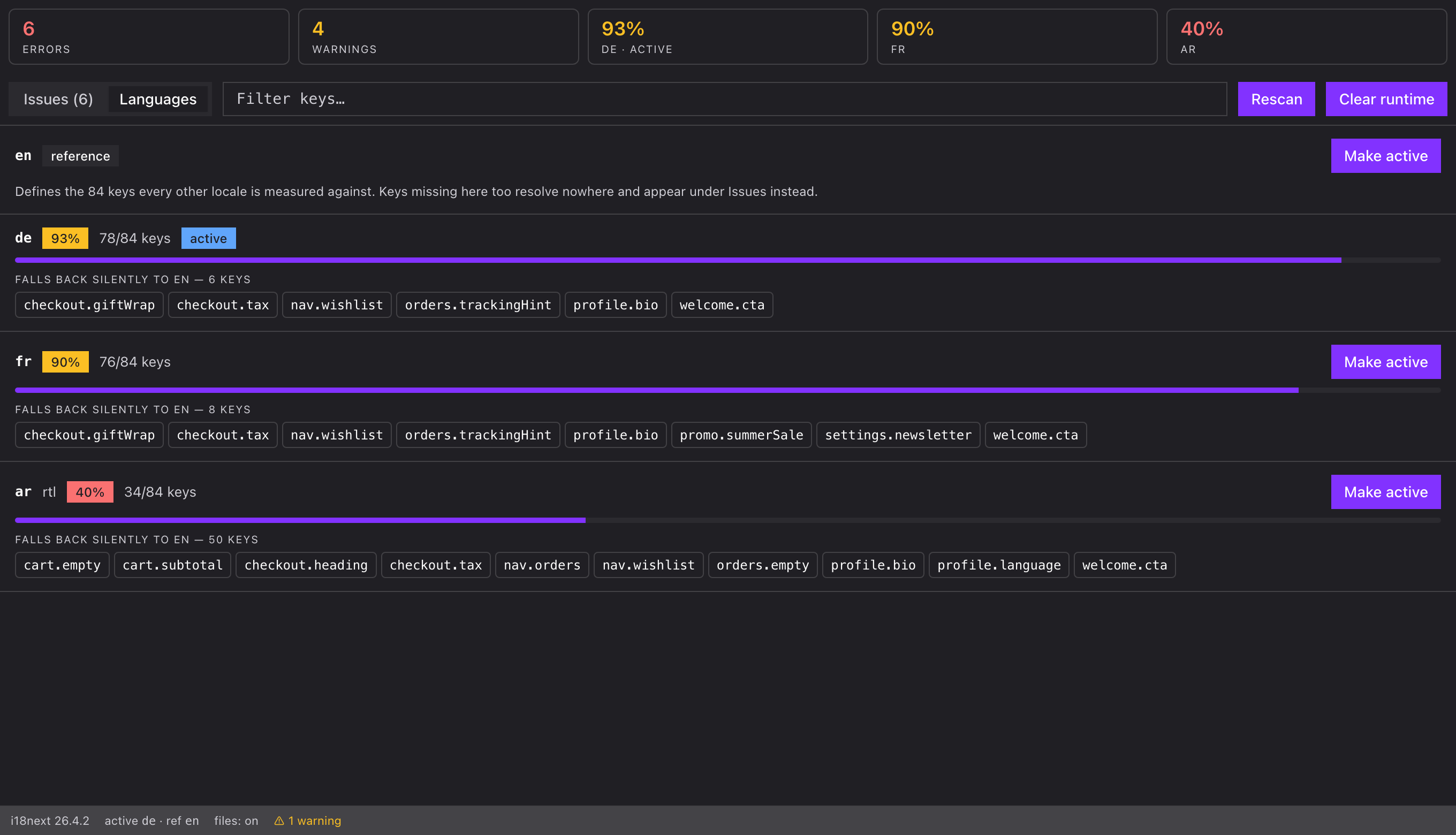
- Scorecard (always visible) — error count, warning count, one tile per locale with its coverage. The tiles navigate: errors/warnings jump to Issues, a locale jumps to Languages.
- Issues — what's broken. One merged list of every finding, runtime and static,
deduplicated by key, with filter chips (
Missing · Variables · Hardcoded · Stale). Each row carries evidence badges:runtime(the running app hit it),files(the scan found it on disk), or both — both at once is the highest-confidence finding the panel can make. - Languages — how translated is each locale. Per-locale blocks with a coverage bar, the keys that silently fall back to the reference, and a locale switcher.
- Status footer — adapter, active/reference locale, whether file checks are on, and any setup warnings. One line; no banners.
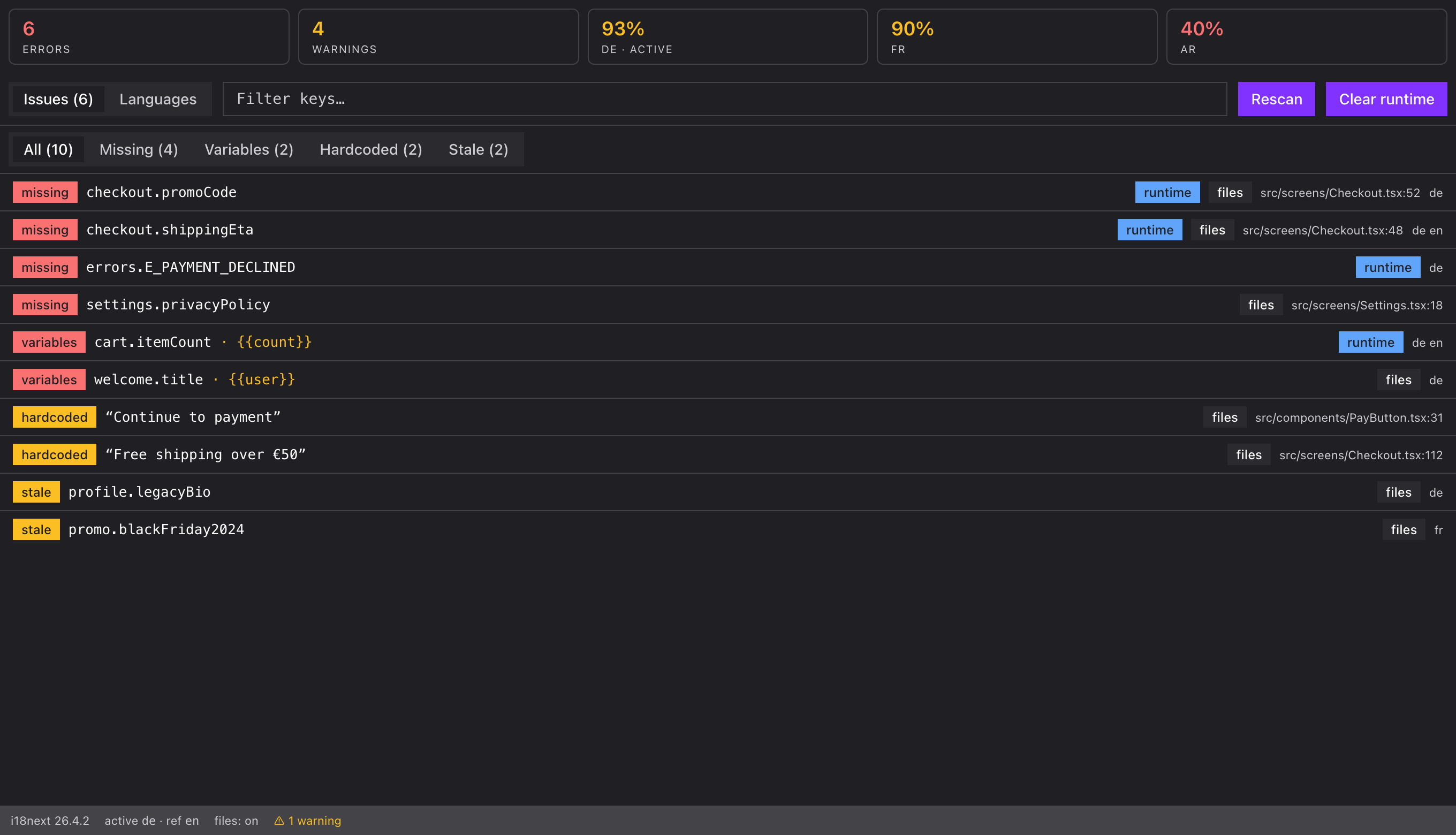
Clicking any row opens a detail pane: per-locale values, which locale the resolution chain actually lands on, variables, and where the key is used in code.
What it catches
| Finding | Severity | Detected by |
|---|---|---|
| Key used in code that resolves in no locale | error | runtime + files |
| Dynamic key (t(`x.${y}`)) that resolves nowhere | error | runtime only — the scan cannot see it |
| Key on a screen nobody opened, absent from the JSONs | error | files only — runtime never saw it |
| {{variable}} never supplied at render | error | runtime |
| {{variable}} renamed or dropped in a translation | error | files |
| Locale JSON that does not parse | error | files |
| Hardcoded JSX text that never goes through i18n (heuristic) | warning | files |
| Stale key present in a locale but not in the reference | warning | files |
| Keys that silently fall back to the reference locale | Languages tab | runtime + files |
The two detectors are complements, not alternatives: the scan covers screens nobody has opened, the runtime covers dynamic keys the scan cannot verify.
Three findings deserve their own line, because nothing else reports them:
- Silent fallbacks are not "missing" to i18next. A key absent in German but present in
English resolves, renders English, and emits no event. It is the most common i18n bug
("why is this screen in English?") and it is invisible to
debug: true. The Languages tab counts exactly these — deliberately kept out of Issues, because they are translation debt, not code bugs, and would repeat once per locale. - Interpolation misses are invisible even with
debug: true. The warning sits behindelse if (skipOnVariables), andskipOnVariablesdefaults totrue, so it never fires. - Missing keys ARE logged by
debug: true(i18next.js:680). On that finding this panel is aggregation, not revelation: dedup, locale sets, persistence, search. If console output is enough for you, use that.
Rows appear as screens render — navigating checks every key the screen requests, no tapping required. Only keys behind a tap or a condition wait for that to happen.
Install
npm install --save-dev rozenite-i18n-devtools// App.tsx
import i18n from './i18n';
import { createI18nextAdapter, useRozeniteI18nPlugin } from 'rozenite-i18n-devtools';
const adapter = createI18nextAdapter({ i18n });
export default function App() {
useRozeniteI18nPlugin({ adapter }); // no-op in production
return <RootNavigator />;
}That enables the runtime side. For the file checks, add one wrapper in metro.config.js
(your locale files live on your machine, so only Metro can read them):
const { withRozeniteI18nScan } = require('rozenite-i18n-devtools/metro');

module.exports = withRozeniteI18nScan(config, {
  locales: './src/locales',  // <lng>.json files, or <lng>/<ns>.json folders
  src: './src',              // omit to skip the source checks
  ref: 'en',
});
It composes with withRozenite in either order. Without it the footer says file checks are
off and the runtime findings work as before.
How it avoids breaking your app
A devtool that corrupts dev builds is worse than no devtool. Every hook was chosen for non-interference, and each choice is covered by a test.
| We do NOT | Because |
|---|---|
| assign missingKeyHandler | It is the if to backendConnector.saveMissing's else if. Setting it silently disables your app's own missing-key reporting. We subscribe to the missingKey event instead, which is emitted unconditionally after both branches. |
| install missingInterpolationHandler | It displaces the skipOnVariables branch, whose continue skips the escape step. Even returning the identical match[0] renders {{a<b}} as {{a<b}}. We use a postProcessor that returns the value unchanged and scans it instead. |
| enable saveMissing when a backend can write | That would POST every missing key to your translation service. We detect backend.create and refuse, with a warning in the footer. |
| call t() for panel reads | t() re-enters the code that emits missingKey and calls saveMissing — a panel probing keys would fabricate rows in its own feed and POST junk. We walk the resource store directly. |
Everything we touch is restored on unmount.
Performance
Snapshot pushes are coalesced (400ms; snapshotDebounceMs on the hook). Feed flushes are
deduplicated and batched on the device (250ms; flushMs). If the panel still feels heavy on
a very large app, the next knob is trackInterpolation: false on the adapter, which removes
the per-t() postProcessor entirely.
Known limitations
- If your app defines its own
missingInterpolationHandler, it replaces the token before we can see it, so interpolation misses are under-reported. The panel says so rather than staying quiet. saveMissingTodefaults to'fallback', so i18next reports misses against the fallback locale. We capture and display the locale your app was actually showing.- The hardcoded-text check is a heuristic (JSX text nodes). Expect false positives; they are warnings, not errors, for exactly that reason.
- Live translation editing is not implemented. Rozenite issue #407 silently drops non-BMP characters host→device, and PR #408 was closed unmerged. The read path is unaffected; the locale switcher sends ASCII only.
- i18next only, today.
i18n-jshas no event emitter and nosaveMissing, so the feed cannot be built on it. The adapter interface is library-neutral so another can be added.
Compared to what you already have
debug: true— logs missing keys, but no dedup, no locale sets, gone on reload, and silent about both fallbacks and interpolation.- i18n Ally (VS Code) — better than this at everything static: it reads your locale files and lets you edit them. It cannot see runtime state: which locale is active, what actually got requested, what fell back.
Use both. They do not overlap.
Development
pnpm install
pnpm --filter rozenite-i18n-devtools test       # 67 tests
pnpm --filter rozenite-i18n-devtools typecheck
pnpm --filter rozenite-i18n-devtools build      # stop Metro first — see below
node spikes/m0-i18next-probe.mjs                # re-run on every i18next major
Do not run
rozenite buildwhile Metro is running. The build emptiesdist/first, Metro has theexportspath cached, and the app dies with "main has not been registered" mid-build.
Verified
- Production stripping.
expo exportof the example app was grepped for every string unique to the real adapter (__rozeniteI18nDevtoolsPristine, the warning texts, the postProcessor name). All absent; only the no-op stub ships. This is the one that matters — a leak would meansaveMissingwriting to a production resource store. - The full panel loop on an iOS simulator: scorecard, the merged Issues list with both evidence sources, Languages, locale switching, detail panes, clear/rescan, the footer.
- No store pollution.
BackendConnector.saveMissingends with an unguardedstore.addResourceoutside itsif (this.backend?.create)check — enabling the flag mutates your translations. The adapter takes the other branch; a test asserts the reference locale's key count is unchanged after a miss. - StrictMode / Fast Refresh. Instrumentation is refcounted across subscribers and restores pristine state on the last unsubscribe; mount → cleanup → mount cycles do not disable capture. Found on a device, not by the suite — then locked in by regression tests.
- Namespaces, including a lazily-loaded namespace being excluded from coverage as "unknown" rather than counted as untranslated.
Not yet proven
- postProcessor cost. It runs on every
t()call — a substring check, and a regex only when{{is present. Never measured on a heavy list screen. - Real multi-namespace apps. Namespace handling is unit-tested and demo-verified only; no production app with lazy-loaded namespaces has been run against it.
License
MIT