
rulereceipt
v0.1.108
Published
Did it push straight to main? Touch a file you told it never to? RuleReceipt checks the finished session against your CLAUDE.md / AGENTS.md rules and marks each followed, broken, or can't-tell, with the exact line as proof. Reads sessions from Claude Code

Maintainers
 shilparpns
Readme
RuleReceipt



Did it push straight to main? Touch a file you told it never to? RuleReceipt checks the finished session against your rules file (CLAUDE.md, AGENTS.md, .cursor/rules) and marks each rule followed, broken, or can't tell — with the exact line as proof.
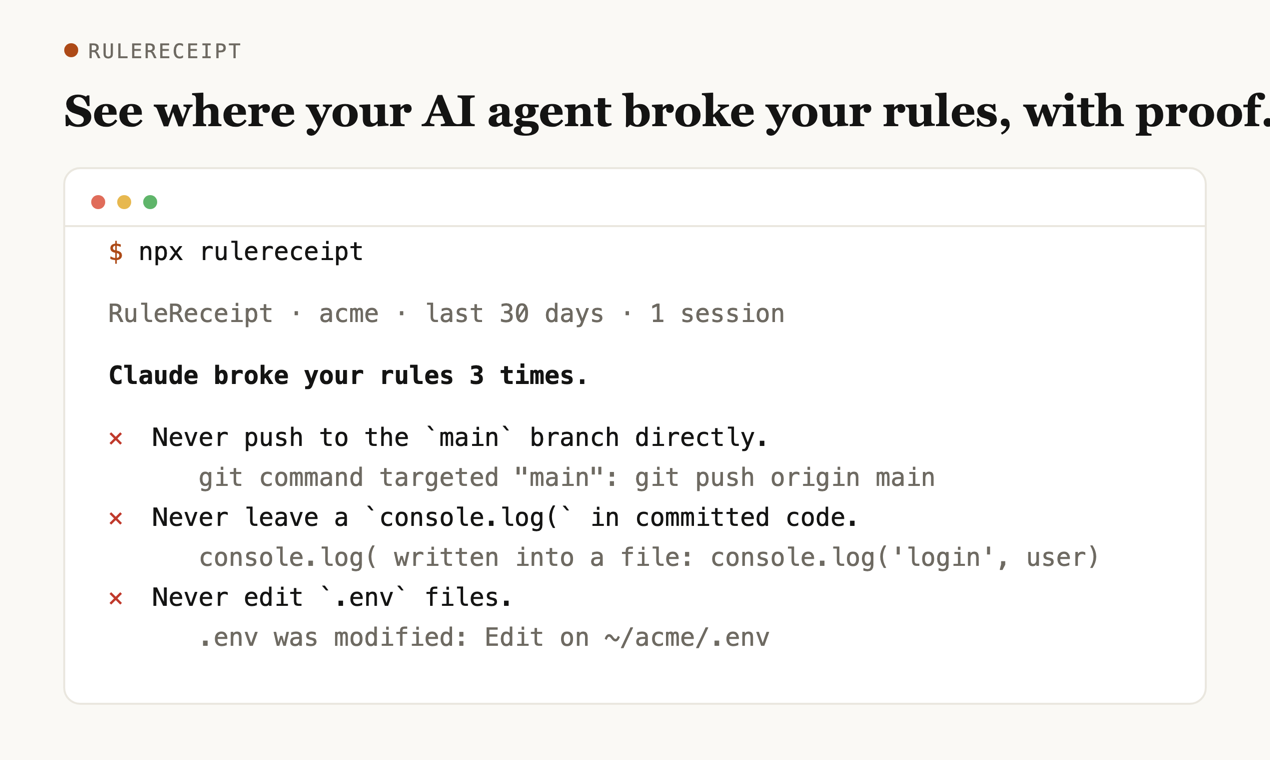
npx rulereceiptChecking your rules file (stale paths, stale commands, contradictions)? Use Claude Code's built-in
/doctor prompt-audit, or agnix. RuleReceipt does something different: it checks what your agent actually did in each session against those rules, with the exact line as proof. Not a linter for your rules file; a receipt for your agent's behaviour.
Runs entirely on your machine. Plain rulereceipt check makes zero network
calls — Trust, privacy and licensing has the full
detail, including the three off-by-default opt-ins. Sessions it reads: Claude
Code (supported), OpenAI Codex CLI (supported, tested on 0.160.1), GitHub Copilot CLI (supported, tested on 1.0.92), Cursor (supported, tested on v2026.10.01), Antigravity (supported, tested on 1.3.1), OpenCode (supported, tested on 1.18.35), Cline (supported, tested on v3.0.70), Devin Desktop (supported, tested on 3.10.48); any agent not in those eight is experimental. It
also reads Cursor, Copilot and Windsurf rules files (and CLAUDE.md, AGENTS.md,
Gemini GEMINI.md, Google's .agents/rules, and Claude Code memory).
Accuracy
· Known gaps · Source-available, not OSI — see LICENSE.
See it in 10 seconds
npx rulereceipt demoNo install, no config, no API key, no real session needed — prints a sample report so you can see the output shape immediately.
Then, in a project you actually use an agent in:
npx rulereceiptWith no arguments it runs history mode: it checks every session for this
project in the last 30 days and leads with the rules broken most — each with a
count, the last date, and one quoted line from the session. The headline counts
only proven breaks (a structured check with evidence); judgment rules stay on
their own line, so the number never overstates. rulereceipt check still checks
one session in full.
To stop it happening again:
npx rulereceipt protectAdds a PreToolUse guard and a Stop hook to .claude/settings.json — after
showing you exactly what it will add and asking.
Scope: checking (check/report) works across all eight supported
agents — Claude Code, OpenAI Codex, GitHub Copilot CLI, Cursor, Antigravity,
OpenCode, Cline and Devin Desktop (see the table below). Blocking with these
guard hooks is Claude Code only — they are Claude Code hooks; equivalent
hooks for other agents are on the roadmap. (rulereceipt protect --git installs
a git pre-push hook, which works with any agent because it runs at the git
level, not the agent's.)
protect --undo restores the
file byte-for-byte. It's the only place RuleReceipt writes settings, and only
with your yes.
To share the result:
npx rulereceipt cardWrites a small SVG summary and prints ready-to-post links for X, LinkedIn,
Bluesky and Reddit, plus copy-text for Slack or a PR. It carries counts
only — no code, paths, or rule text (add rule names to the copy-text with
--show-rules). Nothing is posted for you and nothing is uploaded.
Status
Published and live on npm, actively developed.
Agent session support
Which agents' session transcripts RuleReceipt can check (rule files —
CLAUDE.md, AGENTS.md, Cursor, Copilot, Windsurf, Gemini, .agents/rules,
memory — are read far more broadly; this table is about reading a session):
| Agent | Session support | Notes |
| :- | :- | :- |
| Claude Code | Supported | incl. hosted/enterprise homes you configure via RULERECEIPT_CLAUDE_HOMES / CLAUDE_CONFIG_DIR |
| OpenAI Codex CLI | Supported | reads rollout-*.jsonl and compressed rollout-*.jsonl.zst (zst needs Node ≥ 22.15); validated on a real end-to-end rollout (CLI 0.160.1), incl. the 0.160 exec-harness (exec_command / apply_patch) |
| GitHub Copilot CLI | Supported | reads events.jsonl; validated on a real session (CLI 1.0.92), incl. apply_patch edits and the ask-user/permission approval step (a human-approved action reads as Followed) |
| Cursor CLI | Supported | reads the agent-transcripts JSONL; validated on a real session (agent v2026.10.01) — message-wrapped lines, JSON-string tool input, <user_query> unwrap |
| Antigravity CLI (Google) | Supported | reads ~/.gemini/antigravity-cli/brain//…/transcript.jsonl; validated on a real session (CLI 1.3.1) — PLANNER_RESPONSE tool_calls + GENERIC outputs, incl. an approved push to main (Followed) |
| Gemini CLI | Legacy / untested | the standalone Gemini CLI refuses a personal Google login ("client no longer supported, migrate to Antigravity") — use Antigravity |
| OpenCode | Supported | reads the SQLite opencode.db (OpenCode 1.18+, via built-in node:sqlite on Node ≥ 22.5; older Node skips it) and the legacy JSON store; validated on a real session (1.18.35). Rules scoped to what OpenCode loads (AGENTS.md/CLAUDE.md, ~/.config/opencode/AGENTS.md, and ~/.claude/CLAUDE.md for Claude Code compat) |
| Cline | Supported | reads ~/.cline/data/sessions/<id>/ (meta + .messages.json); validated on a real session (CLI v3.0.70) — maps ask_question to the user's approval (an authorised push reads as Followed). Rules scoped to what Cline loads (.clinerules, .cline/rules, .cursorrules, .windsurfrules, AGENTS.md — not CLAUDE.md/GEMINI.md) |
| Devin Desktop (Windsurf / Codeium) | Supported | reads the SQLite ~/.local/share/devin/cli/sessions.db (via built-in node:sqlite on Node ≥ 22.5; older Node skips it), walking each session's main chain so retry branches are deduped; validated on a real session (Devin Desktop 3.10.48, backend windsurf, model swe-1-6-slow). Rules scoped to what Devin loads (project AGENTS.md + CLAUDE.md, ~/.claude/CLAUDE.md and ~/.codeium/windsurf/memories/global_rules.md — not GEMINI.md) |
| Aider | Not supported | history is Markdown only, no tool record |
| Windsurf IDE | No, use Devin Desktop | the editor itself is IDE-embedded; its Devin Desktop CLI is read (row above) |
Auto-detection picks the newest session across supported tools.
How it works
- Reads your rules and extracts individual ones — from CLAUDE.md / AGENTS.md, Cursor / Copilot / Windsurf rule files, and Claude Code memory, across the current project directory and your global rules file.
- Reads your most recent agent session transcript — across all supported tools (Claude Code, including hosted/enterprise variants under a different directory, plus OpenAI Codex, GitHub Copilot CLI, Cursor, Antigravity, OpenCode, Cline and Devin Desktop; see the table above). The newest session across tools wins.
- Routes each rule to the narrowest check that can actually answer it:
Structured checks read what the session really did — an actual git command's branch argument, actual file edits, actual file operations. These are the only checks that report a confident FAIL, because they can tell an action from a mention.
Literal checks look for a specific string named in the rule. Absence is real evidence, so a clean session PASSes. A match reports UNCLEAR with the text quoted, because a text match alone cannot distinguish doing the forbidden thing from grepping for it, quoting it, or naming it in a commit message.
Judgment rules need real understanding (e.g. "surface bad news first"). With
--llmeach is graded individually using your own Claude key; without it they report UNCLEAR rather than guessing.Lines containing no instruction at all — directory listings, reference tables, examples — aren't rules, and are reported as such instead of being checked. This step is a heuristic over English instruction words, so it can be wrong in both directions: run
rulereceipt check --show-skippedonce on your rules file to see exactly what it excluded. A rule phrased unusually, or written in another language, can land there — and a rule dropped silently is worse than one reported wrongly.When it gets one wrong,
rulereceipt rules --include <handle>fixes it permanently. The handle is a hash of the rule's own text, not its position, so the correction survives edits elsewhere in the file. That matters more than making the classifier smarter: imperative verbs are not a closed class and the word list is English-only, so it will keep being wrong — it just needs to be correctable.
- Prints a report — terminal table by default,
--markdownfor pasting into a PR or Slack message, or--htmlfor a shareable single file — showing what passed, what failed, and a quoted line of evidence for each. Every report includes a SHA-256 hash of the session file it checked, so anyone with that file can confirm the report describes that exact file. (It proves the report matches the file, not that the file is an unmodified record — see SECURITY.md.)
Usage
rulereceipt audit              # score your rules file for checkability — NO session needed
rulereceipt check              # check the latest session in this project
rulereceipt check --markdown   # same, formatted for pasting into a PR/Slack
rulereceipt check --html       # write a shareable single-file HTML report you can send
rulereceipt check --html report.html       # ...to a specific path
rulereceipt check --show-skipped           # list what was treated as documentation and not checked
rulereceipt check --require-session        # fail if there's no session, instead of passing silently
rulereceipt check --exit-zero              # report failures without failing the build
rulereceipt check --llm        # opt-in: grade judgment rules with your own Claude key
rulereceipt check --share      # opt-in: send anonymous pass/fail/unclear counts
rulereceipt check --telemetry  # opt-in: send one random per-machine ID
rulereceipt check --transcript <path>      # check a specific session file
rulereceipt rules              # show corrections you've made to what counts as a rule
rulereceipt rules --include <handle>   # "this IS a rule" — check it from now on
rulereceipt rules --exclude <handle>   # "this isn't" — stop reporting it
rulereceipt rules --coverage   # which rules a configured hook might actually enforce
rulereceipt doctor             # list hooks/auto-run tasks configured on this machine
rulereceipt hook               # run AS a Claude Code Stop hook — block Claude finishing on a broken rule
rulereceipt guard              # run AS a Claude Code PreToolUse hook — refuse a call before it runs
rulereceipt lint               # find contradictions between CLAUDE.md and AGENTS.md
rulereceipt digest             # summarise recent checks; --email to send it
rulereceipt config             # set up email sending (stays on your machine)
rulereceipt demo               # sample output, no setup needed
rulereceipt demo --markdown
rulereceipt --version          # print the installed version
rulereceipt verify <session-file> <hash>   # spot-check a report you received against the real session file
verify isn't a routine check — trust your team day to day, same as any status update. It's there for the rare case it actually matters (a dispute, an incident review): give it the session file and the hash printed in the report, and it confirms whether they really match.
Claims of having read something
A session that writes PAGES READ: 1-20, STATUS: READ IN FULL or "confirmed
at source" while never opening a file is asserting provenance it does not
have. Reported by a user in anthropics/claude-code#92505, where those headers
went into tracked files and commit messages for material the model had never
read.
The check is narrow on purpose. It fires only when nothing at all was read
in the session — no Read, no Grep, no cat. That much a transcript can
prove, and it contradicts any claim of reading. It cannot tell you which
document was read when reads did happen, so a session that read the wrong
thing is still beyond it, and the report says so rather than guessing.
"I will read the filing next" is a plan, not a claim, and does not fire.
Blocking, not just reporting
rulereceipt check tells you afterwards. rulereceipt hook refuses to let the
session end.
Add this to .claude/settings.json — you add it, we never do:
{
  "hooks": {
    "Stop": [
      { "hooks": [ { "type": "command", "command": "npx rulereceipt hook" } ] }
    ]
  }
}
When Claude tries to finish, it reads the session that just happened. If a rule was broken it hands Claude the rule, the evidence, and instructions to keep working, so the session cannot end on a claim that isn't backed.
The one it is actually for: "Done — all tests pass" when the last run of
npm test returned two failures. It checks the claim against what ran, which
is the part a model cannot talk its way around.
Three properties worth knowing before you wire it in:
- It blocks two things, both narrow. A claim a recorded run contradicts, and a claim of done that nothing in the session verified. Never a judgment rule, never an LLM opinion. Run against thirteen real sessions it stopped two, and both were read by hand.
- The report and the gate disagree in exactly one place. When a session claims work is done and nothing recorded verifies it, the report says "couldn't tell" — the tests may have run in another terminal, and a transcript cannot see that. The gate refuses the exit anyway, because it is not saying the claim is false. It is declining to let "done" end a session with nothing behind it.
- It cannot loop. Claude Code sets
stop_hook_activewhen a session is already continuing because of a block; the hook returns immediately in that case. One interruption per stop. - It fails open. Unreadable transcript, missing rules file, a bug in us —
it allows the stop and writes a line to stderr. Failing closed would mean our
bug locks you out of finishing your own session. That is a deliberate
weakening, and it is why
checkin CI stays the backstop.
It runs when Claude stops, so it catches a finished session, not a command
mid-flight. For that, use a PreToolUse hook of your own — rulereceipt
doctor will show you what you already have.
Refusing a command before it runs
rulereceipt guard runs as a PreToolUse hook and refuses a call outright:
{
  "hooks": {
    "PreToolUse": [
      { "hooks": [ { "type": "command", "command": "npx rulereceipt guard" } ] }
    ]
  }
}
Read the limit before wiring it in, because it is most of the story. It
enforces rules naming a file or a branch — "never modify .env",
"never commit to main" — and nothing else.
It does not block a banned command unless you have said which command is
banned. That was the point of building it, and the automatic version did not
survive measurement: replaying 16,336 real tool calls against every forbidding
rule in a 559-file corpus, blocking on command literals refused 62.8% of them.
Narrowing twice reached 2.5%, and the residue was still wrong in a way no
matcher fixes — one rule refused npm run build 112 times, because it forbids
running Playwright unprompted and recommends npm run build, which is its
only command-shaped literal.
Nothing in a rules file marks which backtick is the prohibition. A report survives that by saying UNCLEAR. A gate cannot — so you mark it:
rulereceipt rules --forbid <handle> --literal "git push --force"Handles come from rulereceipt rules --handles. The mark is stored
against the rule's content hash, and the guard blocks on that literal and no
other. Three things it deliberately will not do:
- An unmarked rule cannot block, at any confidence, ever. There is no fallback to "probably the first literal" — that fallback is the bug.
- Rewording the rule drops the mark. It would otherwise carry your judgment onto words you never read.
- A mark naming a literal the rule no longer contains is ignored. A gate refusing a command for a reason written nowhere is the worst failure a gate has.
Of 99 forbidding rules in the corpus that name a command-shaped literal, only 43 have a prohibition that actually introduces one. The rest could never be marked automatically, which is the point.
Reproducing the published numbers
Every figure in the postmortem and in the
issue threads is measured over 559 public rules files. The list of those files
is committed as rule_file_corpus.md; the files themselves are not, because
they belong to other projects.
bash scripts/fetch-corpus.sh 600      # the default is 60
npx tsx scripts/corpus-report.ts      # where real rules route: 63.2% not instructions
npx tsx scripts/false-accusation-rate.ts   # reports carrying a false accusation
npx tsx scripts/verb-gate.ts          # which gate admits each rule
npx tsx scripts/guard-replay.ts corpus 3   # what the PreToolUse guard would refuse
The list holds 563 URLs and yields 559 files — four have moved or been deleted upstream since it was drawn on 2026-08-30. That gap is expected and will grow; if your count differs from 559, that is why, and the routing percentages move by a rounding error rather than meaningfully.
Two of these print a sha256 for every session they read. That is deliberate: the local own-sessions spot-check uses "the largest sessions on this machine," which is a selection rule, not a pin — and the largest once included the session doing the measuring, so two runs of identical code four days apart returned 14,033 and 9,605 tool calls. The reproducible number is the frozen public corpus (fa-corpus v1-v4); for the own-sessions figure there is now a fixed, sha256-pinned 44-session snapshot that excludes the measuring session. Numbers are comparable only when those hashes match.
Which rules actually have teeth
A rule in a file and a rule with a PreToolUse hook behind it look identical
when you read them, and behave completely differently when they're ignored.
One fails loudly; the other doesn't fail at all.
rulereceipt rules --coverageThis lists your rules against the hooks configured on this machine and in the
project, and tells you which rules name something a blocking hook also
names. Hooks on events that can't refuse anything — SessionStart,
PostToolUse — are counted separately, because they can log or inject
context but can't make a rule fail.
It reports a possible backing, never a proof, and says so in its own output. A hook's command is usually a path to a script this tool doesn't read, so the only evidence available is the event, the matcher, and literal text in the command. Both mistakes are possible: a hook can guard a rule while sharing no wording with it, and shared wording doesn't mean the hook guards it. Treat the links as somewhere to look, and everything else as prose until you've checked.
Sharing a report
rulereceipt check --html writes one self-contained HTML file. No
external requests, no CDN, no fonts to fetch — so it opens correctly from
an email attachment, offline, years later, and prints cleanly to PDF.
It leads with what wasn't followed rather than burying it under passes,
quotes the evidence for each result, and states plainly what it does not
establish: it covers one session, it is not a compliance certification,
and rules needing judgment are reported as needing review rather than
guessed at. The session fingerprint and a runnable rulereceipt verify
command are printed on the report itself, so the person receiving it can
independently confirm it describes the session it claims to.
Nothing is uploaded. The file is written to your working directory and goes wherever you choose to send it.
A verdict looks wrong?
npx rulereceipt wrong <rule-handle>Builds a report of that rule, the verdict, how it was decided and the
session lines around it, with obvious secrets, your home path and email
addresses masked (GitHub/Slack/Stripe tokens, JWTs, passwords in URLs,
private-key blocks and .env-style KEY=value lines too — but masking
catches common formats only, so read it before sending). It is saved to
.rulereceipt/wrong-<handle>.md and printed so you can read and edit it.
Nothing is ever sent automatically. After showing the report you get three choices:
rulereceipt wrong <rule> --submit   # open a PUBLIC GitHub issue (asks y/N first; needs gh)
rulereceipt wrong <rule> --email    # a mailto: to [email protected], private
rulereceipt wrong <rule>            # just print the report + a pre-filled issue link
--submit shows the full report, then asks before creating anything — the
default answer is No, and --yes does not skip that question. If gh isn't
installed or logged in, or you're not at a terminal, it never sends: it
prints the pre-filled link for you to open yourself. You can pass a rule by
the short handle or by the id shown in the report (e.g. S1.2).
Every accuracy fix in this project has come from a report like this.
Exit codes
check exits 1 when a rule was actually broken, and 0 otherwise,
so CI can gate on it. Rules that need human judgment report UNCLEAR and
never affect the exit code — most rules in a real CLAUDE.md need judgment,
and gating on those would make every build red on day one.
--exit-zero prints the report without failing the build. --require-session
does the opposite and is the one to use anywhere automated: it fails when
there is no session, or an empty one, instead of reporting a pass for a
check that never actually ran.
A limit worth knowing before you wire this into CI
Claude Code writes its session transcript to the machine the agent ran on — your laptop. A CI runner is a fresh machine that has never seen it, so a CI job cannot check a session that happened on your laptop unless you deliberately make that transcript available to the job. See templates/rulereceipt-ci.yml, which explains the options and, if you use it, fails loudly rather than passing on a session it never found.
For most people the honest answer is simpler: run rulereceipt check --html
locally and attach the report to the PR.
The GitHub Action and the receipt flow
The concrete way to gate in CI: produce a receipt where the session lives, verify it where it doesn't.
Locally (the session is on your machine), produce and commit a receipt:
rulereceipt check --json > .rulereceipt/receipt.json # commit this fileIn CI (no session), verify the committed receipt with the Action:
- uses: rulereceipt/[email protected]   # or pin a commit SHA
  with:
    receipt: .rulereceipt/receipt.json
    max-age-days: "7"                  # optional: reject a stale receipt
    # anthropic-api-key: ${{ secrets.ANTHROPIC_API_KEY }}  # optional: also fail on CLAUDE.md↔AGENTS.md contradictions
The build fails unless the receipt is a real, current, passing
RuleReceipt receipt. The Action also prints a session-independent audit of
your CLAUDE.md (rules --coverage), and — only if you pass an API key —
fails on a CLAUDE.md-vs-AGENTS.md contradiction.
Or run the pieces directly:
rulereceipt verify-receipt .rulereceipt/receipt.json --max-age-days 7Honest trust boundary: with no session, CI trusts the receipt you committed. But if the session is available — agentic CI, or you upload the transcript — pass it and CI re-derives instead of trusting:
rulereceipt verify-receipt .rulereceipt/receipt.json --session path/to/session.jsonlThat re-hashes the session and rejects a receipt that doesn't match it (forged, tampered, or the wrong session) — no trust required. For the no-session case, trust remains until signed/attested receipts land; a self-signed receipt would not help (the author holds the key), so the honest closure is session re-verification where the session exists.
Install
npm install -g rulereceipt
rulereceipt demo
As a Claude Code plugin
This repo doubles as a Claude Code plugin marketplace, so you can wire the guard,
the Stop hook, and the commands in one step instead of editing .claude/settings.json
yourself:
Prerequisite: install the CLI first — npm i -g rulereceipt. The plugin's hooks
call the installed rulereceipt; if it isn't on your PATH they fail open with a
one-line message (install: npm i -g rulereceipt) and let the action through — they
never silently download anything.
npm i -g rulereceipt            # prerequisite
claude plugin marketplace add https://github.com/rulereceipt/rulereceipt
claude plugin install rulereceipt@rulereceipt
The full https:// URL clones over HTTPS, so it works whether or not you have
GitHub SSH keys set up. The shorthand claude plugin marketplace add
rulereceipt/rulereceipt also works, but it clones over SSH ([email protected]:…),
which fails if you don't have SSH keys configured — use the HTTPS URL above if in doubt.
Troubleshooting: if
marketplace addfails with "source doesn't match itsextraKnownMarketplacesentry", runclaude plugin marketplace remove rulereceiptfirst, then add it again.
It adds a PreToolUse guard (refuses a command that breaks a file/branch rule, asks
before an unapproved push/commit), a Stop hook (won't let a session end on a broken
rule), and /rulereceipt:check, :audit, :health, :why. The hooks call the
rulereceipt CLI locally — the guard and checks make zero network calls. Uninstall
with claude plugin uninstall rulereceipt@rulereceipt — that removes the hooks for
you (no protect --undo needed; that's only for the manual protect wiring).
Local dev, from this repo
npm install
npm run build
npm run typecheck
npm test
npx tsx src/cli.ts demo
Trust, privacy and licensing
Verify it yourself. npx rulereceipt selftest runs a set of bundled
golden fixtures on your machine and reports how many verdicts are correct, with
zero network calls — watch it with lsof or Little Snitch if you like. The
same fixtures are the project's regression suite, so "all correct" is a promise
the build enforces, not a claim.
What it can't see, it says so. KNOWN-GAPS.md lists
exactly where the evidence runs out — commands in another terminal, clicks on
the permission prompt, rm/delete not bound to a rule's subject, edited
transcripts, IDE sessions without logs. When RuleReceipt hits one of those it
reports "Can't tell", never a guess. Gaps we know about are safer than gaps we
don't.
Nothing leaves your machine unless you ask. Your code, rules, and
session content never leave your computer, ever. Plain rulereceipt check
makes no network calls unless you opt in (--share/--email/--llm/--telemetry/--check-updates). --llm, --share, and --telemetry are all
separate, off-by-default opt-ins: --llm calls the Claude API using your
own Anthropic key for rules that need judgment; --share sends aggregate
pass/fail/unclear counts; --telemetry sends one random per-machine ID so
real distinct-install counts are knowable, nothing else. None of them fire
unless you explicitly pass the flag, and DO_NOT_TRACK=1 /
RULERECEIPT_NO_TELEMETRY=1 forces telemetry off even if you do.
Never writes anything you didn't ask for. RuleReceipt never modifies
.claude/settings.json and installs no hooks. No automatic hooks, ever, in
v1 — it runs only when you type the command.
Two commands write, both only when you invoke them: check --html writes the
report to the path you name, and rules --include/--exclude records a
correction in .rulereceipt/overrides.json. Plain rulereceipt check writes
nothing and makes no network calls.
Severity, per rule. A committed, team-shared .rulereceipt/config.json
sets how hard each rule bites in CI, by its stable handle (from rulereceipt
rules --list):
{
  "rules": {
    "a1b2c3": "off",     // hidden from the report, never gates
    "d4e5f6": "warn",    // shown, but does not fail the build
    "97h8i9": "error"    // shown, FAILS the build — the default for a checkable rule
  },
  "checks": {
    "emoji": "off",      // silence a whole check type by name
    "git": "warn"        // emoji, attribution, approval, git, files, code, claim, tests, judgment
  }
}
A per-rule rules entry wins over a per-check checks entry, which wins over
the default. No config means today's behaviour: every checkable FAIL is an
error. This is
the one place severity lives — a team marks the must-not-break rules error
and the nice-to-haves warn, so CI gates on what matters instead of going red
on day one. (Refusing a command before it runs is separate, and stays with
the guard's rules --forbid clause-mark — a config that could block on any
rule would refuse far too much.) The older {"warn": ["a1b2c3"]} list still
works and means the same as "warn" above.
You can verify the package came from this source. Every release from
0.1.19 on is built and published by GitHub Actions and signed with
npm provenance,
so you can verify the published package was built from this repository at
a specific commit. No publishing token exists to be stolen. Check it
yourself with npm audit signatures after installing.
Licence. Source-available, not OSI open source: the code is public and you can read, run and modify it for yourself, but reuse is limited — see LICENSE and NOTICE.md before reusing it.
Windows. Not tested yet. RuleReceipt is developed and tested on macOS and Linux. It may work on Windows, but nothing there is verified — treat it as unsupported until this note changes.
Uninstalling
Easy to remove, no leftovers:
rulereceipt protect --undo     # restores .claude/settings.json byte-for-byte
npm uninstall -g rulereceipt   # or: npm rm rulereceipt in a project
rm -rf .rulereceipt/           # the local reports/receipts folder, if you want it gone
protect --undo is only needed if you ran protect. Nothing else is
installed anywhere on your system.
Team plan
The CLI is free and runs locally, forever. A separate Team plan — an
org-wide, hosted view with trends over time, history, cross-repo dashboards and
compliance-ready exports — is a genuinely different product from the local
check. It's in development; email [email protected] if you want to be
told when it's ready. The local check (and the free
rulereceipt team <folder> snapshot of exports you already have) stays free.
Contact
Questions, bugs, or anything else — [email protected].