
secrets-le-mcp
v2.6.1
Published
Detect hardcoded secrets in source and config, reporting masked previews and never the values themselves.

Maintainers
 nolindnaidoo
Readme
secrets-le-mcp
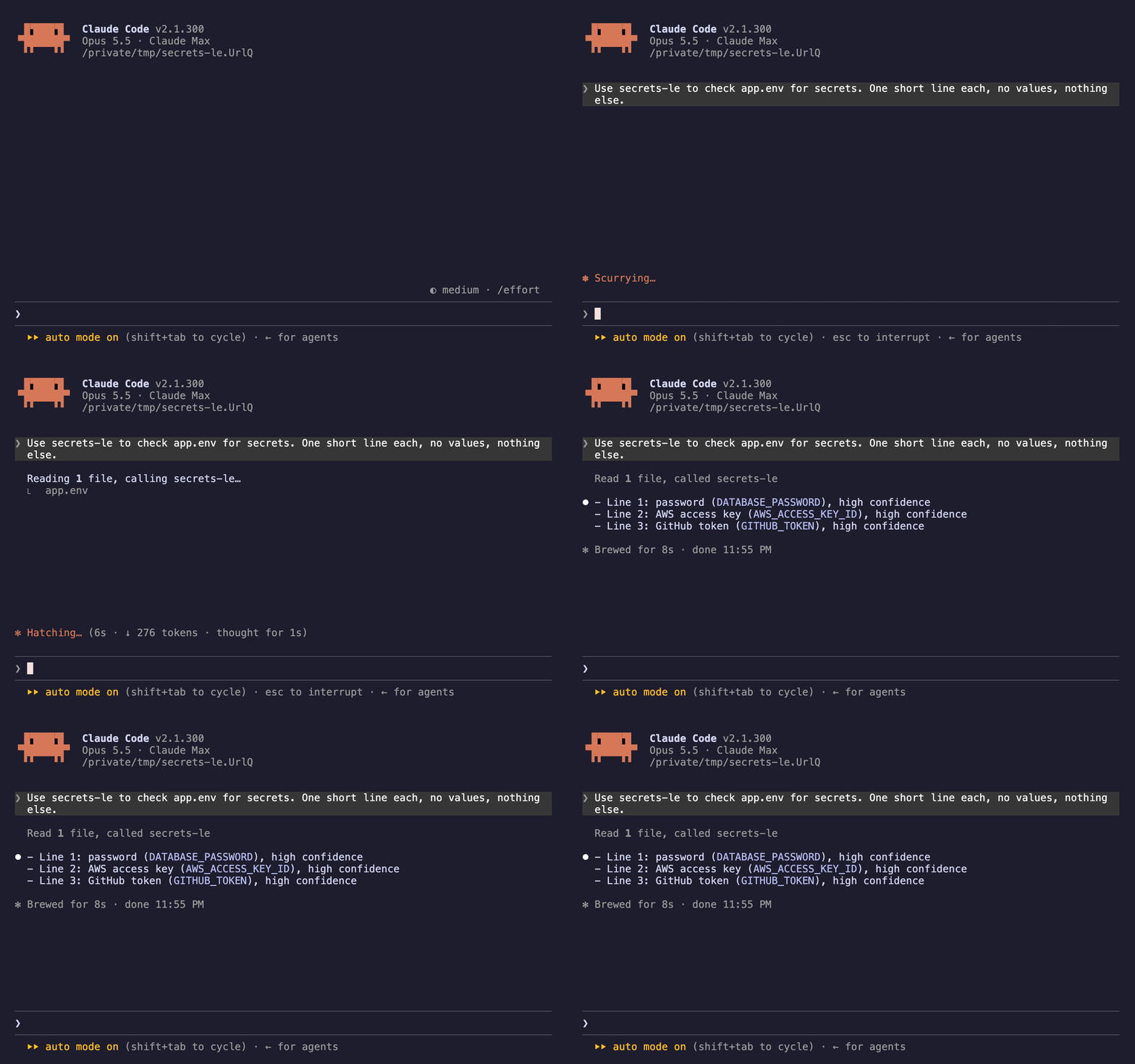
An MCP server that detects hardcoded secrets — API keys, passwords, tokens and private keys — without ever returning one; the detection engine behind the Secrets-LE editor extension, exposed as a tool an agent can call.
No dependencies, no network calls, no filesystem access. Content goes in, structured results come out.
Use it
Point any MCP host at npx secrets-le-mcp.
Claude Code
claude mcp add secrets-le -- npx -y secrets-le-mcpAnything with a JSON config — Cursor, Windsurf, Claude Desktop:
{
  "mcpServers": {
    "secrets-le": {
      "command": "npx",
      "args": ["-y", "secrets-le-mcp"]
    }
  }
}
VS Code needs nothing here. Install the extension instead — it carries this server and registers it for you: VS Code Marketplace · Open VSX
No Node? The same detect_secrets tool ships in a static Rust
binary: cargo install secrets-le, then secrets-le mcp
(crates.io). The two servers
answer identically — one fixture corpus runs against both and CI fails
if they diverge — and both mask the same way. The binary additionally
offers secrets_le_scan, which walks a tree; this server reads no
files, which is what lets an agent call it anywhere.
Prefer a global install to npx on every launch:
npm install -g secrets-le-mcp{
"mcpServers": {
"secrets-le": { "command": "secrets-le-mcp" }
}
}No environment variables, no API key, no configuration of its own. To check it before wiring it into anything:
echo '{"jsonrpc":"2.0","id":1,"method":"tools/list"}' | npx -y secrets-le-mcpIf that prints the tool name, the server works.
The tool
detect_secrets
| argument | type | |
|---|---|---|
| content | string | required. The text to scan. |
| sensitivity | string | low reports every match, medium (the default) drops low-confidence ones, high keeps only high-confidence ones. |
| includeApiKeys | boolean | Include API key detectors. Default true. |
| includePasswords | boolean | Include password detectors. Default true. |
| includeTokens | boolean | Include token detectors. Default true. |
| includePrivateKeys | boolean | Include private key detectors. Default true. |
| maxResults | number | Default 500, ceiling 5000. |
Returns each finding by type, confidence, key name and 1-based line and
column. The value never leaves the tool: preview is truncated and
length-annotated, and context is the line with the value masked out, so a
finding can be located without the credential leaving the machine it was
found on. meta.truncated says whether a capped result dropped anything.
{
  "ok": true,
  "data": {
    "secrets": [
      {"type": "aws-secret", "confidence": "high", "key": "aws_secret_access_key", "preview": "wJalrXUt… (40 chars)", "context": "AWS_SECRET_ACCESS_KEY=wJalrXUt… (40 chars)", "line": 1, "column": 23}
    ]
  },
  "diagnostics": [],
  "meta": {
    "tool": "detect_secrets",
    "count": 1,
    "truncated": false
  }
}
Extraction is heuristic, and what it deliberately does not match is documented as carefully as what it does — see the extension README.
Also in the MCP registry
io.github.nolindnaidoo/secrets-le —
registry.modelcontextprotocol.io
Nine more like it
One tool each, same shape: content in, structured data out, no network and no
filesystem. Every one is on npm as <name>-mcp and in the MCP registry as
io.github.nolindnaidoo/<name>.
| Package | Tool | Extracts |
|---|---|---|
| urls-le-mcp | extract_urls | URLs, with protocol and position |
| colors-le-mcp | extract_colors | colors from stylesheets and code |
| dates-le-mcp | extract_dates | dates and timestamps |
| paths-le-mcp | extract_paths | file and directory paths |
| numbers-le-mcp | extract_numbers | numeric values |
| string-le-mcp | extract_strings | string values |
| regex-le-mcp | extract_patterns | regexes, with a ReDoS verdict |
| envsync-le-mcp | compare_env_files | dotenv key drift, names only |
| scrape-le-mcp | analyze_robots_txt | whether a path may be crawled |
Every tool in the family, one page: letools.dev
Built by
Nolin Naidoo — Chief Engineer, AI/ML & Platform Architecture. nolindnaidoo.com · GitHub · LinkedIn
Also from the same workshop
Twelve Rust tools built the same way: small, single-purpose, and driven by a machine rather than a person. pixelcoords and pixelactions make up one loop — pixelcoords answers where, pixelactions acts there. The ten LE crates are the terminal half of the extensions they sit in: the same detection, held to the extension's own corpus, and an exit code instead of a results editor.
| | | | |---|---|---| | pixelcoords | Freeze your screen, mark regions, get pixel-exact coordinates and crops | site · crates.io · docs.rs | | pixelactions | Consume human-verified coordinates, perform the interaction, confirm it landed | site · crates.io · docs.rs | | paths-le | Find every path in a codebase and report whether it still points at anything | crates.io | | secrets-le | Find hardcoded credentials, and never print one | crates.io | | urls-le | Extract every URL from a codebase, with its protocol and exact position | crates.io | | regex-le | Find every regex in a codebase and report which can be driven into catastrophic backtracking | crates.io | | string-le | Get every string in a codebase out where a person can read them | crates.io | | numbers-le | Find every hardcoded number in a codebase so a person can check them | crates.io | | envsync-le | Compare the dotenv files in a tree and say which keys are missing from which | crates.io | | colors-le | Find every colour in a codebase, and say which are not in your palette | crates.io | | dates-le | Extract every date and timestamp, and the exact instant each one resolves to | crates.io | | scrape-le | Check whether a page is scrapeable before the scraper is written | crates.io |
Licence
MIT © Nolin Naidoo