
sfcc-cip-analytics-client
v0.0.9
Published
SFCC Commerce Intelligence Platform Analytics Client

Maintainers
 clavery
Readme
SFCC Commerce Intelligence Platform Analytics Client
A TypeScript/Node.js client library and CLI tool for querying Salesforce Commerce Cloud (SFCC) Commerce Intelligence Platform (CIP) analytics data through the use of the JDBC protocol. This client abstracts the underlying Avatica protobuf protocol and provides both programmatic and command-line interfaces for accessing your commerce analytics data.
See https://developer.salesforce.com/docs/commerce/b2c-commerce/guide/jdbc_intro.html for the details of the JDBC driver used with Java applications as well as the business object and schema reference.
- SFCC Commerce Intelligence Platform Analytics Client
Installation
npm install sfcc-cip-analytics-clientGlobal CLI Installation
npm install -g sfcc-cip-analytics-client
# Now you can use: cip-query "SELECT * FROM table"
CLI Usage
Configuration
The CLI can be configured using environment variables or command-line options. Your Account Manager API client must have the SALESFORCE_COMMERCE_API:[instance] role and tenant filter.
Environment Variables
export SFCC_CLIENT_ID="your-client-id"
export SFCC_CLIENT_SECRET="your-client-secret"
export SFCC_CIP_INSTANCE="your-instance-name" # example abcd_prd

# Optional: Enable debug logging
export SFCC_DEBUG=true
Command-line Options
You can also provide credentials directly via CLI options (these override environment variables):
cip-query sql --client-id "your-client-id" \
              --client-secret "your-client-secret" \
              --instance "your-instance-name" \
              "SELECT * FROM ccdw_aggr_ocapi_request LIMIT 10"
Commands
The CLI supports two main commands:
sql - Execute custom SQL queries
cip-query sql "SELECT * FROM ccdw_aggr_ocapi_request LIMIT 10"query - Execute predefined business object queries
cip-query query --list
cip-query query --name ocapi-requests --from "2024-01-01" --to "2024-01-31"
Basic Query
cip-query sql "SELECT * FROM ccdw_aggr_ocapi_request LIMIT 10"With Date Placeholders
cip-query sql --from "2024-07-01" --to "2024-07-31" \
  "SELECT * FROM ccdw_aggr_ocapi_request WHERE request_date >= <FROM> AND request_date <= <TO>"
Different Output Formats
# JSON output
cip-query sql --format json "SELECT api_name, COUNT(*) as count FROM ccdw_aggr_ocapi_request GROUP BY api_name"

# CSV output for spreadsheet analysis
cip-query sql --format csv --from "last week" \
  "SELECT * FROM ccdw_aggr_ocapi_request WHERE request_date >= <FROM>"
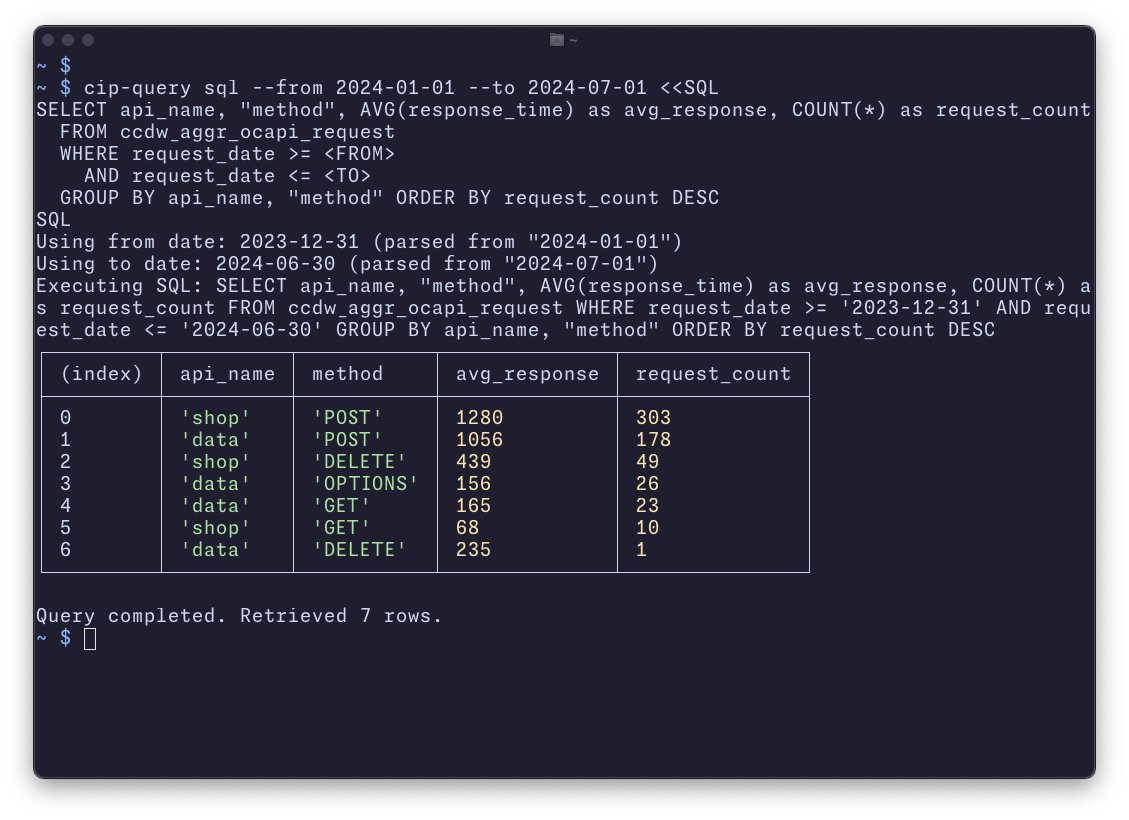
Using Heredocs (Multi-line SQL)
cip-query sql --format json --from "2024-01-01" --to "2024-01-31" <<SQL
  SELECT
    api_name,
    "method",
    AVG(response_time) as avg_response_time,
    COUNT(*) as request_count
  FROM ccdw_aggr_ocapi_request
  WHERE request_date >= <FROM>
    AND request_date <= <TO>
  GROUP BY api_name, "method"
  ORDER BY request_count DESC
SQL
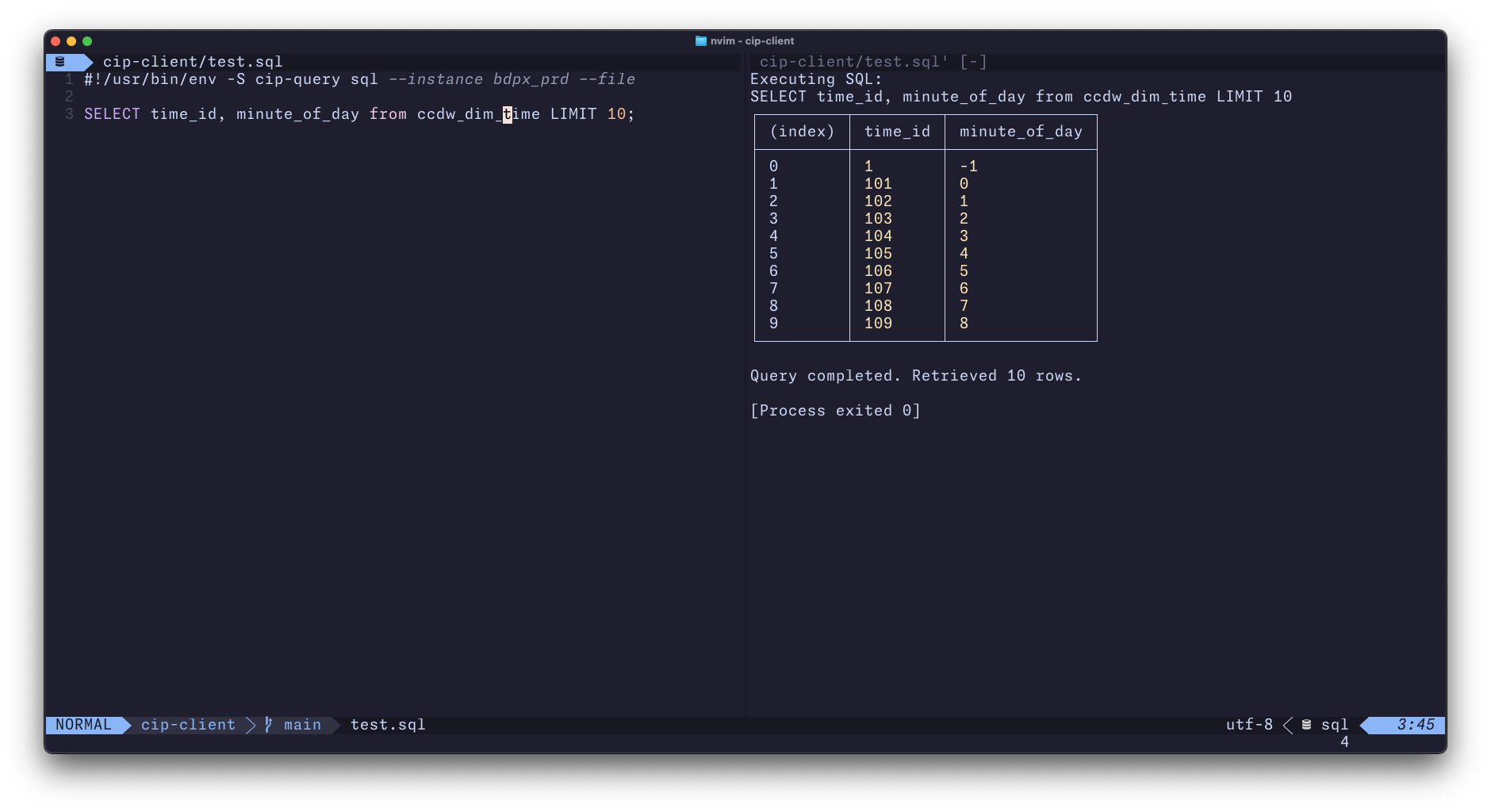
From Files
# Save complex queries in .sql files
cip-query sql --format csv < my-analytics-query.sql
API Usage
Low Level Client
import { CIPClient } from 'sfcc-cip-analytics-client';

const client = new CIPClient(
  process.env.SFCC_CLIENT_ID!,
  process.env.SFCC_CLIENT_SECRET!,
  process.env.SFCC_CIP_INSTANCE!
);

async function queryData() {
  // direct statement execution
  try {
    await client.openConnection();
    const statementId = await client.createStatement();

    const result = await client.execute(
      statementId,
      "SELECT * FROM ccdw_aggr_ocapi_request LIMIT 10"
    );

    // see example/basic.ts for more details on result structure
    console.table(result);

    await client.closeStatement(statementId);
  } finally {
    await client.closeConnection();
  }
}

queryData();
Type-Centric Parameterized Queries
import { CIPClient, executeParameterizedQuery } from 'sfcc-cip-analytics-client';

interface OCAPISummary {
  request_date: string;
  site_id: string;
  api_resource: string;
  num_requests: number;
}

try {
  await client.openConnection();

  const query = executeParameterizedQuery<OCAPISummary>(
    client,
    `SELECT request_date,site_id,api_resource,SUM(num_requests) as requests FROM
      ccdw_aggr_ocapi_request
    WHERE
      request_date >= '2024-01-01'
    AND request_date <= '2024-01-31'
    GROUP BY request_date,site_id,api_resource`,
    [],
    100 // batch size
  );

  for await (const batch of query) {
    console.log(`Processed ${batch.length} ocapi requests`);
    for (const record of batch) {
      // Each record is typed as OCAPISummary
      console.log(record.api_resource);
    }
  }
} finally {
  await client.closeConnection();
}


queryData();
High Level Business Use Case Queries
The client provides specialized query functions for common business analytics use cases. These return simple arrays of plain old JavaScript objects, making it easy to work with the data.
For complete documentation of all available business queries, see Business Queries Reference.
import { CIPClient, querySalesAnalytics } from 'sfcc-cip-analytics-client';

const client = new CIPClient(clientId, clientSecret, instance);

async function analyzeSalesData() {
  await client.openConnection();

  const query = querySalesAnalytics(
    client,
    { siteId: 'Sites-RefArch-Site', startDate: new Date('2024-01-01'), endDate: new Date('2024-01-31') },
    100 // batch size
  );

  for await (const batch of query) {
    console.log(`Processed ${batch.length} daily sales metrics`);
    // Each record has: date, std_revenue, orders, std_aov, units, aos
  }

  await client.closeConnection();
}
Examples
See the examples/ directory for complete working examples:
examples/basic.ts- Basic usage with result paginationexamples/ocapi.ts- Using data helper functions for OCAPI analytics
Development Setup
Prerequisites
- Node.js 18+ or Bun
- SFCC Commerce Cloud production access with CIP Analytics enabled
Getting Started
Clone and install
git clone <repository-url>
# ...
npm install
Build the project
npm run buildRun linting
npm run lint
API Documentation
CIPClient
Main client class for interacting with CIP.
Constructor
new CIPClient(clientId: string, clientSecret: string, instance: string, options?: CIPClientOptions)Methods
openConnection(info?: IConnectionProperties): Promise<void>- Open database connectioncloseConnection(): Promise<void>- Close database connectioncreateStatement(): Promise<number>- Create a new SQL statementcloseStatement(statementId: number): Promise<void>- Close a statementexecute(statementId: number, sql: string, maxRowCount?: number): Promise<NormalizedExecuteResponse>- Execute SQL queryfetch(statementId: number, offset: number, fetchMaxRowCount: number): Promise<NormalizedFetchResponse>- Fetch more resultsprepare(sql: string, maxRowsTotal?: number): Promise<IPrepareResponse>- Prepare a SQL statement with parameter placeholdersexecuteWithParameters(statementHandle: IStatementHandle, parameters?: any[], firstFrameMaxSize?: number): Promise<IExecuteResponse>- Execute a prepared statement with parametersprepareAndExecuteWithParameters(sql: string, parameters?: any[], firstFrameMaxSize?: number): Promise<IExecuteResponse>- Prepare and execute a statement with parameters in one call
Todo
- [ ] support proxy / fetch replacement (for browser use and advanced proxy scenarios)
- [ ] static build of protobuf for web use
License
Licensed under the current NDA and licensing agreement in place with your organization. (This is explicitly not open source licensing.)
Support
This project should not be treated as Salesforce Product. It is a tool B2C instances. Customers and partners implement this at-will with no expectation of roadmap, technical support, defect resolution, production-style SLAs.
This project is maintained by the Salesforce Community. Salesforce Commerce Cloud or Salesforce Platform Technical Support do not support this project or its setup.
THE SOFTWARE IS PROVIDED "AS IS", WITHOUT WARRANTY OF ANY KIND, EXPRESS OR IMPLIED.
For feature requests or bugs, please open a GitHub issue.