
show-me-the-receipts
v0.5.0
Published
Your AI coding agent says it's done. Show me the receipts. Checks an agent's claims (tests pass, build succeeds, file updated, wired in) against what actually happened in the session.

Maintainers
 rocketlang
Readme
🧾 show-me-the-receipts
Your AI coding agent says it's done. Show me the receipts.
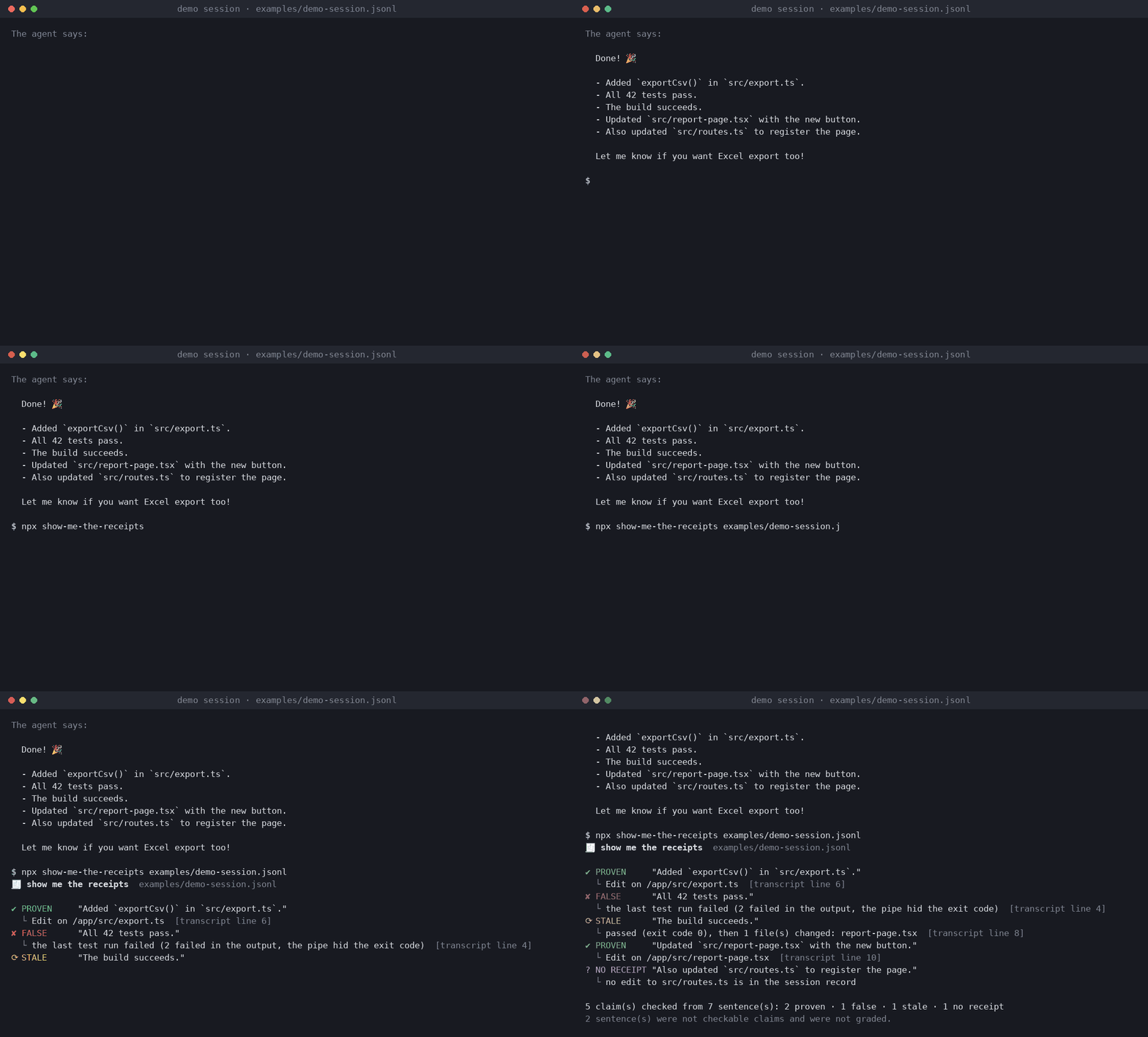
A demo session (examples/demo-session.jsonl), graded by the real tool. The GIF is drawn from that run by scripts/make-demo-gif.py, so anyone can rebuild it.
Agents end their turn with claims: "All 42 tests pass", "The build succeeds",
"exportCsv() is wired into the toolbar". This tool reads the agent's last message, finds the
claims it can check, and checks each one against what actually happened in the session and in
your repository.
$ npx show-me-the-receipts last

🧾 show me the receipts

✔ PROVEN     "Added `exportCsv()` in `src/export.ts`."
  └ Edit on /app/src/export.ts  [transcript line 6]
✘ FALSE      "All 42 tests pass."
  └ the last test run failed (2 failed in the output, the pipe hid the exit code)  [transcript line 4]
⟳ STALE      "The build succeeds."
  └ passed (exit code 0), then 1 file(s) changed: report-page.tsx  [transcript line 8]
✔ PROVEN     "Updated `src/report-page.tsx` with the new button."
  └ Edit on /app/src/report-page.tsx  [transcript line 10]
? NO RECEIPT "Also updated `src/routes.ts` to register the page."
  └ no edit to src/routes.ts is in the session record

5 claim(s) checked from 7 sentence(s): 2 proven · 1 false · 1 stale · 1 no receipt
2 sentence(s) were not checkable claims and were not graded.
That output is real: it is this tool run on examples/demo-session.jsonl.
The four verdicts
| verdict | meaning | |---|---| | ✔ PROVEN | the session shows it happened, and the evidence is attached | | ✘ FALSE | the session or the repository contradicts it, and the contradicting line is shown | | ⟳ STALE | it was true, then code changed after the proof | | ? NO RECEIPT | nothing proves or disproves it, so it is flagged, not believed |
When unsure, it says NO RECEIPT, never FALSE. A claim is called false only when there is a line that contradicts it.
Make the agent prove it: the Stop hook
npx show-me-the-receipts install          # this project (.claude/settings.json)
npx show-me-the-receipts install --user   # every project (~/.claude/settings.json)
Now, when Claude Code tries to finish with a FALSE or STALE claim, it is sent back once
with the verdict and told to prove the claim or correct it. If the claim still doesn't hold after
that one retry, the agent is allowed to stop and you see the verdict. It never loops, and if the
checker itself breaks, it gets out of the way. Add --strict to also send the agent back on
NO RECEIPT, including a hedged claim ("tests should pass now") or a bare "Done!" that names
nothing checkable. Without --strict, those are listed in the report, never counted as passed.
The install keeps your existing hooks, writes a backup (settings.json.before-receipts), and does
nothing if the hook is already there. The repository is also a Claude Code plugin (hooks/hooks.json).
Re-run mode: don't trust the transcript, run it
npx show-me-the-receipts init # writes receipts.config.json from your package.json scripts{ "rerun": true, "timeoutSec": 300, "commands": { "test": "npm test", "build": "npm run build" } }With this file in your repository, a claim about tests, build, lint or typecheck is settled by
running your command now, not by what the session record says. A faked run, a run that
passed before a later edit, or a count that doesn't match all come out FALSE if your command
fails now. Each command runs at most once per check. Only the commands in this file are ever run,
never anything from the transcript. Use --no-rerun to skip it.
Pull requests: the GitHub Action
Agents (and people) write claims in pull request descriptions: "All tests pass", "Updated
src/parse.ts", a ticked "- [x] Ran the tests". The Action checks them against the pull request
itself and posts one receipts comment, updated in place:
# .github/workflows/receipts.yml
on:
  pull_request:
    types: [opened, edited, synchronize, reopened]
permissions:
  contents: read
  pull-requests: write
jobs:
  receipts:
    runs-on: ubuntu-latest
    steps:
      - uses: actions/checkout@v4
        with:
          fetch-depth: 0
- uses: xshieldai/[email protected]- "Updated
file" is checked against the pull request's own diff. A file it never touches is FALSE. - "
fn()is wired in" is checked by searching the pull request's code. - Tests, build, lint, typecheck are settled by running the commands in
receipts.config.jsonfrom the base branch, so a pull request cannot change what is run to judge it. - The check fails on a FALSE claim.
fail-on: no-receiptis stricter;fail-on: neveronly reports. - Use the
pull_requesttrigger. The Action refusespull_request_target, which would run a fork's code with a write token and secrets. A fork's token is read-only, so for forks the receipts are in the job summary instead of a comment.
Subagents
When the agent hands work to subagents, their transcripts (<session>/subagents/agent-<id>.jsonl)
are read too. A test run or an edit made by a subagent counts as evidence for the main agent's
claims, placed in time order, and is marked [subagent <id>] in the report. Work a background
subagent does after the agent's final message is not counted.
With the xShieldAI suite
Optional, and nothing runs unless you ask for it.
- Agentic Control Center events.
setEventBus(bus)takes the same bus as the@xshieldaipackages: each graded claim, and one summary per check, is emitted as a receipt (receipts.claim_graded,receipts.report_graded). From the command line or the hook, setRECEIPTS_ACC_LOG=/path/acc.jsonl(or pass--acc-log) to append the same receipts as JSON lines. - HanumanG.
toHanumanG(report)(or--hanumang) gives the two@xshieldai/hanumang-mandatefields this tool actually measures:truthful_report.errors_reportedandreturn_with_proof.deviations_reported, false when a claim is FALSE (or STALE, for deviations). Before/after state and receipt fields are yours to add before scoring.
import { grade, setEventBus, toHanumanG } from 'show-me-the-receipts';
setEventBus({ emit: (receipt) => myBus.emit(receipt) });
const report = grade('session.jsonl');
const { inputs } = toHanumanG(report);
What it checks
| claim | example | evidence |
|---|---|---|
| tests pass | "All 42 tests pass" | the last test run: its exit code, its pass/fail summary, the count |
| build / lint / typecheck | "The build succeeds" | the last such command: its exit code and any error lines |
| file changed | "Updated src/parse.ts" | an edit to that file in the session; FALSE if no such file exists |
| wired in | "exportCsv() is now called from the menu" | a real caller in the repository, outside tests and outside its own definition |
It catches the classic tricks: npm test | tail hiding a failing exit code, tests that passed
before the last edit, a count that doesn't match the run, a function that is defined but never
called, and test runs that were moved to the background and never finished.
Install and use
npx show-me-the-receipts last                # newest Claude Code session in this directory
npx show-me-the-receipts path/to/session.jsonl
Options: --json · --save (writes .receipts/<session>.json) · --repo <dir> · --verbose
Exit codes: 0 every checkable claim proven · 1 a claim is false · 2 stale or unproven ·
3 the tool broke. So it fits in a script or a CI step.
Requires Node 18 or later. No dependencies. Works with Claude Code transcripts today.
What it does not do
- It doesn't judge your code. PROVEN means "the tests ran and passed", not "the tests are good".
- Without re-run mode, it trusts the session record. That catches honest mistakes. An agent that controls the shell could fake a run, so turn on re-run mode where that matters.
- An agent that claims nothing passes trivially, and the tool says so: "Nothing claimed is nothing proven".
- Claims are found by pattern, not by a model. A claim phrased in an unusual way is left ungraded, and the count of ungraded sentences is always printed. Nothing ungraded is counted as passed.
- It never runs anything from the transcript. The transcript is data. It runs
gitread commands with fixed arguments and, in re-run mode, the commands you wrote inreceipts.config.json. - Local only. No network, no telemetry, no account.
Roadmap
- More claim types ("no errors", counts like "fixed 12 warnings").
- Transcripts from other agents.
- Optional signed receipts, so a team can check what an agent did later.