
singboxctl
v0.6.0
Published
TUI for managing sing-box on macOS and Linux.


Readme
singboxctl


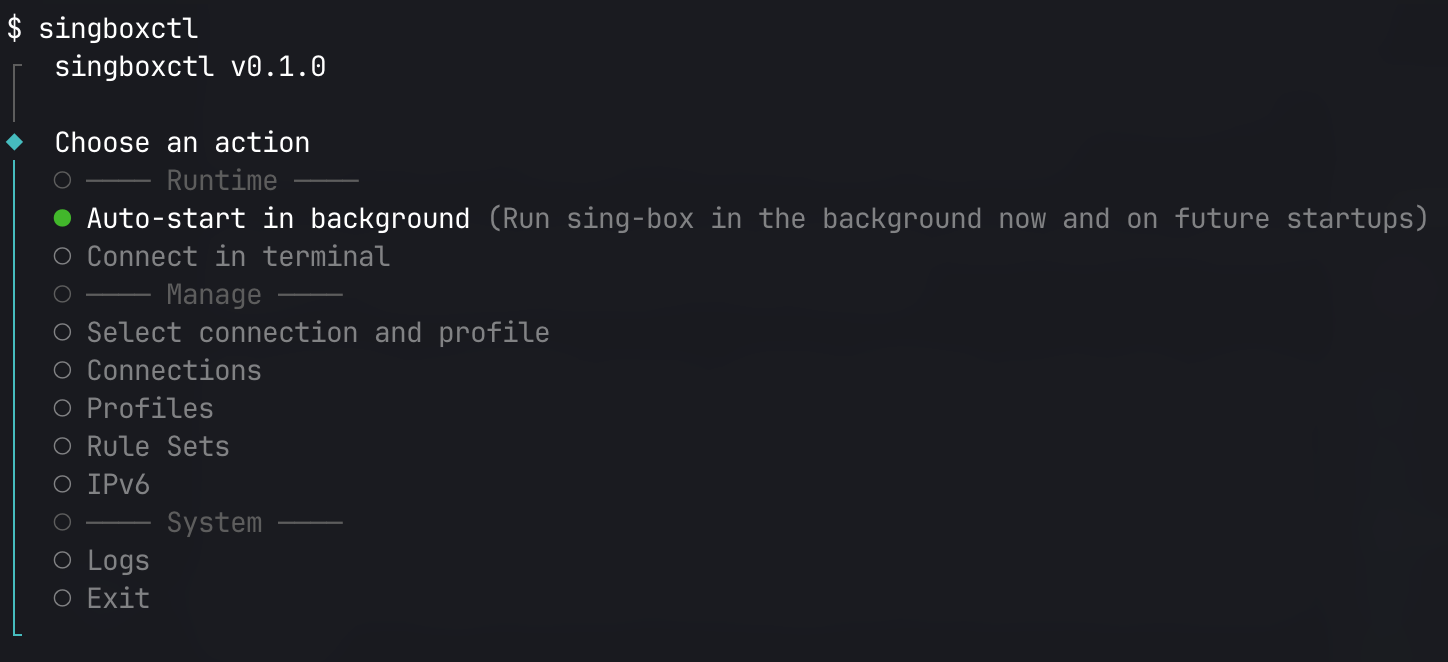
singboxctl is a TUI for managing:
- Xray-compatible connection URIs
- routing profiles
sing-boxmatch rules
Current Limitations
- Supported operating systems: macOS and Linux
- Connection import currently supports a narrow subset of these URI protocols:
vless://trojan://hysteria2://tuic://naive+https://naive+quic://
- Supported rule formats are currently
domain:...,domain_suffix:..., andip_cidr:... - Unsupported URI or rule features fail explicitly instead of being guessed
Supported URI subset
VLESS
Currently supported:
type=tcpsecurity=none|reality- REALITY with
flow=xtls-rprx-vision
Unsupported VLESS features fail explicitly.
Trojan
Currently supported:
type=tcpsecurity=reality- REALITY with required
pbkandsni - optional
sid - optional
fp
For Trojan URIs, the password is read from the URI userinfo segment:
trojan://<password>@example.com:443?...
Provider links in the wild may also include extra Trojan parameters such as spx. Provider-link fields are documented separately from guaranteed generated sing-box runtime support: if a field is not listed above in the supported subset, do not assume it is applied to config.json just because it appears in a provider URI.
Currently, spx is accepted with a warning and is not applied to the generated sing-box config.
Unsupported Trojan features fail explicitly.
Hysteria2
Currently supported:
security=tls- optional
sni alpn=h2|h3
For Hysteria2 URIs, the auth value is read from the URI userinfo segment:
hysteria2://<auth>@example.com:443?...
Provider links in the wild may also include extra Hysteria2 parameters such as fp. Provider-link fields are documented separately from guaranteed generated sing-box runtime support: if a field is not listed above in the supported subset, do not assume it is applied to config.json just because it appears in a provider URI.
Unsupported Hysteria2 features fail explicitly.
TUIC
Currently supported:
- TUIC v5 userinfo
tuic://<uuid>:<password>@example.com:443?... - optional
sni - optional
alpn(comma-separated) - optional
congestion_control=cubic|new_reno|bbr - optional
udp_relay_mode=native|quic allow_insecure=0(insecure TLS is rejected)
TLS is always enabled. TUIC requires sing-box 1.4.0 or newer.
Unsupported TUIC features fail explicitly.
Naive
Currently supported:
naive+https://andnaive+quic://- username and password in URI userinfo
- optional
sni - optional
extra-headers - optional generated
udp_over_tcp: truewhen enabled duringSelect connection and profile
For Naive URIs, the auth values are read from the URI userinfo segment:
naive+https://<username>:<password>@example.com:443?...
Provider links in the wild may also include extra Naive parameters such as padding. Provider-link fields are documented separately from guaranteed generated sing-box runtime support: if a field is not listed above in the supported subset, do not assume it is applied to config.json just because it appears in a provider URI.
Currently, padding is accepted with a warning and is not applied to the generated sing-box config.
Unsupported Naive features fail explicitly.
Install
Install the CLI globally:
npm install -g singboxctlPrerequisites
macOS
- Install Homebrew: https://brew.sh/
- Install
sing-boxwith:
brew install sing-boxLinux
- Install
sing-boxusing its official package instructions: https://sing-box.sagernet.org/installation/package-manager/ - Background service management requires a running systemd and
systemctl. - Non-root service management requires
sudo. - Opening files and directories requires
xdg-open, usually provided byxdg-utils.
singboxctl installs and manages its own singboxctl.service system service. If the package-provided service is active, disable it first to avoid competing TUN interfaces:
sudo systemctl disable --now sing-boxRun
Start the TUI with:
singboxctlOr start sing-box directly with the currently applied config:
singboxctl connectGenerate a config for a specific profile using the active connection:
singboxctl generate main
singboxctl generate main ./artifacts/router-config.json
The optional output path creates missing parent directories. Generation requires the saved active connection and requested profile, but does not require the local sing-box runtime, change the active profile, or restart the service.
If sing-box is not available yet, the app will show an error with installation hints.
Current Menu
The current TUI includes:
Auto-start in backgroundConnect in terminalSelect connection and profileConnectionsProfilesRule SetsIPv6Logs
Notes
Connectionsstore raw Xray-compatible URIs.Rule Setsstore named groups of rules. The rule-set file name is the source of truth for the rule-set name.Profilesselect which rule sets should be active.Select connection and profilevalidates the selected connection with the built-in URI parsers, writes a generated TUN config to~/.config/singboxctl/config.json, and refreshes the running service when needed.generate <profile> [output-path]uses the active connection and writes the selected profile's config to the standard path or an explicit path without changing the active selection.Connect in terminalstartssing-boxin the foreground using the currently applied~/.config/singboxctl/config.jsonand prints logs in the current terminal. This is mainly useful for debugging.Logsopens or clears/var/log/singboxctl.logand lets you change thesing-boxlog level. On Linux, the file opens through the default desktop application registered withxdg-open.Auto-start in backgroundenables or disables runningsing-boxin the background now and on future startups.