
stellar-pay
v0.1.16
Published
Stellar payments layer for agents: a pay.sh-shaped client (curl that answers 402s with a Stellar wallet, x402 + MPP) over a probed catalog of Stellar-payable APIs. Private while the lane is new.
Downloads
1,155

Maintainers
 stellarlight
Readme
Try it now
A real on-chain payment, with play money, in one command — no wallet, no passphrase, no signup:
npx stellar-pay curl https://stellar-pay-sandbox.fly.dev/data --yes --sandboxWith --sandbox and no wallet configured, it makes a throwaway testnet
keypair, has friendbot fund it, and pays. That wallet is unencrypted and
deliberately ungated because there is nothing to protect — testnet, play
money. For anything real, stellar-pay setup --save main seals a key in the
encrypted keystore, and on mainnet a missing wallet is simply an error:
nothing is ever auto-created there.
The payment settles on Stellar testnet for real — the output carries the stellar.expert link, so you can go look at it. The sandbox is our own paid endpoint, priced in native XLM so a friendbot-funded wallet can pay it immediately (no trustline, no faucet) with the seller sponsoring fees.
Or read a live MAINNET 402 without a wallet, spending nothing:
npx stellar-pay offers https://apiserver.mpprouter.dev/v1/services/exa/search -X POST -d '{"query":"stellar"}'Or hand the whole toolkit to an agent:
npx stellar-pay claude # Claude Code with the payment + work tools mountedBefore agent-to-agent commerce goes mainstream, human-to-agent commerce is the wedge: people paying agents to complete real work. That takes more than a payment rail — it takes funding an agent safely, hiring one you don't trust, verifying what it did, paying on the verdict, and keeping evidence of all of it. stellar-pay is that loop as a CLI, an MCP server, and a library — neutral (no gateway, no operator's cut) and self-custody: your keys, and a spend policy you write that refuses before it signs.
Precisely, because the distinction matters: on mainnet, spend is bounded by that policy file — per-host allowlists and per-call ceilings enforced in this process, not by a platform's servers and not by the chain. The smart-account vault does put a cap on-chain, but it caps draws from the vault, in XLM, on testnet. Anyone who tells you their agent's spending is chain-enforced should be asked which account the payment actually leaves.

What you can use today, plainly. The payment client is the product:
paying 402s (x402 + MPP), the probed catalog, the wallet, the spend policy and
the run proxy all work on mainnet, and that is what npm install
stellar-pay gives you. The work layer below — jobs, agreements, bounties,
the vault, payment channels — is testnet-only, because it reuses contracts
that are not audited (see docs/ECOSYSTEM-ASKS.md).
It is real and proven end to end, and it is a preview, not something to run a
business on this week. Direction and the quality bar live in
docs/SPINE.md.
💵 Pay for any API
Both live Stellar payment standards, one client:
- x402 — the
exactscheme (spec), settled through a facilitator. - MPP, Stellar charge method — draft-stellar-charge-00, SDF's spec. No facilitator; the server settles.
On a 402, stellar-pay reads the price, token, recipient and network from the challenge and signs authorization entries, not a whole transaction — the server (or its facilitator) assembles, submits, and pays the fee. Your wallet holds USDC and nothing else: no XLM, no sequence numbers, no RPC.
stellar-pay offers <url>                      # what the 402 asks — pays nothing
stellar-pay curl   <url>                      # asks you, pays, returns the answer
stellar-pay curl   <url> --yes --max-usd 0.05 # unattended, under a ceiling
stellar-pay verify <url>                      # seller check: is your 402 correct and Stellar-payable?
Router-agnostic by design. A router (like mpp-router) proxies many APIs behind one gateway and takes the payment itself — real supply, and the largest source in our catalog. stellar-pay sits above all of them: it pays any host from the user's own wallet — mpp-router, the x402 Bazaar, a provider serving its own 402 — with no gateway in the middle, no operator's cut, no lock-in.
Sessions: pay per call, off-chain (testnet)
Per-request settlement is the floor. For a busy agent loop, a one-way payment channel deposits once and then pays each call with an off-chain signed commitment — measured ~10× faster per call, and the deposit is your maximum exposure to that seller, enforced by the channel contract:
stellar-pay session open <url> --deposit 5   # one on-chain deposit (default 5 XLM)
stellar-pay curl <url> --session             # each call pays OFF-CHAIN
stellar-pay session status                   # cumulative committed, per host
stellar-pay session close <url>              # settle; the funder's refund is verified
The client's cumulative baseline persists across restarts, so a replayed process can't be tricked into re-signing from zero.
Wrap any tool — stellar-pay run
curl pays for requests you make. run pays for requests made by a tool we
didn't write — curl, a Python script, another agent's client:
stellar-pay run --yes --max-usd 0.05 -- curl -X POST https://apiserver.mpprouter.dev/v1/services/exa/search -d '{"query":"stellar"}'
stellar-pay run -- python my_script.py        # any command; its 402s get paid
It starts a localhost proxy, points the child at it (HTTPS_PROXY + a local
CA the child alone trusts, never installed system-wide), and routes every
request through the same pay loop: on a 402 it reads the offer, pays, retries
— the tool just sees the 200. The proxy is gated by a per-run auth token, its
CA key lives only in memory, and it dies with the command.
🤝 The work layer — escrowed jobs (testnet preview)
Paying per-request is the floor. The layer above it is work: hiring an agent you don't trust, or earning as one. The primitive is an escrowed job under a hash-committed agreement — money escrows before work starts, the terms are pinned on-chain, evidence is judged by a declared policy, and payment follows the verdict, with no platform in the middle.
Verification bounties are the first application built on that primitive, not the point of it: they are a job whose evidence contract is a checklist, so they are the easiest shape to demo end to end. The same escrow, agreements and resolver underneath serve any job with a checkable deliverable.
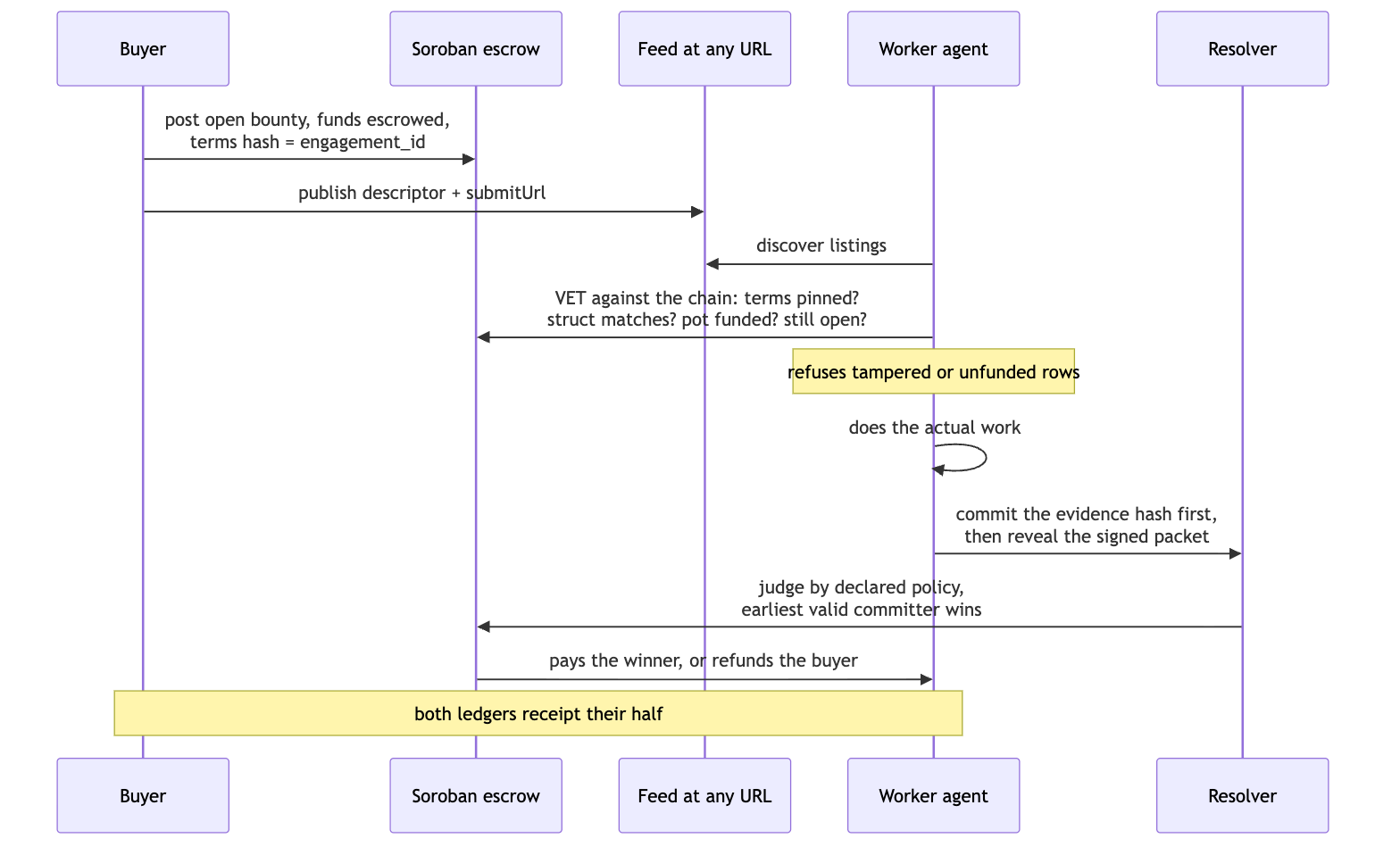
A buyer posts and escrows, a worker discovers and proves the work, a resolver judges by the declared policy — the full command set is in Using stellar-pay:
stellar-pay bounty post … --out bounty.json   # author the terms
stellar-pay bounty open bounty.json           # escrow + fund BEFORE a winner exists
stellar-pay bounty list --from <feed-url>     # worker: vet every listing against the CHAIN
stellar-pay bounty commit / pack / watch      # worker: commit, reveal, get paid
stellar-pay bounty resolve … --submissions … --commits …   # resolver settles
What makes this trustworthy without a platform — the four properties that matter more than the verb list:
- Agreements are chain-pinned. The terms document's sha256 is the escrow's engagement id, so a worker re-derives the terms from public data and checks them against the chain. A feed that lies about pay or scope is caught before any work is spent — proven: the e2e feeds the worker a tampered listing claiming 10× the pot, and it is refused.
- Funded means funded. The vet asks the token contract what the escrow holds — not the terms, not the feed — and checks who holds the approve and release seats, so a buyer cannot look neutral and pay itself.
- The author of the work wins it. Publish a hash first, reveal later, and the earliest committer wins; someone who only sees the evidence at reveal time cannot overtake them. (Signatures alone can't do this — the unit suite asserts the thief winning the plain race and losing under commit-reveal.)
- Judgments are declared and receipted, with the policy label and the
evidence the resolver saw. And the escrow itself is a commodity we rent
behind a swappable seam (
src/pay/rails.ts) — today Trustless Work's Soroban escrow, integrated keyless. Their 0.3% settlement fee goes to whatever address the caller supplies, so it is only their fee if you setTW_FEE_ADDRESS— mainnet settlement refuses to proceed without it rather than quietly rebating the fee to the buyer, which is what an unset value used to mean.
Jobs without the bounty wrapper (openJob/fundJob/deliverJob/…) are the
library's lower layer — same escrow, same agreements, custom terms.
🔐 Fund an agent: the vault (testnet)
Handing an agent a funded key is how budgets die. The vault inverts custody: bulk funds live in a smart account the human owns; the agent's key can only draw float under a cap the chain enforces.
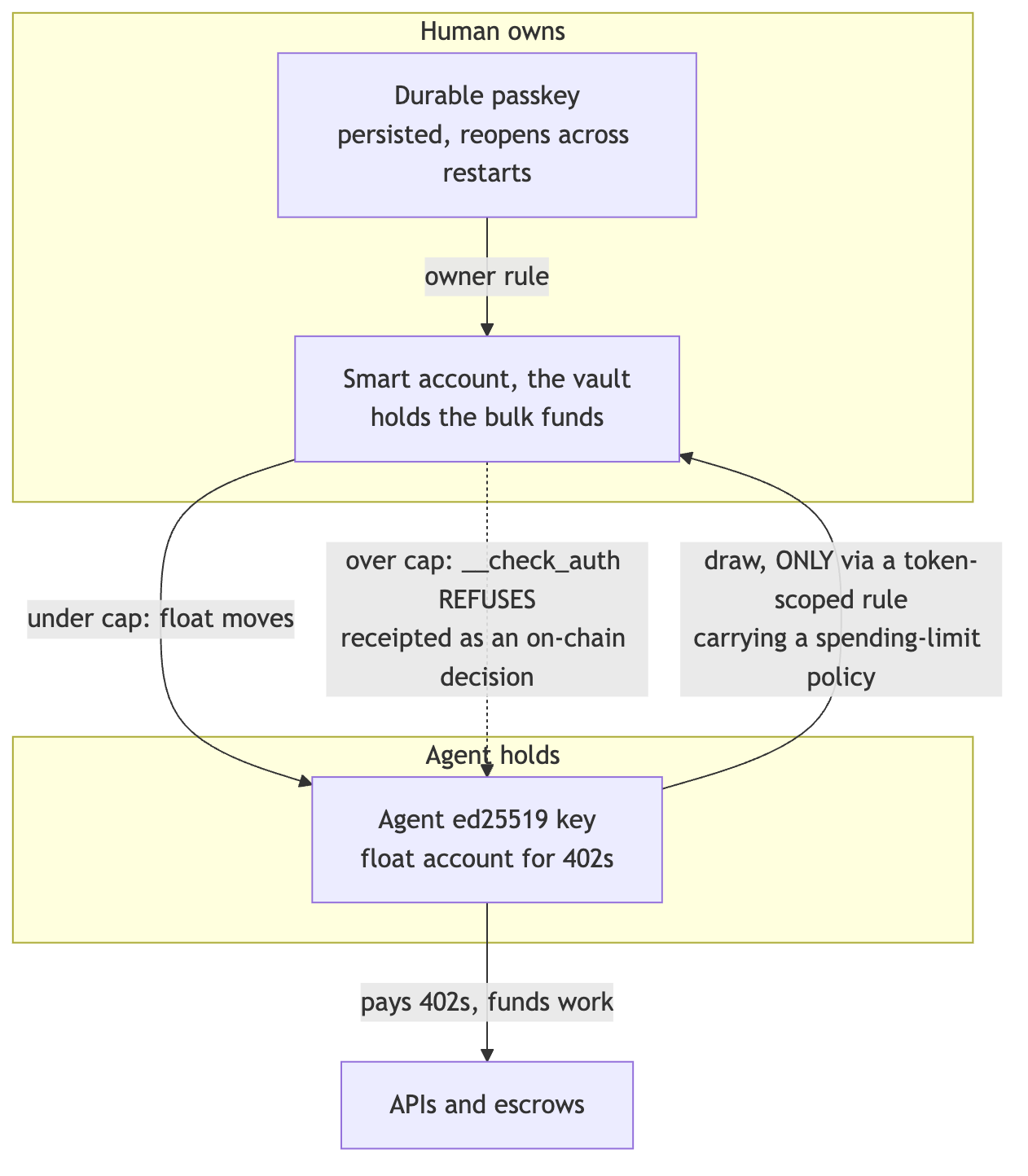
stellar-pay vault create --cap-xlm 5    # deploy; owner = durable passkey, agent = THIS wallet
stellar-pay vault topup --amount-xlm 20 # bulk funds behind the cap (a plain SAC transfer)
stellar-pay vault draw  --amount-xlm 2  # agent pulls float; over-cap → REFUSED BY THE CHAIN
stellar-pay vault status
The contrast that matters, stated precisely: a hosted platform's spending
limit is a policy promise enforced by its own servers — Circle's is a good
one, and their MPC wallets are not simply "they hold your keys". Ours is a
property of the contract (__check_auth): the refusal is a transaction
anyone can verify, and it holds even if every server we run disappears. Proven
end-to-end: create → topup → draw → pay a real 402 from the drawn float →
over-cap draw refused on-chain → reopen from persistence
(test:vault-flow). Built on SDF's
smart-account-kit and
OpenZeppelin's contracts — we author no Soroban contracts, anywhere.
🧾 Receipts: the evidence substrate
Every step above — payments, refusals, jobs, judgments, bounty income, vault draws — lands in a local, content-addressed ledger:
stellar-pay receipts                    # the ledger
stellar-pay receipts check              # integrity: ids re-derive, links resolve, no unreadable lines
stellar-pay receipts --verify <id>      # prove a row against Horizon (tx + credited effects)
Row ids are sha256 of the row's content, refs chain rows into attributions
(open → fund → deliver → resolved), and each row's prev links it to the one
before — so a deleted row, not just an edited one, is caught.
What this does and does not prove. receipts check detects editing,
deletion, reordering and corruption. It cannot defend the file against its own
owner: anyone who can write it can rewrite it whole and recompute every id and
link consistently. The real anchor for a payment is the chain —
receipts --verify <id> proves the row against Horizon, and that check needs
nothing of ours. Treat the ledger as the index and Horizon as the witness.
This ledger is deliberately the substrate reputation will be built from — see
Not built yet.
✅ Everything here is checkable
Most agent-payment tooling asks you to believe a README. This one is built so you don't have to — every claim below has a command next to it, and none of them require our cooperation.
| Claim | Check it yourself |
|---|---|
| the catalog is fresh | curl …/catalog.json \| jq '[.[].lastCheckedAt] \| min' — every row carries its own probe date |
| a listed endpoint really pays | stellar-pay verify <url> — the same validator the probe runs, pointed wherever you like |
| a payment happened | stellar-pay receipts --verify <id> — proves the row against Horizon; needs nothing of ours |
| the ledger wasn't edited | stellar-pay receipts check — ids re-derive, links resolve, corrupt lines are reported |
| our formats are real | specs/vectors/ — regenerate with npm run vectors, or recompute a hash with sha256 and no code of ours at all |
| the code does what it says | 18 offline suites in CI. Six carry a recorded negative control — run against the pre-fix tree and observed to fail: grep -r "NEGATIVE CONTROL" src/sandbox/. The other twelve predate that practice and do not claim it |
Where a check would be dishonest, there isn't one. receipts check cannot
defend the file against its own owner — anyone who can write it can rewrite it
consistently — so the README says that and points at Horizon as the real
anchor. The commit timestamp is a signed claim, not an authority; what it
buys is that a cheating resolver becomes detectable, not impossible. The
specs note their own canonicalisation hazard.
Reach without asking permission. The client reads its offers from the live 402 response — body and headers — and picks the protocol from what the seller actually advertises. There is no manifest to publish, no file a provider has to adopt, no registration. If a server speaks x402 or MPP, this pays it today. That is a deliberate trade: less metadata than a signed provider manifest, and no coordination cost, because a payment layer that only works with sellers who adopted your file is a payment layer with no sellers.
📐 The formats, specified
Everything above payment — the bounty descriptor, the agreement whose hash the
escrow pins, the commit, the submission packet, the feed — is specified in
specs/SPEC.md with reproducible test vectors in
specs/vectors/. Preimages, canonicalisation rules, the
ordering rule a resolver must follow, and the checks a worker must run before
doing any work.
The vectors are generated from the implementation through its public entry
point and re-checked in CI, so the published bytes are the bytes we emit. Where
a format has a weakness — the JSON.stringify key-order dependency, a
self-signed timestamp that is a claim rather than an authority — the spec says
so rather than describing the version we wish we had shipped.
Paying the 402 itself is x402 and MPP. Those are other people's specs and we are
a client of them; nothing in specs/ redefines or forks them.
🔍 A catalog that's evidence, not a listing
Registries list endpoints that died months ago, and "supports x402" says
nothing about Stellar: the same standard runs on Base, Solana and Polygon,
and most servers name only those. Measured 2026-08 from the x402 Bazaar: of
its ~1,611 hosts, three named stellar:pubnet. A listing is not supply.
So the catalog probes instead of trusting. An entry appears in the default
view only if it answered a real 402, on a network this catalog claims, and
was re-probed within the last 48 hours — carrying its price, protocol, the
method that produced the challenge, the networks it actually named, and how
long it has been alive. (48 hours, not 24, so a single missed daily probe is
not an outage. The one deliberate exception is our own testnet sandbox,
marked curated, so newcomers have something to pay.)
What that actually amounts to, stated properly. The published snapshot holds 1,261 rows across 5 distinct hosts, 749 of which accept Stellar, and every row was re-probed today. Two gateway hosts account for 1,226 of those rows. So this is deep coverage of a handful of sellers, not broad coverage of the ecosystem — the row count is a count of payable endpoints, and quoting it as if it were a count of independent providers would be the same sleight-of-hand we call out in registries. (This README previously said "about 390 endpoints", which matched neither number.) Supply on Stellar is genuinely thin right now; the catalog's job is to tell you exactly how thin, with dates, rather than to look bigger than it is.
Verify any of it yourself, without asking us:
curl -s https://raw.githubusercontent.com/Stellar-Light/stellar-pay/catalog/catalog.json \
  | jq '{rows: length,
         hosts: [.[].host] | unique | length,
         stellar: [.[] | select(.acceptsStellar)] | length,
         oldest_probe: [.[].lastCheckedAt] | min}'
Every row carries lastCheckedAt. A catalog without per-row dates cannot be
audited for staleness at all — you have to take its word — which is why that
field matters more here than the row count does.
Being in the catalog means it answered a Stellar 402 at the last probe —
strictly better than a registry listing, and still short of a guarantee.
Roughly 8% of live rows fail a strict check (stellar-pay verify <url>
is the same validator our probe uses, and the honest second opinion): a host
can rotate its price, change asset, or go down between probes. The live 402
is always the authority — curl re-reads it and pins the payment to what you
approved, so a stale row costs you a refusal, never a wrong payment.
Using the catalog needs no secret — it's a public feed anyone can pull:
https://raw.githubusercontent.com/Stellar-Light/stellar-pay/catalog/catalog.jsonThe daily job publishes the snapshot to the catalog branch; the client
fetches that URL over plain HTTPS — no token, no account. Aggregators and
other agents are welcome to ingest it — every row carries its evidence.
🤖 For agents: MCP, Claude Code, Raven
stellar-pay claude            # Claude Code with stellar-pay mounted
stellar-pay codex             # Codex with stellar-pay mounted
claude mcp add stellar-pay -- stellar-pay mcp   # or register it yourself
stellar-pay mcp               # raw stdio server for Cursor, goose, or your own client
26 tools, grouped by job:
| group | tools |
|---|---|
| discover & pay | search_catalog, get_catalog_entry, list_catalog, curl |
| wallet | get_balance, send_usdc (two-step confirm, single-use server nonce), get_history |
| governance | begin_task / end_task, spend_report |
| sessions | session_open, session_status, session_close (+ curl{session:true}) |
| hire | bounty_post, bounty_assign, bounty_open, bounty_dispute, bounty_resolve, bounty_status |
| earn | bounty_feed, bounty_pack, bounty_submit (directed), bounty_submit_packet, bounty_watch |
| fund | vault_draw, vault_status |
The agent-facing playbook — including the Earning loop — is
skills/stellar-pay/SKILL.md.
Who approves what: the CLI asks a human before it signs (or --yes
--max-usd N to authorize unattended); the MCP signs only within a spending
policy — on mainnet a payment must be USDC, under a per-call ceiling
(STELLAR_PAY_MAX_USD_PER_CALL), and inside a session budget
(STELLAR_PAY_SESSION_BUDGET_USD). When the MCP client supports
elicitation, a payment the policy refuses on price is put to the person
driving the agent rather than failing silently; a denied host or a network
mismatch is never escalated, because those are operator decisions or attacks,
not judgement calls. Agent-reachable URLs (curl, session_open,
bounty_feed, bounty_submit_packet) all pass one SSRF guard —
loopback/private/link-local targets are refused.
Per-host spend policy. Beyond the flat ceiling, an optional policy file
(~/.config/stellar-pay/policy.json, stellar-pay policy init to scaffold)
gives an operator per-host control the flat cap can't — a different ceiling
per host, an outright deny, or allowlist mode where only listed hosts
are payable at all. It applies to every door (CLI curl, run, and the MCP):
{
  "mode": "denylist",
  "default": { "maxUsdPerCall": 0.05 },
  "hosts": {
    "apiserver.mpprouter.dev": { "maxUsdPerCall": 0.10 },
    "*.trusted-provider.com": { "maxUsdPerCall": 0.50 },
    "sketchy.example.net": { "deny": true }
  }
}
A host rule can raise or lower the ceiling; an explicit --max-usd only ever
tightens it. In allowlist mode an autonomous agent can pay only the
hosts you pre-approved.
Spend governance — pay for what's used, not what's asked. Inside a task,
Scrimp (by Kaan Kacar, vendored with
permission) adds outcome-attributed control a budget cap can't match: a
request already bought in this task is replayed free; one re-fetched
inside its freshness window is replayed free; a provider that just failed
repeatedly is quarantined; every purchase is labelled wasted if its
response was never read. spend_report shows spend versus what an ungoverned
client would have paid.
Raven. Raven is the Stellar ecosystem's agent gateway — one MCP that routes an agent's question to the right Stellar service. stellar-pay mounts the same way: catalog search through Raven's routing, paid calls through a wallet under the same spend governance.
💼 Wallet
stellar-pay setup --save main                 # new wallet, sealed in an encrypted local keystore
stellar-pay topup                             # get USDC in: QR + address + live on-ramps; waits for the deposit
stellar-pay cashout                           # get value OUT: live fiat anchors + the exchange route
stellar-pay balance                           # USDC + XLM at a glance
stellar-pay send <G...address|name> --amount 1.5   # send USDC (confirms first); --amount max drains
stellar-pay account export --name main backup.json # 0600 backup; import restores it
stellar-pay history                           # recent payments to/from the wallet
The key never sits in plaintext: the keystore seals it with AES-256-GCM under
a passphrase (STELLAR_PAY_PASSPHRASE for agents and the MCP, an interactive
prompt for humans), or --keychain keeps it in the macOS Keychain — written
over stdin, so it never appears in the process table. Unlocking a
--keychain wallet requires Touch ID (or the login password).
account list / import / default / remove / export manage saved wallets.
STELLAR_SECRET_KEY in the environment still wins when set — handy in CI and
for throwaway testnet keys, but it leaves a raw secret in your shell, so
prefer the keystore for anything funded. run and the agent launchers strip
it from the commands they spawn.
topup shows a SEP-7 QR any mobile Stellar wallet scans (Lobstr, Freighter),
and on mainnet lists live fiat on-ramps — MoonPay card/PayPal, Lobstr, Rozo,
exchange-withdraw routes (Coinbase, Kraken — buy then withdraw on the
Stellar network), the Rozo Intent Bridge for USDC you hold on other chains,
and fiat anchors (MoneyGram cash→USDC and more) pulled live from Stellar
Light's partner directory. topup --buy opens a card on-ramp pre-filled and
waits for the USDC to land.
Using stellar-pay
Each row links to its section — full flags there, not a pointer to the pitch.
| | |
|---|---|
| Pass-through commands | curl, offers, and run -- <anything> |
| Sessions | session open/status/close, curl --session |
| Escrowed jobs | bounty post/assign/open/list/commit/pack/submit/dispute/resolve/watch/status — testnet |
| The vault | vault create/topup/draw/status |
| Receipts | receipts, receipts check, --verify |
| Manage accounts | setup --save, the account family, --account, send, history, topup/cashout |
| Find things to pay for | search over the daily-probed catalog |
| Spend policy | per-host ceilings, deny, allowlist |
| Exit codes & JSON | what to branch on in a script |
Pass-through commands
Same request shape as curl, with 402s handled.
stellar-pay offers <url>                     # read the challenge, pay NOTHING
stellar-pay curl   <url>                     # ask, pay, return the body
stellar-pay curl   <url> --yes --max-usd 0.05  # unattended, under a ceiling
stellar-pay run -- <command> [args…]         # wrap a tool that isn't ours
| flag | meaning |
|---|---|
| -X <METHOD> | HTTP method (-d implies POST) |
| -H "K: V" | extra header, repeatable |
| -d <body> | request body; JSON gets content-type: application/json |
| -i | include response headers in the output |
| --yes | don't prompt — approve anything the policy allows |
| --max-usd <N> | ceiling for this call; can only tighten a host rule |
| --x402 / --mpp | force a protocol instead of letting us pick |
| --session | pay via the host's open channel, off-chain |
| --sandbox | testnet |
| --json | machine output |
| --account <name> | run this one command as another saved wallet |
Find things to pay for
stellar-pay search "web search for a query" --json
stellar-pay search "price data" --limit 3
Searches the catalog — rows carry price, protocol, method and days alive, so you pick on evidence.
Exit codes & JSON
Every command that returns data takes --json — setup, topup, account
and policy init are interactive and print prose. Branch on the code, not the
text:
| code | meaning |
|---|---|
| 0 | ok |
| 1 | runtime failure |
| 2 | usage error |
| 3 | payment refused or declined (incl. losing an open race) |
| 4 | no wallet available |
Building with stellar-pay
The other side: making your own API answer a Stellar 402 so clients like this one can pay it.
1 — Check what you serve. verify is the neutral validator, the same one
our probe uses:
stellar-pay verify https://your-api.example/paid -X POST -d '{}'It checks the things that actually break payment: that you answer 402, that
the challenge parses, that it names a Stellar network, that the asset is a
real SAC (USDC or native XLM — not the string "USDC"), that a recipient and
amount are present, and whether you sponsor fees.
2 — Serve the 402. We do not ship a paywall gateway — on Stellar that
layer is SDF's own. Gate your route with
@stellar/mpp (charge mode) or
@x402/stellar (the exact
scheme).
3 — Copy a working seller. sandbox-server/ is the
real, deployed seller behind the sandbox — MPP charge, channel mode, and
x402 v2 (an unmodified @x402/fetch client pays it). It shows the parts that
are easy to get wrong: sponsoring fees so the buyer needs no XLM, pricing in
a SAC rather than an asset code, and a challenge store that must be shared
across instances.
4 — Get discovered. Anything that answers a live Stellar 402 is picked up
by the daily probe and appears in search for every agent using this client
— no registration, no listing fee. Liveness is the only membership test.
Install
Alpha. From source:
git clone https://github.com/Stellar-Light/stellar-pay && cd stellar-pay
npm install     # .npmrc sets legacy-peer-deps: @x402/stellar and @stellar/mpp pin different stellar-sdk majors; both run on 16
npm run build   # compile to dist/ (the CLI runs from source via tsx without this)
npm link        # puts `stellar-pay` on your PATH (or use `npm run pay -- <args>`)
📦 Use it as a library
The same package is the CLI, the MCP server, and an importable library:
import { payFetch, loadWallet, decide } from "stellar-pay";

const wallet = loadWallet();
const { res, paid } = await payFetch(url, { method: "POST", body }, {
  wallet,
  approve: async (offer, url) =>
    decide(offer, { network: wallet.network, url, requested: 0.05 }).ok,
});
Also exported: the 402 surface (readOffers, offerUSD, verifyEndpoint,
startProxy/proxyEnv, loadCatalog/searchCatalog, buildGoverned,
buildServer) and the work layer — jobs on swappable EscrowRails
(openJob … releaseJob, setRails), agreements
(buildAgreement/agreementHash), resolver policies (resolveJob,
hashMatchPolicy, callbackPolicy), bounty verbs (postOpenBounty,
makeSubmission, pickWinner), the worker loop (fetchFeed, vetListing,
submitPacket, awaitPayout), the vault (createVault/drawFromVault),
channels (openChannel/sessionFetch), and the receipts ledger
(listReceipts, checkLedger, verifyOnChain). Full TypeScript types; the
Mongo indexer is a dev-only dependency, so installing the library doesn't
pull it.
📚 Proof you can run
Every claim above is backed by a runnable check — no real funds touched:
Payments — npm run sandbox (mint a SEP-41 asset, run a local MPP
seller, pay it, check settlement on-chain) · test:mcp (a 402 paid over
stdio, duplicate replayed free) · test:proxy (402 → paid → 200 through
run) · test:x402 (an unmodified @x402/fetch client pays our
sandbox) · test:wallet · test:send · test:keystore · test:scrimp ·
test:ssrf · test:parity (our parser reads pay.sh's own reference
challenge) · test:verify · test:policy · test:pin · test:redirect ·
test:hostile.
Sessions — test:session (channel deploy → 8 off-chain commitments, 10×
per-call vs charge → close, refund verified to the stroop) ·
test:session-ux (the --session flow) · test:mcp-session (the 16
session, bounty and vault tools present; open → pay ×2 → status → close
through the MCP).
Work — test:job (open → fund → deliver → approve → release, payout
exact at amount − 0.3%) · test:resolver (both verdicts: release on match,
refund on mismatch) · test:bounty (a bounty whose work is REAL — live
directory-row verification) · test:bounty-open (the race: sloppy rejected,
a replayed signature rejected, winner paid the pot exactly, and the
re-sign limit asserted rather than glossed) ·
test:marketplace (the thesis as one story: a spawned worker — separate
process, separate key, knowing ONLY a feed URL — refuses a tampered listing,
vets the honest one against the chain, does real work, and is paid exactly
pot − 0.3%; both ledgers carry their halves).
Fund & evidence — test:vault (over-cap transfer refused by the chain) ·
test:vault-flow (create → topup → draw → pay a real 402 from the float →
over-cap refused → reopen from persistence) · test:receipts (tamper check;
on-chain verification) · test:units (36 offline checks on the money-path
functions).
The benchmark we hold ourselves to
Three reference points, honestly scored — the full pay.sh feature-by-feature
table lives in PARITY.md.
| | pay.sh (Solana) | Circle for Agents | stellar-pay |
|---|---|---|---|
| What it is | HTTP 402 client CLI | Custodial platform: funded agent wallets + an x402 API marketplace | CLI + MCP + library: 402 client and a work layer |
| Custody | self-custody (OS keystore, Touch ID) | MPC key shares in Circle's wallet infrastructure — developer-controlled (the developer moves funds) or user-controlled (the user must authorize). Not "Circle holds your keys"; but the spend limits are enforced by their policy engine | self-custody (encrypted keystore / macOS Keychain); caps enforced by the chain (vault) |
| Where a spend limit lives | client-side | Circle's infrastructure — a policy promise, and a good one | the contract's __check_auth — the refusal is a transaction |
| Pay a 402 | ✓ | ✓ | ✓ (x402 + MPP, interop-tested against pay.sh's own reference) |
| Discovery | contributor catalog, CI-probed | curated marketplace | daily-probed public feed — liveness is the only membership test |
| Spend control | budgets/caps | platform policy | ceilings + per-host policy + outcome-attributed governance (Scrimp) + on-chain vault cap |
| Hire / escrow work | — | — | ✓ testnet (escrowed jobs, chain-pinned agreements, policy resolver) |
| Earn as an agent | — | — (sellers list APIs) | ✓ testnet (vet feed → work → signed evidence → paid) |
| High-frequency | subscriptions | Gateway Nanopayments — gasless, sub-cent, batch-settled, mainnet on 12 chains (none of them Stellar), aggregated by Circle's ledger | payment channels, ~10× per call, two-party with no operator (testnet) |
| Reputation | — | announced direction | deliberately not built yet — see below |
| Fiat rails | MoonPay | Circle's own ramps (their strongest card) | linked ramps (MoonPay, exchanges, anchors) — we operate none |
The research this design answers to — agent-coordination theses, Ricardian contracts, ERC-8004-style identity/reputation registries, task-market protocols (ERC-8194/8195), Nookplot's bonded-arbiter model — shows up as design choices, not dependencies: terms pinned by hash to the escrow, evidence bound to the payout address by signature, judgments receipted with their policy, custody kept at the chain. Where a prior art is closest we say so in the module headers.
Not built yet — and why
The honest gap list. Each is a decision, not an oversight. The gaps that are
not ours to fix — blocked on an unaudited contract, a spec that doesn't
exist, or a capability the rails don't expose — are separated out in
docs/ECOSYSTEM-ASKS.md, with what would unblock
each and who owns it.
- Reputation. The most requested layer, and deliberately still a design
phase —
docs/reputation-design-questions.md. A score cheap enough to compute is cheap enough to fake: our own math says wash-trading a 5-XLM-scale history costs ~0.4% of the volume claimed. The bar we set: evidence a future underwriter could price a credit line against, or nothing. Meanwhile every payment, judgment, and bounty income lands in the receipts ledger — the substrate accrues while the design cooks. - Mainnet for the work layer. The escrow, smart-account, and channel contracts we reuse are unaudited (their own READMEs say so). The 402 client and catalog run on mainnet today; jobs/bounties/vault/sessions stay testnet until the audit posture changes. We author no contracts, so our mainnet date is their audit date.
- An operated resolver service. The resolver is a library + CLI you run
yourself. Running it as a neutral hosted service (the "auto service" role)
is the next product on the layer per
docs/SPINE.md— it needs uptime, key custody, and an abuse story before it's honest to offer. - A bounty discovery board. Feeds are self-serve JSON at any URL, vetted client-side against the chain. A hosted board would make us the platform — the thing this project exists to not be. If we ever run one, it will be one feed among many, not the front door.
- ~~Commit-reveal for open races~~ — built. A signature only proves who
authored a packet; anyone who sees the evidence can re-sign the same
content as their own, and that packet is valid by construction. So a worker
publishes a hash first (
bounty commit), reveals the evidence later (bounty pack --nonce), and the earliest committer wins — a thief who first learns the evidence at reveal time has no commit that predates the author's. The unit suite asserts both directions: the thief wins the plain race and loses under commit-reveal. - On-chain submissions for open races. The escrow gates evidence writes by role, so open-claim packets travel out of band (HTTP inbox). An on-chain submission mailbox would need a contract we'd have to author — see the rule above.
- An escrow exit that doesn't need the resolver. A funded escrow can only be released or refunded with the resolver's signature, and the resolver cannot dispute its own escrow. The agreement's deadline now terminates a job (past it with no evidence, the resolver refunds), but if the resolver vanishes the funds stay put. A unilateral after-deadline buyer reclaim is a rails capability we'd have to ask Trustless Work for, not something we can add on our side.
- A bond on submissions. Open races are free to enter, so they can be flooded; deterministic evidence policies mean junk loses, but nothing makes junk costly. A refundable per-submission bond — returned on a valid submission, forfeit on an invalid one — is the narrow version of what the research argues for, and unlike a staked identity it doesn't gate entry. Not built.
- Anything private. The agreement, the review question, and the worker's full evidence document all sit on a public chain in the clear. For paying an agent to work on a private document, customer list, or internal URL, that is disqualifying rather than merely incomplete.
- Sybil resistance in open races. Identities are free, so a race can be flooded. Today's mitigations: deterministic evidence policies (sloppy work loses regardless of volume) and first-valid-wins. The real fix is the reputation layer, which is why its bar is set where it is.
- A fully sealed session store. Half done. The vault owner passkey now
lives in the OS secret store (macOS Keychain / libsecret / Windows DPAPI),
migrated out of
sessions.jsonone-way on first use, and the vault refuses to operate on a machine with no usable store unless you setSTELLAR_PAY_ALLOW_PLAINTEXT_VAULT=1and own that risk. The channel commitment seeds still sit plaintext insessions.json(mode 0600, flagged in the file that writes them); sealing those is queued. The wallet secret itself has always been sealed. - Seller-side session settlement. Our sandbox serves channel mode, but the operator loop (settle-without-close, batch settlement) isn't built — the client side was the wedge.
- Subscriptions / standing delegations. pay.sh has them; we don't. Sessions are the honest primitive for "pay repeatedly without asking" — a delegation UX on top is not designed yet.
- Paying 402s directly from the smart account.
@x402/stellarsigns with classic keys, and the blocker is on the client side: stellar-base'sauthorizeEntryhard-wraps the classic credential shape and rejects aC…address outright, with no override exposed byExactStellarScheme. The reference facilitator already accepts contract-account payers — an earlier version of this bullet had that backwards. Hence the vault→float pattern (bulk funds capped on-chain, small float at the paying key) until the client hook lands upstream; we are askingcoinbase/x402for it, and the wiring on our side is ours to build once it does — not an SDF ask. - x402
uptoscheme. Requires authoring the scheme spec upstream; when it lands in@x402/stellarwe inherit it by bumping the dependency. - Windows Hello / Linux biometric gating; per-signature biometrics in the
MCP. macOS Touch ID works via
--keychain; the others are genuinely not built. - ~~SSE streaming through
run~~ — built. The proxy pipes response bodies through with backpressure instead of buffering them, so a wrapped tool gets the first token when the server sends it.test:streamasserts timing, not style: the first event must beat the last by the upstream's own gap, which a buffering proxy cannot do.
Status
Alpha. Built on Stellar's own rails — @x402/stellar, @stellar/mpp,
SDF's smart-account-kit, Trustless Work's escrow — and on the measurement
that made it necessary: the x402 standard alone does not make an endpoint
Stellar-payable, so the catalog probes instead of trusting. Testnet claims
are proven by the checks above; mainnet claims are limited to what runs
there today.
License
MIT (the stellar-pay code). vendor/ carries third-party code under its own
terms — see vendor/NOTICE.md.