
sunrise-sunset-js
v3.3.1
Published
High-precision sunrise and sunset time calculation using NREL's Solar Position Algorithm

Maintainers
 allx
allxReadme
sunrise-sunset-js
High-precision sunrise and sunset calculation library using NREL's Solar Position Algorithm (SPA).



Interactive Demo
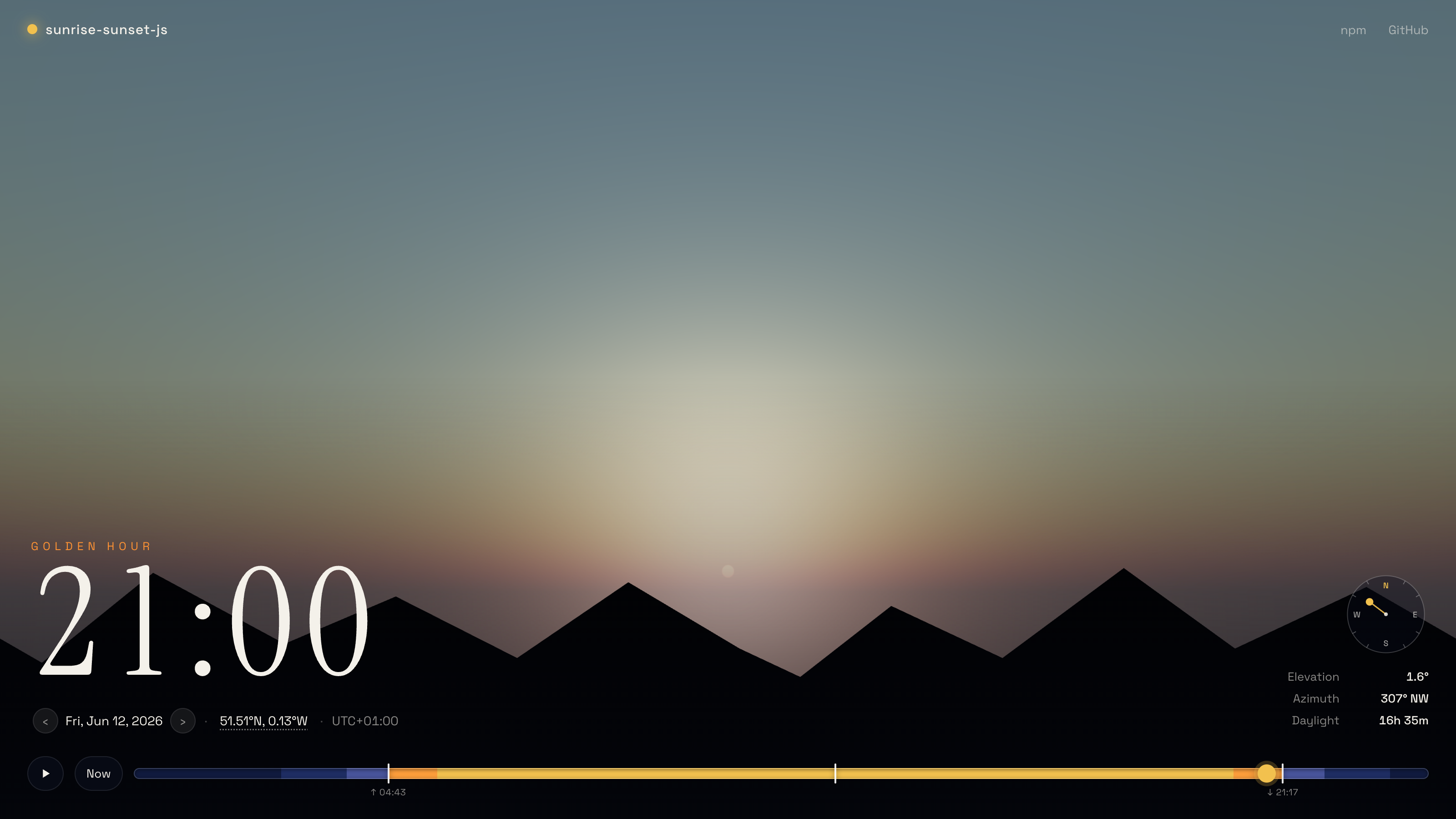
Scrub through a day anywhere on Earth under a physically-based WebGL sky driven by the library's real solar position output. Explore every twilight phase on a 24-hour dial, drag around the "year of light" ring to watch the seasons reshape the day, and share any scene via URL (?lat=…&lng=…&date=…&t=…). Timezones are resolved offline; polar day and night are handled gracefully.
Overview
This library provides accurate solar position calculations with uncertainties of ±0.0003 degrees for dates from year -2000 to 6000. It's based on the National Renewable Energy Laboratory's Solar Position Algorithm (SPA), which offers significantly improved accuracy over simplified algorithms.
Algorithm Reference
The implementation is based on:
Reda, I.; Andreas, A. (2004). Solar Position Algorithm for Solar Radiation Applications. Solar Energy, Vol. 76(5), pp. 577-589.
NREL Technical Report: TP-560-34302, Revised January 2008
Distributed by the National Renewable Energy Laboratory
Solar Radiation Research Laboratory
Features
- ✅ High-precision calculations (±30 seconds accuracy)
- ✅ Advanced twilight detection (Civil, Nautical, Astronomical, Golden, and Blue hours)
- ✅ Proper high-latitude handling (returns
nullduring polar day/night) - ✅ Full TypeScript support with comprehensive type definitions
- ✅ ESM and CommonJS dual package exports
- ✅ Zero dependencies for runtime
- ✅ Extended solar calculations (solar noon, solar position, etc.)
- ✅ Comprehensive timezone support (implicit and explicit)
- ✅ Native Temporal support via
sunrise-sunset-js/temporal - ✅ Tree-shakeable modular architecture
Installation
npm install sunrise-sunset-jsRequirements: Node.js ≥18.0.0
Quick Start
import { getSunrise, getSunset } from 'sunrise-sunset-js';

// Sunrise today in London
const sunrise = getSunrise(51.5074, -0.1278);

// Sunset on a specific date
const sunset = getSunset(51.5074, -0.1278, new Date('2024-06-21'));

console.log(`Sunrise: ${sunrise?.toLocaleTimeString()}`);
console.log(`Sunset: ${sunset?.toLocaleTimeString()}`);
Native Temporal API
The main entrypoint keeps returning JavaScript Date objects for backward compatibility.
If your runtime supports native Temporal, import the Temporal entrypoint instead:
import { getSunTimes } from 'sunrise-sunset-js/temporal';

const times = getSunTimes(
  40.7128,
  -74.0060,
  Temporal.PlainDate.from('2026-05-03'),
  { timezoneId: 'America/New_York' }
);

console.log(times.sunrise?.toString()); // Temporal.Instant
console.log(
  times.sunrise
    ?.toZonedDateTimeISO('America/New_York')
    .toPlainTime()
    .toString({ smallestUnit: 'minute' })
); // Local wall-clock time, e.g. "05:37"
The Temporal entrypoint exports the same function names as the main package:
import {
  getSunrise,
  getSunset,
  getSolarNoon,
  getTwilight,
  getSunTimes,
} from 'sunrise-sunset-js/temporal';
These functions return Temporal.Instant | null instead of Date | null, and the date
argument accepts Date, Temporal.Instant, Temporal.ZonedDateTime,
Temporal.PlainDateTime, or Temporal.PlainDate.
Native Temporal is required only when calling sunrise-sunset-js/temporal. The main
sunrise-sunset-js entrypoint still works in Node.js 18+ and returns Date values.
Temporal with geo-tz
sunrise-sunset-js does not depend on timezone boundary data. In Node.js or server-side
code, you can derive the IANA timezone from latitude/longitude with a package such as
geo-tz:
npm install sunrise-sunset-js geo-tzimport { find } from 'geo-tz';
import { getSunTimes } from 'sunrise-sunset-js/temporal';
const latitude = 40.7128;
const longitude = -74.0060;
const timezoneId = find(latitude, longitude)[0]; // "America/New_York"
const times = getSunTimes(
latitude,
longitude,
Temporal.PlainDate.from('2026-05-03'),
{ timezoneId }
);
const sunriseClockTime = times.sunrise
?.toZonedDateTimeISO(timezoneId)
.toPlainTime();
console.log(sunriseClockTime?.toString({ smallestUnit: 'minute' }));API Reference
getSunrise(latitude, longitude, date?, options?)
Calculate sunrise time for a given location and date.
Parameters:
latitude(number): Latitude in decimal degrees (-90 to 90)longitude(number): Longitude in decimal degrees (-180 to 180)date(Date, optional): Date to calculate for (defaults to today)options(SpaOptions, optional): Additional calculation options
Returns: Date | null
- Returns
Dateobject with sunrise time - Returns
nullduring polar night (sun never rises)
Example:
// Basic usage
const sunrise = getSunrise(40.7128, -74.0060); // New York City

// Specific date
const summerSolstice = getSunrise(
  51.1788,
  -1.8262,
  new Date('2024-06-21')
); // Stonehenge

// High-latitude location during polar night
const arcticWinter = getSunrise(
  69.6496,
  18.9560,
  new Date('2024-12-21')
); // Tromsø, Norway
console.log(arcticWinter); // null (polar night)
getSunset(latitude, longitude, date?, options?)
Calculate sunset time for a given location and date.
Parameters: Same as getSunrise()
Returns: Date | null
- Returns
Dateobject with sunset time - Returns
nullduring polar day (midnight sun)
Example:
const sunset = getSunset(40.7128, -74.0060);

// During midnight sun period
const arcticSummer = getSunset(
  67.9323,
  13.0887,
  new Date('2024-06-21')
); // Reine, Norway
console.log(arcticSummer); // null (midnight sun)
getSolarNoon(latitude, longitude, date?, options?)
Calculate solar noon (sun transit) - when the sun reaches its highest point in the sky.
Returns: Date | null
Example:
const solarNoon = getSolarNoon(51.5074, -0.1278);
console.log(`Solar noon: ${solarNoon?.toLocaleTimeString()}`);
getSolarPosition(latitude, longitude, date?, options?)
Calculate the sun's position in the sky at a given time.
Returns: SolarPosition | null
interface SolarPosition {
  zenith: number;           // Zenith angle (0° = directly overhead)
  azimuth: number;          // Azimuth angle (0° = North, 90° = East)
  azimuthAstro: number;     // Azimuth westward from South (astronomical)
  elevation: number;        // Elevation angle above horizon
  rightAscension: number;   // Right ascension (degrees)
  declination: number;      // Declination (degrees)
  hourAngle: number;        // Local hour angle (degrees)
}
Example:
const position = getSolarPosition(51.5074, -0.1278);

if (position) {
  console.log(`Azimuth: ${position.azimuth.toFixed(2)}°`);
  console.log(`Elevation: ${position.elevation.toFixed(2)}°`);
  console.log(`Zenith: ${position.zenith.toFixed(2)}°`);
}
getTwilight(latitude, longitude, date?, options?)
Calculate twilight times (civil, nautical, and astronomical).
Returns: TwilightTimes | null
interface TwilightTimes {
  civilDawn: Date | null;           // Sun at -6° (before sunrise)
  civilDusk: Date | null;           // Sun at -6° (after sunset)
  nauticalDawn: Date | null;        // Sun at -12°
  nauticalDusk: Date | null;        // Sun at -12°
  astronomicalDawn: Date | null;    // Sun at -18°
  astronomicalDusk: Date | null;    // Sun at -18°
  goldenHour: {                     // Sun between 6° above and horizon
    morning: { start: Date | null, end: Date | null };
    evening: { start: Date | null, end: Date | null };
  } | null;
  blueHour: {                       // Sun between horizon and 4° below
    morning: { start: Date | null, end: Date | null };
    evening: { start: Date | null, end: Date | null };
  } | null;
}
Example:
const twilight = getTwilight(51.5074, -0.1278);

if (twilight) {
  console.log(`Civil dawn: ${twilight.civilDawn?.toLocaleTimeString()}`);
  console.log(`Civil dusk: ${twilight.civilDusk?.toLocaleTimeString()}`);
  console.log(`Astronomical dawn: ${twilight.astronomicalDawn?.toLocaleTimeString()}`);
}
getSunTimes(latitude, longitude, date?, options?)
Get all sun times in a single efficient calculation.
Returns: Object with all sun times
interface SunTimes {
  sunrise: Date | null;
  sunset: Date | null;
  solarNoon: Date | null;
  twilight: TwilightTimes | null;
}
Example:
const times = getSunTimes(51.5074, -0.1278);

console.log('Sunrise:', times.sunrise);
console.log('Solar Noon:', times.solarNoon);
console.log('Sunset:', times.sunset);
console.log('Civil Dawn:', times.twilight?.civilDawn);
console.log('Civil Dusk:', times.twilight?.civilDusk);
Options
All functions accept an optional SpaOptions parameter:
interface SpaOptions {
  temperature?: number;    // Temperature in °C (default: 15)
  pressure?: number;       // Atmospheric pressure in mbar (default: 1013)
  deltaT?: number;         // Earth rotation correction in seconds (default: 67)
  elevation?: number;      // Observer elevation in meters (default: 0)
  timezone?: number;       // Explicit timezone offset in hours (e.g. -5). Takes precedence over timezoneId
  timezoneId?: string;     // IANA Timezone ID used to resolve the local date and UTC offset when timezone is omitted
  atmosphericRefraction?: number; // Refraction at horizon in degrees (default: 0.5667)
}
Returned values are JavaScript Date objects, which always represent absolute instants.
If you want to display the result in a specific timezone, format it with Intl.DateTimeFormat
or toLocaleString(..., { timeZone: 'America/New_York' }).
Example:
// Calculate for high-altitude location
const sunrise = getSunrise(
  27.9881, // Everest Base Camp
  86.9250,
  new Date(),
  {
    elevation: 5364,      // meters above sea level
    temperature: -10,     // °C
    pressure: 500         // mbar (lower at altitude)
  }
);
Usage Examples
Browser Integration with Geolocation
import { getSunrise, getSunset } from 'sunrise-sunset-js';

navigator.geolocation.getCurrentPosition((position) => {
  const { latitude, longitude } = position.coords;

  const sunrise = getSunrise(latitude, longitude);
  const sunset = getSunset(latitude, longitude);

  console.log(`Sunrise at your location: ${sunrise?.toLocaleTimeString()}`);
  console.log(`Sunset at your location: ${sunset?.toLocaleTimeString()}`);
});
Annual Solar Events
import { getSunrise, getSunset } from 'sunrise-sunset-js';

function getAnnualSolarEvents(latitude: number, longitude: number, year: number) {
  const events = [];
  const startDate = new Date(year, 0, 1);

  for (let day = 0; day < 365; day++) {
    const date = new Date(startDate);
    date.setDate(startDate.getDate() + day);

    const sunrise = getSunrise(latitude, longitude, date);
    const sunset = getSunset(latitude, longitude, date);

    if (sunrise) events.push({ type: 'sunrise', date: sunrise });
    if (sunset) events.push({ type: 'sunset', date: sunset });
  }

  return events;
}

// Get all sunrise/sunset times for 2024 in London
const events = getAnnualSolarEvents(51.5074, -0.1278, 2024);
Day Length Calculation
import { getSunrise, getSunset } from 'sunrise-sunset-js';

function getDaylightHours(latitude: number, longitude: number, date: Date) {
  const sunrise = getSunrise(latitude, longitude, date);
  const sunset = getSunset(latitude, longitude, date);

  if (!sunrise || !sunset) {
    // Polar day or polar night
    return sunrise === null && sunset === null ? 0 : 24;
  }

  const milliseconds = sunset.getTime() - sunrise.getTime();
  return milliseconds / (1000 * 60 * 60); // Convert to hours
}

const hours = getDaylightHours(51.5074, -0.1278, new Date('2024-06-21'));
console.log(`Daylight hours on summer solstice: ${hours.toFixed(2)}`);
Golden Hour Detection
import { getSunrise, getSunset, getSolarPosition } from 'sunrise-sunset-js';

function isGoldenHour(latitude: number, longitude: number, date: Date): boolean {
  const position = getSolarPosition(latitude, longitude, date);

  if (!position) return false;

  // Golden hour: sun elevation between 0° and 6° above horizon
  return position.elevation > 0 && position.elevation < 6;
}

const now = new Date();
if (isGoldenHour(51.5074, -0.1278, now)) {
  console.log('Perfect time for photography! 📸');
}
Project Structure
src/
├── index.ts                    # Main API exports
├── temporal.ts                 # Native Temporal API exports
├── types.ts                    # TypeScript type definitions
├── constants.ts                # Physical constants & periodic terms
├── spa.ts                      # Main SPA calculation orchestrator
├── calculations/
│   ├── earth.ts               # Earth heliocentric position
│   ├── sun.ts                 # Geocentric sun position
│   ├── nutation.ts            # Nutation & obliquity calculations
│   ├── observer.ts            # Topocentric corrections
│   └── rts.ts                 # Rise/Transit/Set calculations
└── utils/
    ├── date.ts                # Julian day conversions
    ├── time.ts                # Time conversion utilities
    └── math.ts                # Mathematical helpers
Testing
The library includes comprehensive test coverage:
# Run tests
npm test

# Run tests in watch mode
npm run test:watch

# Generate coverage report
npm run test:coverage
Test suite includes:
- ✅ Basic sunrise/sunset calculations
- ✅ High-latitude edge cases (polar day/night)
- ✅ Solar noon calculations
- ✅ Solar position accuracy
- ✅ Twilight time calculations
- ✅ Timezone handling
- ✅ All sun times in single call
Migration from v2.x
The v3.0.0 release brings significant improvements but maintains backward compatibility for basic usage:
Breaking changes:
- Node.js 18+ required (was Node 8+)
- Returns
nullinstead of incorrect dates during polar day/night - Slightly different times due to improved algorithm accuracy (±30 seconds vs ±1-2 minutes)
What stays the same:
getSunrise()andgetSunset()function signatures unchanged- Still works in browser and Node.js
- TypeScript support (now with strict types)
New features:
// v2.x - only sunrise/sunset
const sunrise = getSunrise(lat, lng);
const sunset = getSunset(lat, lng);

// v3.0 - extended API
const solarNoon = getSolarNoon(lat, lng);
const position = getSolarPosition(lat, lng);
const twilight = getTwilight(lat, lng);
const allTimes = getSunTimes(lat, lng); // Single efficient call
Build & Development
# Install dependencies
npm install

# Build the library
npm run build

# Type check
npm run type-check

# Run all checks (type-check + build + test)
npm run prepublishOnly
Build outputs:
dist/index.js- ESM bundle with source mapsdist/index.cjs- CommonJS bundle with source mapsdist/index.d.ts- TypeScript declarationsdist/temporal.js- ESM Temporal subpath bundledist/temporal.cjs- CommonJS Temporal subpath bundledist/temporal.d.ts- Temporal subpath declarations
Algorithm Details
Why SPA?
The previous version used a simplified USNO algorithm with ~1-2 minute accuracy. The NREL SPA algorithm provides:
- Higher accuracy: ±30 seconds vs ±1-2 minutes
- Wider date range: Year -2000 to 6000 (vs 1900-2100)
- Better high-latitude handling: Proper polar day/night detection
- More comprehensive: Includes nutation, aberration, atmospheric refraction
Calculation Flow
1. Julian Day Calculation (date.ts)
   ↓
2. Earth Heliocentric Position (earth.ts)
   - Longitude, latitude, radius vector
   - ~250 periodic terms for precision
   ↓
3. Geocentric Sun Position (sun.ts)
   - Apply nutation corrections
   - Calculate apparent position
   ↓
4. Observer Corrections (observer.ts)
   - Topocentric adjustments
   - Atmospheric refraction
   ↓
5. Rise/Transit/Set Times (rts.ts)
   - Solve for horizon crossing
   - Handle polar day/night cases
Accuracy Factors
The algorithm accounts for:
- Earth's elliptical orbit
- Axial precession and nutation
- Atmospheric refraction
- Observer elevation
- Temperature and pressure effects
- Gravitational aberration
Development
To run the interactive demo locally:
cd demo
npm install
npm run dev
The demo will be available at http://localhost:5173.
License
MIT
Contributing
Contributions welcome! Please open an issue or submit a pull request.
Acknowledgments
- NREL (National Renewable Energy Laboratory) for the SPA algorithm
- Ibrahim Reda & Afshin Andreas for their comprehensive research paper
- Original library contributors for establishing the foundation
References
- Reda, I.; Andreas, A. (2004). "Solar Position Algorithm for Solar Radiation Applications." Solar Energy, 76(5), 577-589.
- NREL Technical Report TP-560-34302 (Revised January 2008)
- NREL Solar Position Algorithm
Version 3.1.4 - Enhanced with full SPA implementation and extended twilight data.