
teevi
v2.7.1
Published
Allows unit testing of ES6 modules without additional dependencies right in your browser.

Maintainers
 shaack
Readme
Teevi
Tired of installing hundreds of dependencies just to run unit tests? Teevi is the essence of unit testing in JavaScript.
It allows unit testing of ES6 modules without additional dependencies, right in your browser. Teevi has almost the same syntax as Mocha with Chai but is a hundred times smaller. The whole framework is one file, src/teevi.js, with about 200 lines of plain ES6.
Demo: http://shaack.com/projekte/teevi/test/
Why Teevi
- Zero dependencies. Teevi has no dependencies, not even dev dependencies. Nothing to install, nothing to update, no
node_moduleswith thousands of files. - No build step. Tests are plain ES6 modules that run as they are. No bundler, no transpiler, no config file.
- Runs in the browser. Your code is tested in the environment it is written for, with a real DOM, real events and real timers.
- Familiar syntax.
describe,itandassertwork like in Mocha and Chai, so there is nothing new to learn. - Headless if you want.
npm testruns the same tests in headless Chrome, for CI or a pre-commit hook, see Running tests headless.
Installation
Via npm:
npm install --save-dev teeviIn the browser, import it by path, for example ../node_modules/teevi/src/teevi.js. Bundlers and Node resolve the bare specifier teevi through the exports field in package.json.
Or just copy src/teevi.js into your project. It is a single file without imports.
Quick start
- Create a test script, for example
test/MyTest.js
import {describe, it, assert} from "../node_modules/teevi/src/teevi.js"

describe("Teevi test demo", () => {
    it("will not fail", () => {
        assert.true(2 * 2 === 4)
    })
    it("will fail", () => {
        assert.equal(4 + 2, 42)
    })
})- Create a
test/index.htmlthat imports your test scripts and runs them
<!DOCTYPE html>
<html lang="en">
<head>
    <meta charset="UTF-8">
    <title>Tests</title>
</head>
<body>
<script type="module">
    import {teevi} from "../node_modules/teevi/src/teevi.js"
    import "./MyTest.js"
    teevi.run()
</script>
</body>
</html>- Open
test/index.htmlin your browser
Browsers do not load ES6 modules from file:// URLs, so serve the project over http. Any static server will do, for example npx serve or the one built into your IDE.
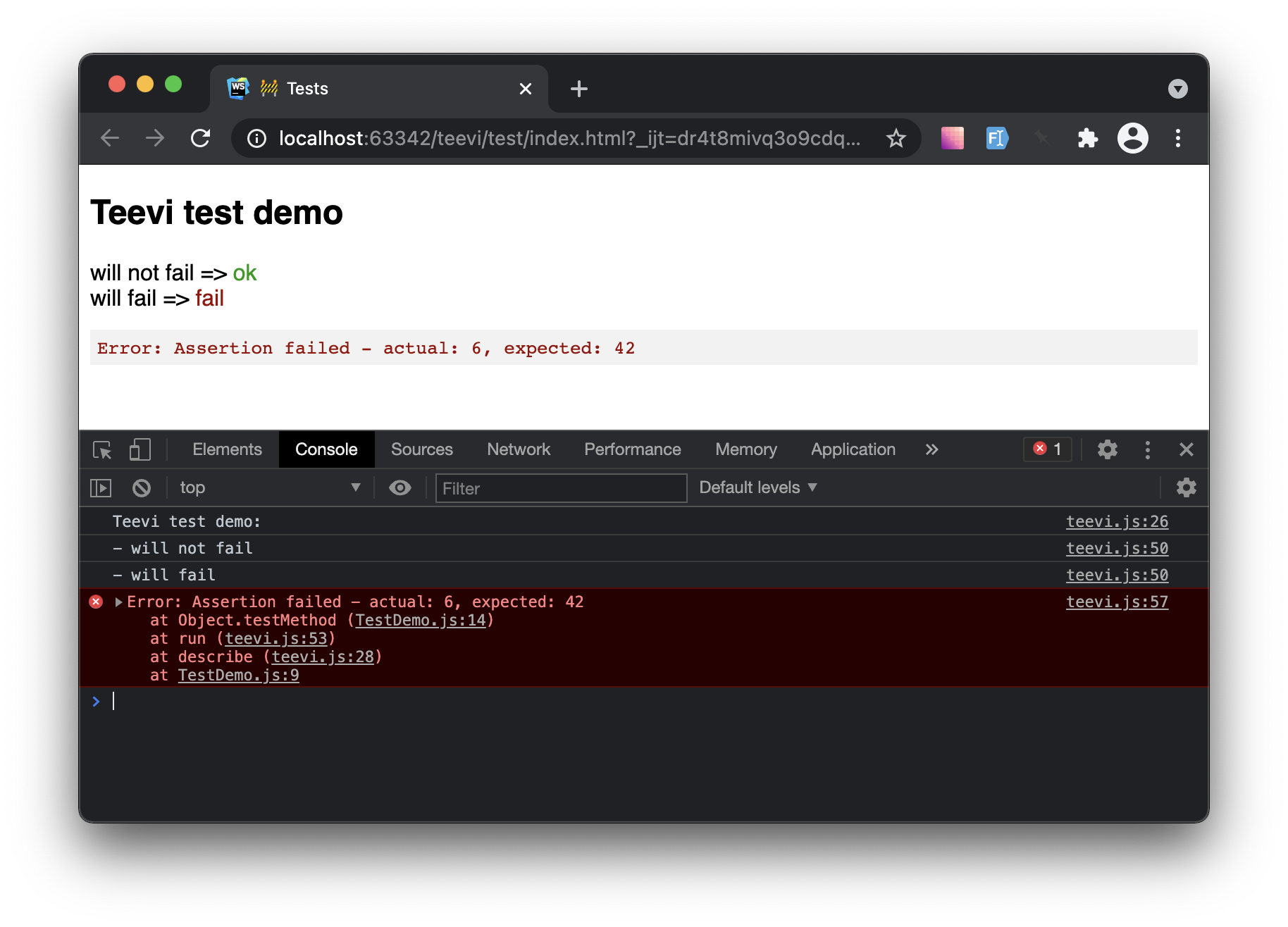
How it works
Importing a test script queues its tests. describe() runs its callback immediately, which calls it() for every test case, and it() pushes the test to an internal list. Nothing is executed yet.
teevi.run() then walks through that list and runs the tests one after the other. Every test is awaited, so an async test has finished before the next one starts. Results are rendered to document.body and mirrored to the browser console.
When all tests are done, Teevi appends a summary line to the page, green "All N tests passed" or red "N tests, X passed, Y failed", and teevi.run() resolves with {total, passed, failed, skipped}. While tests stream in, the viewport scrolls to the latest result, so long suites stay readable.
API
teevi.run(options)
Runs all queued tests and returns a Promise that resolves with {total, passed, failed, skipped} when the last test is done. total counts the tests that ran, skipped tests are not included. Calling it a second time logs a warning and returns the Promise of the first run instead of running everything twice.
| Option | Default | Meaning |
|---|---|---|
| timeout | 0 | Fail a test that takes longer than this many milliseconds. 0 disables the timeout. |
Without a timeout, an async test that never resolves blocks the whole run without any output. In CI it is a good idea to set one.
const result = await teevi.run({timeout: 5000})
console.log(result.failed === 0 ? "green" : "red")
describe(name, fn)
Groups tests under a heading. fn is called immediately and should contain the it() calls of the group.
describe("Chessboard", () => {
    it("should create a board", () => {
        // ...
    })
})
You can use as many describe() blocks as you like, also across multiple test files.
it(name, fn)
Defines a test case. The test passes when fn returns without throwing. If fn returns a Promise, Teevi waits for it, see Testing async code.
it.only(name, fn)
Works like it(), but once at least one it.only() exists, only the tests defined with it.only() are run. All other tests are skipped. This is useful while working on a single failing test.
it.only("the test I am working on", () => {
    // only this test runs
})
Do not forget to change it back to it() afterwards.
it.skip(name, fn)
Defines a test that is not run. It shows up grey as "skipped" in the output and in the summary, so it is not forgotten like a commented out test would be.
it.skip("drag and drop on touch devices", () => {
    // not implemented yet
})
assert
All comparisons are strict (=== and !==). The message parameter is optional and defaults to "Assertion failed".
| Assertion | Passes when |
|---|---|
| assert.fail(message) | never, always fails |
| assert.true(condition, message) | condition is truthy |
| assert.false(condition, message) | condition is falsy |
| assert.equal(actual, expected, message) | actual === expected |
| assert.notEqual(actual, notExpected, message) | actual !== notExpected |
| assert.throws(fn, message) | calling fn() throws |
| assert.rejects(promiseOrFn, message) | the Promise rejects, or calling the async function throws. Returns a Promise, so await it |
assert.equal() and assert.notEqual() print both values in the failure output, so you see what went wrong without adding a message. Objects and arrays are printed as JSON, not as [object Object].
it("should compare values", () => {
    assert.equal(board.getPiece("e1"), "wk", "white king on e1")
    assert.notEqual(board.getPiece("e2"), undefined)
    assert.throws(() => JSON.parse("{"), "invalid JSON should throw")
})
Because assert.equal() is strict, objects and arrays are compared by reference. To compare their content, compare a serialized form, for example assert.equal(JSON.stringify(actual), JSON.stringify(expected)).
Testing async code
Return a Promise from the test, or make the test function async. Teevi awaits it before running the next test.
With an async function, assert works as usual. A thrown assertion rejects the Promise and the test fails.
it("should load a position", async () => {
    await board.setPosition("rnbqkbnr/pppppppp/8/8/8/8/PPPPPPPP/RNBQKBNR")
    assert.equal(board.getPiece("e1"), "wk")
})
To check that async code fails, use assert.rejects(). It takes a Promise or a function that returns one and must be awaited.
it("should reject an invalid FEN", async () => {
    await assert.rejects(board.setPosition("not a fen"), "invalid FEN should reject")
    await assert.rejects(() => board.setPosition("not a fen"))
})
If you construct the Promise yourself and the check happens in a callback, for example in setTimeout or an event handler, an exception thrown there is not caught by the Promise. Call reject() instead of assert in that case.
it("should test async", () => {
    return new Promise((resolve) => {
        setTimeout(() => {
            // `resolve`, if test succeeds
            resolve()
        }, 500)
    })
})
it("should fail async", () => {
    return new Promise((resolve, reject) => {
        setTimeout(() => {
            // in callbacks use `reject()`, not `assert`
            reject("failed, because of testing")
        }, 500)
    })
})
Testing DOM components
Because the tests run in a real browser, you can test components that render to the DOM. Put a container into test/index.html and let your test create the component in it.
<div id="TestBoard"></div>
<script type="module">
    import {teevi} from "../node_modules/teevi/src/teevi.js"
    import "./TestChessboard.js"
    teevi.run()
</script>
import {describe, it, assert} from "../node_modules/teevi/src/teevi.js"
import {Chessboard} from "../src/Chessboard.js"
describe("Chessboard", () => {
it("should render an svg into the container", () => {
new Chessboard(document.getElementById("TestBoard"))
assert.true(document.querySelector("#TestBoard svg") !== null)
})
})cm-chessboard uses Teevi this way, its test suite is a good real-world example.
Running tests headless
The same test/index.html can run in headless Chrome, for example in CI or in a pre-commit hook. Teevi ships the runner as the command teevi. It needs puppeteer, which is not a dependency of Teevi, so both stay dependency-free. Install puppeteer globally instead of adding it to your package.json:
npm install -g puppeteerThen make teevi the test script of your project:
{
  "scripts": {
    "test": "teevi"
  }
}
Now npm test runs your suite headless and fails when a test fails. Without puppeteer it fails with a hint how to install it, so nothing is silently green.
The runner
- starts a tiny static http server on a free port, serving your project root, because ES6 modules do not load from
file:// - resolves puppeteer from the global npm root (or from the project, if it is installed there) and launches headless Chrome
- opens
test/index.htmland waits for the element#teevi-summarythatteevi.run()appends when all tests are done - prints the summary and the failed tests to the console and exits with code 0 when all tests passed, code 1 when a test failed, and code 2 when the test page, puppeteer or its Chrome is not available
Example output:
10 tests, 4 passed, 6 failed, 1 skipped
  FAIL: will fail → fail Error: Assertion failed actual: 6 expected: 42
  FAIL: should fail when no error is thrown → fail Error: should have thrown an error
  FAIL: should render <b>HTML</b> in test names & messages as text → fail Error: this <i>tag</i> must be shown literally
  FAIL: should fail by timeout → fail Error: timeout after 2000ms
  FAIL: should fail when the promise does not reject → fail Error: should have rejected
  FAIL: should fail async → fail failed, because of testing
The runner takes two environment variables:
| Variable | Default | Meaning |
|---|---|---|
| TEEVI_TEST_PAGE | /test/index.html | path of the test page, relative to the project root |
| TEEVI_TIMEOUT | 30000 | milliseconds to wait for the page to load and for the summary to appear |
TEEVI_TEST_PAGE=/test/other.html TEEVI_TIMEOUT=60000 npm testWhen the summary does not appear in time, for example because a test module has a syntax error, an import returns 404 or a test never resolves, the runner prints what it collected on the page, uncaught errors, failed requests and console errors, and exits with code 1:
No test summary after 30000ms. The test page did not load, or a test never finished.
Hint: pass a timeout to teevi.run({timeout}) to make hanging tests fail with their name.
  HTTP 404: http://127.0.0.1:54313/test/DoesNotExist.js
  request failed: http://127.0.0.1:54313/test/DoesNotExist.js net::ERR_ABORTED
If puppeteer is installed but its Chrome download is missing, the runner says so and points you to npx puppeteer browsers install chrome. Pass a timeout to teevi.run() in your test page, otherwise a hanging test only shows up as a timeout of the runner itself, without the name of the test.
DOM markers for your own tooling
If you prefer to write your own runner, for example with Playwright, Teevi marks its output in the DOM:
| Selector | Meaning |
|---|---|
| h2.teevi-describe | a describe() heading |
| div.teevi-test.teevi-pass | a passed test |
| div.teevi-test.teevi-fail | a failed test, contains a pre with the error |
| div.teevi-test.teevi-skip | a test defined with it.skip() |
| #teevi-summary | the summary line, present once all tests are done, with data-total, data-passed, data-failed and data-skipped |
Example: GitHub Actions
name: tests
on: [push, pull_request]
jobs:
  test:
    runs-on: ubuntu-latest
    steps:
      - uses: actions/checkout@v4
      - uses: actions/setup-node@v4
        with:
          node-version: 22
      - run: npm ci
      - run: npm install -g puppeteer
      - run: npm test
Running the Teevi tests
Teevi tests itself with test/TestDemo.js. Open test/index.html in your browser, or run npm test with a global puppeteer. Six of the ten demo tests fail on purpose and one is skipped, to show how that looks.
Projects using Teevi
- cm-chessboard, a lightweight SVG chessboard
- cm-chess, a chess library with PGN and variations support
- cm-pgn, a PGN parser
Changelog
- 2.7.1 The runner serves
.wasmasapplication/wasmand.binasapplication/octet-stream. Without the type the browser refuses to compile a WebAssembly worker, so tests with an engine or a binary fixture never finished. - 2.7.0 The headless runner is now the command
teevi, installed with the package. Put"test": "teevi"into yourpackage.jsoninstead of copyingtest/headless.mjs. It serves the current working directory and complains when the test page is missing. - 2.6.0
it.skip()shows a test as skipped instead of running it.assert.rejects()as async counterpart ofassert.throws(). The summary and the result ofteevi.run()include the skipped count. Favicon for the test page. - 2.5.1 Headless runner reports page errors, failed requests and console errors when the test page never finishes, and exits with code 2 when Chrome is missing.
TEEVI_TEST_PAGEandTEEVI_TIMEOUT. A secondteevi.run()call is ignored with a warning.assert.equal()andassert.notEqual()print objects and arrays as JSON.exportsfield and corrected repository links inpackage.json. - 2.5.0
teevi.run()returns{total, passed, failed}and accepts{timeout}. Test names and error messages are rendered as text, HTML in them is no longer interpreted. Results carry CSS classes and the summary has the idteevi-summarywith data attributes, for headless runners. New optional headless runnertest/headless.mjs. - 2.4.0 Summary line at the end of the run, auto-scroll while tests stream in.
License
MIT, see LICENSE. Author: Stefan Haack