
three-sdf-loader
v0.6.12
Published
Lightweight loader to convert SDF (V2000) molecular files into THREE.Group for Three.js visualisation.

Maintainers
 jakekinchen
Readme
three-sdf-loader
Convert
.sdf(V2000) molecular files into ready-to-renderTHREE.Groupobjects. Zero patches to Three.js — only public APIs.
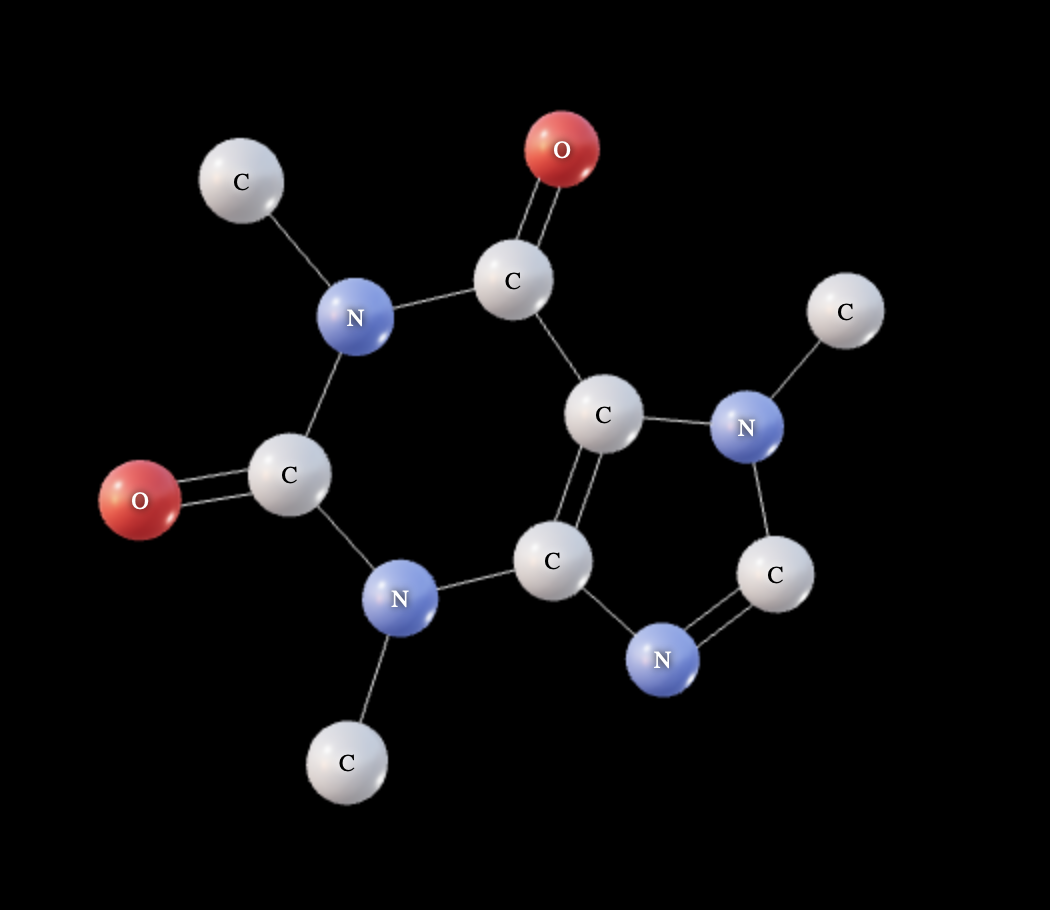
Install
npm install three three-sdf-loaderPeer-dep: Three.js (r151+) must be installed alongside.
Quick usage
import { loadSDF, parseSDF } from 'three-sdf-loader';
import * as THREE from 'three';

const text = await fetch('caffeine.sdf').then((r) => r.text());

// Auto-detects 2-D vs 3-D layout (see next section)
const molecule = loadSDF(text, { showHydrogen: false });

// Example: switch to orthographic camera for purely planar files
if (molecule.userData.layoutMode === '2d') {
  camera = new THREE.OrthographicCamera(
    innerWidth / -2,
    innerWidth / 2,
    innerHeight / 2,
    innerHeight / -2,
    0.1,
    1000,
  );
  camera.position.set(0, 0, 10);
}

scene.add(molecule);

// … render loop …
Options
| Name | Type | Default | Description |
| --------------------- | -------------------------------- | ------- | -------------------------------------------------------------- |
| showHydrogen | boolean | false | Render hydrogens (H) when true. |
| elementColors | Record<string, THREE.ColorRep> | preset | Per-element material colors. |
| elementRadii | Record<string, number> | preset | Per-element sphere radii (in scene units). |
| attachAtomData | boolean | true | Copy each atom record onto corresponding mesh.userData.atom. |
| attachProperties | boolean | true | Copy molecule-level properties onto group.userData. |
| layout | 'auto' \| '2d' \| '3d' | auto | Force 2‑D or 3‑D handling; 'auto' infers from Z‑coordinates. |
| renderMultipleBonds | boolean | true | Render double / triple bonds as parallel lines. |
| renderStereoBonds | boolean | false | When true, render wedge/hash geometry for stereo single bonds; when false, render normal bonds. |
| multipleBondOffset | number | 0.1 | Separation between parallel lines (scene units). |
| addThreeCenterBonds | boolean | true | Infer three-center bonds (e.g., B–H–B bridges in diborane). |
| coordinationMode | 'none'|'transitionOnly'|'all' | transitionOnly | Scope of coordination bond inference. 'all' mirrors older behavior. |
| suppressOppositeChargeCoordination | boolean | true | When inferring coordination, skip links between oppositely charged ions. |
| relFactor | number | 1.4 | Relative factor on closest distance for adaptive thresholding. |
| cutoff | number | 3.0 | Hard minimum distance (Å) for coordination inference. |
| instancing | boolean | false | Use InstancedMesh for atoms. |
| instancedBonds | boolean | false | Use InstancedMesh for cylinder bonds (perf). |
| useCylinders | boolean | true | Cylinder bonds; set false for lines (order‑0 bonds render dashed). |
| useFatLines | boolean | — | Removed. Only classic LineSegments or cylinder bonds are supported. |
| hideIsolatedAtoms | boolean | false | Hide atoms with zero bonds that are farther than cutoff from any neighbor. |
| isolatedAtomCutoff | number | 3.0 | Distance threshold (Å) used when hideIsolatedAtoms is true. |
| style | 'ballStick'\|'spaceFill'\|'licorice' | ballStick | Visual preset adjusting atom/bond scale. |
| palette | 'default'\|'jmol'\|'material' | default | Element color palette; elementColors overrides per-element. |
| materialFactory | (role, default)=>material | — | Hook to override materials by role. |
| coordinateScale | number | 1.0 | Global scale for coordinates (scene units per Å or nm). |
| units | 'angstrom'\|'nm'\|'scene' | angstrom | Input coordinate units. |
| index | number | 0 | For multi-record SDFs, selects which record to load. |
| headless | boolean | false | Parse-only mode; returns chemistry/metadata without geometry. |
| performance.atomSegments | number | 16 | Sphere segments (memoized). |
| performance.bondSegments | number | 8 | Cylinder segments. |
| performance.buildBondBVH | boolean | true | Build BVH for fast line-mode bond picking. |
| performance.usePCANormal | boolean | false | Use PCA for multiple-bond offset direction. |
2-D vs 3-D layout detection
three-sdf-loader now tags every returned THREE.Group with group.userData.layoutMode:
const group = loadSDF(text);      // ← auto-detects layout
console.log(group.userData.layoutMode); // '2d' or '3d'
When the layout is '2d', the loader skips coordination-bond inference to avoid false positives and lets your app decide how to frame the molecule (e.g., swap to an orthographic camera). However, if any metal atoms have zero explicit bonds, coordination inference will still run to fix common cases like ferrocene (honoring coordinationMode). You can override detection with layout: '2d' | '3d' if needed.
Example (browser)
Below is a zero-build browser snippet (ES modules + CDN). It uses the
loadSDF named export and maps dependencies with an import-map so that
sub-modules resolve correctly.
<!-- index.html -->
<script type="importmap">
  {
    "imports": {
      "three": "https://cdn.jsdelivr.net/npm/[email protected]/build/three.module.js",
      "sdf-parser": "https://cdn.jsdelivr.net/npm/[email protected]/+esm"
    }
  }
</script>

<script type="module">
  import * as THREE from 'three';
  import { OrbitControls } from 'https://cdn.jsdelivr.net/npm/[email protected]/examples/jsm/controls/OrbitControls.js';
  import { loadSDF } from 'https://unpkg.com/three-sdf-loader@latest/src/index.js';

  const scene = new THREE.Scene();
  const camera = new THREE.PerspectiveCamera(
    60,
    innerWidth / innerHeight,
    0.1,
    100,
  );
  const renderer = new THREE.WebGLRenderer({ antialias: true });
  renderer.setSize(innerWidth, innerHeight);
  document.body.appendChild(renderer.domElement);

  const controls = new OrbitControls(camera, renderer.domElement);
  controls.enableDamping = true;

  const sdfText = await (
    await fetch(
      'https://pubchem.ncbi.nlm.nih.gov/rest/pug/compound/name/caffeine/SDF?record_type=3d',
    )
  ).text();
  const mol = loadSDF(sdfText);
  scene.add(mol);
</script>

### Lighting tips After loading, swap the default `MeshBasicMaterial` for
`MeshStandardMaterial` to get PBR shading, then add a HemisphereLight +
DirectionalLights: ```js mol.traverse((o) => { if (o.isMesh) o.material = new
THREE.MeshStandardMaterial({ color: o.material.color, metalness: 0.1, roughness:
0.8, }); });
Make sure to enable renderer.physicallyCorrectLights = true and set
renderer.outputEncoding = THREE.sRGBEncoding.
Picking & Metadata
The loader attaches a structured LoadResult to the returned THREE.Group at group.userData.loadResult. It contains stable indices, chemistry arrays, and mappings for picking.
Non‑instanced picking:
const group = loadSDF(sdfText, { showHydrogen: true, useCylinders: false });
const res = group.userData.loadResult; // { metadata, chemistry, mappings, ... }

// Raycast → mesh → atom index
const raycaster = new THREE.Raycaster();
raycaster.setFromCamera(mouse, camera);
const hit = raycaster.intersectObject(group, true)[0];
if (hit?.object?.userData?.role === 'atom') {
  const { index, element } = hit.object.userData.atom; // 0-based index
  console.log(index, element);
}
Instanced picking:
const group = loadSDF(sdfText, { includeHydrogens: true, instancing: true });
const res = group.userData.loadResult;

const hit = raycaster.intersectObject(res.mappings.instancedAtoms.mesh, true)[0];
if (hit && hit.instanceId != null) {
  const atomIndex = res.mappings.instancedAtoms.instanceToAtomIndex[hit.instanceId];
  const atom = res.chemistry.atoms[atomIndex];
}
Notes:
- Indices are 0‑based and align with SDF atom/bond block order.
- Coordinates are in Å by default in
chemistry. Setunits: 'nm'to interpret inputs as nanometers. Visuals can be scaled usingcoordinateScaleor by transforming the returnedGroup.
Bond Metadata (userData.bond)
Each bond cylinder mesh (non-instanced mode) exposes detailed metadata at mesh.userData.bond:
interface BondMeta {
  index: number;           // 0-based bond index
  beginAtomIndex: number;  // 0-based
  endAtomIndex: number;    // 0-based
  order: 1 | 2 | 3 | 4;    // Normalized order for rendering (4 = aromatic)
  originalOrder: number;   // Raw order from molfile/inference (0 = coordination, 4 = aromatic)
  isAromatic?: boolean;    // true when originalOrder === 4
  isCoordination?: boolean;// true when originalOrder === 0 (ionic/coordination bond)
  isBridge?: boolean;      // true when bond is a bridging/three-center bond
  source: 'molfile' | 'inferredCoordination' | 'inferredBridge';
}
Example: detecting coordination bonds for custom styling:
const group = loadSDF(text, { useCylinders: true, coordinationMode: 'all' });
group.traverse((obj) => {
  if (obj.userData?.bond?.isCoordination) {
    // Apply dashed overlay or custom material for ionic bonds
    obj.material = new THREE.MeshBasicMaterial({ color: 0xff6600, wireframe: true });
  }
});
For instanced bonds (instancedBonds: true), metadata is available via:
const { instancedBonds } = group.userData.loadResult.mappings;
if (instancedBonds) {
  const { instanceToBondIndex, bondTable } = instancedBonds;
  // On raycast hit with instanceId:
  const bondIndex = instanceToBondIndex[hit.instanceId];
  const bondMeta = bondTable[bondIndex];
  console.log(bondMeta.isCoordination, bondMeta.source);
}
The chemistry.bonds array also includes these fields for programmatic access.
LoaderOptions (additions)
type LoaderOptions = {
  instancing?: boolean;
  instancedBonds?: boolean;
  headless?: boolean;
  createBonds?: boolean;
  includeHydrogens?: boolean;
  hideIsolatedAtoms?: boolean;
  isolatedAtomCutoff?: number;
  atomGeometry?: { type?: 'icosahedron' | 'sphere'; detail?: number; widthSegments?: number; radius?: number };
  bondGeometry?: { type?: 'cylinder' | 'line'; radius?: number; segments?: number };
  performance?: { skipBondsOverAtomThreshold?: number; atomSegments?: number; bondSegments?: number; buildBondBVH?: boolean; usePCANormal?: boolean };
  onProgress?: (stage: string, value: number) => void;
  coordinateScale?: number;
  units?: 'angstrom' | 'nm' | 'scene';
  palette?: 'default' | 'jmol' | 'material';
  style?: 'ballStick' | 'spaceFill' | 'licorice';
  index?: number;
  materialFactory?: (role: 'atom'|'atomInstanced'|'bondCylinder'|'bondLine'|'bondDashed', defaultMaterial: THREE.Material) => THREE.Material;
};
The existing options remain supported. The group remains structured exactly as before for backward compatibility; the new metadata is available via group.userData.loadResult.
Palettes and data sources
- Default colors are CPK‑ish and inspired by community conventions.
- The
'jmol'palette approximates the Jmol color set. - The
'material'palette provides muted Material‑style hues for UI consistency. - Atomic numbers table covers 1–118 based on periodic table ordering.
You can always override any entry with elementColors.
Recipes
Parse-only (headless) usage
import { loadSDF } from 'three-sdf-loader';

const group = loadSDF(text, { headless: true });
const { chemistry, metadata } = group.userData.loadResult;
console.log(metadata.title, chemistry.atoms.length, chemistry.bonds.length);
Instanced atoms and bonds (performance)
const group = loadSDF(text, {
  includeHydrogens: true,
  instancing: true,        // atoms via InstancedMesh
  instancedBonds: true,    // cylinders via InstancedMesh
});
scene.add(group);
Center and fit to a target radius
const group = loadSDF(text);
// Compute bounds and re-center (and optionally uniform-scale)
group.userData.center('centerAndScale', 5.0); // fit to radius=5 scene units
Bond picking in line mode (BVH-accelerated)
const group = loadSDF(text, { useCylinders: false });
const raycaster = new THREE.Raycaster();
raycaster.setFromCamera(mouse, camera);
const hit = group.userData.pickBond(raycaster, { threshold: 0.05 });
if (hit) {
  console.log('Bond index:', hit.bondIndex, 'Distance:', Math.sqrt(hit.distanceSq));
}
Atom picking (instanced and non‑instanced)
const res = group.userData.loadResult;
const raycaster = new THREE.Raycaster();
raycaster.setFromCamera(mouse, camera);
const hit = raycaster.intersectObject(group, true)[0];
const atomIndex = group.userData.pickAtom(hit); // null if none
Custom materials via materialFactory
const group = loadSDF(text, {
  materialFactory: (role, defaultMat) => {
    if (role === 'atom') return new THREE.MeshStandardMaterial({ color: defaultMat.color });
    if (role === 'bondCylinder') return new THREE.MeshStandardMaterial({ color: 0xaaaaaa, metalness: 0.1, roughness: 0.8 });
    return defaultMat;
  },
});
Multi‑record selection and units
// Select the 3rd record from a multi-record SDF and interpret as nanometers
const group = loadSDF(text, { index: 2, units: 'nm' });