
token-diet-cli
v0.11.1
Published
Static project review + Token-reduction agent for Claude Code workflows: measures, diagnoses, plans, executes, verifies

Maintainers
 kasperchen_npm
Readme
token-diet



Token observability for your AI agents — read your real transcripts, see where the architecture wastes tokens, and restructure it.
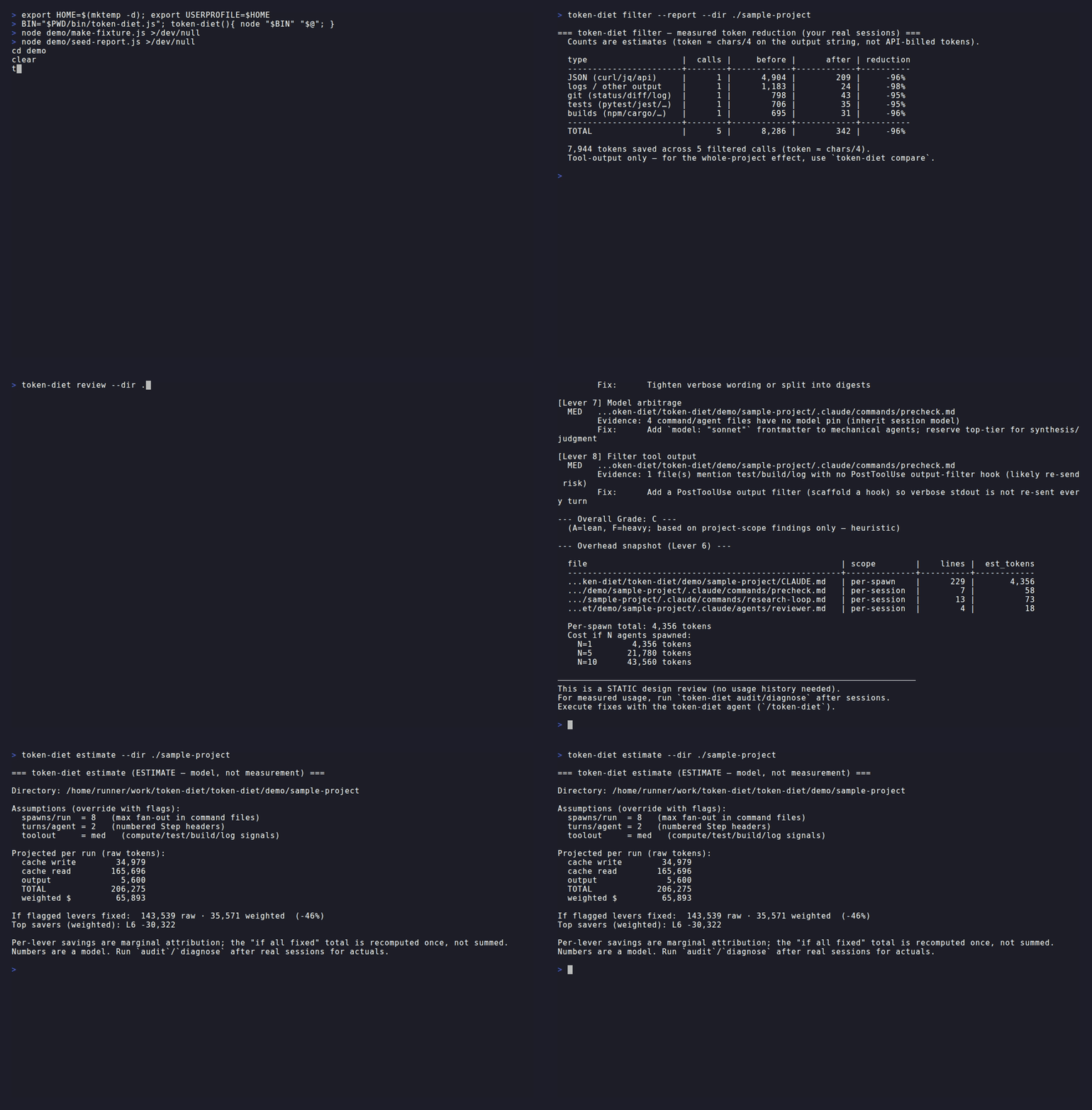
Agentic pipelines burn tokens structurally — too many helper agents, instruction files reloaded every step, results recomputed, verbose output re-sent every turn — because of how they're built, not what they say. token-diet is a Claude Code agent + CLI + skill that measures where your tokens actually go (from real usage logs, not estimates), sorts the waste into 8 levers, and fixes it — moving content to references, never deleting.
Runs entirely on your machine — reads your local transcripts, sends nothing. Zero dependencies. The set-and-forget output filter alone cuts a self-measured −69% of shell output; the bigger win is structural.
It eats its own dogfood — scripts compute, LLM judges: the CLI does every measurement and applies every edit mechanically; the model is used only for keep-or-trim judgment calls.
Try it in 30 seconds
No agent install and no usage history needed — grade any project's Claude Code design against all 8 levers:
npm install -g token-diet-cli
token-diet review --dir .
Lever 1 Delete ceremonial agents 5 findings med
Lever 4 Scripts for determinism 2 findings high
Lever 7 Model arbitrage 1 finding high
Grade: F(Abbreviated — the real output lists all 8 levers with per-finding evidence and an overhead snapshot.) review reads no history and changes nothing — it grades your .claude/ design (CLAUDE.md, commands, agents, skills) A–F and tells you how to cut tokens before you've spent one.
Install the agent — global or project-scoped (your choice)
Install: the npm package is
token-diet-cli(npm's name guard blocked the baretoken-diet) — but the command it installs is justtoken-diet. GitHub install also works (npm i -g github:KasperChenGH/token-diet#v0.11.0) for pinning a release or the bleeding edge.
The CLI is the engine; the /token-diet agent drives it. Pick the scope that fits — they're fully separate, and project-scoped needs no global install at all:
A) Global — one install serves every project on the machine (best for polyglot setups):
npm install -g token-diet-cli   # the CLI, on your PATH (command: token-diet)
token-diet init --global        # agent + subagents + command + skill → ~/.claude/
B) Project-scoped — fully self-contained, no global anything (works in any project, including non-Node like Python):
npx token-diet-cli init   # one-shot: vendors a zero-dep CLI copy into ./.claude/token-diet/
                          #           + installs the agent into ./.claude/
In project mode, init vendors the whole (zero-dependency) CLI into .claude/token-diet/, so the agent and the pre-commit drift gate run it via node .claude/token-diet/bin/token-diet.js — no global binary, no npx per call, no PATH. The pre-commit hook auto-resolves whichever you have: vendored project copy → global → node_modules → npx.
Either way, reload Claude Code, then run /token-diet (or just say "put this project on a token diet").
The project
.claude/files (artifacts and the vendored CLI) are plain text — commit them to give your whole team the exact same setup with zero install, or gitignore them to keep it personal. Global vs. project is decided purely by whether you pass--globaltoinit.
How to use it — two modes
Start with Mode 1 — the structural review is where the real savings are. Mode 2 (the output filter) is an automatic quick-win you can also leave running, but on its own it's the smaller pool. Most people do the review once, then keep the filter on. A companion read-path gate (token-diet readgate) does the same for redundant file re-reads within a session — off by default, audit-first, measured via readgate --report.
Mode 1 · Review — /token-diet (full control)
Run the agent. It measures your real token usage, finds the structural waste (sorted into the 8 levers), and shows you a plan with the expected savings — then stops. Nothing in your project changes until you approve (reply approve all, approve 1,3, or none), and every applied change is a move, never a delete. This is the mode for the big structural wins, where you want to see each trim before it lands.
Mode 2 · Auto — token-diet setup (set-and-forget)
The problem it fixes: the same context gets re-sent to the model on every later turn — noisy command output (a test run, a git diff, a build log) and files an agent re-reads even though they haven't changed. Both quietly inflate your bill. Auto mode runs two background hooks — the output filter (compresses verbose tool output the moment it appears) and the read-path gate (skips redundant in-session re-reads of unchanged files) — so the bloat never piles up. Nothing to review, nothing to activate piece by piece — one command does the whole stack.
Fastest — one command, then reload:
token-diet setup --activate   # wires the filter + readgate AND turns them both live
# → reload Claude Code — verbose output is compressed and redundant re-reads are skipped automatically
That's the whole thing — set-and-forget. Both are fully recoverable: the full original tool output is kept in .claude/toolout/, the gated file stays on disk, and you can token-diet filter --disable / token-diet readgate --disable anytime.
Prefer to preview first? Run token-diet setup without --activate — it wires both hooks in audit (watch-only) mode, changing nothing; check token-diet filter --report and token-diet readgate --report to see what they would cut, then token-diet setup --activate when you're happy.
Structural waste regrows as you work — you add an agent, CLAUDE.md creeps up, new files get re-read — so a one-time /token-diet decays. You shouldn't have to remember to re-run it. So setup records a drift baseline (your current grade) and drops a git pre-commit hook (token-diet review --dir .) that re-grades on every commit. If the grade regresses since your last token-diet run, the commit prints one loud line — "⚠ Structural drift: grade regressed B → C … run /token-diet to re-optimize" — otherwise it stays quiet. So you re-optimize when told, not on a guess. (Add --fail-under C to the hook line to block the commit instead of warning.)
The fix itself stays manual by design: re-optimizing means an LLM editing your files with judgment, so it always goes through /token-diet's approval gate. token-diet auto-detects the drift; you approve the fix.
# MEASURE — where do tokens actually go?
token-diet audit   [--days 7] [--project myapp]   # usage by session-kind × model + heaviest sessions
token-diet agents                                  # useful-work ratio per agent file; flags READING NOT THINKING

# DIAGNOSE — what structural waste exists?
token-diet diagnose                                # red flags mapped to levers
token-diet trace                                   # BEHAVIORAL waste from real transcripts: loops,
                                                   #   retries (measured) + delegation-fit (projected)
token-diet digest                                  # Lever 5: files an agent re-reads, with their token cost

# ACT — turn findings into work
token-diet plan --out diet-plan.md                 # ordered checkbox plan per lever with evidence + savings
token-diet compact [--session id] [--out h.md]     # Lever 2: deterministic {intent,artifacts,next-steps} handover
token-diet route --classify "rename a symbol"      # Lever 7: route a task to a model tier (--scaffold the rules)
token-diet readgate --install                      # Lever 3: PreToolUse read-dedup hook (audit-first)
token-diet init [--global]                         # install the agent + subagents + command + skill

# VERIFY — did it work?
token-diet compare --before-days 14 --after-days 7 # per-day deltas across windows; the re-measure bookend
token-diet burn                                    # 5-hour billing-block view + current-block burn projection
token-diet savings                                 # per-lever/section reduction table; --share for opt-in feedback
Usage is deduplicated per API request (requestId) — Claude Code writes 2–3 transcript lines per call with repeated usage; naive summing inflates totals ~2–3×. This tool counts each call once. The CLI review is entirely static — regex + file-size heuristics, no LLM, no history, returns in milliseconds. LLM judgment (the Sonnet lever specialists, deployed self-contained with inlined rubrics) happens in the /token-diet agent's review phase, not in the review command.
The 8 levers (the methodology)
In leverage order — each shrinks the next:
- Delete agents — every spawn must buy parallelism, isolation, or model-arbitrage worth more than its ~20–40k establishment tax
- Merge sessions — one per cycle; state in files, never conversations
- Evict compute — long commands run in drivers between sessions: zero tokens
- Scripts compute, LLM judges — deterministic kernels emit conclusions
- Tier the knowledge — living doc → digests → archive (
token-diet digestfinds the candidates) - Trim the always-loaded — every spawn pays for it
- Model arbitrage — big model only where judgment lives
- Filter tool output — verbose test/build/log stdout compressed at the source, never re-sent every turn
Estimated saving per lever
These are different mechanisms in different units — don't read them as one stackable %. Each row marks its basis:
- measured — real data
- demonstrated — a worked example
- model — a forward projection from
token-diet estimate(run it for your own numbers) - restructure — project-specific, not token-modeled
| Lever | Typical saving | Basis |
|---|---|---|
| 1 · Delete agents | ~20–40k tokens per removed ceremonial spawn | model |
| 2 · Merge sessions | one cycle's re-sent context per merge | restructure |
| 3 · Evict compute | the idle / compute-adjacent tokens of babysat commands | restructure |
| 4 · Scripts compute | halves the LLM's re-derivation (output ×0.5) — ~−3k weighted tok/run on a representative project | model |
| 5 · Tier knowledge (digests) | a digest replaces N repeated full reads → see Measured reduction | measured + model |
| 6 · Trim always-loaded | reference bulk → a pointer: −80% of the always-loaded file, × every spawn (the largest compounding saver) | demonstrated |
| 7 · Model arbitrage | $-cost only — token-diet route classifies each task to the cheapest safe tier (not raw tokens) | model |
| 8 · Filter tool output | verbose tool output compressed at the source → see Measured reduction | measured |
Lever 6 —
subagent-context-trimmercut a representativeCLAUDE.mdfrom 524 → 104 always-loaded tokens (moved the reference bulk — script catalog, definitions, layout — to a pointer + companion file).- −80% of what every spawn pays, compounding to −4,200 tok/round at 10 agents.
- Move-not-delete; the moved content loads on demand.
On a representative heavy project,
estimateprojects −41% of the per-run bill from the flagged levers combined (top savers: L6, L1, L4).Project-specific — run
token-diet estimate --dir .for your projection,token-diet comparefor the measured result.Bookends: measure first (this CLI), re-measure + adversarial consistency review after. Full methodology with red flags and common mistakes: SKILL.md.
Measured reduction
All numbers on this page are self-measured. They come from the author's own corpus and from token-diet's own committed benchmarks/
--report— not from an independent third party. They use a token≈chars/4 estimate, not API-billed tokens. Treat them as honest, reproducible-on-this-corpus figures, not a vendor guarantee — and runtoken-diet compare/filter --reportto get your own.
Pooled across twelve production codebases (≈389 shell calls), counting only what the default filter actually compresses — shell output (Bash + PowerShell), weighted by token volume (not a min–max over a few runs).
| tool output | what it keeps · what it collapses | reduction |
|---|---|---|
| git — status / diff / log | branch + changed files + diff hunks · unchanged-tree noise | −83% |
| tests — pytest / jest / cargo / go / Pester | failures, tracebacks, the pass/fail summary · passing runs | −86% |
| JSON — curl / jq / --output json / API | every key + error/status values · truncates long arrays, clips long strings | −40% |
| logs / other shell output | dedups repeats · head/tail-elides middles (errors/warnings always kept) | −62% |
| shell total — Bash + PowerShell (the safe default) | the rows above, blended | −69% |
| builds — npm / cargo / docker / tsc / eslint | errors, warnings, the final summary · per-package/layer progress | −86…−98% |
| listings — ls -R / tree / find / du (v0.9) | head + tail + a count · the bulk of entries (errors/permissions always kept) | −50% (fixture; scales up) |
| MCP — mcp__* server responses (v0.9, opt-in) | same structural crush as JSON for JSON bodies · dedup for prose | −40…−95% (JSON engine) |
| file reads — Lever 5, via token-diet digest | one authored digest replaces N repeated full reads | −77%/read (−42% blend is a projection) |
- Structured output compresses hardest (tests/git rival a specialized Rust command-rewriter's ~−80%); the blend is held down by free-form logs, which dominate the volume and have no schema to exploit. Low-call rows (tests, git, JSON) are lightly sampled.
- Per-call, but compounding: each compressed output is re-sent every later turn, so the real effect compounds through
cache_read— your dominant cost. Measure the whole-session result withtoken-diet compare. - builds / JSON vary by output: builds land −86…−98% on verbose tools (quiet-by-default ones show little); JSON lands −40% here but −41% (
npm view react) to −95% on array-heavy API output. listings / MCP are new in v0.9 and demonstrated, not pooled-measured — real numbers populate from your ownfilter --report. - file reads are a separate, opt-in, and far bigger pool:
subagent-digesterturned a real 321-line file into a 740-token digest (−77%/read, measured; the −42% blend is a projection).token-diet comparegives your real multi-session number.
The output filter — config & keep-patterns
The Lever 8 filter (turned on in Mode 2 above) compresses shell output — Bash + PowerShell — by default; Read/Grep are opt-in (better handled by Lever 5 digests) and Task/Edit are left untouched. It is audit-first and the full original output is always kept in .claude/toolout/<ts>.log with a pointer, so nothing is lost.
Generic rules can't know what matters in your output. Add regexes to keep; any matching line is never collapsed.
{
  "enabled": true,
  "mode": "audit",
  "tools": ["Bash", "PowerShell"],
  "keep": ["WARNING", "DEPRECATION", "your-custom-marker"],
  "minTokensToCompress": 1500,
  "minLines": 60,
  "headTail": 20,
  "sidecarRetentionDays": 7
}
| field | meaning |
|---|---|
| mode | audit (record only, output unchanged) or active (compress for real) |
| tools | which tools to compress — ["Bash", "PowerShell"] by default; add "Read"/"Grep" to opt in (then re-run --install to re-sync the hook matcher) |
| keep | regexes whose matching lines are never collapsed |
| minTokensToCompress / minLines | only compress output above this size; smaller output passes through untouched |
| headTail | head/tail lines kept when eliding an oversized middle |
| sidecarRetentionDays | prune full-output sidecar logs older than this |
How it works
A zero-dependency CLI owns every deterministic step — real transcript measurement, overhead quantification (part of review), rule-based waste detection, the plan/changeset skeleton, mechanical edit application, and before/after re-measurement. The LLM is never asked to count, compute, or apply. (The one forward projection, estimate, is labelled a model — not a measurement.)
The /token-diet agent runs in three tiers: the orchestrator (runs as your session model — set it to Opus for synthesis-quality judgment) → an analyst (Sonnet) that measures, plans, and spawns specialists → eight lever specialists (Sonnet; Lever 6 adds an opt-in prose-auditor, so nine files in all) that each judge only their flagged files and return KEEP / MOVE / DISPOSE verdicts. Each specialist is deployed self-contained: init inlines its lever rubric + private professional knowledge + shared contracts into one file, because spawned subagents run in your project dir and can't read companion files at runtime.
token-diet/
├── bin/token-diet.js              CLI entry — subcommands: review · estimate · audit · agents · diagnose ·
│                                  plan · fix · filter · readgate · route · digest · compare · burn · savings · init · setup
├── src/filter.js                  Lever 8 output-compression engine (PostToolUse hook)
├── src/digest.js                  Lever 5 read-digests: finds re-read files, scaffolds, routes (INDEX + pointer)
├── src/readgate.js                Lever 3 read-path dedup (PreToolUse hook)
├── src/router.js                  Lever 7 model-arbitrage rule-table router
├── src/*.js                       the deterministic engine (zero deps, no LLM): scan, collectors,
│                                  review, review-render, estimate, diagnose, plan, changeset, fix,
│                                  compare, burn, savings, history, …
├── skills/
│   ├── SKILL.md                   the 8-lever methodology (the main skill)
│   └── shared/                    knowledge shared across subagents (inlined on install)
├── agents/
│   ├── token-diet.md              tier-1 orchestrator (the /token-diet agent)
│   ├── subagent-analyst.md        tier-2 — measures, plans, spawns specialists, merges
│   └── subagent-<role>.md  ×9     tier-3 lever specialists
├── references/
│   ├── levers/lever-N-*.md  ×8    per-lever judgment rubrics
│   └── subagents/*.md       ×10   per-subagent extra professional knowledge
└── commands/token-diet.md         the /token-diet slash command
Is token-diet for you?
- Built for teams running recurring or multi-agent Claude Code workflows — research loops, CI agents, review bots — where token cost or usage limits actually bite.
- Not for one-off single-prompt scripts where cost is a non-issue, or non–Claude-Code setups: token-diet reads Claude Code's usage transcripts and
.claude/artifacts, so that's what it measures and optimizes. - Domain-neutral. It works at the architecture layer; it was distilled from one project but is tied to none.
token-diet sits above observability
Cost dashboards — ccusage, Langfuse, Helicone — tell you what the bill is. token-diet tells you which agent, session, and lever to cut to lower it, then restructures the workflow and re-measures. It's diagnosis + treatment, not a meter. Use a dashboard to watch spend; use token-diet to reduce it. (token-diet burn even speaks the dashboards' language — a 5-hour billing-block view reconcilable with ccusage.) The defensible difference: every competitor optimizes exactly one axis (output filtering, or routing, or read-dedup); token-diet diagnoses the architecture and restructures across all eight at once.
Measured impact (originating case)
23-round autonomous research loop (Claude Code, Opus + Sonnet): ~1.1M tokens/round → ~100–180k/round, subagent useful-work ratio ~9% → ~40%, two recorded LLM-judgment errors eliminated by the script kernel. The domain contributed nothing — the architecture did.
Privacy & feedback
token-diet runs entirely on your machine and sends nothing by default. It reads your local Claude Code transcripts and writes to your project — no network calls, no account, no analytics.
The one exception is strictly opt-in: token-diet savings --share builds an aggregate-only report (version, OS, a random anonymous install id, your grade, projected + measured reduction % — no paths, names, commands, or code) and prints a pre-filled, public GitHub issue link you choose to submit (or POSTs it if you set TOKEN_DIET_TELEMETRY_URL). Preview the exact bytes with token-diet savings --share --dry-run. Not sharing costs you nothing.
Fidelity guarantee
token-diet measures real transcript usage (not chars/4 estimates) and never trims information irrecoverably — every trim is a move, not a delete: content goes to an on-demand reference file with a pointer left behind.
Contributing
Issues and PRs welcome. The repo is zero-dependency Node — npm test runs the suite (node --test, 191 tests) and CI runs it on Node 18/20/22. Coverage is ~85% of lines overall, and every path that writes a file or rewrites live tool output (the filter, fix, atomic writes, scan, install/setup) sits at 87–100% — the safety-critical surface is where the tests are deepest. Two house rules carry the project's own methodology: keep determinism in the CLI (the LLM only judges), and make every trim a move to a reference, never a delete. By participating you agree to the Code of Conduct; notable changes are tracked in the changelog.
License
MIT — see LICENSE.