
tokseal
v0.3.0
Published
Seal your AI coding usage into a GitHub badge. Local-first token stats, a grade, and a shareable card — your data never leaves your machine.
Downloads
52

Maintainers
 len.choi
Readme
tokseal
Seal your AI coding usage into a badge. tokseal reads your local AI coding sessions, grades how hard you lean on AI, and turns it into a shareable card for your GitHub profile — proof that you build with AI, at a glance.
Local-first: your usage is parsed on your machine. Nothing is uploaded unless you explicitly opt in to the leaderboard.
Live from tokseal.vercel.app, updated a few minutes after every Claude Code session ends.
Three embeddables: a badge (/badge/<user>), a card (/api/card), and a contribution graph (/api/graph).
Every profile page has an Embed panel with Markdown and HTML snippets.
The card's text is drawn from a built-in 5×7 bitmap font, so it looks
pixel-perfect anywhere an SVG renders, including GitHub READMEs, which strip
external web fonts. Themes: pixel (default), dark, light.
  ◆ tokseal  2026-08-02 → 2026-09-07

  Grade      A-  (top 29%)
  Tokens     14.0B
  Est. cost  $8.3K
  Active     34 days   Sessions 28   Messages 47.2K

  By model
    claude-opus-5              $5.8K  31084 msgs
    claude-fable-5             $1.8K  12736 msgs
AI contributions: green squares, but for tokens
Commits measured effort when humans typed every line. tokseal's bet is that the honest signal now is how much you build with AI, so it gives you a per-day token graph for your README, next to the classic contribution grass.
- All-time history on the server.
tokseal submituploads per-day aggregate counts and the server merges them by date, so your record survives Claude Code's default 30-day transcript cleanup. - Minutes-fresh README.
tokseal loginoffers to install a Claude CodeSessionEndhook that re-submits after every session (debounced, silent). The graph and card are cached for 5 minutes. - A 30-day grade. The letter is computed over a rolling 30-day window and recomputed server-side, so people with different log retention are comparable and the client can't just claim an S.
- Streak. Consecutive active days, shown on the graph and ranked on the hi-score board.
[](https://tokseal.vercel.app/u/LenChoi)
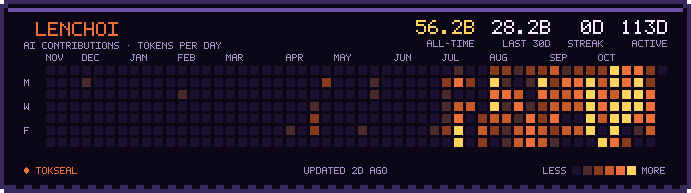
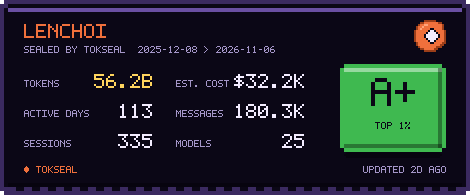Badge options: ?style=flat, ?metrics=grade,tokens,streak,days, ?label=….
Quick start
npx tokseal            # your usage summary and grade (local only)
npx tokseal login      # opt in: GitHub sign-in → auto-submit hook → first submit, in one go
That is the whole onboarding. After login, every Claude Code session end re-submits
aggregate counts, and your badge, card, and graph stay fresh. Other commands:
npx tokseal card       # write an SVG card (tokseal.svg)
npx tokseal --json     # full report as JSON
npx tokseal submit     # re-upload now (the hook normally does this)
npx tokseal hook       # (re)install the SessionEnd hook; `hook remove` to undo
npx tokseal logout     # forget the token and remove the hook
After submit, drop the live card in your README:
No install, no signup, no API key. tokseal reads local session logs directly.
Supported agents
Measured means the log carries a real usage block from the API. Estimated means the
log only has text, so tokens are counted from length; those show with ~ and never
touch your grade or rank. Experimental means written from the documented log format
but not yet verified against real logs on our machines.
| Agent | Reads | Status |
| --- | --- | --- |
| Claude Code | ~/.claude/projects/**/*.jsonl, ~/.claude/transcripts/ | measured |
| Codex CLI | ~/.codex/sessions/**/*.jsonl | measured |
| Gemini CLI | ~/.gemini/tmp/*/chats/*.jsonl | measured |
| Qwen Code | ~/.qwen/projects/*/chats/*.jsonl | measured · experimental |
| opencode | ~/.local/share/opencode/opencode*.db, legacy storage/message/ | measured · experimental |
| GitHub Copilot CLI | ~/.copilot/otel/*.jsonl | measured · experimental |
| Cline · Roo Code · Kilo Code | VS Code globalStorage tasks/*/ui_messages.json | measured · experimental |
| Amp | ~/.local/share/amp/threads/T-*.json | measured · experimental |
| Droid (Factory) | ~/.factory/sessions/*.settings.json (+ transcript for timing) | measured · experimental |
| Kiro CLI | ~/.kiro/sessions/cli/*.jsonl | estimated (Kiro logs no token counts) |
| claude.ai / Claude Desktop | tokseal import <export.zip> | estimated |
| ChatGPT | tokseal import <export.zip> | estimated |
Every parser is a few dozen lines in packages/core/src with a
fixture test in packages/core/test. If you use an experimental
agent, npx tokseal --client <id> and an issue with a redacted sample line is all we
need to promote it. Unknown models are counted at $0 but their tokens still count.
npx tokseal --client codex,gemini # limit to some clientsThe grade
The grade (S → C) is computed over the last 30 days and blends four signals so no single number can carry it:
| Signal | Why it counts | | --- | --- | | Total tokens | Raw scale of AI-assisted work | | Active days | Consistency, not a one-off spike | | Messages | Depth of interaction | | Sessions | Breadth across projects |
Signals are smoothed with an exponential CDF (the curve github-readme-stats uses for its rank), so there are no hard cliffs. The percentile is "top X%" — lower is better. Until 50 people are on the board the percentile comes from fixed medians; after that it is your rank in the real population, re-derived on every submit and nightly.
Acknowledgements
- github-readme-stats for the idea of a stats card in a README and the exponential-CDF rank curve.
- tokscale for documenting where fifty-odd agents keep their logs. tokseal's parsers are written independently from those formats; the two projects differ in scope (tokseal is badge-first, local-first, and labels estimated data as estimated).
- ccusage for early Claude Code log analysis.
- LiteLLM whose pricing table will back the
next version of
pricing.ts.
Trust model
tokseal numbers are self-reported, exactly like a GitHub contribution graph: the source is a log file on your machine, so no server can prove them. What the server does instead is make crude forgery fail and subtle forgery visible:
- Repricing. Cost is recomputed from tokens with the bundled price table. The client's cost is discarded.
- Physical limits. Days that are impossible (more tokens per message than the largest context window, hundreds of millions of output tokens, tokens without messages, future dates) are rejected with a reason.
- Plausibility flags. Implausible days and sudden jumps against your own history mark the profile UNVERIFIED: still shown, not ranked. A normal re-submit from real logs clears it.
- Audit log. Every submit records which days changed and by how much.
- One submit per minute per token.
If a provider ever exposes signed per-user usage, that becomes a "verified" source; until then the badge says what it is.
Privacy
- Parsing happens entirely on your machine, in a few hundred lines of dependency-light TypeScript.
- Individual messages and code are never read for content — only token counts, model ids, and timestamps.
- The leaderboard is strictly opt-in via
tokseal login. The payload is exactly what@tokseal/core'stoSubmissionproduces: totals, per-model totals, grade, and a date range. No message content, no file paths, no project names, no session ids. It is validated server-side by the samevalidateSubmissionyou can read in the repo. tokseal loginuses a device-link flow: the CLI prints a short code, you approve it in the browser after GitHub sign-in, and the CLI stores a token in~/.config/tokseal/config.json.tokseal logoutforgets it and removes the hook.- The auto-submit hook is added to
~/.claude/settings.jsononly after you say yes. It runstokseal submit --quiet --debounce 600onSessionEnd, exits silently if this machine was never linked, and never blocks Claude Code. - Per-day rows are counts only: tokens, cost, messages, sessions. No content, no file paths, no project names, no session ids.
Packages
| Package | What |
| --- | --- |
| @tokseal/core | Local parser, pricing, aggregation, grading, and the SVG card renderer |
| tokseal | The CLI |
| @tokseal/web | Pixel-art arcade site: hi-scores, /u/<user> profiles, /api/card endpoint, device-link login (Next.js + Supabase) |
Roadmap
- [x] Claude Code parser + grade + SVG card + CLI
- [x] Hosted card endpoint (
/api/card?user=…) + leaderboard + profiles (apps/web) - [x] Opt-in
tokseal login/tokseal submitwith GitHub device-link flow - [x] AI contribution graph (
/api/graph), per-day history, 30-day grade, streaks, SessionEnd auto-submit hook - [ ] Deploy: tokseal.vercel.app on Vercel + Supabase,
npm publish - [x] More agents: Codex CLI, Gemini CLI, Qwen Code (experimental)
- [x] Trust layer: repricing, physical limits, UNVERIFIED flags, audit log
- [ ] More agents: opencode, Cursor (via export), Copilot CLI
- [ ] Custom pricing overrides & themes
Development
npm install
npm run build          # builds @tokseal/core then tokseal
node packages/cli/dist/index.js
npm run dev:web        # web app on :3000 (demo data until Supabase env is set)
Point the CLI at a local server with --server http://localhost:3000 or
TOKSEAL_SERVER=…. Supabase setup: supabase/README.md.
License
MIT © Choi Minho (@LenChoi)