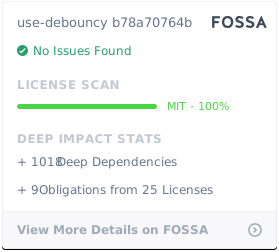
use-debouncy
v6.0.0
Published
🌀 Small (~0.2kb) debounce effect hook for React with TypeScript support

Maintainers
 eavam
eavamReadme
useDebouncy
🌀 Small (~0.2kb) debounce effect hook for React with TypeScript support





Features
- 👌 No dependencies.
- 🏋️ Tiny. ~0.2kb.
- 🦾 Frame-aligned. Driven by
requestAnimationFrame. - 📖 Types. Written in TypeScript, ships its own declarations.
- 🎣 Three hooks. Debounce an effect, a callback or a value.
Installation
npm install use-debouncyyarn add use-debouncypnpm add use-debouncyRequires React 18 or 19 as a peer dependency.
Usage
Three hooks, one idea: do the work only after things have stopped changing for a while. Pick the one that fits what you already have.
Debounce an effect
Reads like useEffect, but waits for the dependencies to settle. It does not
run on the initial render.
import { useState } from 'react';
import { useDebouncyEffect } from 'use-debouncy';

const Search = () => {
  const [value, setValue] = useState('');

  useDebouncyEffect(
    () => fetchData(value), // called once typing stops
    400, // milliseconds to wait
    [value], // dependencies, like useEffect
  );

  return (
    <input value={value} onChange={(event) => setValue(event.target.value)} />
  );
};
Like useEffect, the callback may return a destructor. It runs before the next
invocation and when the component unmounts:
useDebouncyEffect(
  () => {
    const controller = new AbortController();
    fetchData(value, { signal: controller.signal });

    return () => controller.abort();
  },
  400,
  [value],
);
Debounce a callback
Returns a function that delays the call until it stops being called. Handy for event handlers, where there is no dependency array to speak of.
import type { ChangeEvent } from 'react';
import { useDebouncyFn } from 'use-debouncy';

const Search = () => {
  const handleChange = useDebouncyFn(
    (event: ChangeEvent<HTMLInputElement>) => fetchData(event.target.value),
    400,
  );

  return <input onChange={handleChange} />;
};
The returned function keeps the same identity across renders, so it is safe to hand to a memoized child or to put in a dependency array. It also carries two controls for the call that is currently waiting:
const save = useDebouncyFn(saveDraft, 1000);

save.flush(); // run the pending call now
save.cancel(); // drop it instead
Debounce a value
The shortest path when the value already lives in state — you get a copy that trails behind until things go quiet.
import { useEffect, useState } from 'react';
import { useDebouncyValue } from 'use-debouncy';

const Search = () => {
  const [value, setValue] = useState('');
  const query = useDebouncyValue(value, 400);

  useEffect(() => {
    fetchData(query);
  }, [query]);

  return (
    <input value={value} onChange={(event) => setValue(event.target.value)} />
  );
};
Recipes
Autosave that survives navigation
Debounce the writes while typing, and flush the last one when the user leaves.
const Editor = ({ id }: { id: string }) => {
  const [draft, setDraft] = useState('');
  const save = useDebouncyFn((text: string) => saveDraft(id, text), 1000);

  // Nothing is lost on unmount: the pending write goes out immediately
  useEffect(() => () => save.flush(), [save]);

  return (
    <textarea
      value={draft}
      onChange={(event) => {
        setDraft(event.target.value);
        save(event.target.value);
      }}
    />
  );
};
Validation that stops when the field is cleared
const Email = () => {
  const [email, setEmail] = useState('');
  const [error, setError] = useState<string | null>(null);

  const validate = useDebouncyFn((value: string) => {
    setError(isEmail(value) ? null : 'Enter a valid email');
  }, 500);

  return (
    <input
      value={email}
      onChange={(event) => {
        const { value } = event.target;
        setEmail(value);
        setError(null);

        // No point validating an empty field, so drop the pending run
        if (value) validate(value);
        else validate.cancel();
      }}
    />
  );
};
API
useDebouncyEffect(fn, wait?, deps?)
function useDebouncyEffect(
  fn: EffectCallback,
  wait?: number,
  deps?: DependencyList,
): void;
| Argument | Required | Default | Description |
| -------- | -------- | ------- | ------------------------------------------------------------- |
| fn | ✓ | | Called once the dependencies settle. May return a destructor. |
| wait | | 0 | Milliseconds to wait. |
| deps | | [] | Dependencies, as in useEffect. |
Skips the initial render, restarts the timer whenever the dependencies change, and cancels a pending call on unmount.
useDebouncyFn(fn, wait?)
function useDebouncyFn<Args extends unknown[]>(
  fn: (...args: Args) => unknown,
  wait?: number,
): DebouncyFn<Args>;
| Argument | Required | Default | Description |
| -------- | -------- | ------- | ------------------------------------------------- |
| fn | ✓ | | Called with the arguments of the last invocation. |
| wait | | 0 | Milliseconds to wait. |
Returns a function with a stable identity, which also exposes:
| Method | Description |
| ---------- | ------------------------------------------ |
| cancel() | Drops the pending call, if any. |
| flush() | Runs the pending call immediately, if any. |
useDebouncyValue(value, wait?)
function useDebouncyValue<Value>(value: Value, wait?: number): Value;| Argument | Required | Default | Description |
| -------- | -------- | ------- | --------------------- |
| value | ✓ | | Value to trail. |
| wait | | 0 | Milliseconds to wait. |
Returns the value unchanged on the first render, then updates once it has stopped changing.
Types
import type { DebouncyFn } from 'use-debouncy';

type DebouncyFn<Args extends unknown[]> = ((...args: Args) => void) & {
  cancel: () => void;
  flush: () => void;
};
Good to know
The timer follows frames, not the wall clock. Waiting is driven by
requestAnimationFrame, so the callback lands right before a repaint, together
with the rest of the frame's work. The flip side: browsers pause frames for
hidden tabs, so a pending call resumes only when the tab becomes visible again.
Work that has to happen while the user is away belongs in visibilitychange or
sendBeacon instead.
Server rendering works. Nothing touches browser globals during render, so
renderToString is fine — the timer only ever starts in the browser.
You may not need this package. If the only goal is to keep a heavy render
from blocking typing, React's own useDeferredValue does that with no
dependency at all. Reach for these hooks when you want to delay a side effect:
a request, an autosave, a validation.
Testing. Fake timers have to mock requestAnimationFrame as well, or the
callback never fires. jest.useFakeTimers() and Playwright's
page.clock.install() both do.
Development
yarn install
yarn hooks      # once per clone: installs the pre-commit hook

yarn dev        # story gallery at http://localhost:3100/playwright/gallery/index.html
yarn test       # component tests in Chromium, Firefox and WebKit
yarn test --ui  # same, in Playwright's UI mode
yarn lint       # oxlint + oxfmt
yarn typecheck  # tsc
yarn build      # bundle into lib/
Components under test live in playwright/stories/*.story.tsx, one export per
scenario, and the tests address them by id. The gallery is served by the
project's own Vite dev server and renders stories in StrictMode, so React's
development-only behaviour is covered too. Open the gallery URL in a browser to
eyeball every story by hand.
Commit messages follow Conventional Commits — they decide the released version.
License
MIT © Egor Avakumov