
veche
v0.4.2
Published
MCP server for bounded multi-agent committee meetings — Codex + Claude Code deliberate in rounds and self-extinguish on <PASS/>

Maintainers
 cyberash-dev
Readme
Veche
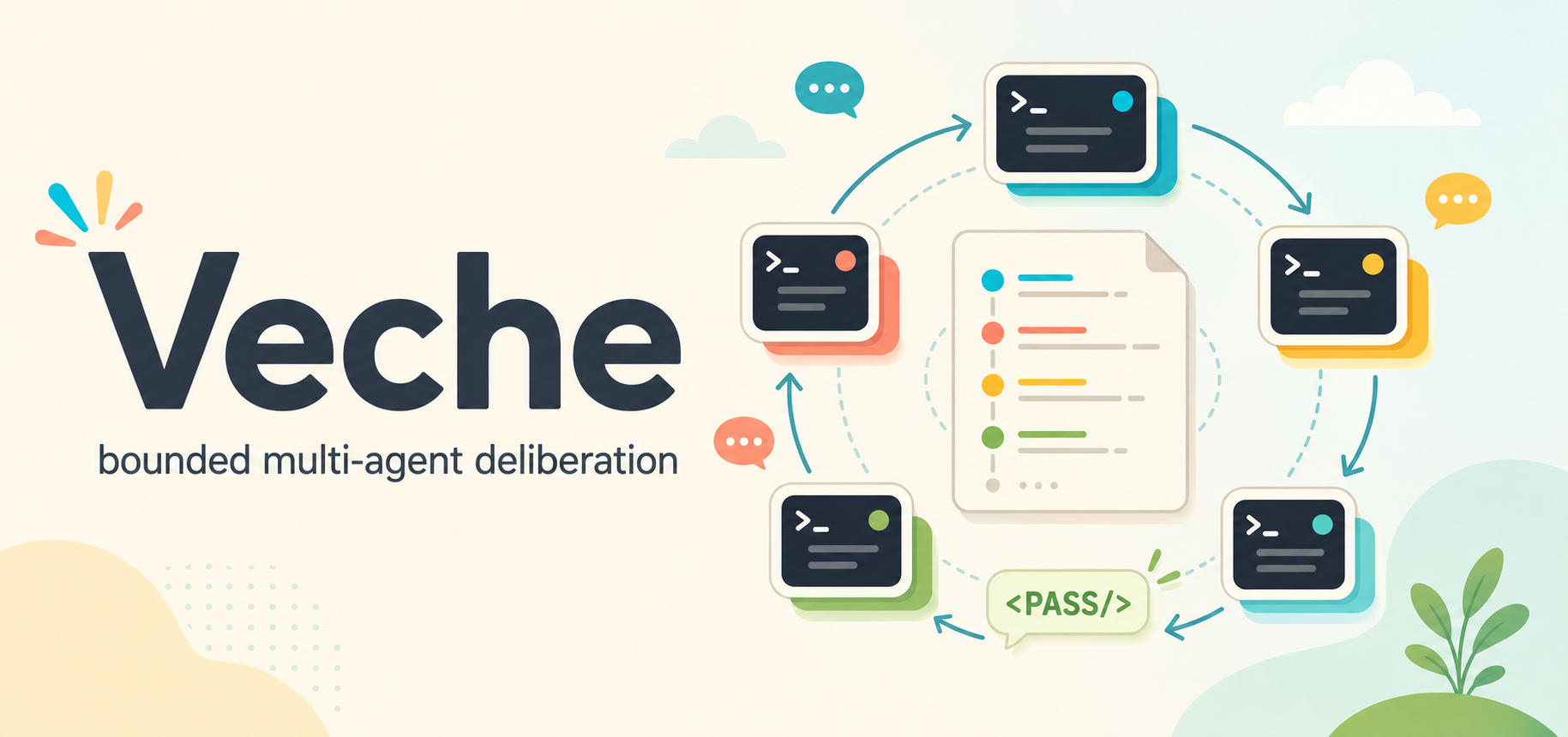
Вече — bounded multi-agent deliberation as an MCP server.
veche is a Model Context Protocol (MCP) server that lets an orchestrator agent (Claude
Code, a custom agent, your IDE) convene committee meetings between LLM agents and read
back a structured transcript. The protocol is self-extinguishing: every member replies in
rounds, anyone can opt out with the literal token <PASS/>, and the meeting terminates the
moment everyone passes in the same round (or hits max_rounds).
The name comes from the medieval Slavic вече — a popular assembly that deliberated by
acclamation and dispersed when the matter was settled. That maps almost directly onto
rounds + <PASS/> until silence.
v1 ships two symmetric CLI-backed adapters:
- Codex via
codex exec(OpenAI) - Claude Code via
claude -p(Anthropic) — with a recursion guard that prevents a child Claude Code from re-entering this same server
The orchestrator may itself be Claude Code, enabling
Claude Code ↔ another Claude Code + Codex committees. Architecture and behaviour are
fully specified in spec/ using a C4-inspired four-level model; code follows the
spec and changes are made to the spec first.
Why
LLMs collapse into a single line of reasoning on hard problems. A standing MCP tool for pulling a second opinion from a different model — or a differently-prompted instance of the same model — broadens the search, surfaces blind spots, and produces more balanced decisions. The committee protocol drives the discussion to a stable point without the orchestrator hand-rolling turn-taking.
Install
npm install -g veche
veche install        # writes SKILL.md to ~/.claude/skills/veche/ and ~/.codex/skills/veche/
                     # plus optional skill UI metadata under agents/openai.yaml
                     # plus claude mcp add / codex mcp add for the stdio MCP server

veche install --for=hermes   # opt-in install into Hermes Agent (~/.hermes/skills/veche/
                             # plus `hermes mcp add veche --command node --args …`)
Restart your Claude Code / Codex / Hermes Agent session after installing. The skill is
invoked as /veche <question>.
If you cloned the repo:
npm install
npm run build
node dist/bin/veche.js install
Prerequisites
| | Required for |
|---|---|
| Node.js ≥ 20.11 | running the server |
| codex on PATH | Codex participants |
| claude on PATH | Claude Code participants and as an MCP host |
| CODEX_API_KEY or codex login | Codex auth (either path works) |
| claude login | Claude Code auth |
Quick start
As a Claude Code skill
After veche install, open Claude Code and type:
/veche should we use argparse or click for a new Python CLI?The skill first asks for launch options: whether to include a Human Participant, whether
to use the default round budget or enter --rounds N, and whether to customize roles for
this launch. If custom roles are enabled, it shows the default codex / claude role
metadata and system prompt, then lets you override role description, weight, and system
prompt without writing a persistent profile.
After that, the skill drives the full lifecycle: start_meeting → send_message →
poll get_response until the Job terminates → end_meeting → render the transcript
grouped by member with a synthesis paragraph. --rounds N, --human, --no-human,
--custom-roles, and --default-roles preselect the corresponding launch answers.
As a generic MCP server
veche install registers the server under Claude Code and Codex by default, and under
Hermes Agent when invoked with --for=hermes. To wire it into a different MCP host, use
whichever invocation that host supports — the binary is just stdio. A representative
mcp.json snippet:
{
  "mcpServers": {
    "veche": {
      "command": "node",
      "args": ["/abs/path/to/dist/bin/veche-server.js"],
      "env": { "VECHE_LOG_LEVEL": "info" }
    }
  }
}
Programmatic embedding (Node)
import { bootstrap } from 'veche';

const { mcp, shutdown } = await bootstrap();
await mcp.connect(); // stdio — point an MCP client at the process
// ...
await shutdown();
Committee protocol
One send_message = one Job. Each Job executes up to maxRounds (default 8, capped by
VECHE_MAX_ROUNDS_CAP, default 16) rounds:
- Round 0 — the facilitator's message is appended to the transcript.
- Round N (N ≥ 1) — every active model member is dispatched in parallel. Each member sees
every other member's prior messages since its own last turn. A member replies with
either new substantive content (
speech) or the literal token<PASS/>(pass) to opt out of the current round. - If an enabled Human Participant is present, the Job enters
waiting_for_humanafter the model round. The human can agree with a target at strength 1..3, skip, or steer the next model round. - The discussion terminates when:
- every active model member emits
<PASS/>in the same round →all-passed roundNumber >= maxRounds→max-rounds- all members dropped out →
no-active-members - an external
cancel_jobfired →cancelled
- every active model member emits
If a member's adapter fails irrecoverably, that member is dropped and the discussion
continues. The drop is recorded in the transcript as a system message so remaining
members can acknowledge the missing voice.
Full rules: spec/partitions/committee-protocol.md.
MCP tool surface
| Tool | Purpose |
|------|---------|
| start_meeting | Create a Meeting. Opens an adapter Session per member. |
| send_message | Post a facilitator message; returns jobId + cursor. Non-blocking. |
| get_response | Poll a Job: status + transcript delta since a cursor. Supports waitMs. |
| list_meetings | Enumerate meetings. Filter by status / time range. |
| get_transcript | Read a transcript outside of a Job-polling loop. |
| end_meeting | Close a meeting. cancelRunningJob terminates an in-flight Job first. |
| cancel_job | Abort a running Job. Graceful first (30s), forced after. |
| submit_human_turn | Submit human agree, skip, or steer feedback for a pending request. |
| set_human_participation | Enable or disable a Human Participant for future pauses. |
| submit_synthesis | Store the facilitator's final synthesis for a terminal Job. |
Schemas and per-tool behaviour: spec/partitions/meeting.md.
CLI: veche
veche is a separate read-only binary that reads $VECHE_HOME directly via FileMeetingStore.
It can run alongside the MCP server safely — both processes share the same data.
veche list                           # active meetings (default)
veche list --status all --limit 20   # widen the filter
veche list --format json | jq .

veche show <meetingId>                          # text + ANSI on a TTY
veche show <meetingId> --format markdown
veche show <meetingId> --format json > transcript.json
veche show <meetingId> --format html --out report.html
veche show <meetingId> --format html --open     # tmp file + browser
veche show <meetingId> --raw                    # include round.* and job.* events
veche show <meetingId> --home /alt/store        # override $VECHE_HOME

veche watch                          # local web viewer (live SPA + SSE)
veche watch --port 7654 --no-open    # explicit port, skip auto-open

veche install                        # register skill + MCP server (both hosts)
veche install --for=claude-code      # only one host
veche install --dry-run              # print actions without performing them
The HTML report (show --format html) is a single self-contained file (no remote
assets, no <script>, no <link rel="stylesheet">) with a chat-bubble layout per round
and colors derived deterministically from participantId.
The live web viewer (watch) starts a loopback HTTP server with a single-page app and
two Server-Sent Events channels: one for the meeting list (sidebar updates as new meetings
appear / change status), one per selected meeting (transcript updates as messages are
appended). Cross-process safe — the watch server polls the on-disk store at 750 ms cadence,
so MCP-server-driven updates surface within ~1 s without restarting anything. Speech
bubbles render the same Markdown subset as show --format html. The viewer remains
loopback-only by default and has a narrow write surface for Human Turn submit/toggle
controls only.
Exit codes: 0 ok · 2 store unavailable / write failed · 3 meeting not found ·
64 usage error · 1 unhandled internal error.
Full CLI specs: spec/partitions/meeting.md (list / show), Partition: web-viewer (watch), Partition: install (install).
Configuration
Environment
| Variable | Default | Purpose |
|----------|---------|---------|
| VECHE_HOME | ~/.veche | Root for FileStore data and the user config. |
| VECHE_STORE | file | file or memory. |
| VECHE_LOG_LEVEL | info | trace/debug/info/warn/error. |
| VECHE_MAX_ROUNDS_CAP | 16 | Hard clamp for max_rounds. |
| VECHE_E2E | — | Set to 1 to enable opt-in real-CLI E2E tests. |
| CODEX_API_KEY | — | Optional; Codex also reads ~/.codex/auth.json. |
| CODEX_BIN | codex | Override the Codex binary. |
| CLAUDE_BIN | claude | Override the Claude Code binary. |
Profiles
Named participant profiles live in $VECHE_HOME/config.json
(see examples/config.json.example):
{
  "version": 1,
  "profiles": [
    {
      "name": "codex-senior",
      "adapter": "codex-cli",
      "model": "gpt-5-codex",
      "systemPrompt": "You are a senior engineer. Give concise opinions.",
      "discussionRole": {
        "name": "senior engineer",
        "description": "Independent model participant focused on implementation tradeoffs.",
        "weight": 1
      },
      "workdir": null,
      "extraFlags": ["--skip-git-repo-check"],
      "env": {}
    }
  ]
}
start_meeting.members[] accepts either { profile: "codex-senior" } or ad-hoc overrides.
Recursion guard (Claude Code)
Every claude -p invocation is launched with
--strict-mcp-config --mcp-config '{"mcpServers":{}}' plus
--disallowedTools=Bash,Edit,Write,NotebookEdit by default. The child Claude Code cannot
inherit the parent's MCP configuration, so it cannot re-enter this server and spawn more
children. Participants that need extended isolation can add --bare via extraFlags
(which additionally requires ANTHROPIC_API_KEY).
Architecture
Hexagonal + Vertical Slices. Every feature lives under src/features/<feature>/ with its
own domain/, application/, ports/, and (for features that own ports) adapters/.
src/
├── features/
│   ├── meeting/                 # 7 MCP tools, domain entities, JobRunner
│   ├── committee-protocol/      # round algorithm, pass signal, terminate/drop
│   ├── agent-integration/       # AgentAdapterPort + codex-cli, claude-code-cli, fake
│   └── persistence/             # MeetingStorePort + in-memory, file (JSONL)
├── adapters/inbound/
│   ├── mcp/                     # MCP server (stdio), tool registration, zod schemas
│   ├── cli/                     # veche CLI (list, show, watch, install) + renderers
│   └── web/                     # watch server: HTTP, SSE, SPA
├── shared/markdown/             # escape-then-transform Markdown converter (used by html + watch)
├── infra/                       # DI composition root, StructuredLogger, SystemClock, UuidIdGen
├── shared/                      # branded ids, DomainError, Clock/IdGen/Logger ports
└── bin/
    ├── veche-server.ts          # stdio MCP entrypoint
    └── veche.ts                 # human-operator CLI entrypoint
Full specification: spec/spec.md (index) → spec/partitions/ for the per-feature spec files.
Development
npm run typecheck      # strict tsc across src/
npm run lint           # biome check
npm run lint:fix       # biome check --write
npm test               # vitest — unit + MCP stdio smoke + web SSE integration
npm run build          # emit dist/
End-to-end against real CLIs (opt-in)
Gated on VECHE_E2E=1 to avoid token spend on normal runs:
VECHE_E2E=1 npx vitest run src/e2e/claude-code.e2e.test.ts   # ~4s
VECHE_E2E=1 npx vitest run src/e2e/codex.e2e.test.ts         # ~6s
VECHE_E2E=1 npx vitest run src/e2e/committee.e2e.test.ts     # ~25s
The committee test runs a real 3-round discussion between codex exec and claude -p
through the full pipeline (start_meeting → send_message → DiscussionRunner →
adapters → get_response).
Troubleshooting
claude-runtime: Not logged in · Please run /login— runclaude loginon the host. Do not set--barein memberextraFlagsunless you also provideANTHROPIC_API_KEY.codex-genericon every turn — checkcodex loginstatus or setCODEX_API_KEY.MeetingBusy— an earlier Job is still running.get_responseto let it finish, orcancel_jobto abort.Session ID <uuid> is already in use(directclaude -ptest) — don't hand-craft a stable UUID across runs; the adapter generates a fresh one per session.veche showprintsmeeting <id> not found— the meeting lives under a different$VECHE_HOME. Pass--home <path>or export the env var. Exit code3signals this.veche show --format html --opendoes not open a browser on Linux —xdg-openmust be onPATH. The file is still written to$TMPDIR; the path is printed to stderr.veche watchdoesn't show new meetings until restart — fixed in current builds via cross-processMeetingStorePort.refresh(). If you observe it on an old build, rebuild and restartveche watch.- Empty transcript on
get_response— make sure you're passingcursorback unchanged each poll; advancing it is the server's job. mcp__veche__start_meetingnot available afterveche install— restart the host session. Claude Code / Codex only loads MCP servers at startup.
License
MIT — see LICENSE.