
vitest-snapshot-tools
v0.5.0
Published
Safely capture, review, and apply Vitest snapshot updates
Downloads
50

Maintainers
 awakae
Readme
vitest-snapshot-tools
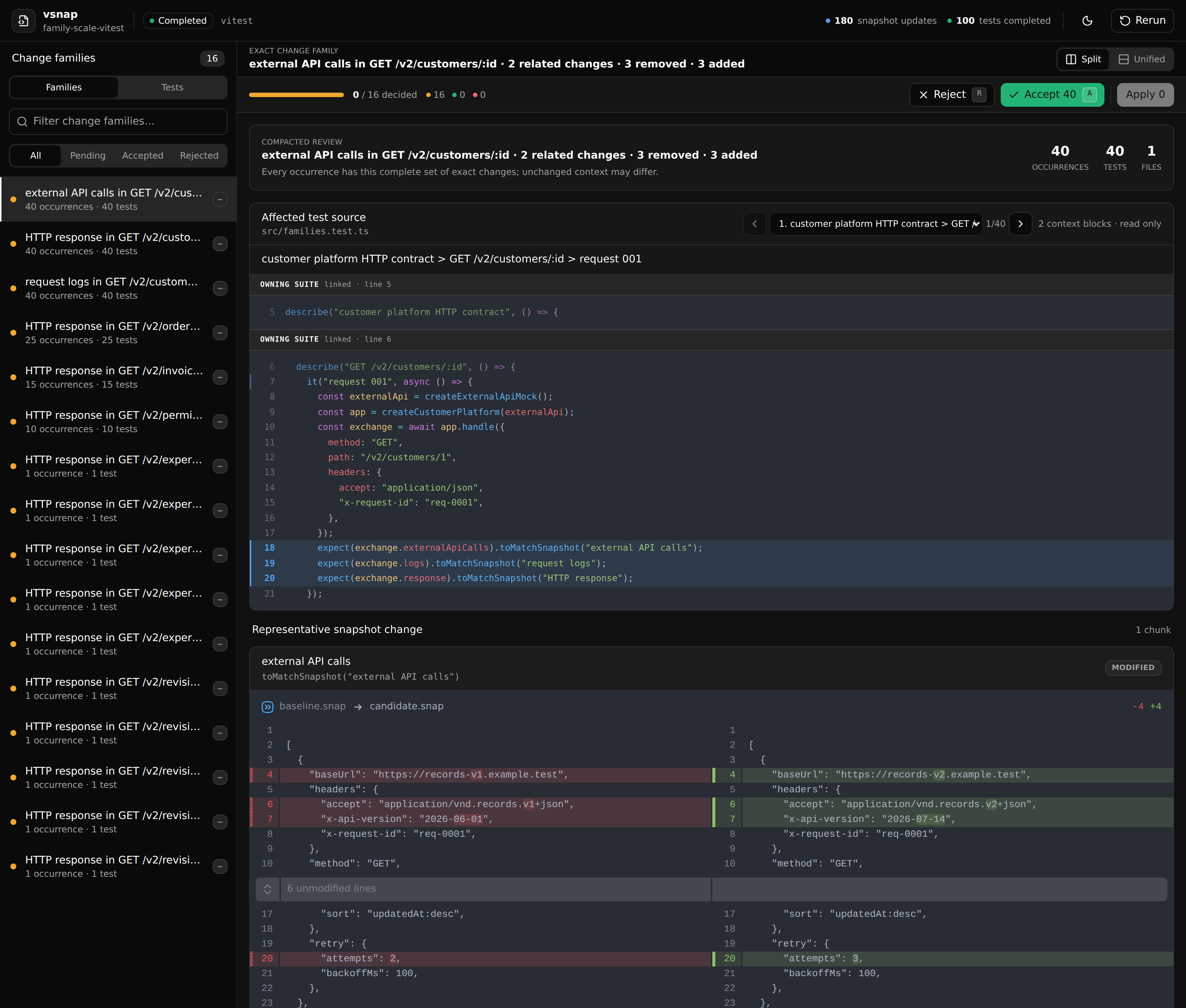
Compact repeated Vitest 4 snapshot failures into exact change families, review each distinct change once, and safely apply only approved updates.
vitest-snapshot-tools runs the target project's own Vitest installation,
redirects snapshot candidates outside the repository, and writes only explicitly
accepted changes. Review in a local authenticated UI or use the versioned JSON
CLI for automation.
Quick start
npx vitest-snapshot-toolsRequires Node.js 22.14 or newer and a project-local Vitest version in the
>=4 <5 range. npx downloads the package for a one-off run or uses the local
version when installed. To pin it for a project:
npm install --save-dev vitest-snapshot-tools
npx vitest-snapshot-tools
Optional arguments after -- are passed to Vitest.
Agent skill and token-efficient review
A repeated API or rendering change can appear in hundreds of snapshots. Instead
of sending every diff through an agent, the CLI groups snapshot entries with
the same complete set of added and removed lines. The agent reviews one
representative diff and can accept or reject all occurrences with one
family_... selector. Unique changes remain separate.
npx vitest-snapshot-tools skill installAsk a Codex-compatible agent to use $review-vitest-snapshots. The bundled skill
starts with exact families to reduce JSON payloads, repeated diff inspection,
model context, and token usage while preserving preview and stale-write checks.
Headless workflow
npx vitest-snapshot-tools run --json -- src/example.test.ts
npx vitest-snapshot-tools families --status pending --json
npx vitest-snapshot-tools diff entry_... --format unified
npx vitest-snapshot-tools accept family_...
npx vitest-snapshot-tools preview --format patch
npx vitest-snapshot-tools apply
npx vitest-snapshot-tools verify
Vitest snapshot updates reach the repository only through vsnap apply. The
tool hash-checks the captured baseline, rejects unsafe paths, uses crash-aware
atomic writes, and never invokes Git.
For the source demo, full CLI reference, safety model, current limitations, and contribution guide, read the project README.