
weft-sdk
v1.0.0
Published
Reactive surface-layout SDK for Three.js/WebGPU.

Maintainers
 seloslav
Readme
Weft
Deterministic reactive surface SDK for Three.js.
Weft lets you author surfaces as source -> layout -> effect so placement and gameplay response stay in one model instead of splitting into scatter code plus a separate reaction system.
- Live site: pretext-weft.vercel.app
- npm package:
weft-sdk - AI integration guide:
weft.md
Current release: 1.0.0 as of March 31, 2026.
Mental model
Think about Weft as:
source -> layout -> effect
source: a measured stream built from repeated units or a semantic palettelayout: rows, sectors, and available width across a surfaceeffect: projection of laid-out glyphs into world-space instances
The key contract is width:
- narrower width means fewer glyphs fit
- zero width means that part of the surface disappears
- semantic state can change the apparent surface without inventing a second placement pipeline
Where it fits
Weft is strongest when the thing you are placing can honestly be treated as a reactive surface:
- grass and ground cover
- roadside bands, seams, clutter corridors, and fungus strips
- leaf litter, sticks, needles, logs, rocks, shrubs, and trees
- shell-like walls, shutters, ivy, glass, and fish-scale surfaces
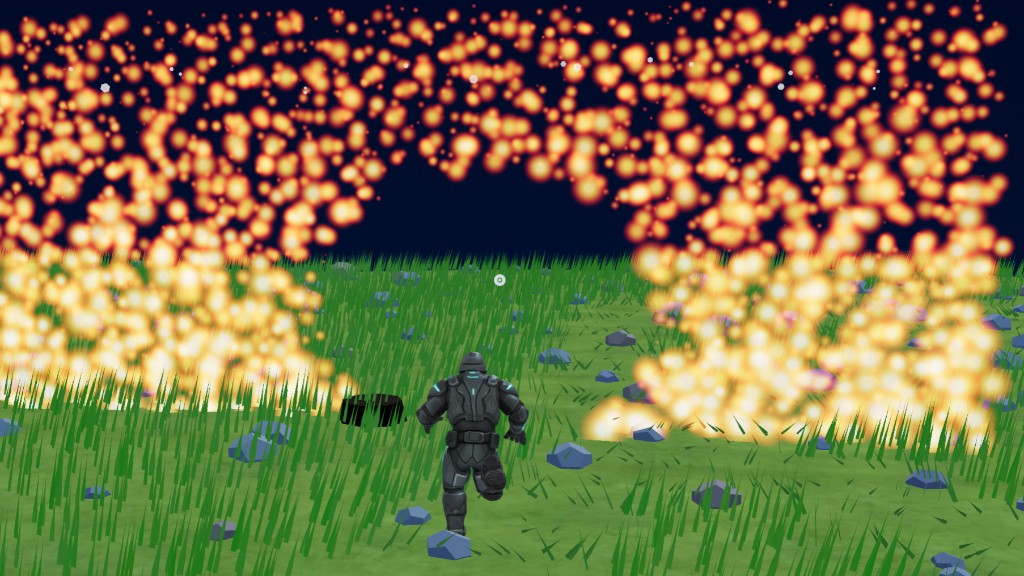
- puncturable fire walls and recoverable sky surfaces
- stylized page/text surfaces and other layout-driven instance fields
It is not trying to replace every biome or world-simulation system. It works best when deterministic layout, thinning, recovery, and semantic state are the main problem.
Package layers
weft-sdk/three: preset factories, layouts, behaviors, and Three.js-facing helpersweft-sdk/core: source preparation, deterministic seed cursors, layout traversal, and world-field helpersweft-sdk/runtime: reusable state, recovery, and sampled motion helpers
Shipped presets
Current public presets include:
createBandFieldEffect()createLeafPileBandEffect()createFungusSeamEffect()createGrassEffect()createRockFieldEffect()createLogFieldEffect()createStickFieldEffect()createNeedleLitterFieldEffect()createShrubFieldEffect()createTreeFieldEffect()createShellSurfaceEffect()createFishScaleEffect()createFireWallEffect()createStarSkyEffect()createBookPageEffect()
Quick start
Install the package with Three.js:
npm install weft-sdk threeThen create a source, feed it into a preset, and mount the returned group into your scene:
import * as THREE from 'three'
import {
  DEFAULT_GRASS_FIELD_PARAMS,
  createGrassEffect,
  createSurfaceSource,
} from 'weft-sdk/three'
import { seedCursor } from 'weft-sdk/core'

const scene = new THREE.Scene()

const surface = createSurfaceSource({
  cacheKey: 'hello-weft',
  units: ['|', '/', '\\'],
  repeat: 24,
})

const grass = createGrassEffect({
  seedCursor,
  surface,
  initialParams: {
    ...DEFAULT_GRASS_FIELD_PARAMS,
    layoutDensity: 8,
  },
})

scene.add(grass.group)
Deterministic world fields
For larger authored worlds, use weft-sdk/core world fields to drive masks and density without inventing a separate scatter pipeline:
import {
  DEFAULT_TREE_FIELD_PARAMS,
  createTreeFieldEffect,
  getPreparedTreeSurface,
} from 'weft-sdk/three'
import { createWorldField, seedCursor } from 'weft-sdk/core'

const forestSignal = createWorldField(17, {
  scale: 28,
  roughness: 0.55,
  warpAmplitude: 9,
})

const trees = createTreeFieldEffect({
  seedCursor,
  surface: getPreparedTreeSurface(),
  initialParams: DEFAULT_TREE_FIELD_PARAMS,
  placementMask: {
    bounds: { minX: -64, maxX: 64, minZ: -64, maxZ: 64 },
    includeAtXZ: (x, z) => forestSignal(x, z) > 0.58,
  },
})
Learn more
- For full preset/API detail, use the SDK docs page powered by
src/Docs.tsx. - For AI/codegen context, use
weft.md. - For additional preset ideas, see
preset-ideas.md.
Local development
Node.js 20+ is recommended.
npm install
npm run dev
The local site is WebGPU-only.