
worldgraphs
v0.1.3
Published
AI coding agent for building digital twins with worldgraph — architect, implement, review, and test the Rust spatial/sensor-graph crates

Maintainers
 ruvnet
Readme
worldgraph
A privacy-aware environmental digital twin — and an AI agent that helps you build one.
worldgraph is two things in one project:
- A Rust library that models a physical space as a typed, provenance-tracked graph — rooms, zones, sensors, people, and beliefs about what's happening — geospatially grounded and able to forecast occupancy.
- An AI coding agent (
npx worldgraphs) — architect → implement → review → test — that helps you build digital twins and spatial/sensor applications on top of it.
Keywords: digital twin · world model · environmental digital twin · spatial computing · indoor positioning · sensor fusion · occupancy modeling · ambient intelligence · knowledge graph · scene graph · WiFi sensing · RF sensing · privacy-by-design · provenance · geospatial · occupancy forecasting · Rust · AI coding agent · agent harness



🌐 Live demo — the twin in your browser
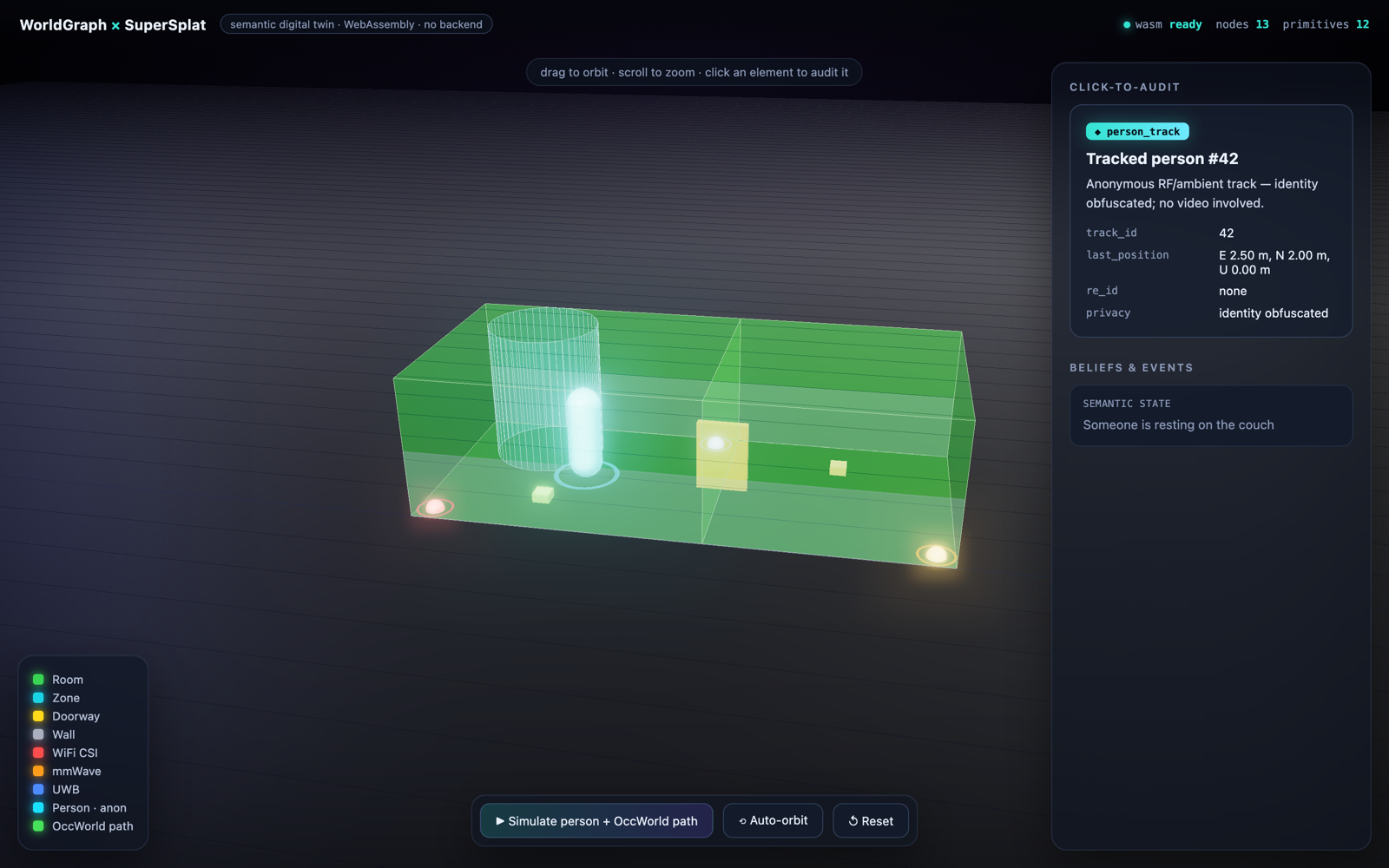
The WorldGraph semantic twin rendered in 3D over a SuperSplat-style scene — compiled to WebAssembly and running entirely client-side (no backend). Drag to orbit, click any element for its privacy-aware provenance card, and hit Simulate to see the OccWorld occupancy forecast. Person tracks carry no identity by construction.
Two ways to use it
🤖 The AI agent — npx worldgraphs
A focused coding harness (architect / implementer / reviewer / test-writer) that drops into your AI host and helps you design, build, review, and test digital-twin code.
npx worldgraphs init       # wire the agents into your AI host (Claude Code, Codex, Copilot, …)
npx worldgraphs doctor     # health check

# or install globally:
npm i -g worldgraphs
worldgraphs init
Why
worldgraphs(plural)? npm reserves the bare nameworldgraph(too similar to the existingworld-graphpackage), so the npm package is published asworldgraphs. You can also run it straight from this repo:npx ruvnet/worldgraph.
Then ask your host to design or implement a change — the four agents run an opinionated pipeline so you get a plan, clean code, a bug-hunting review, and the missing tests. Ships adapters for 9 hosts: Claude Code, Codex, Copilot, OpenCode, GitHub Actions, pi-dev, Hermes, OpenClaw, RVM.
| Agent | Role | |-------|------| | architect | Designs the change before any code is written | | implementer | Writes code that matches the surrounding style | | reviewer | Hunts correctness bugs in the diff | | test-writer | Adds the missing tests for the change |
📦 The library — Rust crates
cargo add wifi-densepose-worldgraph # the typed digital-twin graph| crate | role |
|-------|------|
| wifi-densepose-geo | Geospatial grounding — IP geolocation, satellite tiles, SRTM elevation, OSM buildings/roads, ENU↔geo transforms |
| wifi-densepose-worldgraph | The digital twin — a petgraph graph of typed nodes + relations; provenance-mandatory semantic beliefs; JSON persistence |
| wifi-densepose-worldmodel | Predictive layer — bridges person-track history to an OccWorld occupancy model and returns trajectory priors |
What is an "environmental digital twin"?
A digital twin is a live, queryable model of a real space. worldgraph builds one as a typed graph — rooms, zones, walls, doorways, sensors, RF links, person tracks, object anchors, events, and semantic-state beliefs — connected by typed relations (observes, located_in, adjacent_to, supports, contradicts, derived_from, privacy_limited_by).
It stores what is believed about the space, not raw sensor frames — and every belief is auditable back to the evidence that produced it.
What makes it trustworthy
- Provenance is mandatory — every semantic belief carries
SemanticProvenance(signal evidence + model + calibration + privacy decision). You can't record a belief without recording why. - Privacy is first-class — a
PrivacyRollupandprivacy_limited_byrelations make the privacy posture of any belief queryable; downstream consumers respect it. - Deterministic & versioned — a serde enum model → a deterministic, schema-versioned wire layout;
to_json/from_jsonround-trips the whole graph. - Geospatially grounded — ties the local scene to real coordinates, terrain, and map features.
- Predictive — forecasts occupancy and emits trajectory priors that improve downstream tracking.
Where it sits
sensor fusion  →  worldgraph (digital twin)  →  semantic / agent layer
  fused beliefs     typed belief graph            queries, reasoning, eval
                          │
                          └─→ worldmodel → occupancy forecast / trajectory priors
Part of the RuView / wifi-densepose ecosystem (ADR-139).
Build
cargo build && cargo test      # the Rust library
npm install && npm test        # the agent harness
License
Dual-licensed MIT OR Apache-2.0 — see LICENSE-MIT and LICENSE-APACHE.