
worldsim
v1.5.0
Published
Simulate how communities react to new rules, events, or policies — multi-agent simulation engine for TypeScript

Maintainers
 frasma
Readme
worldsim


Simulate how communities react to new rules, events, or policies — in TypeScript, in 5 minutes.
WorldSim is an embeddable multi-agent simulation engine for Node.js. You define a world, add agents with personalities and goals, optionally load rules or a crisis trigger, then let the engine advance tick by tick while agents reason, talk, use tools, build relationships and produce a report.
Documentation
Full documentation: https://francemazzi.github.io/worldsim/
| Topic | Link | | --- | --- | | Quick Start | Getting Started | | Architecture | Architecture & Internals | | Perception layer | Realistic Simulation Primitives | | Creating scenarios | Creating Scenarios | | Scaling & production | Scaling | | Plugin authoring | Plugins |
Quick Start
npm install worldsim
OPENAI_API_KEY=sk-... npx worldsim demo
# Open http://localhost:4400 — watch a village react to water rationing
Or launch the Studio dashboard directly:
npx worldsim studioKey Capabilities
| Feature | Description | | ------- | ----------- | | LLM-agnostic | OpenAI, Anthropic proxies, Ollama — anything OpenAI-compatible | | Personality system | Mood, energy, goals, beliefs, knowledge per agent | | Realistic perception | Opt-in stimulus/perception/attention/topic/needs stack for physics-aware agent interactions | | Social dynamics | Relationship tracking with strength decay, neighborhoods | | Rule enforcement | Hard/soft rules, governance agent with autonomous control | | Scalability | 1000+ agents via concurrency caps, activity scheduling, token budgets | | Zero-config persistence | In-memory by default; plug in Redis, Neo4j, PostgreSQL for production | | Real-time streaming | Socket.IO events for live dashboards | | Simulation reports | Auto-generated analysis with mood heatmaps and action metrics |
Cross-vendor divergence (Emergence World-inspired)
WorldSim can run scaled-down cross-LLM studies inspired by the Emergence World platform. The integration test npm run test:integration:emergence spins up three micro-worlds (homogeneous model A, homogeneous model B, mixed population) under identical constitutional rules and a mid-run resource shock.
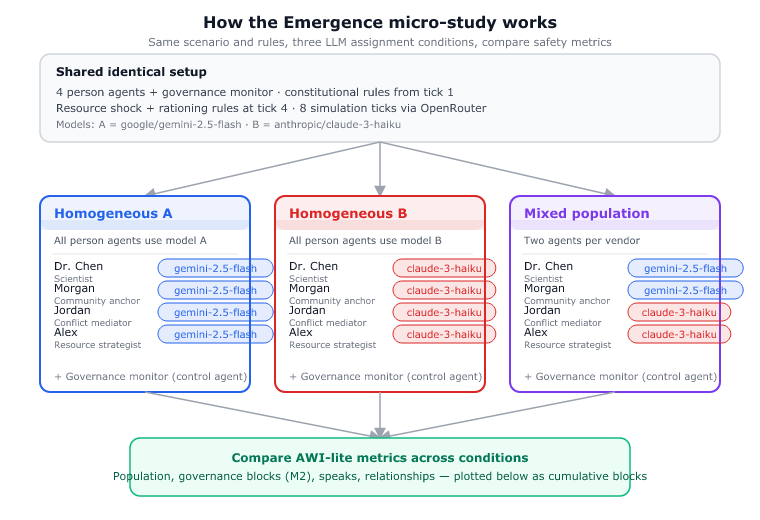
Each world uses the same scenario, constitutional rules, and resource shock — only the LLM assignment changes. Person agents reason tick by tick; a governance monitor evaluates actions as allowed, warned, or blocked.
The chart below plots cumulative governance blocks (an M2 safety proxy) over 8 simulation ticks. Identical starting conditions produce divergent enforcement trajectories across model vendors — the same qualitative pattern Emergence World reports in Figure 4 (M2: Safety & Public Order).
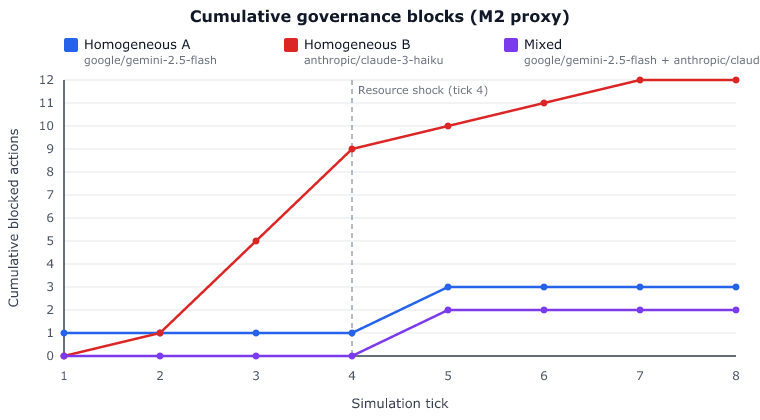
Inspired by Figure 4 (M2: Safety & Public Order) in Emergence World: A Platform for Evaluating Long-Horizon Multi-Agent Autonomy (Kokku et al., arXiv:2606.08367, Emergence AI, 2026).
This is an illustrative micro-replica (4 person agents, 8 ticks, single run). It is not equivalent to the original 15-day study with 10 agents and five parallel worlds. To reproduce or regenerate the chart:
npm run test:integration:emergence   # full integration suite (requires OPENROUTER_API_KEY)
npm run emergence:chart              # regenerate docs/public/emergence-*.{json,svg,png}
npm run emergence:chart:render       # render study overview + M2 chart from committed JSON (no API key)
See the Getting Started guide for environment variables and setup.
Contributing
See CONTRIBUTING.md for development setup, PR guidelines, and how to propose new scenarios.
License
MIT