
wso2-docs-mcp-server
v1.3.2
Published
Production-ready MCP server providing RAG-based access to WSO2 documentation

Maintainers
 iamvirul
Readme
WSO2 Docs MCP Server


"This is an unofficial community project. Not affiliated with or endorsed by WSO2."
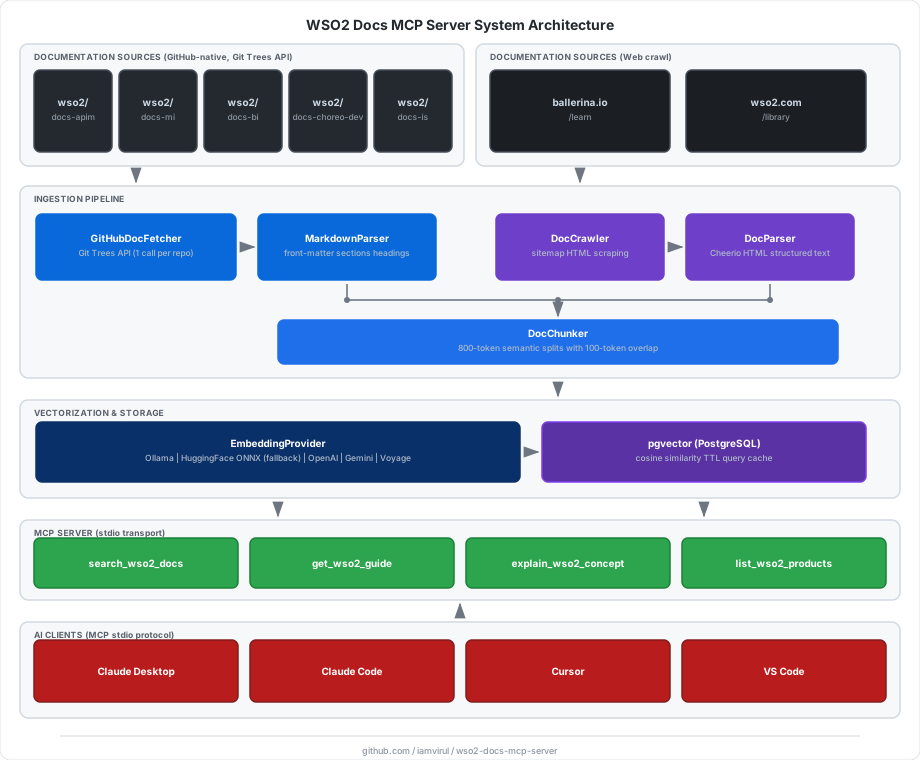
A production-ready Model Context Protocol (MCP) server that provides AI assistants (Claude Desktop, Claude Code, Cursor, VS Code) with semantic search over WSO2 documentation via Retrieval-Augmented Generation (RAG).
Under the hood, it uses a blazing-fast dual-ingestion engine:
- GitHub Native: Fetches raw Markdown directly from WSO2's public GitHub repositories via the Git Trees API (avoids web-scraping noise and rate limits)
- Web Crawl Fallback: For products without dedicated GitHub docs repos (like the WSO2 Library)
Architecture
Documentation Sources
| Product | ID | URL |
|---|---|---|
| API Manager | apim | https://apim.docs.wso2.com |
| Micro Integrator | mi | https://mi.docs.wso2.com/en/4.4.0 |
| Ballerina Integrator | bi | https://bi.docs.wso2.com |
| Choreo | choreo | https://wso2.com/choreo/docs |
| Identity Server | is | https://is.docs.wso2.com/en/latest |
| Ballerina | ballerina | https://ballerina.io/learn |
| WSO2 Library | library | https://wso2.com/library |
Prerequisites
- Node.js ≥ 20
- Docker (for pgvector)
- Embeddings - no API key required by default:
- Ollama (recommended) - runs locally, model auto-downloaded on first run
- If Ollama is not running, the server automatically falls back to HuggingFace ONNX (in-process, also downloads automatically)
- Cloud providers are also supported: OpenAI, Google Gemini, Voyage AI
Quick Start
Choose the setup path that fits your use case:
- Install from npm - simplest, no cloning required
- Clone and build - for development or contributions
Install from npm
Install the package globally to get the wso2-docs-mcp-server, wso2-docs-crawl, and wso2-docs-migrate commands available system-wide:
npm install -g wso2-docs-mcp-serverPrefer no global install? You can use
npx wso2-docs-mcp-server,npx wso2-docs-crawl, andnpx wso2-docs-migratein every step below - just replace the bare command with itsnpxequivalent.
1. Start pgvector
Download the docker-compose.yml and start the database:
curl -O https://raw.githubusercontent.com/iamvirul/wso2-docs-mcp-server/main/docker-compose.yml
docker compose up -d
2. Start Ollama (optional but recommended)
Install Ollama and pull the default embedding model:
ollama pull nomic-embed-text
ollama serve
No Ollama? Skip this step. The server automatically falls back to HuggingFace ONNX - model downloads on first use with no extra setup.
3. Run database migration
DATABASE_URL="postgresql://wso2mcp:wso2mcp@localhost:5432/wso2docs" \
  wso2-docs-migrate
Run migration again whenever you change
EMBEDDING_DIMENSIONS(i.e. switch embedding provider). The script detects and handles dimension changes automatically.
4. Index WSO2 documentation
# Index all products (first run downloads the embedding model automatically)
DATABASE_URL="postgresql://wso2mcp:wso2mcp@localhost:5432/wso2docs" \
  wso2-docs-crawl

# Index a single product (faster, great for testing)
DATABASE_URL="postgresql://wso2mcp:wso2mcp@localhost:5432/wso2docs" \
  wso2-docs-crawl --product ballerina --limit 20

# Force re-index even unchanged pages
DATABASE_URL="postgresql://wso2mcp:wso2mcp@localhost:5432/wso2docs" \
  wso2-docs-crawl --force
Available product IDs: apim, mi, bi, choreo, is, ballerina, library
5. Configure your AI client
The MCP server is launched on demand by your AI client - no background process needed.
Claude Desktop - edit ~/Library/Application Support/Claude/claude_desktop_config.json:
{
  "mcpServers": {
    "wso2-docs": {
      "command": "wso2-docs-mcp-server",
      "env": {
        "DATABASE_URL": "postgresql://wso2mcp:wso2mcp@localhost:5432/wso2docs",
        "EMBEDDING_PROVIDER": "ollama"
      }
    }
  }
}
Claude Code - run once in your terminal:
claude mcp add wso2-docs \
  --transport stdio \
  -e DATABASE_URL="postgresql://wso2mcp:wso2mcp@localhost:5432/wso2docs" \
  -e EMBEDDING_PROVIDER="ollama" \
  -- wso2-docs-mcp-server

# Verify
claude mcp list
Cursor - create .cursor/mcp.json in your project root:
{
  "mcpServers": {
    "wso2-docs": {
      "command": "wso2-docs-mcp-server",
      "env": {
        "DATABASE_URL": "postgresql://wso2mcp:wso2mcp@localhost:5432/wso2docs",
        "EMBEDDING_PROVIDER": "ollama"
      }
    }
  }
}
VS Code - create .vscode/mcp.json:
{
  "servers": {
    "wso2-docs": {
      "type": "stdio",
      "command": "wso2-docs-mcp-server",
      "env": {
        "DATABASE_URL": "postgresql://wso2mcp:wso2mcp@localhost:5432/wso2docs",
        "EMBEDDING_PROVIDER": "ollama"
      }
    }
  }
}
Using
npxinstead of global install? Replace"command": "wso2-docs-mcp-server"with"command": "npx"and add"args": ["-y", "wso2-docs-mcp-server"].
Cloud embedding provider? Add the key to
env, e.g."EMBEDDING_PROVIDER": "openai", "OPENAI_API_KEY": "sk-...".
Clone and build
1. Clone and install
git clone https://github.com/iamvirul/wso2-docs-mcp-server.git
cd wso2-docs-mcp-server
npm install
2. Start Ollama (optional but recommended)
Install Ollama and start it:
ollama serveNo Ollama? Skip this step. The server detects Ollama is not running and automatically falls back to HuggingFace ONNX inference - the model downloads on first use with no extra setup.
3. Configure environment
cp .env.example .env
# Defaults work out of the box with Ollama.
# Only edit if using a cloud provider (OpenAI / Gemini / Voyage).
4. Start pgvector
docker compose up -d
# pgAdmin available at http://localhost:5050 ([email protected] / admin)
5. Run database migration
npm run db:migrateNote: Run migration again whenever you change
EMBEDDING_DIMENSIONS(i.e. switch embedding provider). The script detects and handles dimension changes automatically.
6. Index documentation
# Index all products
# On first run the embedding model is downloaded automatically (Ollama or HuggingFace)
npm run crawl

# Index a single product (faster, great for testing)
npm run crawl -- --product ballerina --limit 20

# Force re-index even unchanged pages
npm run crawl -- --force
7. Build and start the MCP server
npm run build
npm start
For development (no build step):
npm run dev8. Configure your AI client
Replace
/ABSOLUTE/PATH/TO/wso2-docs-mcp-serverwith your actual clone path.
Claude Desktop - edit ~/Library/Application Support/Claude/claude_desktop_config.json:
{
  "mcpServers": {
    "wso2-docs": {
      "command": "node",
      "args": ["/ABSOLUTE/PATH/TO/wso2-docs-mcp-server/dist/src/index.js"],
      "env": {
        "DATABASE_URL": "postgresql://wso2mcp:wso2mcp@localhost:5432/wso2docs",
        "EMBEDDING_PROVIDER": "ollama"
      }
    }
  }
}
Claude Code:
claude mcp add wso2-docs \
  --transport stdio \
  -e DATABASE_URL="postgresql://wso2mcp:wso2mcp@localhost:5432/wso2docs" \
  -e EMBEDDING_PROVIDER="ollama" \
  -- node "/ABSOLUTE/PATH/TO/wso2-docs-mcp-server/dist/src/index.js"

# Verify
claude mcp list
See config-examples/claude_code.sh for a convenience script.
Cursor - create .cursor/mcp.json - see config-examples/cursor_mcp.json.
VS Code - create .vscode/mcp.json - see config-examples/vscode_mcp.json.
MCP Tools
| Tool | Description |
|---|---|
| search_wso2_docs | Semantic search across all products. Optional product and limit filters. |
| get_wso2_guide | Search within a specific product (apim, mi, bi, choreo, is, ballerina, library). |
| explain_wso2_concept | Broad concept search across all products, returns 8 top results. |
| list_wso2_products | Returns all supported products with IDs and base URLs. |
Example response
[
  {
    "title": "Deploying WSO2 API Manager",
    "snippet": "WSO2 API Manager can be deployed in various topologies…",
    "source_url": "https://apim.docs.wso2.com/en/latest/install-and-setup/...",
    "product": "apim",
    "section": "Deployment Patterns",
    "score": 0.8712
  }
]
Local Embeddings
The default EMBEDDING_PROVIDER=ollama runs entirely on your machine with no API key. The startup sequence is:
Is Ollama running?
├── Yes → Is model present?
│         ├── Yes → Ready (instant)
│         └── No  → Pull via Ollama (streamed, runs once)
└── No  → Download ONNX model from HuggingFace Hub (~250 MB, cached after first run)
           and run inference in-process via @huggingface/transformers
Both paths use nomic-embed-text / Xenova/nomic-embed-text-v1 by default and produce identical 768-dim vectors, so you can switch between them without re-indexing.
Hardware acceleration (HuggingFace ONNX fallback)
When Ollama is not available, the server auto-detects the best compute backend:
| Machine | Detection | ONNX dtype | Batch size | Throughput |
|---|---|---|---|---|
| Apple Silicon (M1/M2/M3/M4) | process.arch === 'arm64' | q8 INT8 | 32 | ~9 ms/chunk |
| NVIDIA GPU | nvidia-smi probe | fp32 | 64 | GPU-dependent |
| All others | fallback | q8 INT8 | 16 | ~10 ms/chunk |
Why q8 on Apple Silicon instead of CoreML/Metal?
CoreML compiles Metal shaders on first use (~20 min cold-start). For the typical chunk sizes produced by this server (6–20 chunks per page), the CPU↔GPU transfer overhead eliminates any inference gain. INT8 quantized inference on ARM NEON SIMD is consistently ~100× faster than fp32 CPU with zero cold-start cost.
Benchmark (Apple M-chip, Xenova/nomic-embed-text-v1):
fp32 CPU (before): ~1,000 ms/chunk   (68 chunks ≈ 68 s of embedding)
q8  ARM NEON:          ~9 ms/chunk   (68 chunks ≈  0.6 s of embedding)  ← ~100× speedup
Note: For small crawls (≤ 10 pages) total wall-clock time is dominated by network I/O (HTTPS fetches to docs sites), so the end-to-end improvement is modest. The embedding speedup becomes significant at scale - crawling 500+ pages where embedding previously accounted for hours of runtime. For best crawl performance, run Ollama (
ollama serve) which parallelises inference natively and has no per-chunk overhead.
Environment Variables
Core
| Variable | Default | Description |
|---|---|---|
| DATABASE_URL | - | PostgreSQL connection string (required) |
| EMBEDDING_PROVIDER | ollama | ollama | openai | gemini | voyage |
| EMBEDDING_DIMENSIONS | 768 | Must match model output dimensions |
| CRAWL_CONCURRENCY | 5 | Concurrent HTTP requests during crawl |
| CHUNK_SIZE | 800 | Approximate tokens per chunk |
| CHUNK_OVERLAP | 100 | Overlap tokens between chunks |
| CACHE_TTL_SECONDS | 3600 | In-memory query cache TTL |
| TOP_K_RESULTS | 10 | Default search result count |
Ollama (default)
| Variable | Default | Description |
|---|---|---|
| OLLAMA_BASE_URL | http://localhost:11434 | Ollama server URL |
| OLLAMA_EMBEDDING_MODEL | nomic-embed-text | Model pulled and used via Ollama |
| HUGGINGFACE_EMBEDDING_MODEL | Xenova/nomic-embed-text-v1 | ONNX fallback when Ollama is not running |
Cloud providers
| Variable | Default | Description |
|---|---|---|
| OPENAI_API_KEY | - | Required if EMBEDDING_PROVIDER=openai |
| OPENAI_EMBEDDING_MODEL | text-embedding-3-small | OpenAI model |
| GEMINI_API_KEY | - | Required if EMBEDDING_PROVIDER=gemini |
| GEMINI_EMBEDDING_MODEL | text-embedding-004 | Gemini model |
| VOYAGE_API_KEY | - | Required if EMBEDDING_PROVIDER=voyage |
| VOYAGE_EMBEDDING_MODEL | voyage-3 | Voyage model |
Embedding dimension reference
| Provider | Model | Dimensions |
|---|---|---|
| Ollama / HuggingFace | nomic-embed-text / Xenova/nomic-embed-text-v1 | 768 (default) |
| Ollama / HuggingFace | mxbai-embed-large / Xenova/mxbai-embed-large-v1 | 1024 |
| Ollama / HuggingFace | all-minilm / Xenova/all-MiniLM-L6-v2 | 384 |
| OpenAI | text-embedding-3-small | 1536 |
| OpenAI | text-embedding-3-large | 3072 |
| Gemini | text-embedding-004 | 768 |
| Voyage | voyage-3 | 1024 |
| Voyage | voyage-3-lite | 512 |
Scheduled Re-indexing
# Run a one-off re-index (checks hashes, skips unchanged pages)
npm run reindex

# Or from the project directory using node-cron (runs daily at 2 AM)
DATABASE_URL=... node -e "
  const { ReindexJob } = require('./dist/jobs/reindexDocs');
  const job = new ReindexJob();
  job.initialize().then(() => job.scheduleDaily());
"
Project Structure
src/
  config/          env.ts · constants.ts
  vectorstore/     pgvector.ts · schema.sql
  ingestion/       crawler.ts · parser.ts · githubFetcher.ts · markdownParser.ts · chunker.ts · embedder.ts
  server/          mcpServer.ts · toolRegistry.ts
  jobs/            reindexDocs.ts
  index.ts
scripts/
  crawl.ts         CLI ingestion pipeline
  migrate.ts       Dynamic schema migration
config-examples/   claude_desktop.json · claude_code.sh · cursor_mcp.json · vscode_mcp.json
docker-compose.yml
.env.example
Development
# Type-check
npx tsc --noEmit

# Run crawl with tsx (no build needed)
npm run crawl -- --product ballerina --limit 5

# Run server in dev mode
npm run dev