
zerobits
v0.1.2
Published
Measure the information density of text. Catches 500+ tokens that carry ~zero bits of information.

Maintainers
 anianroid
Readme
zerobits
Make it illegal to speak over 500 tokens in a row while providing zero bits of information.
zerobits measures the information density of text and flags the crime: long, and empty. It reads a message, a doc, a PR description, an agent's monologue — and tells you how many bits of actual information it carries per token, then strips the padding so you can read what was actually said.
Zero build. Zero required dependencies. Point any agent (or yourself) at it and it just runs.
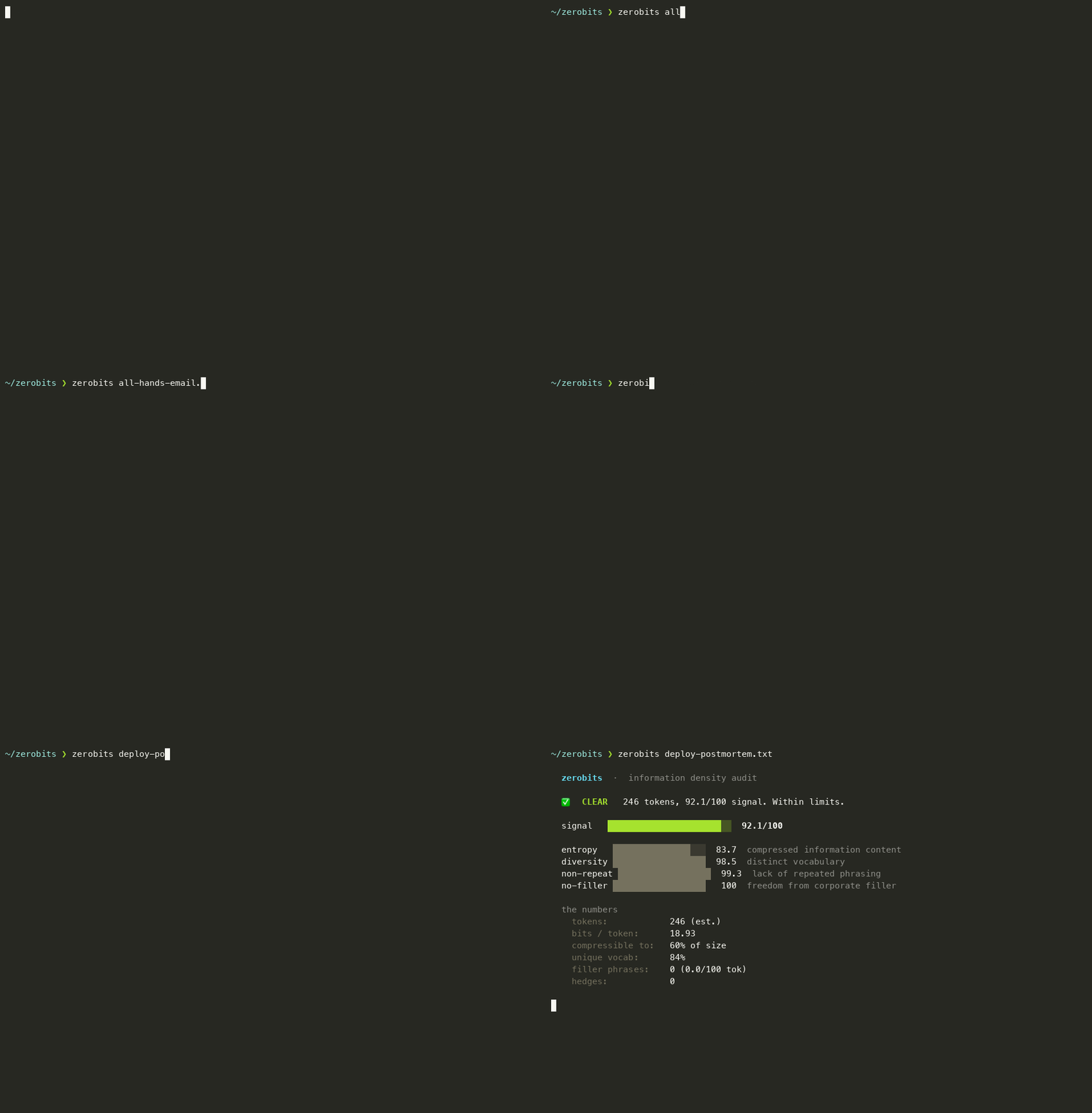
Run it (nothing to install)
git clone https://github.com/Ani-HQ/zerobits
node zerobits/bin/zerobits.js zerobits/examples/empty.txt
It uses only Node's built-ins (zlib, fetch), so git clone && node bin/zerobits.js <file> works with an empty node_modules. Node ≥ 18.
Or via npm once published:
npx zerobits path/to/file.md
echo "some waffle" | npx zerobits
zerobits "inline text to score"
Usage
zerobits [file...]            analyse one or more files
zerobits "some text"          analyse a string directly
cat notes.md | zerobits       analyse piped stdin

-v, --verbatim         strip the padding, show what was actually said
-j, --judge            add a semantic pass via a cheap model (needs an API key)
    --rubric           print the judging prompt so YOUR agent judges it (no key)
    --json             machine-readable output
-t, --threshold <n>    "long" token threshold (default 500)
    --min-density <n>  low-signal cutoff, 0-100 (default 35)
    --check            exit non-zero if any input is GUILTY (CI / git hooks)
-q, --quiet print only the verdict line--verbatim: cite what you actually said
The tweet's real ask. zerobits file.md --verbatim ranks every sentence by information contribution, drops the padding, and shows the signal:
what you actually said  (166 of 508 tokens — 67% was padding)
  • I wanted to circle back and touch base regarding some of the exciting things...
  • ...
How it works
The verdict combines two things gzip alone can't do together:
- Structural information — the genuine content is well approximated by how many bytes a compressor needs (raw DEFLATE). Filler and repetition compress away; novel content doesn't. Blended with vocabulary diversity (moving-average type-token ratio) and repeated-phrase rate.
- Filler tax — corporate/AI word-salad is fluent, varied, and non-repetitive, so compression and diversity read it as "fine." A curated lexicon of ~200 filler phrases and hedges taxes the whole score, because that's the tell for semantic emptiness.
density = structural_quality × (1 − filler_tax)The statute fires when a message is over the token threshold (default 500) and below the signal floor. Every constant lives in src/score.js and is documented — tune to taste.
Optional: semantic judge
Compression + lexicon catch ~everything. For the last case — text that is fluent, varied, filler-free, and still says nothing — add a cheap model:
export ANTHROPIC_API_KEY=...   # or GEMINI_API_KEY, or OPENAI_API_KEY
zerobits file.md --judge
Auto-detects the provider (Claude Haiku / Gemini Flash / GPT-4o-mini), rates density, and extracts the distinct real claims. A 500-token check costs about $0.0007 — under a tenth of a cent — and only runs on inputs you pass --judge.
No key? Let your own agent judge it. zerobits file.md --rubric prints a ready-to-use prompt; the LLM already driving the tool applies it. See AGENTS.md and RUBRIC.md.
Use as a library
import { analyze } from 'zerobits';

const r = await analyze(text, { threshold: 500, verbatim: true });
r.verdict.guilty;      // boolean
r.scores.density;      // 0-100
r.metrics.bitsPerToken;
r.verbatim.condensed;  // the padding-stripped version
analyze() is fully local — no network, no key.
Gate it in CI
zerobits --check PR_DESCRIPTION.md # exit 1 if GUILTYDrop it in a pre-commit hook to keep commit messages honest, or in CI to keep PR descriptions from waffling.
Accuracy & scope
Be honest about what this is:
- Token count is an estimate. The zero-dependency build approximates tokens (within ~10-15% of tiktoken for English prose). For exact cl100k counts,
npm i gpt-tokenizer— zerobits uses it automatically if present. - Scores are directional, not audit-grade. The thresholds are documented heuristics tuned for readable English. Borderline inputs can tip either way; treat the verdict as a strong hint, not a proof.
- English-tuned. The filler lexicon and calibration target English. Other languages still get compression/diversity signals, but expect less precise verdicts.
- Repetitive structured data (JSON, logs) reads as low-density — which is usually correct, but occasionally surprising.
License
MIT © Ani. Built in reply to @gabriel1's statute.